
How to Grip a Golf Club: Grip Styles, Strength, and Pressure
Your grip sets the clubface, the biggest factor in where the ball starts. The 3 grip styles, how to set grip strength, and how hard to actually hold on.
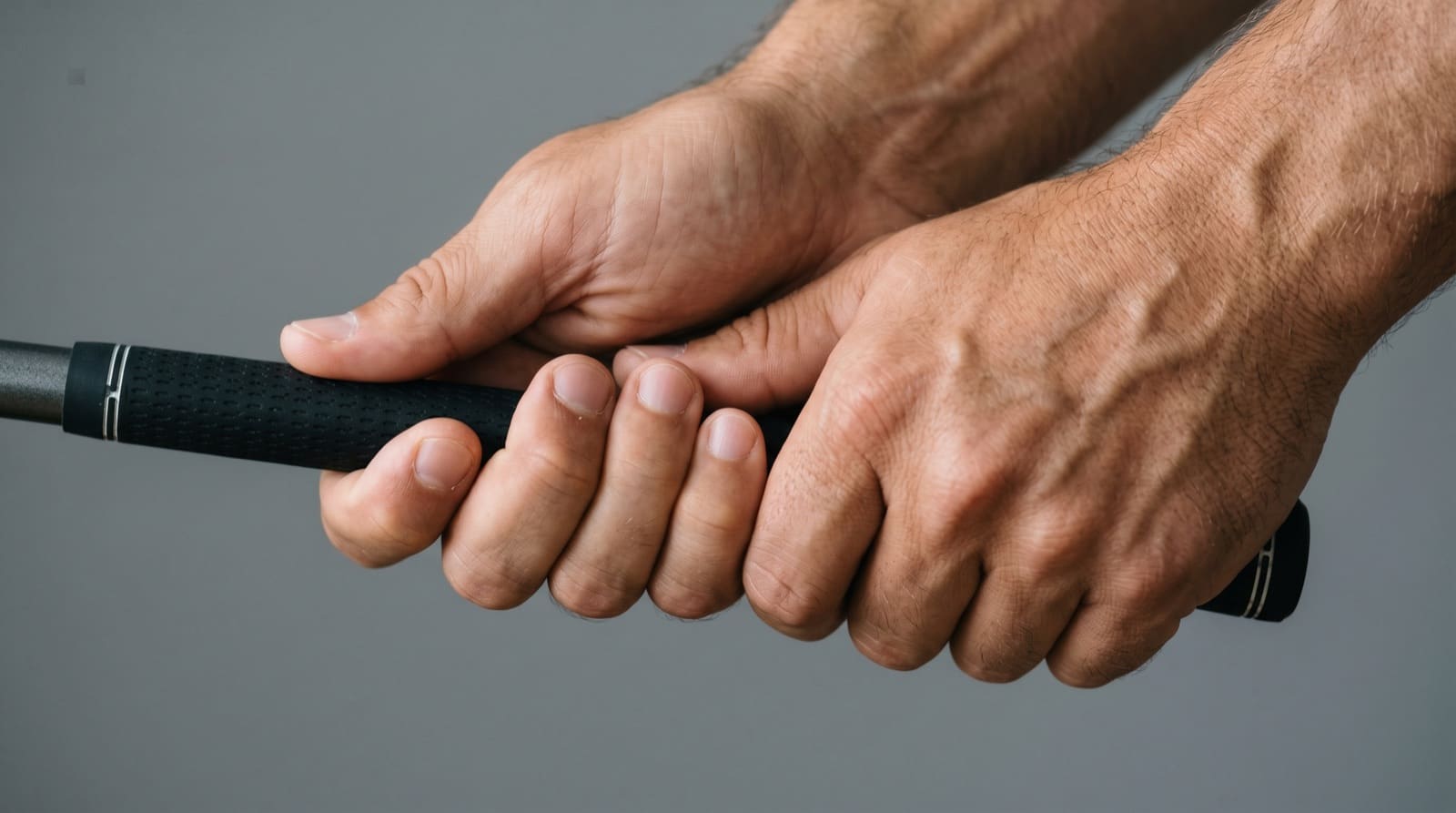
Quick answer
A correct golf grip is neutral, set in the fingers, and held at light-to-medium pressure. Neutral means two to two-and-a-half knuckles visible on your lead hand and both “V” shapes pointing at your trail shoulder. The grip sets your clubface, and the clubface is the biggest factor in where the ball starts. Most amateurs grip too weak and too deep in the palm, which opens the face and feeds a slice. Expect a change to feel strange for a few weeks before it settles.
The neutral grip vs a faulty grip — the checkpoints
| Checkpoint | Neutral grip (the target) | Too weak (slice bias) | Too strong (hook bias) |
|---|---|---|---|
| Lead-hand knuckles visible | 2 to 2.5 | 0 to 1 | 3 or more |
| Both “V”s (thumb-forefinger) point | Trail shoulder | Chin or lead shoulder | Outside the trail shoulder |
| Where the club sits in the lead hand | In the fingers, heel pad on top | Up in the palm | In the fingers, rotated under |
| Clubface tendency at impact | Square to the path | Open to the path | Closed to the path |
| Typical ball flight | Straight or slight draw | Fade or slice | Draw or hook |
| Grip pressure (1 to 10) | 4 to 7 | often too tight | often too tight |
Why the grip controls your clubface
Your hands are the only thing touching the club, so they set where the face points at impact. TrackMan calls face angle “the most important number when determining the starting direction of the golf ball.” Control the face and you control where the ball starts.
Ben Hogan made the grip the first of his modern fundamentals in Five Lessons, summing it up as “good golf begins with a good grip.” On a centered strike, the ball starts close to where the face points and curves away from the swing path, so the face is the dominant influence on start line. Since the grip is the primary control on face angle, it is the single highest-leverage setup variable you own.
That makes a faulty grip expensive. An open face at impact is the direct cause of a slice, and a weak grip is the most common reason the face shows up open. The same chain runs the other way for a hook. Get the grip neutral and the rest of the swing has far less to correct.
What a neutral grip actually is
A neutral grip lets the clubface return to square without any last-second hand manipulation. Four checkpoints define it.
Start with the lead hand (the left, for a right-handed golfer). The club runs diagonally across the base of the fingers, from the middle joint of the index finger to the fleshy heel pad, and that heel pad sits on top of the grip rather than off to the side. Hogan called the heel pad the “sixth finger” because it presses down and secures the club.
Now look down. You want to see two to two-and-a-half knuckles on the lead hand, with the “V” between thumb and forefinger pointing at your trail shoulder. That knuckle count is the fastest at-address tell of a neutral build.
Then add the trail hand. Bring it in from underneath so the lifeline of the palm sits directly on top of your lead thumb, fingers wrapping the grip, and the second “V” pointing at the trail shoulder as well. The two hands work as one unit.
The thread through all four checkpoints is fingers over palm. A club held in the fingers lets the wrists hinge freely; a club buried in the palm locks the wrists and steals both power and consistency.
The three grip styles: overlap, interlock, and ten-finger
These three describe how your hands link together. How far they rotate is grip strength, which is the next section. All three styles can deliver a square face, so the right one is the one you can repeat.
Overlap (Vardon)
The trail-hand pinky rests on top of the gap between the lead index and middle fingers. Named after Harry Vardon, it is the most common grip on the PGA Tour and tends to suit larger or stronger hands. It frees the trail hand slightly so it can’t overpower the lead.
Interlock
The trail pinky and lead index finger hook together. Jack Nicklaus and Tiger Woods both built their careers on it, and Collin Morikawa, one of the best iron players of his generation, uses it too. The locked connection helps players with smaller hands, or anyone who feels the club shifting at the top.
Ten-finger (baseball)
All ten fingers sit on the grip with no overlap or interlock. It gives the most hand-on-club contact and the least wrist complication, which makes it a fair choice for juniors, players with smaller or weaker hands, and golfers managing arthritis. The trade-off is that it can let the trail hand take over and add unwanted face rotation, which is why it stays rare on tour.
Grip strength: neutral, strong, and weak
Grip strength refers to how far your hands are rotated on the handle. (Squeeze is grip pressure, which comes next.) Rotation is the lever that biases your ball flight.
A strong grip rotates both hands away from the target (clockwise for a right-hander), showing three or more knuckles on the lead hand and pointing the “V”s outside the trail shoulder. It makes the face easier to close, so it biases the ball toward a draw or a hook. A stronger build is the standard setup for an intentional draw.
A weak grip rotates both hands toward the target, showing fewer than two knuckles and pointing the “V”s at the chin. It keeps the face open longer, biasing the ball toward a fade or, when it goes too far, a slice.
This is the mechanism behind most amateur slices. GOLFTEC’s swing data, reported by Golf Magazine, found that about 60% of golfers slice, and a lead hand turned too weak is a frequent root cause of the open face that produces it. For many golfers, going from one visible knuckle to two or three removes most of the slice on its own. The full sequence lives in the slice-fix protocol.
Grip pressure: how tight to hold it
Aim for light-to-medium pressure, around the middle of a 1-to-10 scale where 10 is a white-knuckle squeeze. The useful cue comes from instructor Milo Lines: keep the pressure firm in the fingers while the wrists and arms stay loose. Sam Snead’s old image was holding the club like a small bird, secure enough that it can’t escape, soft enough that you don’t hurt it.
Too tight is the more common mistake, and it is costly. A clamped grip restricts wrist hinge, which shortens your backswing and bleeds clubhead speed. Under pressure it gets worse. Excess grip tension combined with anxiety is one of the contributors to the yips, the involuntary hand spasms that wreck a putting stroke, according to the Mayo Clinic.
A simple field test: have a friend try to pull the club from your hands at address. You want it secure enough that it doesn’t slide out, soft enough that your shoulders and forearms still have some give.
How to build your grip step by step
Learning how to grip a golf club from scratch goes in this order, slowly, before you ever make a swing. It is the same sequence as the howTo on this page.
- Set the lead hand in the fingers. Lay the grip diagonally across the base of your lead-hand fingers, from the middle joint of the index finger to the heel pad. Close your hand so the heel pad sits on top.
- Check your knuckles and the “V.” Look down. You should see two to two-and-a-half knuckles, and the “V” between thumb and forefinger should point at your trail shoulder.
- Add the trail hand. Bring it in from underneath so its lifeline covers your lead thumb. Wrap the fingers, and point its “V” at the trail shoulder too.
- Set the pressure. Squeeze to about five of ten, with firm fingers and soft wrists and arms.
- Mirror-check before you swing. Verify both “V”s and the knuckle count in a mirror at home. Grip changes are cheap to rehearse in the living room and expensive to learn on the range.
- Range-test against ball flight. Hit twenty half-wedges and watch the start direction, not your hands. The face is telling you whether the new grip works.
What the research says about changing your grip
A new grip feels wrong, and that feeling is where most golfers quit. You are overwriting a motor pattern built over thousands of swings, so your hands fight to return to the old, comfortable, slice-producing position.
The motor-learning research points to two habits that make the change stick. A peer-reviewed review of motor learning in golf suggests that an external focus of attention and higher contextual interference can both improve retention and transfer, though the strength of the evidence varies by task. In plain terms: focus on the ball flight you want, not on the mechanics of your hands, and vary your shots instead of grooving the same one. This is the same reason random practice beats block practice for transfer to the course.
A reasonable rule of thumb: a static change like grip stops feeling foreign at address within two to three weeks of consistent reps, but holding it under full speed takes longer, and it tends to revert first under pressure. Re-check it in a mirror every few sessions until it stops feeling new.
When a non-neutral grip is the right call
Neutral is the starting point. A few situations justify a deliberate move away from it.
- Chronic slicer. A stronger-than-neutral grip (three knuckles) is a legitimate, durable fix when an open face is your built-in miss. See the slice-fix protocol for the full sequence.
- Chronic hooker. The mirror image. Weaken toward one-and-a-half to two knuckles to take some closure out of the face.
- Hand limitations. Arthritis, smaller hands, or weaker grip strength can make the ten-finger grip the most repeatable option, even though it is rare on tour.
- Shot-shaping on purpose. Strong to turn one over, weak to hold one up. Skilled players nudge grip strength to shape a draw or a fade on demand.
The honest read: change grip strength to fix a miss or shape a shot, but always know your neutral baseline so you can find your way back.
Common grip mistakes
- Holding the club in the palm. It locks the wrists and kills hinge. The lead-hand club should run through the fingers with the heel pad on top.
- A lead hand too weak. Fewer than two knuckles is the most common amateur build, and it is the engine of the slice.
- Over-correcting to a death grip of strength. Past three to four knuckles you have traded a slice for a hook. Stop at the count that straightens the ball on a half-swing.
- White-knuckle pressure. Above a seven, the wrists stop hinging and speed drops. Firm fingers, soft arms.
- A different grip every swing. Tour players reset the same grip before every shot. Amateurs rebuild it from scratch each time and then wonder why contact wanders.
- Ignoring the trail-hand “V.” Both “V”s matter. A neutral lead hand paired with a trail hand rotated underneath still delivers a twisted face.
Key takeaways
- Neutral is the target: two to two-and-a-half knuckles on the lead hand, both “V”s pointing at the trail shoulder.
- The grip controls the face, and the face is the main factor in the ball’s start direction (TrackMan). It is the highest-leverage setup variable you own.
- Grip in the fingers, not the palm. Fingers free the wrists to hinge; the palm locks them.
- Strong grip biases a draw or hook, weak biases a fade or slice. Most amateur slices trace to a lead hand turned too weak (GOLFTEC data).
- Pressure four to seven of ten. Firm fingers, soft wrists. Too tight costs hinge and speed and feeds the yips under pressure.
- Pick the link style you can repeat: overlap for larger hands, interlock for smaller hands, ten-finger for hand limitations.
- Give a grip change a few weeks to stop feeling foreign, and practice it by watching ball flight rather than your hands.
Frequently asked questions
How should a beginner grip a golf club?
Start with a neutral grip held in the fingers, not the palms. Set the club diagonally across the base of your lead-hand fingers so the heel pad sits on top of the grip, then close your hand until you see two to two-and-a-half knuckles. Add the trail hand so its lifeline covers your lead thumb, and check that both V shapes between thumb and forefinger point at your trail shoulder. Hold at about five out of ten pressure. Most beginners start too weak and too deep in the palm.
What is a neutral golf grip?
A neutral grip positions both hands so the clubface returns square without manipulation. The checkpoints: two to two-and-a-half knuckles visible on the lead hand at address, and both V shapes formed by thumb and forefinger pointing toward the trail shoulder (the right shoulder for a right-handed player). The club sits in the fingers with the heel pad on top, not buried in the palm. Neutral is the default because it pairs a square clubface with a natural release, which is why most instruction starts there before any adjustment.
Should I use an overlap, interlock, or ten-finger grip?
All three can deliver a square clubface, so the choice is about comfort and hand size. The overlap (Vardon) grip, where the trail pinky rests over the gap between the lead index and middle fingers, is the most common on tour and suits larger or stronger hands. The interlock, where the trail pinky and lead index lock together, helps smaller hands and players who feel the club slipping. The ten-finger grip suits juniors, weaker hands, and arthritis. Pick the one you can repeat shot after shot.
Does my grip cause my slice?
Often, yes. A lead hand turned too weak (fewer than two knuckles showing, the V pointing at your chin) leaves the clubface open to your path at impact, and an open face is what curves the ball right for a right-handed player. The clubface is the main factor in where the ball starts, so the grip is the highest-leverage face fix you own. Strengthening to two or three knuckles often reduces the slice on its own, though swing path and sequence can also be involved. Fix the grip first, then test.
How tight should I hold a golf club?
About four to seven on a scale where ten is a white-knuckle grip. The pressure lives in the fingers while the wrists, forearms, and shoulders stay relaxed. Sam Snead’s old image was holding the club like a small bird: firm enough that it can’t fly off, soft enough that you don’t crush it. Gripping too tight is the more common amateur error. It restricts wrist hinge, bleeds clubhead speed, and under pressure it feeds the tension linked to the yips.
How long does it take to get used to a new golf grip?
A grip change feels wrong at first because you are overwriting a motor pattern reinforced over thousands of swings. For most golfers, a new grip stops feeling foreign at address within two to three weeks of consistent reps, but holding it under full speed takes longer. Practice it the way the motor-learning research suggests: focus on the ball flight you produce rather than on your hands, and vary your shots instead of grooving one. Expect the old miss to creep back early. Honest measurement is the counter.
Related reading
- Golf Ball Position by Club — the other half of setup; where the ball sits sets the low point the grip-squared face then strikes.
- Golf Stance and Posture — the setup platform the grip works from; stance and posture set your spine angle and base while the grip sets the face.
- How to Fix a Slice in Golf — the grip change is step one of this 4-week protocol; this post adds the path and transfer work.
- How to Stop Shanking Irons and How to Stop Shanking the Golf Ball — hosel-contact fixes that start from grip pressure and a square face.
- How to Stop Topping the Golf Ball — the low-point fault a calm grip and stable setup feed into.
- How to Hit a Draw and How to Hit a Fade — how a stronger or weaker grip shapes the ball on purpose.
- Early Extension in Golf: Causes, Drills, and a 4-Week Fix — the dynamic posture-loss fault behind many shanks, thin shots, and blocks; a screen-first protocol to retrain it.
- Weight Shift in the Golf Swing: Pressure, Sequence, and the Fix — the trail-to-lead pressure move that powers ball-striking; the three faults that wreck it and a 4-week fix.
- How to Fix an Over-the-Top Golf Swing — the out-to-in path fault that drives the slice; a path-first 4-week reroute built on lower-body and shallowing drills.
- Casting in the Golf Swing: Causes, Drills, and a 4-Week Fix — the early wrist release that adds loft and weak contact; a face-first protocol and the truth about holding lag.
- Golf Ball Flight Laws: Why the Ball Starts and Curves Where It Does — the diagnostic hub for this whole cluster; read your start direction and curve to reverse-engineer the face and path behind any miss.
- How to Fix a Hook in Golf: Causes, Drills, and a 4-Week Plan — the slice’s mirror image; a strong grip closing the face is the usual cause, so the fix starts with the grip neutralizer here, then path and release.
- Reverse Pivot in Golf: Causes, Drills, and a 4-Week Fix — the backswing weight-and-tilt reversal that makes you hang back and hit it fat, thin, and short; a setup-first protocol to reload the trail side.
- How to Aim in Golf: Alignment and Aim for Every Shot — the setup step that points the whole swing; aim the clubface to a start line, then build the body parallel to it, since the grip-squared face still needs the right line.
- How to Stop Pulling the Golf Ball: Causes, Drills, and a 4-Week Fix — the straight-left miss where path and aim lead the fix, not the face; a path-first 4-week protocol and the pull-hook/pull-slice diagnostic.
- How to Stop Hitting Fat Shots (and Thin Shots): Fix Your Low Point — fat and thin are one fault, a low point stuck behind the ball; a setup-then-pressure-shift protocol that moves it ahead and trains both misses out together.
- How to Stop Swaying in the Golf Swing: Causes, Drills, and a Fix — the backswing hip-slide away from the target that drifts you off the ball; a corridor-test diagnosis and a braced-load 4-week fix.
- How to Swing a Golf Club: The Sequence That Actually Repeats — the cornerstone that ties this cluster together; the ground-up kinematic sequence, the setup that enables it, and a sequence-first order to learn the whole motion.
- The Golf Backswing: Takeaway, Rotation, and Plane by the Numbers — the loading phase in detail; shoulder-over-hip X-factor, swing plane, the wrist set, and a five-checkpoint phone audit to see where your coil breaks down.
- How to Compress the Golf Ball: Shaft Lean, Low Point, and the Impact Numbers — the efficiency side of ball-striking; forward shaft lean, a low point ahead of the ball, and low spin loft, with a launch-monitor scorecard and a 4-week program.
- How to Hit a Stinger in Golf: Setup, Technique, and When to Use It — the low, wind-cheating shot; the delofted, low-spin-loft strike from a back-of-center ball, plus the knock-down most amateurs should hit instead and a numeric gate drill.
- How to Hit Irons: Setup, the Descending Strike, and Solid Contact — the ball-striking cornerstone for irons; ball position by club, the forward low point, iron-by-iron gapping, and a no-launch-monitor ball-first self-test.
- How to Hit Off Uneven Lies: Ball Above, Below, Uphill, and Downhill — the setup adjustments for sloped ground; a two-axis read that separates the direction fix (aim and grip length) from the distance fix (club and shoulder tilt), plus an honest audit of which slope rules are actually measured.
- How to Put Backspin on a Golf Ball: Spin Loft and the Real Numbers — the spin side of ball-striking; the four levers of backspin (spin loft, speed, friction, clean contact), the real rpm numbers by club, and a launch-monitor scorecard for your wedges.
- Golf Swing Tips: 7 Data-Backed Fixes You Can Actually Measure — the prioritized tour of this whole cluster; seven measured fixes (face, setup, impact, attack angle, tempo, sequence, practice), each with a phone-camera checkpoint.
- Golf Downswing Sequence: The Order That Actually Makes Speed — the downswing half in detail; pelvis-thorax-arm-club ordering, the 0.23–0.30 second window, ground force timing, and a phone audit that catches a broken link without a 3D system.
- How to Hit a Punch Shot in Golf: The Escape Shot and the Wind Shot — the low escape and wind shot; a three-number window test for trouble, Broadie’s recovery-lie cost, Rice’s wind formula, and the six setup dials that deloft the face.
- How to Release the Golf Club: Timing, Face Control, and the Data — what the grip-set face does through impact; rate of closure, the 1.6% lag myth, and a ball-flight test that tells you whether to add forearm rotation or body rotation.
- How to Hit a Fairway Bunker Shot: Ball-First Contact, Club Choice, and the Escape Math — the clean, ball-first sand strike (the opposite of the greenside splash); a five-part setup for a forward low point, the club-up-and-clear-the-lip rule, and a lip-and-lie matrix for when to lay up.
- Golf Loft and Lie Explained: What One Degree Actually Costs — the equipment half of face control; how far a tilted sole points the face off target club by club, why wedges punish it most, and a marker test that separates a spec problem from a swing problem.
- Senior Golf Swing Tips: The 7 Changes That Work After 50 — the setup and swing permissions that fit a body past 50, including the finger-grip pressure change; plus the 2-to-4-mph speed evidence and the bag re-gapping that shorter carries force.
- How to Read Your Divots: What a Golf Divot Tells You (and What It Doesn’t) — the free feedback left on the ground after every iron shot; what start point, direction, and depth each prove, why TrackMan low-point spread beats position as the skill signal, and a five-ball line test to read your own pattern.
- Golf Grip Size Chart: How to Measure and What the Data Says — the diameter under your hands, measured 2 inches below the cap; the fitting chart, the tape math, and why PING’s testing pinned the ball-flight change on club weight rather than grip width.
- Golf Shaft Flex Chart: What Swing Speed Actually Tells You — the spec above your hands; the swing-speed starting bands, why nine shafts recommended for the same golfer measured 23 CPM apart, and a blind range test that says whether flex is your problem at all.
- How to Measure Putter Length — the putter’s own spec, measured along the shaft axis rather than off the 60-degree plane every other club uses; the at-home method, the two-ruler eye test, and the fitting study showing length is the least-wrong spec on the club.
- Wedge Bounce Explained — the sole spec under the club; why three published charts label the same 7-degree wedge three different ways, and a two-lie test that scores outcomes instead of feel.
- Steel vs Graphite Iron Shafts: What the Testing Actually Shows — the material question one spec up from flex; the 46.5-gram window both materials share, and the 40-golfer study that swapped only the shaft and measured the same 72 mph either way.
- Cavity Back vs Blade Irons: The Toe Miss Decides It — the head at the other end of the shaft; sixteen #6 heads where MOI overlaps between blades and cavity backs while the hosel-to-CG distance does not, and the robot data showing the two are equal at centre.
- Golf Swing Weight Explained: What D2 Actually Means — the balance spec the whole club adds up to; why D2 is 217 ounce-inches rather than a weight, and the one constant that reproduces the 2-gram head rule, the 5-gram grip rule and the 4-gram counterweight rule.
- Driver Loft Chart — the loft you need is set by attack angle as much as speed, and TrackMan’s own optimizer shows a 4.5-degree spread at a single club speed.
- Wedge Loft Chart — the same spec question at the other end of the bag; two Ping sets where the span from the pitching wedge to a 56-degree sand wedge runs 5.5 degrees in one and 16.0 in the other, and the arithmetic that says how many wedges fill it.
- How to Clean Golf Clubs — the maintenance side of the same equipment; three published tests where a dirty or wet clubface cost 2,093 to 3,464 rpm of backspin, which is more than 125 rounds of groove wear takes, plus the grip-cleaning method that changes with the grip material.
- Golf Glove Size Chart: What the Brands Actually Publish — the layer between your hand and the grip; three brands measuring three different quantities while two publish no numbers at all, a Nike chart that fits one hand into five of its six sizes, and the cadet cut that fixes what no size change can.
- Block vs Random Practice in Golf — the motor-learning research behind practicing a grip change by varying shots instead of grooving one.
- Golf Tempo Drills: The 3:1 Ratio — once the grip frees your wrists, tempo is the next fundamental worth measuring.
- Golf practice drills, organized by skill area — the companion drill library, with setup steps and success criteria.
- 30-minute golf practice plan — where to slot grip and face rehearsals into a short session.