How to Hit Irons: Setup, the Descending Strike, and Solid Contact
A pure iron strike is ball-first then turf: the low point sits ahead of the ball, the club still descending at impact. Setup, strike, and iron-by-iron control.
Quick answer
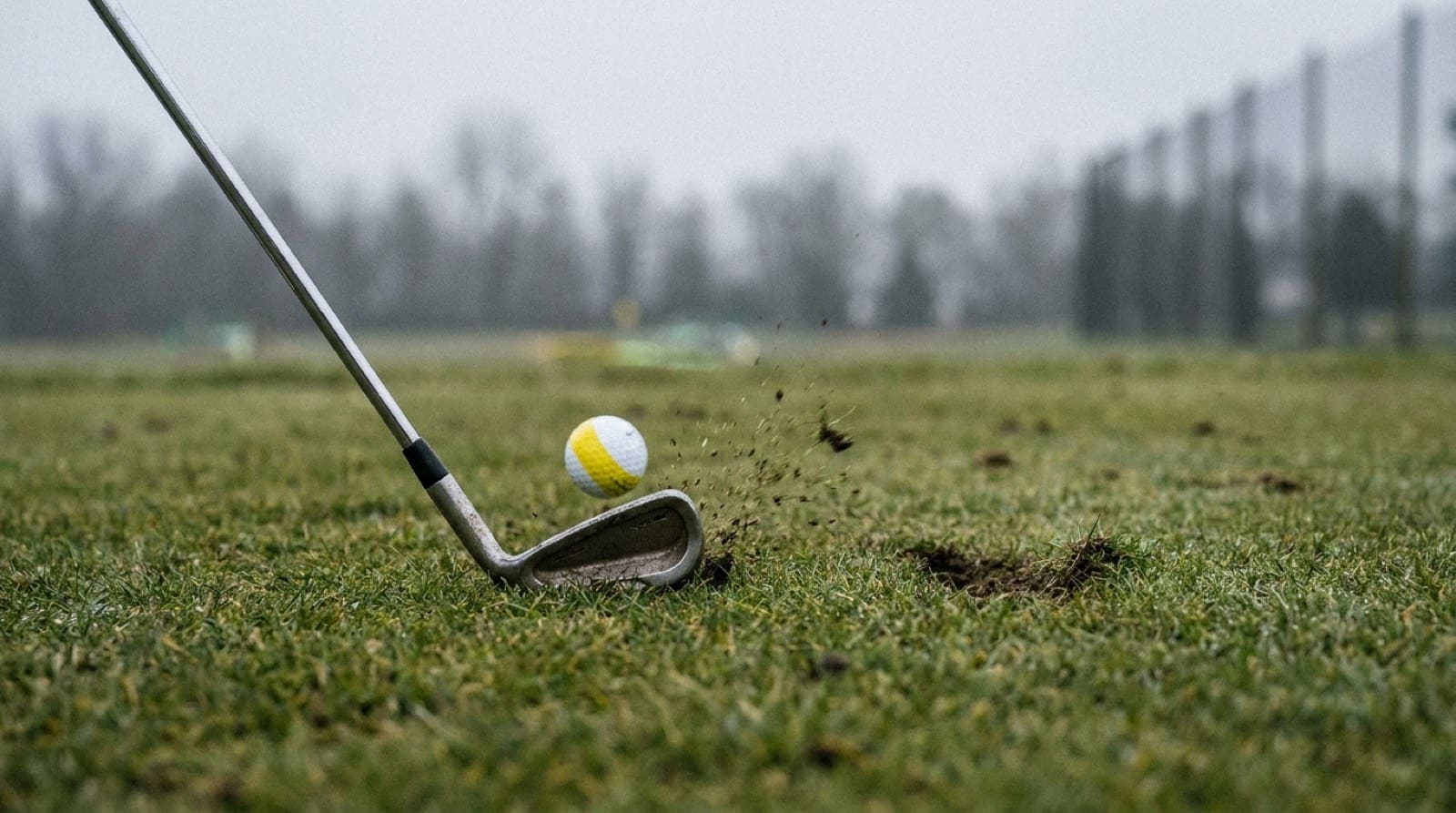
To hit an iron pure, strike the ball first, then the turf. That requires the low point of your swing to sit a few inches ahead of the ball, with the clubhead still descending at impact. Set up with the ball roughly one clubhead inside your lead heel, 55 to 60 percent of your pressure on the lead foot, and the hands slightly ahead of the ball. Move toward the target through the strike so the divot starts after the ball.
Tour vs amateur iron delivery
| What it measures | PGA Tour | Typical amateur |
|---|---|---|
| 6-iron attack angle | ~ −3.7° (descending) | ~ −2° to −3.2° (shallower) |
| Low point vs ball | ahead of the ball, ball-first | wanders behind (fat) or ahead (thin) |
| 7-iron carry | ~170 yards | well short of that, more variable |
| Divot | starts after the ball | often before, or none |
The tour attack-angle figure comes from TrackMan’s tour data; the modeled amateur 6-iron of about −3.2° comes from the same page. The tour 7-iron carry comes from TrackMan tour averages, and the low-point and divot rows reflect the coaching consensus discussed below. The pattern holds across every row: better players deliver a descending strike with the low point ahead of the ball, and amateurs lose contact quality when that geometry breaks down.
Why iron contact is the fastest way to lower your scores
Approach shots are where scores separate, which makes iron striking the highest-value skill most amateurs can build. Mark Broadie’s strokes-gained work in Every Shot Counts established that approach play accounts for a large share of the scoring gap between amateurs and better players, more than putting for most handicaps. Arccos and Shot Scope confirm the same shape in real on-course data: greens in regulation fall steadily as handicap rises. Shot Scope’s amateur data show a 15-handicap hits only about 4 of 18 greens a round, and the average golfer has roughly a 1-in-5 chance of hitting the green with a 7-iron in hand. Arccos analyst Lou Stagner puts it plainly — approach play is “where the rubber meets the road in improving your scoring.”
Every green you hit removes a scrambling situation. That is why cleaner iron contact moves your handicap faster than a new putter or 10 extra yards off the tee. The rest of this guide is the mechanics that produce it, in the order they matter.
What a pure iron strike actually is
A pure iron strike is ball-first, then turf. The clubhead is still traveling down when it meets the ball, compresses it against the face, and only reaches the bottom of its arc — the low point — after the ball is gone. The visible signature is a divot that starts on the target side of where the ball sat.
TrackMan’s amateur guide turns this into a simple readout. Its low-point number is tagged “A” for after or “B” for before, and with an iron “you would typically like to see an ‘A’ for after,” meaning the club bottoms out past the ball. A “B” with an iron means the club reached the ground before the ball — a fat shot waiting to happen. The driver is the opposite: teed up, it wants a “B” and an upward strike. Titleist Performance Institute says it directly: “a descending blow is required with your irons for a solid strike.”
How much down? Moderately. TrackMan reports a PGA Tour 6-iron attack angle around −3.7 degrees and models a typical male amateur near −3.2 degrees for the same club, so both hit down and the gap is smaller than most golfers assume. For most good amateurs, the real leak is a wandering low point: the same swing catches turf-first on one shot and thins the next. The physics of what a compressed strike does to ball speed and spin is its own topic — the compression guide covers the smash-factor and spin-loft numbers in full. This guide is about repeating the strike.
The setup that pre-loads a ball-first strike
Most of the descending strike is bought at address, before the club moves. Three setup levers put the low point ahead of the ball for you.
Ball position, matched to the club. The low point of a good iron swing sits under the lead shoulder, so where you place the ball relative to that point decides whether the club is descending or rising when it arrives. GOLFTEC teaches a single anchor that handles the whole bag: for every club except the driver, place the ball about one clubhead-length inside your lead heel, then change stance width by club. That keeps the ball behind the low point on every iron.
Pressure slightly lead-favoring. Start with roughly 55 to 60 percent of your weight on the lead foot. Most modern coaching lands near a 60/40 lead bias at address, which nudges the bottom of the arc forward before you swing. Neutral or trail-heavy weight drags the low point back behind the ball, which is the setup half of a fat shot.
Hands ahead of the clubhead. Set the grip end slightly toward the target so the shaft leans a few degrees forward and the hands sit ahead of the ball. That forward lean lowers the loft the face delivers and supports the descending strike. It also starts the grip and stance chain that begins with a neutral grip and correct stance and posture.
Ball position by iron: short, mid, and long
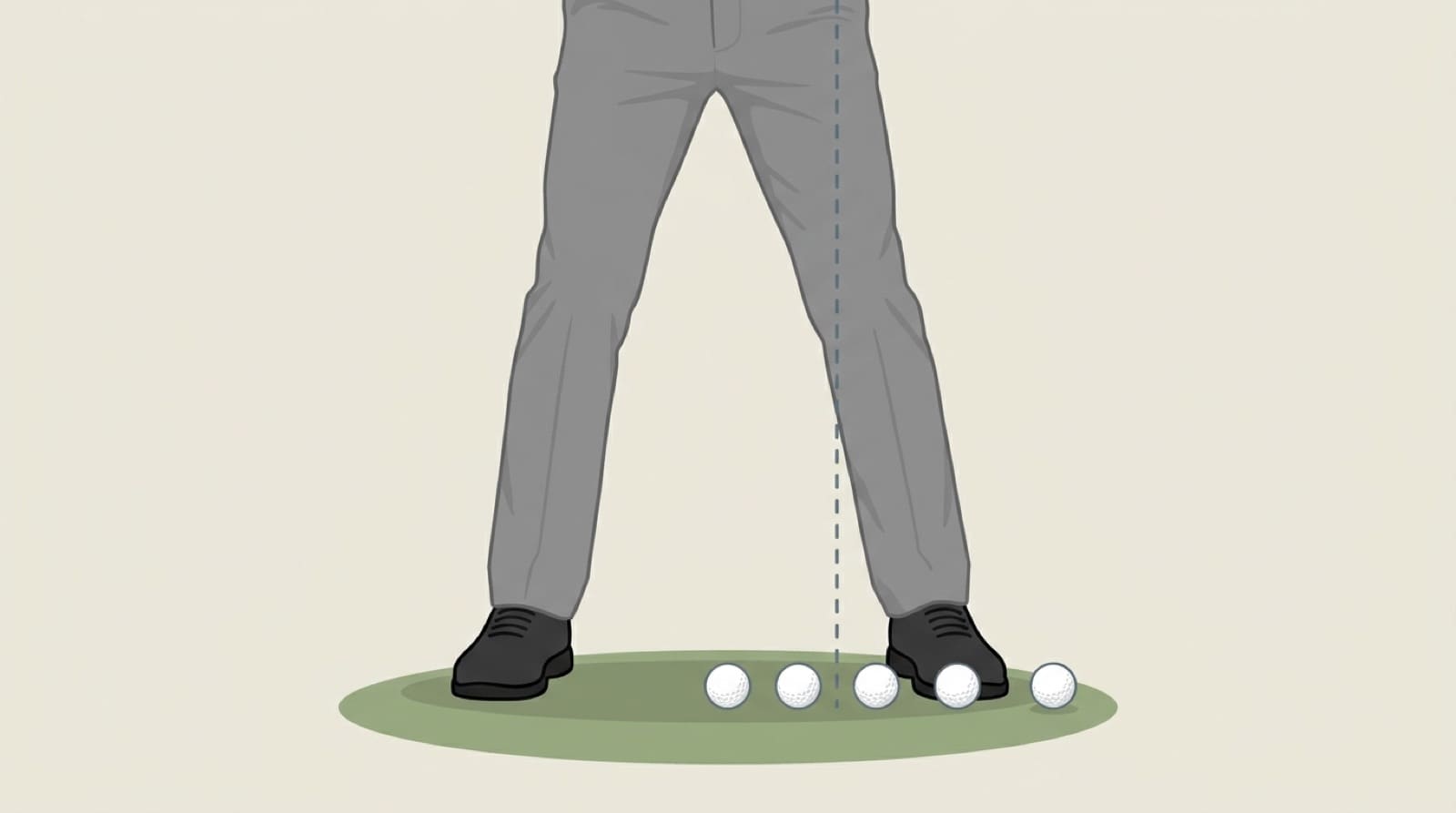
Ball position slides forward as the club lengthens, and getting it wrong is the most common reason a decent swing produces fat or thin contact.
| Club group | Ball position | What it does |
|---|---|---|
| Wedges, 9-iron | Center of stance | Steepest, most descending strike for spin and control |
| Mid-irons (6–8) | ~1 ball forward of center | Descending strike with a shallower angle than short irons |
| Long irons (3–5) | Forward of mid-iron, inside lead heel | Shallower approach to launch the lower loft |
| Hybrids | Just inside long-iron position | Sweeps more than a long iron, still ball-first |
| Driver | Off the lead heel/instep | The exception — struck level to slightly up off a tee |
The through-line is that irons are never played as far forward as the driver. Play a mid-iron off your lead heel and you move the ball ahead of the low point, so the club is rising at impact and you thin or catch it heavy trying to compensate. GOLFTEC’s one-clubhead-inside-the-lead-heel rule keeps every iron behind the arc’s bottom without you having to think about degrees. For the club-specific details on the hardest irons in the bag, the long-irons guide goes deeper on ball position and angle of attack.
The strike: hit down without chopping
The number-one misread of “hit down on it” is chopping steeply at the ball. At amateur speeds, that costs both distance and control. The descending strike you want comes from moving the low point forward with your body. The hands stay quiet through the ball while the lower body leads.
Through the transition, let your lower body move toward the target so the bottom of the swing shifts ahead of the ball. Danny Maude frames the swing as a circle whose lowest point should sit “about 4 inches past the ball,” with contact happening before the club reaches that point. The weight shift from trail foot to lead foot is the engine that drags the low point forward, and holding your wrist angles instead of casting keeps the hands ahead of the clubhead through the ball. When the body leads and the hands do not flip, the club arrives descending on its own.
Two faults sabotage this more than any others. Early extension — standing up through impact — lifts the whole arc late and forces a compensating flip. Casting — throwing the clubhead out early — adds loft and moves the low point backward. Both push you toward thin and fat contact, and neither is fixed by the old cue to “keep your head down.”
Why long irons are hard, and when to swap for a hybrid
Long irons are the hardest clubs in the bag to strike. Lower loft means a smaller launch window, and the longer shaft lengthens your swing radius and demands tighter low-point and face control. The same slightly thin strike that still flies with a 9-iron leaves a 4-iron low, short, and offline.
That difficulty is why Titleist Performance Institute and modern fitters stock hundreds of hybrid and utility options as long-iron replacements. Hybrids carry a lower center of gravity and a wider sole, so they launch higher and hold ball speed better on off-center hits. For most amateurs, a hybrid in place of a 3 or 4-iron produces more reliable carry and tighter dispersion, which is a real strokes-gained upgrade on long approaches. The hybrid guide covers the setup differences, and the honest rule is simple: if you cannot carry a long iron high enough to hold a green on a good strike, the club is costing you shots.
Distance gapping and realistic expectations
Consistent gaps matter more than raw distance. A common fitting rule of thumb is 10 to 15 yards of carry between consecutive irons, and that spacing only holds when your contact repeats. When your strike wanders, your gaps collapse — a thin 7-iron can fly shorter than a flushed 8-iron, and you can no longer trust a number.
Set your expectations from your own measured carries. TrackMan tour averages put a PGA Tour 7-iron carry around 170 yards, but that comes from elite speed and near-perfect strikes. Most amateurs carry it well short of that, with more shot-to-shot variance. Measure your real carries on a launch monitor or shot-tracker, then build your gapping from those. Approach shots left short usually come from gapping built on a best-ever number you hit once, rather than the carry you actually average.
Common iron faults and what causes them
Nearly every ugly iron shot traces back to the low point or the face. GolfWRX’s low-point breakdown frames fat and thin as the same fault in two directions, and the table below adds the usual cause and first fix.
| Fault | What it looks like | Root cause | First fix |
|---|---|---|---|
| Fat (heavy) | Turf before the ball, short and weak | Low point behind the ball, weight hangs back | Pressure forward, fat/thin low-point work |
| Thin | Ball caught on the way up, low and hot | Standing up or hanging back, arc rising at impact | Keep posture, move low point ahead |
| Topping | Blade catches the ball’s equator | Early extension, ball too far forward | Topping fix |
| Toe/heel | Off-center, curves and loses speed | Path or radius error, poor face control | Centered-strike drills, face awareness |
Fat and thin share one root: a low point in the wrong place, so the same forward-low-point work fixes both. Off-center strikes are a face-and-path issue that ties into the ball-flight laws — where the ball starts and curves tells you which one you have.
The ball-first self-test (no launch monitor needed)
Feel lies about contact, so here is a PracticeCaddie test that turns iron striking into a pass-or-fail you can run on any range mat or patch of turf.
- Draw a low-point line. Lay a tee or draw a chalk line on the turf, perpendicular to your target, and set the ball one ball-width behind it.
- Hit 10 shots. Watch where the ground disturbance starts. A divot or brush mark that begins on or ahead of the line is a pass — you struck the ball first. A mark that starts behind the ball is a fail.
- Score it. Ball-first on 7 of 10 is a solid baseline. Below that, your low point is behind the ball, so move your setup pressure forward and rehearse the impact position before trying again.
- Then randomize. Once you pass with a 7-iron, rotate clubs and targets so no two shots repeat. Ball-first contact that survives random practice is contact that will survive the course.
This mirrors how PracticeCaddie’s AI plans sequence an iron ball-striking block: baseline the strike, groove the setup and low point with block practice, then move to a randomized shot list so the change transfers. Feel-only reps are how the old fat-and-thin pattern hides.
Related reading
- How to Grip a Golf Club — the setup cornerstone under every iron strike; face control and clean contact both start from a neutral grip.
- How to Compress the Golf Ball — the impact-physics deep dive behind ball-first contact: smash factor, spin loft, and forward shaft lean, with the numbers.
- How to Hit Long Irons — the club-specific guide to the hardest irons in the bag: ball position, angle of attack, and the hybrid decision.
- How to Hit a Hybrid — the higher-launching long-iron replacement, and how its sweep differs from an iron’s descending strike.
- Ball-Striking Drills for Golf — the wider contact-drill library the self-test above slots into.
- How to Stop Hitting Fat Shots (and Thin Shots) — the dedicated low-point fault fix for the two most common iron misses.
- Golf Ball Position by Club — the setup lever that decides where the low point can sit for each iron.
- Weight Shift in the Golf Swing — the trail-to-lead pressure move that drags the low point ahead of the ball.
- Strokes Gained: Approach Explained — why approach play is the biggest scoring category, and how to read your own numbers.
- Golf practice drills that actually transfer — the companion drill library, organized by skill area with setup steps and success criteria.
Key takeaways
- Ball-first, then turf is the whole game. The low point must sit a few inches ahead of the ball with the club still descending, so the divot starts after the ball. TrackMan’s low-point readout should show “A” for after on every iron.
- Most of the strike is bought at address. Ball roughly one clubhead inside the lead heel, 55 to 60 percent pressure on the lead foot, hands slightly ahead. That geometry pre-loads a forward low point.
- Hit down with your body, from a forward low point. A PGA Tour 6-iron runs about −3.7°; moderate descent beats a steep hack that costs distance and control.
- Ball position slides forward with club length. Short irons center, mid-irons a ball forward, long irons and hybrids further forward — never as far forward as the driver.
- Long irons are physically harder. Lower loft and longer shafts shrink the margin; swapping a 3 or 4-iron for a hybrid is a real scoring upgrade for most amateurs.
- Gap from your own carries. Aim for 10 to 15 yard gaps built on the distances you actually average, since a tour 7-iron of ~170 yards is out of reach for most amateurs.
- Iron contact is the fastest scoring lever. Per Broadie, approach play is one of the largest handicap differentiators; Shot Scope data show a 15-handicap hitting only about 4 of 18 greens a round.
Frequently asked questions
How do you hit irons pure?
Strike the ball first, then the turf. That happens when the low point of your swing sits a few inches ahead of the ball and the clubhead is still moving down at impact. Set up with the ball roughly one clubhead inside your lead heel, about 55 to 60 percent of your pressure on the lead foot, and the hands slightly ahead of the ball. Then move your body toward the target through impact so the club bottoms out after the ball. The proof is a divot that starts on the target side of where the ball sat.
Should you hit down on irons?
Yes. Irons sit on the ground, so the club must still be descending at impact to catch the ball before the turf. TrackMan reports a PGA Tour 6-iron attack angle of about minus 3.7 degrees and models a typical male amateur near minus 3.2 degrees, so both hit down, but many recreational golfers arrive too shallow or try to scoop the ball up. The goal is a moderate descending blow driven by a forward low point. Hitting down too hard costs distance and control, especially at slower swing speeds.
Where should the golf ball be in your stance for irons?
Ball position moves gradually forward as the club gets longer. Play short irons and wedges at the center of your stance, mid-irons like a 7-iron about one ball forward of center, and long irons and hybrids a touch further forward still, though never as far forward as the driver. GOLFTEC teaches a simple anchor: for every club except the driver, place the ball about one clubhead-length inside your lead heel and adjust stance width by club. That keeps the ball behind the low point so the club is still descending when it arrives.
Why do I hit my irons fat and thin?
Fat and thin shots are the same fault in two directions: your low point is in the wrong place. Catch the ground before the ball and the club digs early, killing ball speed. That is a fat shot, and it means the bottom of your arc is behind the ball. Catch the ball on the way up and you thin it, usually from hanging back or standing up through impact. Both are low-point errors, and both improve when you get your weight forward and move the bottom of the swing ahead of the ball.
How far should each iron carry?
Aim for consistent 10 to 15 yard carry gaps between consecutive irons rather than chasing tour numbers. TrackMan puts a PGA Tour 7-iron carry around 170 yards, but that comes from tour-level speed and near-perfect contact. Most amateurs carry it well short of that, with more variance shot to shot. Measure your own carries on a launch monitor or shot-tracker rather than guessing, because gapping built on your real numbers is what stops you leaving approach shots short.
Are long irons harder to hit than short irons?
Yes. Long irons have lower loft, longer shafts, and a smaller launch window, so they demand more speed and tighter low-point and face control to get the ball airborne and carrying. The same slightly thin strike that still works with a 9-iron leaves a 4-iron low and short. That difficulty is why fitters like Titleist Performance Institute stock hundreds of hybrid and utility options as long-iron replacements, and why many amateurs score better swapping a 3 or 4-iron for a higher-launching hybrid.
Why does hitting irons well matter so much for scoring?
Because approach shots are one of the largest scoring differentiators in golf. Mark Broadie’s strokes-gained work in Every Shot Counts shows approach play accounts for a large share of the gap between amateurs and better players, and Arccos and Shot Scope data show greens in regulation falling sharply as handicap rises — a 15-handicap hits only about 4 of 18 greens a round. More greens hit means fewer scrambling situations, so cleaner iron contact lowers scores faster than almost anything else you can practice.