
The Golf Backswing: Takeaway, Rotation, and Plane by the Numbers
The backswing loads the swing: about 90° of shoulder turn over 45° of hip, a 45° X-factor, and pressure shifting to the lead side before the top. Plus the fix.

Quick answer
The backswing is the swing’s loading phase: it stores the energy the downswing spends. Tour pros turn the shoulders about 90° against a 45° hip turn, a roughly 45° X-factor that stretches the trunk, keep the club on plane through a one-piece takeaway, and begin shifting pressure toward the target before the club reaches the top. Backswing length is individual. Structure and sequence repeat under pressure; copying a top-of-swing photo does not.
Tour backswing vs typical amateur
| Backswing variable | Tour typical | Typical amateur |
|---|---|---|
| Shoulder turn at the top | ~90° | shorter, arms lift to fake length |
| Hip turn at the top | ~45° | too little (rigid) or too much (sway) |
| X-factor (shoulder minus hip) | ~45° at top; ~42° at transition, +5° stretch | poorly timed, less stretch into transition |
| Driver swing plane | ~45–50° (general range) | 48.1° scratch to 49.4° bogey (nearly identical) |
| Target-ward hip position at top (GOLFTEC) | ~3.9″ toward target | ~2.3″ (30-handicap) |
| Backswing length | tuned to what the body can control | often overswings past parallel, loses structure |
Every tour figure above is drawn from the biomechanics, radar, and force-plate research cited through this post. The pattern is consistent: the differences that matter are how the body rotates and loads, not the plane angle or the length of the swing.
What the backswing actually does
The backswing is the loading phase of a rotational strike. You rotate and tilt the body so the club rides onto a workable plane while the trunk and hips store elastic energy. The arms and club are light, and the torso is the spring. A peer-reviewed systematic review of golf-swing biomechanics frames the whole motion this way: the backswing creates the joint angles and separation that let an efficient kinematic sequence unfold coming down.
Its pieces are coupled. A takeaway that whips the club inside tends to flatten the shoulder plane, which sends the arms too deep, which forces a stand-up move to make room in the downswing. An under-set wrist that leaves the face open makes you throw the club early to square it. So treat takeaway, rotation, plane, wrist set, and pressure as one system that starts interacting from the first inch, not five separate positions to hit.
One more systemic point that surprises most amateurs: the best players are already changing direction before the club finishes going back. Force-plate work shows pressure moving toward the lead foot while the club is still completing the backswing, so the end of the backswing and the start of the downswing overlap. Reaching the top is a moment inside a continuous flow, and the change of direction has already begun.
The takeaway: one piece, and the P2 checkpoint
Start the club back with the hands, arms, and chest moving together, without the wrists snatching it inside or the forearms rolling the face open. Biomechanically, the first part of the backswing is dominated by torso and pelvis rotation, with little independent hand action, which is exactly what the old “one-piece takeaway” cue is describing.
The cleanest checkpoint comes when the shaft is parallel to the ground, a position coaches call P2. From down the line, the shaft should sit roughly on your toe line, with the clubhead in line with your hands. Whip the hands away from your body and the shaft points well right of target and the clubhead disappears inside; shove them out and it points left. A useful feel: let the hands track slightly inward in the first foot so the grip stays close to your trail thigh.
Get P2 close and the rest of the backswing has a fighting chance. Miss it badly and every later position is a compensation for the first foot of motion. This is why the takeaway earns its own attention even though it feels like the least athletic part of the swing.
Rotation: shoulder turn, hip turn, and the X-factor
Rotation is where the backswing stores power. Instruction data and Titleist Performance Institute both put the tour full-swing pattern near 90° of shoulder turn over about 45° of hip turn. Rebellion Golf’s analysis reports the same benchmark: hips around 45° when the shoulders reach 90°. The 45° difference between them is the X-factor, a term instructor Jim McLean coined in the early 1990s.
That separation is the coil. Turning the shoulders farther than the hips stretches the trunk and oblique muscles, storing elastic energy the downswing releases. TPI’s work on X-factor stretch, authored by biomechanist Phil Cheetham, puts the tour average at about 42° of separation when the hips begin the downswing, growing roughly 5° more as the hips lead and the shoulders briefly lag. That extra stretch, produced by starting the lower body first, is tightly linked to efficient speed.
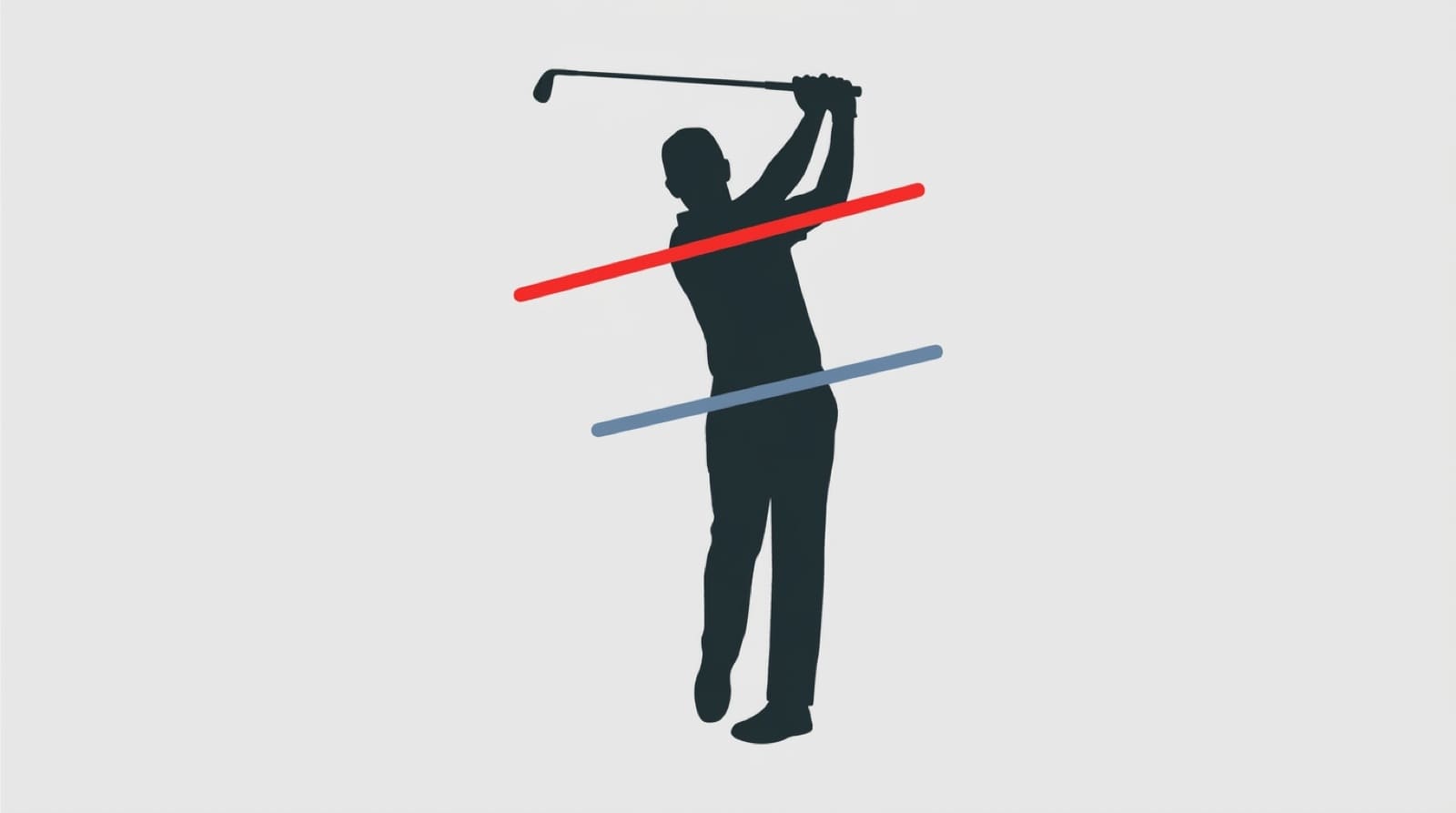
A quick honesty note on the numbers, because you will see different ones online. The visible “~90° shoulder turn” is a shoulder-line measurement, not pure trunk rotation, which is smaller, around 60° at the top, the figure our sister guide on how the full swing sequences cites. The shoulder line adds spine tilt and shoulder-blade glide the trunk-only measure ignores. The X-factor separation itself also shifts with method: the systematic review reports roughly 30° by a torso-versus-pelvis calculation and about 60° by a shoulder-versus-pelvis one. For your own practice, chase a fuller chest turn against a stable base rather than a precise degree you cannot feel.
More separation is not automatically better. The title of TPI’s own article on the subject puts it plainly, “X-Factor: Why More Isn’t Always Better”: the goal is an optimal preload, and pulling the rubber band past where it can snap back hurts sequencing and consistency. An X-factor in the mid-40s with a well-timed 5° of stretch is plenty for tour-level speed. If you want to turn that stored coil into clubhead speed the right way, how to increase golf swing speed covers the release side.
Swing plane, without the mysticism
Swing plane has been used loosely for decades, but radar gives it a specific meaning. TrackMan defines it as the vertical angle between the ground and the circle the clubhead travels on through the bottom of the arc, measured from about 2.5 feet before impact to 2.5 feet after. So the plane you hear about is really a downswing-into-impact measurement, and your backswing job is to set positions that let the club return on a good one.
Here is the number that reframes most plane obsession: TrackMan’s driver swing plane runs about 45–50°, and across handicaps it barely moves. Their combine averages put scratch male amateurs at 48.1° and bogey golfers at 49.4°, a spread of only 1.3°. Plane angle, by itself, does not separate good players from weak ones. How consistently the club stays on its plane, and whether the body supports it, matters far more.
What the backswing controls is the shaft’s direction at the checkpoints. At the top, a neutral look has the shaft roughly parallel to the target line, neither pointing well right (across the line) nor left (laid off). A club dragged too far inside and flat at the top usually gets rerouted steep and over the top coming down, which is the out-to-in path behind most slices. There is no single correct top position every pro copies, but the farther you sit from neutral, the more precise your downswing rescue has to be.
The wrist set that controls the clubface
The wrists do two jobs in the backswing: they hinge the club up onto plane and they set the clubface. At the top, aim for a lead wrist that is flat to slightly cupped, with the clubface roughly parallel to your lead forearm. That keeps the face square enough that you do not have to manipulate it on the way down.
An open face at the top is the quiet cause of a loud downswing fault. If the face hangs wide open, your body’s only way to square it in time is to throw the club early, releasing the wrist angle from the top. That early release is casting, and it bleeds the shaft lean and lag that compress an iron. The face angle at impact is the main driver of where the ball starts, so a backswing that pre-sets a square face saves you from fighting it under speed. The root of face control is your hold on the club, covered in how to grip a golf club.
Pressure, not weight: what actually shifts
Your mass does not change during a swing; what moves is pressure, the force each foot puts into the ground. In the backswing, pressure loads into the trail foot as you coil. The mistake most amateurs make is treating that as a cue to slide the whole body toward the trail side, which is a sway, or to keep pressure pinned back on the trail leg all the way to the top.
The better players do the opposite of stuck. GOLFTEC’s SwingTRU Motion Study, built from more than 13,000 analyzed swings, found that hip position at the top correlates strongly with skill: tour players had their hips an average of 3.9 inches toward the target at the top of the backswing, versus 2.3 inches for a 30-handicap. Read that carefully, because it is correlational, not a mechanism. Better players are further into the target-ward move by the top, matching the force-plate finding that pressure heads for the lead foot before the club finishes going back. The mechanism behind why that helps lives in the kinematic sequence, not in the hip number itself.
Two faults live here. A sway slides the hips laterally past the trail foot, trading rotation for a slide you then have to reverse. A reverse pivot tilts the upper body toward the target at the top while weight hangs back, the exact opposite of loading the trail side, and it produces fat, thin, and weak contact. Both are covered with fixes in weight shift in the golf swing and how to stop swaying. The cure for each is the same idea: turn the trail hip behind you and load it, rather than sliding your body to feel power.
How long should your backswing be?
Backswing length is the most visible difference between players and the most overrated. Coach Adam Young makes the case directly: the idea that there is one perfect top-of-swing position, usually “shaft parallel to the ground,” is an arbitrary look with little performance relevance. Some tour players stop well short of parallel and hit it miles; others swing past it.
A longer swing does offer more potential speed, because the club has more distance and time to accelerate. The catch is whether your body can control that extra length without losing structure. Young points out that a longer backswing can come from more shoulder turn, collapsing arms, extra wrist hinge, or a longer hip turn, and each of those has different consequences for your sequence. Add length by collapsing the arms and you get a longer-looking, weaker swing. Add it through more turn you can control and you might gain real speed.
The practical read: shorter backswings are generally more repeatable for strike and direction, longer ones raise the speed ceiling for players who can hold their structure. Pick length by what you can control on film, not by matching a photo of a long-drive champion.
Common backswing faults and the fix
Most backswing faults are the same failure wearing different clothes: rotation gets replaced by some other motion. Here is how the common ones map to a cause and a first fix.
| Fault | What it looks like | Root cause in the backswing | First fix (go deeper) |
|---|---|---|---|
| Sway | Hips slide past the trail foot; off the ball | Lateral slide replaces the turn | Turn the trail hip in place — stop swaying |
| Reverse pivot | Weight hangs on the lead side at the top | Trail side never loads; upper body tilts to target | Load trail, then lead — weight-shift fix |
| Early extension | Hips thrust toward the ball; blocks and thins | Pelvis drifts to the ball early, losing depth | Keep the hips back and turning — early-extension fix |
| Over the top | Steep, out-to-in path; pull-slice | Club dragged inside and flat, then rerouted | Shallow from the inside — over-the-top fix |
| Lift, no coil | Long backswing, narrow, open face | Arms lift while the shoulders stop turning | Turn the chest, set the wrists — casting fix |
Notice the “first fix” column keeps returning to the same idea: turn and load rather than slide or lift. Chase these faults one at a time and you are slow; fix the rotation-and-pressure root and several symptoms clear together.
What the research says about the backswing
Three findings should shape how you think about it.
- The backswing exists to set up the sequence. The downswing fires pelvis, then thorax, then arm, then club, a wave measured on 3D velocity graphs by researchers including Sasho MacKenzie and formalized in TPI’s kinematic sequence. A backswing with real coil and an early pressure shift lets the pelvis lead. A backswing with no separation gives the sequence nothing to release.
- Separation matters more than range of motion for its own sake. The biomechanics review links greater shoulder-pelvis dissociation to more stored elastic energy, but also notes the relationship to clubhead speed is not simply “more is faster.” Timing and the ability to hold structure govern how much of that coil becomes speed.
- Plane angle barely changes with skill. TrackMan’s plane numbers barely change across handicaps. Being “on plane” comes down to returning the club consistently to whatever plane your body supports, and consistency beats a textbook position.
The backswing is a loading strategy. Turn the shoulders against the hips to build separation, set the wrists to keep the face square, start the pressure moving before the top, and tune the length to what you can control. Get those right and the downswing has something to fire. — synthesized from TPI (X-factor), TrackMan (plane), and the PMC biomechanics review
How to audit your backswing at home
You do not need a launch monitor to check your backswing. A phone and five checkpoints cover most of it, and this is the exact protocol PracticeCaddie’s plan builder structures into a repeatable session. Film first, fix one thing, re-film.
- Film two angles at 120 fps. Phone at hip height, 10 to 15 feet away. Shoot one swing down the line (behind you, on the target line) and one face-on. Do it before changing anything.
- Check the takeaway at P2. Step to the shaft-parallel frame. Down the line, the shaft should sit roughly on your toe line, clubhead in line with the hands.
- Check rotation at the top. Look for a full shoulder turn (near 90°) against a quieter hip turn (near 45°). Barely past 45° of shoulder means you are lifting, not coiling.
- Check the wrist and face. Lead wrist flat to slightly cupped, clubface roughly parallel to the lead forearm. A wide-open face at the top is a casting cause.
- Check pressure and sway. Hips turn in place with only a small trail-ward drift, not a slide past the trail foot. Better players are already easing toward the target at the top.
Then fix the single worst checkpoint for two weeks, three short sessions a week, and re-film. Working one checkpoint at a time is how the change actually sticks, a principle rooted in how random, focused practice transfers better than scattershot reps. For a full skill-area routine that folds this audit into weekly practice, the golf practice drills library organizes the drills by what they train.
Key takeaways
- The backswing stores energy by coiling the torso. You rotate and tilt the body to load elastic energy in the trunk; the arms just carry the club along.
- Rotate about 90° of shoulder over 45° of hip. That ~45° X-factor is the coil (TPI). More separation is not automatically better, so chase a controllable turn, not a maximum one.
- Plane angle barely changes with skill. TrackMan’s driver plane sits near 48–49° for scratch and bogey golfers alike; consistency on your plane matters more than the number.
- Set the wrist to keep the face square. An open face at the top forces the early release that costs compression and speed.
- Pressure moves before the top. GOLFTEC found better players’ hips average 3.9 inches toward the target at the top versus 2.3 for a 30-handicap; sway and reverse pivot are the two ways that goes wrong.
- Length is individual. Parallel at the top is arbitrary. Longer raises the speed ceiling only if you can hold your structure; shorter is generally more repeatable.
- Audit with your phone. Two angles, five checkpoints, fix one at a time, re-film in two weeks.
Frequently asked questions
What is the correct golf backswing?
A correct backswing is a coordinated coil of the whole body. The club, hands, arms, and chest move together in a one-piece takeaway, the shoulders turn to roughly 90° against about 45° of hip turn, the wrists set to support a square clubface, and pressure loads into the trail foot and then begins moving back toward the target before the club reaches the top. It stores elastic energy in the torso so the downswing can fire from the ground up. The exact length is individual; the structure and sequence are what repeat.
How far should you turn your shoulders in the backswing?
Tour players average about 90° of shoulder turn at the top, paired with roughly 45° of hip turn, according to Titleist Performance Institute and instruction data. That 45° gap is the X-factor. Measured differently, the trunk’s own rotation at the top is smaller, closer to 60°, because the visible shoulder line adds spine tilt and shoulder-blade movement. For most amateurs the goal is simply a fuller turn of the chest against a stable lower body, rather than hitting a precise number you cannot feel.
What is the X-factor in the golf swing?
The X-factor is the difference between shoulder rotation and hip rotation at the top of the backswing, a term coined by instructor Jim McLean. Titleist Performance Institute reports a tour average around 45°, with about 42° at the moment the hips start down and another 5° of stretch as the hips lead while the shoulders lag. That separation stretches the trunk muscles and stores elastic energy. More is not automatically better: beyond what you can control and time, extra separation hurts sequencing and consistency.
Should the backswing be slow or fast?
Smooth and unhurried, but not artificially slow. The backswing should take roughly three times as long as the downswing, the 3:1 tempo ratio shared by nearly every elite golfer. Most amateurs actually take the club back too slowly relative to their downswing, which stretches the ratio and scrambles the sequence. Focus on a takeaway that starts unrushed and a smooth build to the top, then let the transition happen without a deliberate pause. The proportion matters more than the absolute speed.
Should you take the club back to parallel?
No, parallel at the top is an arbitrary look with little performance relevance, as coach Adam Young argues. Some tour players stop well short of parallel and still produce elite speed; others swing past it. A longer backswing offers more potential speed only if your body can control the extra motion without losing structure, posture, or clubface. Shorter backswings are generally more repeatable for strike and direction. Tune your length to what you can control on film.
Why do I lose my posture or sway in the backswing?
Swaying is a lateral slide of the hips away from the target instead of a turn in place, and loss of posture usually means the pelvis drifts toward the ball early. Both trade rotation for sliding, which kills the coil and forces compensations coming down. The fix is to feel the trail hip turn behind you while staying inside its starting position, and to keep your chest over the ball. A simple check: an alignment stick just outside your trail hip that you must not bump during the backswing.
What is the most common backswing mistake?
Lifting the arms instead of turning the body. When the shoulders stop turning and the arms keep going up, you reach a long-looking backswing with no coil, a narrow position, and an open clubface, which encourages casting the club from the top. The related faults are swaying off the ball, reverse-pivoting so weight hangs on the lead side, and early extension where the hips push toward the ball. All of them replace rotation with some other motion, and all of them show up clearly on a slow-motion phone video.
Related reading
- How to Swing a Golf Club: The Sequence That Actually Repeats — the cornerstone this backswing fits inside; the ground-up sequence the loaded backswing exists to feed.
- How to Grip a Golf Club — the setup fundamental that pre-sets the clubface your wrist set has to keep square.
- Golf Stance and Posture and Golf Ball Position by Club — the setup platform your backswing rotates from.
- Weight Shift in the Golf Swing and How to Stop Swaying — the pressure and sway faults that wreck the backswing load, with fixes.
- Reverse Pivot in Golf and Early Extension in Golf — the two loading faults that start in the first frames of the backswing.
- Golf Tempo Drills: The 3:1 Ratio — the backswing-to-downswing timing that sits on top of these positions.
- Block vs Random Practice in Golf — why fixing one backswing checkpoint at a time, then varying reps, transfers better to the course.