
How to Fix a Slice in Golf: Causes, Drills, and a 4-Week Practice Plan
GOLFTEC measures mid-handicap slicers at 4 to 7 degrees of open face-to-path. What that gap costs in yards, and the fix order that closes it.

Quick answer
A slice is caused by a clubface open to the swing path at impact — the ball curves toward the face, away from the path. GOLFTEC’s OptiMotion data puts mid-handicap slicers at four to seven degrees open, on a path three to six degrees out-to-in. The fix order that works: get out of a weak grip (face), then swing less out-to-in (path), then rehearse both under random practice (transfer).
Slice diagnostic — find your pattern, then your fix
| Type of slice | Ball flight | Most likely cause | Highest-leverage first fix |
|---|---|---|---|
| Pull-slice | Starts left, curves right | Out-to-in path with face right of path | Escape a weak grip; square the face |
| Push-slice | Starts right, curves further right | In-to-out path with face even further right | Escape a weak grip; check alignment |
| Straight slice | Starts at target, curves right | Face near the target with the path left of it | Gate drill for path; the face is already aimed |
| Banana slice | Starts left, curves hard right | Severely open face on a steep out-to-in path | Grip + 9-to-3 drill; gate drill for path |
| Driver-only slice | Slices driver, irons fine | Long shaft + ascending strike exaggerates face error | Tee height + grip; same drills with driver |
If the shape names are unfamiliar, the ball flight laws cover how start direction and curve are produced separately, which is the model everything below rests on.
Why most amateurs slice
The number most often quoted — that around 60% of golfers slice, with an average score near 101 — comes from a 2021 GOLF.com article reporting analysis by GOLFTEC, which that article describes as its partner. It is worth knowing where the figure came from before leaning on it: no sample size, no definition of a slice, no methodology, and a lesson-taking population rather than all golfers. Treat it as directional.
The measured numbers are better. GOLFTEC’s 2026 analysis of more than 14 million captured swings, recorded with its markerless OptiMotion system, reports that mid-handicap slicers — roughly 90 to 100 shooters — deliver the face four to seven degrees open relative to the path, on a driver path running three to six degrees out-to-in. Those two numbers are the slice.
The reason it matters is the modern ball-flight model. TrackMan’s face-to-path page states it plainly: assuming centered contact, the ball curves toward the face angle and away from the club path. The face dominates start direction, and GOLFTEC puts that contribution at roughly 85% on a driver; Titleist, citing TrackMan data, puts the mid-iron figure nearer 75%. The face-to-path gap dictates how much the ball curves after that.
What a degree of face-to-path costs in yards
TrackMan publishes four worked examples on that page, and they are more specific than the rule of thumb most golfers carry around:
| Club (carry) | TrackMan’s smaller example | TrackMan’s larger example | Yards of curve per degree |
|---|---|---|---|
| PGA Tour driver (275 yd) | 2° ≈ 19 yd | 5° ≈ 44 yd | 8.8 |
| LPGA Tour driver (218 yd) | 2° ≈ 14 yd | 5° ≈ 32 yd | 6.4 |
| PGA Tour 6-iron (183 yd) | 2° ≈ 8 yd | 5° ≈ 20 yd | 4.0 |
| LPGA Tour 6-iron (152 yd) | 2° ≈ 6 yd | 5° ≈ 14 yd | 2.8 |
Per-degree rates are computed from TrackMan’s published pairs (yards divided by degrees) at the five-degree example. TrackMan signs its figures — a negative face-to-path curves left for a right-hander, a positive one curves right — and the table compares magnitudes only.
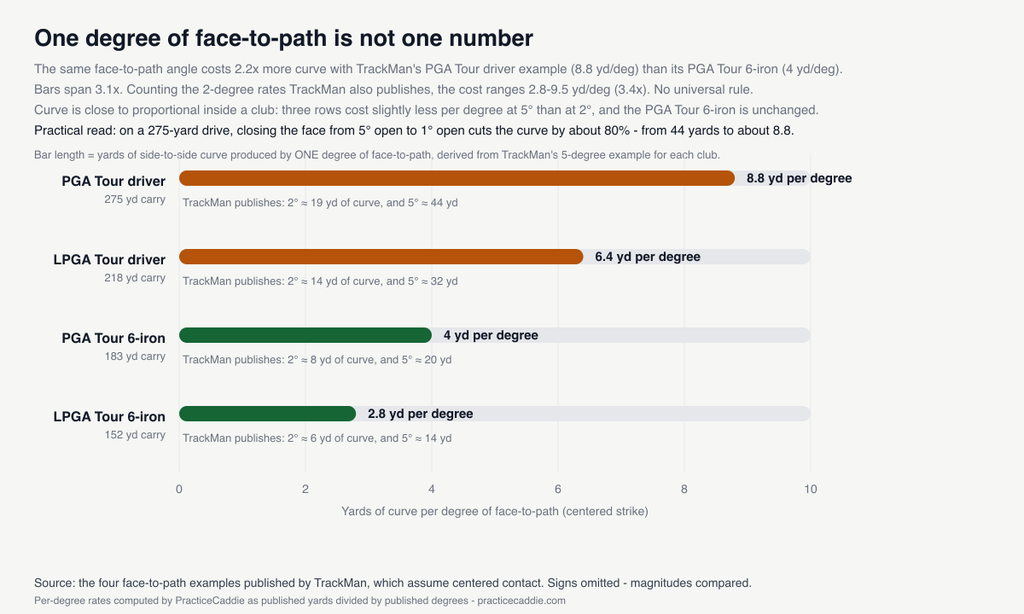
Three readings come out of that table. The same swing error costs 2.2 times more curve with TrackMan’s PGA Tour driver example than with its PGA Tour 6-iron, which is the arithmetic behind the driver-only slice. Curve stays close to proportional inside a club — three rows cost slightly less per degree at five degrees than at two, while the PGA Tour 6-iron is unchanged — so the miss does not accelerate as the gap widens. And there is no universal yards-per-degree conversion: across TrackMan’s four examples the rate ranges from 2.8 to 9.5 yards, a 3.4x spread.
The widely repeated “one degree equals twelve yards” line comes from that same page, but it is a quotation from TrackMan University Master John Parkinson, scoped to elite players who drive the ball 300-plus yards. His point was that a PGA Tour fairway is only 30 to 32 yards wide, so anything past 1.5 degrees forces a tour player to aim off the short grass. Applied to a 250-yard amateur drive, it overstates the cost.
The practical version for a slicer is the top row. At five degrees of face-to-path, a 275-yard drive curves about 44 yards. Close that to one degree and the curve falls to roughly nine — about an 80% reduction, on the same path, from face delivery alone.
What a slice costs you
No published dataset isolates “slicers” and prices their slice in strokes, so anyone quoting a precise figure is estimating. Large samples identify penalty shots and lost distance as the measurable damage from wild driving.
Shot Scope’s own data booklet reports that a 25-handicapper hits a higher fairway percentage than a scratch player, while sitting roughly 60 yards shorter off the tee. Shot Scope’s separate strokes-gained guide gives average penalty shots per round by handicap:
| Handicap | Penalty shots per round |
|---|---|
| 0 | 0.56 |
| 5 | 0.91 |
| 10 | 1.62 |
| 15 | 2.45 |
| 20 | 3.03 |
| 25 | 4.67 |
A 25-handicapper hits more fairways than a scratch player and takes more than eight times the penalty shots. Fairways hit counts a one-yard rough miss and an out-of-bounds tee shot alike, which can hide how damaging severe misses are. Shot Scope’s strokes-gained guide makes the same criticism directly, noting that a fairway missed by a yard, a ball in the water, and one out of bounds all record identically. Traditional metrics can be misleading. The cost of a slice lives in the tail — the drives that curve past the rough into a hazard or a re-tee — and that is the part a face-to-path fix shortens.
The right-miss assumption is mostly wrong
Worth correcting a belief this post used to encourage. The same GOLF.com piece quoted above states that higher handicaps “miss to the right of their target more than half the time,” and tracked shot data disagrees. Shot Scope’s booklet reports that left-versus-right miss numbers are similar for scratch players and lower-scoring players, and a large preference for a right miss appears only once you reach 25 handicap. A MyGolfSpy analysis of the same Shot Scope data reaches the same conclusion across the handicap range.
If you slice, you slice, and the drills below apply. But a mid-handicapper who assumes every bad drive goes right will misread half their own misses — which is the argument for measuring rather than remembering. A pull and a pull-slice start on the same line and need opposite corrections.
The fix order: face, then path, then transfer
Teaching pros have argued the face-versus-path ordering for years — this GolfWRX piece covers the debate well. The honest answer is both, in the right order, depending on the player.
For most weekend slicers, the order that works is:
- Face first. A grip change is the face fix that asks least of your swing: it alters face delivery at address rather than mid-motion, and it is the one change D’Arcy’s group showed moving delivered face angle within a single session. See how to grip a golf club for the positions themselves.
- Path second. Once the face delivers closer to square, the path fix does something. Before that, swinging more from the inside converts a slice into a push. The gate drill and the headcover-under-armpit drill are the two path drills this protocol uses, and the over-the-top fix covers the transition move underneath them.
- Transfer third. Drilling under block conditions makes everything look good on the range without carrying to the course. The last phase of practice has to be random — see Block vs Random Practice in Golf for why that matters more than the drill choice.
GOLFTEC states the limit of step one directly, and it is worth quoting against the usual advice: with a path five degrees out-to-in, a stronger grip converts a slice into a pull or a pull-hook. Their wording: “Grip is the starting point, not the finish line.” Two of the three biomechanical causes they name — out-to-in path and early extension — live below the hands entirely.
What the grip research actually says
Most slice articles assert that a stronger grip fixes a slice. Two peer-reviewed studies have measured it, and they support a narrower claim than the usual one.
D’Arcy and colleagues (2021, Journal of Sports Sciences) tested 28 recreational golfers on TrackMan across five grip positions in 15-degree increments, from 30 degrees strong to 30 degrees weak, with handicaps spanning 3 to 36. Grip position significantly affected six accuracy measures — clubface angle, club path, face-to-path, launch direction, absolute accuracy, and sideways deviation — plus clubhead speed and total distance. Neutral and stronger grips produced the best results; weaker grips were significantly worse on both accuracy and distance.
That distance finding is the part usually left out. A weak grip cost yards and accuracy together in D’Arcy’s data, which removes the trade-off most slicers assume they are making.
Carson and colleagues (2019, European Journal of Sport Science) put 12 male professionals through 24 driver shots under weak, neutral and strong grips using ten-camera motion capture. Clubface angle differed significantly between the weak grip and both the strong and neutral grips, with the weak grip presenting a more open face. Strong and neutral did not differ significantly from each other.
Read together, the two studies support escaping a weak grip. Neither supports rotating as far as the hands will go. Both were acute within-session tests, so the question of how long a grip change takes to hold stays open — a limit the four-week plan below has to respect.
Five drills that move the needle
Every slicer has heard of these drills. What separates a drill that changes something from one that fills a bucket is doing them in order, against a success criterion, and re-testing on video or a launch monitor.
1. The strong-grip half-swing (face fix)
Set up with two to three knuckles visible on the lead hand. Take a half-swing — club at 9 o’clock on the backswing, finish at 3 o’clock — and hit a wedge 50 yards. Goal: 8 of 10 shots starting straight or with a slight draw, never with a slice. Stop the rep when the face is square.
2. The 9-to-3 face-rotation drill (face fix)
Same setup, but with a 7-iron. Half swing back, half swing through. Pause at the finish and check that the toe of the club has rotated over the heel — the toe should point roughly skyward rather than at the target. This trains the release pattern your full swing needs.
3. The gate drill (path fix)
Stick two alignment sticks (or headcovers) in the ground in a “gate” — one slightly outside the ball-target line about a foot in front of the ball, the other slightly inside the line about a foot behind. The gate forces a less out-to-in path. Goal: 10 mid-iron swings without hitting either stick. MyGolfSpy’s path-fix sequence explains the geometry in more detail.
4. The headcover-under-trail-armpit drill (path + connection)
Tuck a headcover or small towel under your trail armpit (right armpit for a right-hander). Hit half-swing 7-irons; the headcover should fall during the follow-through rather than before impact. Promotes a connected, less steep delivery. Caveat: this drill is famously misused — if you already swing too far inside-out, the trail-armpit version deepens the problem. If that is you, switch to the lead armpit (left, for a right-hander), which trains the opposite feel.
5. The driver-only attack-angle drill (driver-specific)
If you slice driver but strike irons clean, the table above is your explanation: the same error costs 2.2 times the curve. Set the ball one to two ball-widths forward of your normal driver position, raise the tee so half the ball sits above the crown, and feel a slight upward strike. That is standard driver setup rather than a slice cure on its own — how to hit a driver covers it in full. The reason to fix it alongside the grip is that the driver is where a given face-to-path error is most expensive, so the same correction shows up biggest here. Pair it with the strong-grip half-swing for the first 10 reps each session.
The four-week protocol that makes it stick
This is the part most articles skip. A drill practised only under block conditions can look solved on the range and still fail on the course, because it never meets the variability a round supplies. The plan below mirrors the howTo schema on this page and is the same sequence PracticeCaddie’s AI plans use when a user reports a slice in onboarding.
- Week 0 — measure. Phone video down-the-line. Five drivers, five 7-irons. Record curve in yards, start direction, grip position, and face-to-path if your monitor reports it. No fix yet.
- Week 1 — face. 30 minutes, three sessions. Strong-grip half-swing wedges, then 9-to-3 with a 7-iron. Block practice is correct here — you are acquiring a new motor pattern. No driver yet.
- Week 2 — path. 30 minutes, three sessions. Gate drill with mid-iron, then headcover-armpit drill with hybrid, then driver. Re-film at the end of week 2 and write down start direction and curve in yards against your week-0 numbers. Record what changed rather than deciding in advance what should have.
- Week 3 — random. 45 minutes, three sessions. Pre-write an 18-shot list rotating club and target. No two consecutive shots match. The fix has to survive variability before it transfers. (See Block vs Random Practice in Golf for the research underneath this step.)
- Week 4 — pressure. 45 minutes, three sessions. Each session ends with a “first-tee” simulation: three driver shots with a fairway-or-inside-30-yards success criterion. Play one nine-hole round at week’s end. Record slice rate.
- Maintenance. Re-film every two weeks for two months. The slice tries to return, and measurement is the reliable counter.
How much of that timeline is evidence, and how much is convention
Four weeks is a coaching convention, and this post treats it as one. A 2024 systematic review of motor learning in golf found 52 randomised trials, of which 43 studied putting and 41 used novices, with 29 underpowered. The handful of full-swing studies tested retention at one, two, three and fourteen days, with mixed results — one 7-iron video-feedback study found no group difference in directional error at all.
So there is no research-backed answer to “how many weeks does a swing change take.” The review supports two things about structure: practice distributed across sessions beats the same volume massed into one, and a delayed retention test is what measures learning, where a good range session only measures the day. The week-4 play-test is doing that job.
If your slice has not measurably reduced by the end of week four, the cause is usually one of two things: the grip change reverted under speed (re-run week 1), or the path needs a coach with a launch monitor. Most slicers can fix the face alone. Many need help with a deep path pattern.
When to skip the protocol and book a lesson
Self-coaching works for the typical weak-grip-plus-over-the-top slice. Three patterns benefit more from a one-hour TrackMan or FlightScope lesson than from another month of self-practice:
- Two-way miss with no consistent shape. If you slice and hook in the same round, the path is unstable. A coach with a launch monitor isolates the variable in one session.
- Slice that worsens with speed. Changes that hold at 80% and break down at 100% are usually a sequencing problem. Worth diagnosing under load.
- A slice that has survived two prior fix attempts. The pattern is grooved deep enough that supervised re-patterning beats more self-driven repetition. Budget one lesson plus four weeks of follow-up.
A single launch-monitor session runs about $75–$150 at most teaching facilities, which is a field figure rather than a surveyed one. The case for paying it is diagnostic: it settles whether face or path is your constraint in one session, and that is the question four weeks of unsupervised practice answers slowly. Launch monitor numbers explained covers which readings to ask for, and face-to-path is the one to watch.
Common mistakes
- Doing path drills before the face is fixed. Swinging more from the inside with an open face produces a push-slice, which feels worse than the original pull-slice and convinces players the drill fails. Sequence matters.
- Over-strengthening the grip. Carson’s study found no significant clubface difference between its neutral and strong conditions, so the gain is in leaving weak rather than in rotating further. It never tested positions beyond a strong grip, so treat four or five knuckles as unmeasured rather than recommended. Stop at the knuckle count that produces a straight ball or slight draw on the half-swing test.
- Assuming every bad drive went right. Shot Scope’s data says left and right misses run close to even until 25 handicap. Record the miss instead of recalling it.
- Block practice for four weeks. Same shot, same target, 50 reps. Range performance climbs and course performance does not. The week-3 random phase is where transfer is bought.
- Skipping the baseline measurement. Without week-0 video you cannot tell at week 4 whether anything changed. A fair share of perceived “no progress” is poor memory of how bad it was.
- Blaming the swing when the aim is off. An open stance and a shut face produce the same starting line as a slice. Alignment and aim is the ten-minute check to run before four weeks of drills.
Key takeaways
- Mid-handicap slicers deliver the face 4–7° open to the path, on a driver path 3–6° out-to-in, per GOLFTEC’s OptiMotion data across 14 million-plus swings.
- Face first. The clubface drives roughly 85% of starting direction on a driver, so a face closer to the path reduces curve even on an unchanged path.
- There is no universal yards-per-degree rule. TrackMan’s four published examples range from 2.8 to 9.5 yards of curve per degree — 2.2x more with the PGA Tour driver example than the PGA Tour 6-iron.
- Closing 5° of face-to-path to 1° cuts the curve about 80% on a 275-yard drive, from 44 yards to roughly nine.
- The grip research supports escaping a weak grip. Going maximally strong is a separate bet the studies never tested. A weak grip cost both accuracy and distance in D’Arcy et al. (2021); strong and neutral did not differ in Carson et al. (2019).
- Fairways hit hides the slice. A 25-handicapper hits more fairways than a scratch player and takes 4.67 penalty shots a round against 0.56, per Shot Scope.
- Four weeks is a coaching convention. The 2024 golf motor-learning review tested full-swing retention only out to 14 days, so judge the fix by a play-test rather than a calendar.
Frequently asked questions
What causes a slice in golf?
A slice is caused by a clubface that is open relative to the swing path at impact — the ball curves toward where the face is pointing, away from where the club is moving. GOLFTEC’s OptiMotion data, drawn from a database of more than 14 million captured swings, puts mid-handicap slicers at typically four to seven degrees of face open to path, usually paired with a path three to six degrees out-to-in. Grip, setup, and transition sequence are the three usual culprits.
How many degrees open is a slicer’s clubface?
GOLFTEC reports that when OptiMotion measures face angle at impact for mid-handicap slicers — roughly 90 to 100 shooters — the face is typically four to seven degrees open relative to the path. Their driver path over the same group runs three to six degrees out-to-in. Those are the two numbers that produce the curve. Both are measurable on any launch monitor that reports club delivery, and face-to-path is the single figure worth watching if you only track one.
Should I fix my clubface or my swing path first?
Fix the face first for most amateur slicers. The clubface contributes roughly 85% of starting direction on a driver, and a face closer to the path reduces curve even on an unchanged path. Getting out of a weak grip is the highest-leverage face fix, because it changes face delivery without rebuilding your swing. GOLFTEC adds a caveat worth heeding: with a path five degrees out-to-in, a grip change alone converts a slice into a pull, so the path work still has to follow.
How long does it take to fix a slice?
Three to four weeks of structured practice is a reasonable field expectation, at roughly two to three sessions a week, with the change taking a couple of months to hold under pressure. Treat those figures as a coaching rule of thumb rather than a research finding. A 2024 systematic review of golf motor-learning trials found full-swing retention tested only at one to fourteen days, with mixed results, so no evidence-based timeline for a swing change exists.
Why do I slice my driver but not my irons?
Because the same face-to-path error costs more with a driver. TrackMan publishes examples at both ends of a PGA Tour bag: five degrees of face-to-path produces about 44 yards of curve on a 275-yard drive, and about 20 yards on a 183-yard 6-iron. That is roughly 2.2 times the curve per degree from the same swing error. Drivers are also hit off a tee on an ascending strike and swung harder, which exposes sequence flaws an iron hides.
Can a stronger grip really fix my slice?
Partly, and the research is more specific than the usual advice. D’Arcy and colleagues tested 28 recreational golfers on TrackMan across five grip positions and found grip significantly affected clubface angle, face-to-path, club path and launch direction, with neutral and stronger grips producing the best accuracy and distance. Carson and colleagues found a weak grip presented a significantly more open face than either neutral or strong, while strong and neutral did not differ. The support is for escaping a weak grip. Maximum rotation is a separate bet the evidence does not cover.
Do most amateur golfers actually miss right off the tee?
Less often than the slice’s reputation suggests. Shot Scope’s own data booklet reports that left-versus-right miss numbers are similar for scratch and lower-scoring golfers, and that a large preference for a right miss appears only at 25 handicap. The same booklet notes 25-handicappers hit a higher fairway percentage than scratch players while sitting roughly 60 yards shorter. Fairways hit hides the damage; penalty shots per round, which run 0.56 at scratch and 4.67 at 25 handicap, show it.
Related reading
- How to Grip a Golf Club — the open clubface that causes the slice usually starts in the grip; this cornerstone is step one of the fix.
- Golf Ball Flight Laws Explained — the face-and-path model this whole protocol rests on, including why the ball starts where the face points.
- Block vs Random Practice in Golf: What the Research Actually Says — the motor-learning research behind the week-3 transfer phase.
- Over the Top Golf Swing Fix — the transition move that produces the out-to-in path GOLFTEC measures at 3–6 degrees.
- Early Extension Golf Swing Fix — the third of GOLFTEC’s three biomechanical slice causes, and the one no grip change reaches.
- How to Fix a Hook in Golf — the mirror image; overcook this fix and you land here, so the two protocols share a face-then-path logic.
- How to Read Your Divots — free turf feedback on path and low point, useful between range sessions when no launch monitor is available.
- Golf practice drills that actually transfer to the course — the drill list curated against the same skill-acquisition literature.
- Driving range practice plan — how to structure the 30–45 minute sessions in this protocol.
- Golf practice plan by handicap — what to weight as you move from “fix the slice” to “lower the handicap.”