
How to Aim in Golf: Alignment and Aim for Every Shot
Your clubface points the ball; your body sets the path. To aim in golf, set the face to a spot a few feet ahead, then build your stance parallel to it.
Quick answer
Your clubface points the ball onto its starting line; your body sets the path that curves it. So aiming is a two-part job: set the clubface square to your start line, then build your body parallel to that line, which for a right-hander points slightly left of the flag. Pick an intermediate spot a foot or two ahead and aim over it, which beats aiming at a distant target. Then run the same routine every shot.
The aim system at a glance
| Part of aim | What it sets | Aim it at | Common amateur error |
|---|---|---|---|
| Strategic target | Where the shot should finish | Safe part of the green or fairway, not always the pin | Firing at every flag |
| Start line | The line the ball launches on | From the ball, over an intermediate spot, to the target | No defined line at all |
| Clubface | The ball’s starting direction (the large majority) | Square to the start line | Aiming the face at the flag while the body drifts right |
| Body (feet, hips, shoulders) | The swing path and shot dispersion | Parallel to the start line (parallel-left for righties) | Pointing the body at the target, which aims it right |
What good aim actually saves you
Aim gets treated as a beginner topic, then quietly costs strokes for a lifetime. The evidence for how much it costs is in the shot data. According to Mark Broadie’s strokes-gained work in Every Shot Counts, PGA Tour pros average about 23 feet from the pin on a 150-yard approach, while 90-shooters average around 56 feet, more than double the distance.
Some of that gap is pure ball-striking. A lot of it is aim and target choice. In his talk Use Golf Statistics to Actually Lower Your Handicap, Broadie notes that amateurs tend to be 10 or more yards short on that 150-yard shot and aim at flags their dispersion cannot support, which turns a decent swing into a long two-putt. The miss even has a direction. Shot Scope’s data, aggregated across thousands of golfers, shows the average player misses short and right with wedge approach shots, a pattern that points at under-clubbing and a rightward aim bias at the same time.
The good news about aim is that it corrects faster than almost any swing change, because the error is geometric and visible. You do not have to rebuild a move. You have to point the right things in the right direction, then repeat it. The rest of this guide is how.
Why the clubface decides where the ball starts
Here is the single fact that reorganizes everything about aiming: your clubface points the ball onto its starting line, and your body’s alignment shows up later, in the swing path and the curve. TrackMan, whose launch monitors sit behind most tour ranges and club-fitting studios, states that the ball “will launch very closely to the direction the club face (Face Angle) is pointed at impact.” The clubface is responsible for the large majority of where the ball starts, and more so with the longer clubs, while the swing path contributes mostly to curve.
That overturns the old teaching, which blamed swing path for where the ball started and treated the face as secondary. Modern D-plane data flipped it. The practical takeaway is direct: if your clubface is aimed 3 degrees off your start line, the ball starts off-line, no matter how good your body alignment looks in the mirror.
Aim the clubface first, then build the body to match it. The face decides your start line while the body shapes the path and the curve, so a golfer who locks the face square and stands parallel to it has removed the two biggest sources of a mis-aimed shot before the swing even begins.
This is why aiming in golf runs as a sequence. Set the face to the target line, then set the body parallel to it. Reverse that order, building the stance first and squaring the face last, and the face tends to drift to wherever the body points it. If you want the full physics of why the ball starts and curves where it does, the ball-flight laws are the diagnostic hub for this whole topic.
The aim paradox: why aiming at the flag makes you miss right
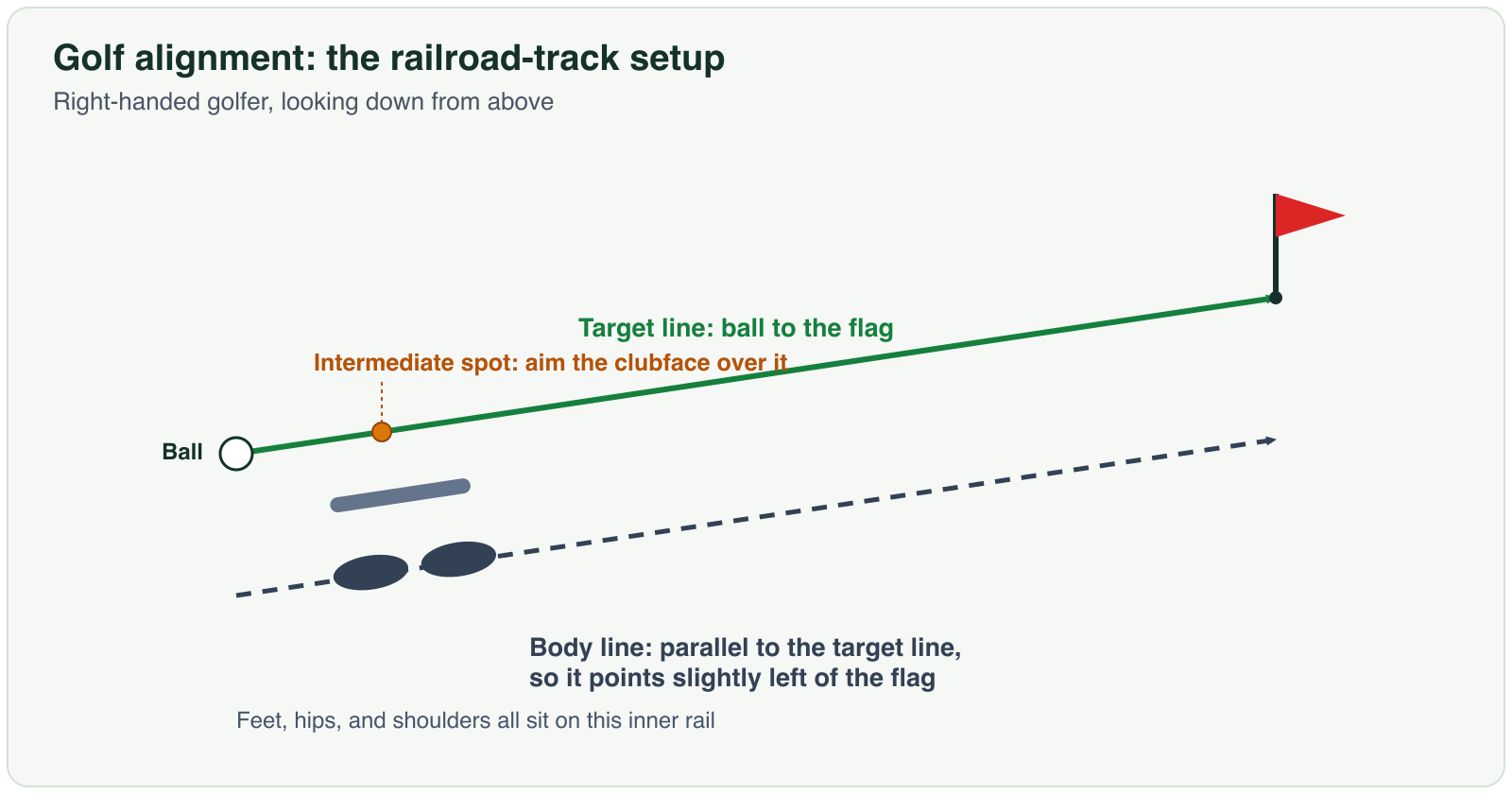
Try to aim your body straight at the flag and you will usually aim it right of the flag instead. This is the aim paradox, and it comes from geometry. You stand to the side of the target line, so your body sits on a line that is offset from the ball. The correct body line is parallel to the target line, which for a right-hander runs slightly left of the target, the way railroad tracks appear to converge in the distance even though they never touch.
Ben Hogan built this into a mental picture in his classic Five Lessons: the ball rests on the outer rail (the target line) and your feet, hips, and shoulders sit on the inner rail, parallel to it. A right-hander who ignores the inner rail and rotates the shoulders to point “at” the flag opens the whole stance and aims it right. Then the swing follows the body out to the right, and the player either blocks it there or yanks it back left to save it. Two misses, one root cause.
The deeper problem is that you cannot feel the error. Because you view the line from the side, your eyes hand you a distorted picture of where straight is. Most golfers believe they are square when they are aimed several degrees off. On the green the effect is measurable: Titleist reports that in its own testing, players using its AIM alignment designs were up to 35% more precise at aiming their putts than with a standard side stamp, which tells you how much error hides in ordinary “eyeball it” aim. Putting-instruction pioneer Dave Pelz makes the same point a different way: every putt is a straight putt off the face, and the green does the curving, so a stroke that starts the ball off your intended line misses even when the read and pace are perfect.
Use an intermediate target, the way the best players do
The fix for a distorted long-range view is to aim short. Jack Nicklaus built his entire alignment method around it in Golf My Way: lining up a 2-foot putt is easy, lining up a 40-foot putt is hard, so he shrinks every shot down to a 2-foot problem. Standing behind the ball, he picks a spot on the ground a foot or two ahead of the ball, directly on the target line, then aims the clubface over that near spot and sets his body to it. Tiger Woods uses the same routine, aiming over an intermediate spot just in front of the ball and setting up the same way on every shot.
Your eyes cooperate with a near target and fight a far one. That is parallax working for you instead of against you. A spot two feet away holds still and gives you a precise reference the flag cannot.
Vision is the other half of aim, and it matters most on the green. Your dominant eye and head position change what “straight” looks like from address. A common check is to set your eyes just behind and slightly inside the ball, then verify your perception against a known-straight line before trusting it. One habit costs more strokes than any other here: lifting the head to peek at the hole. Lifting drags your eye line and shoulders open and skews the aim you just built. Swivel the head to look, keeping the eye line level, then swivel back. On full shots, the line printed on your ball works as a built-in intermediate aim you can point down the start line at address.
The pre-shot aim routine
Good aim comes from a routine you repeat. The same six steps, run in the same order every time, turn aim from a variable into a habit. This is the sequence tour players run without thinking about it.
- Pick a strategic target. Choose where the shot should finish from behind the ball, usually the fat part of the green rather than the pin. Off the tee, keeping the ball in play comes first. Broadie’s advice is blunt: if you would hit more than about 1 drive in 50 out of bounds at a target, change the target or the club.
- See the whole line from behind the ball. Stay behind the ball, on the target line, and trace it from ball to target. This is the only view without parallax.
- Pick an intermediate spot a foot or two ahead. Find a small mark on that line, one to three feet in front of the ball, to aim over.
- Set the clubface square to the spot first. Aim the leading edge perpendicular to the line through your spot, before your feet get involved.
- Build your stance parallel to the start line. Set feet, hips, and shoulders on a line parallel to the target line, slightly left of the target for a right-hander. Match all three rails.
- Swivel your head to the target and go. Look by turning the head, not lifting it, trust the aim, and pull the trigger.
The routine is worth as much as the mechanics. A consistent pre-shot routine is what carries good aim from the range to the first tee, and it is one of the few habits that holds up under pressure precisely because it never changes.
An aim audit: match your miss to your aim error
Aim errors leave fingerprints. Because the clubface sets the start line and the body sets the path, a repeatable miss usually traces back to a specific alignment fault, not a mystery in your swing. Use the table below to find your likely cause before you rebuild anything. It draws on the ball-flight physics above, the Shot Scope miss data, and the parallax problem, mapped to the fix that addresses each.
| Your typical miss | Likely aim or alignment error | First fix |
|---|---|---|
| Pushes and blocks right | Body aimed right of target (pointed at the flag, not parallel) | Rebuild parallel-left with sticks; set the face to an intermediate spot |
| Pulls left | Body aimed right, swing rerouted left to save it | Same parallel-left fix; stop steering the club back to the target |
| Short and right with wedges | Under-clubbing plus a rightward aim bias, firing at the pin | Aim center-green, take one more club, check the face aim |
| Putts missing on the same side | Putter face mis-aimed at address, plus parallax | Use the ball line and a two-tee gate; reset dominant-eye position |
| Two-way miss, no pattern | Aim changing shot to shot with no fixed routine | Lock the six-step routine and the intermediate-target step |
Treat this as a starting map for the likely cause. If your miss is a genuine two-way that shows up even with clean alignment, that usually points to a swing-path issue, and the over-the-top and slice fixes are the better place to look. Aim is the first thing to rule out because it is the cheapest to check.
Drills to check and train your aim
Aim training comes down to feedback, because the whole problem is that you cannot feel where you point. Three stations cover it, and none needs a launch monitor.
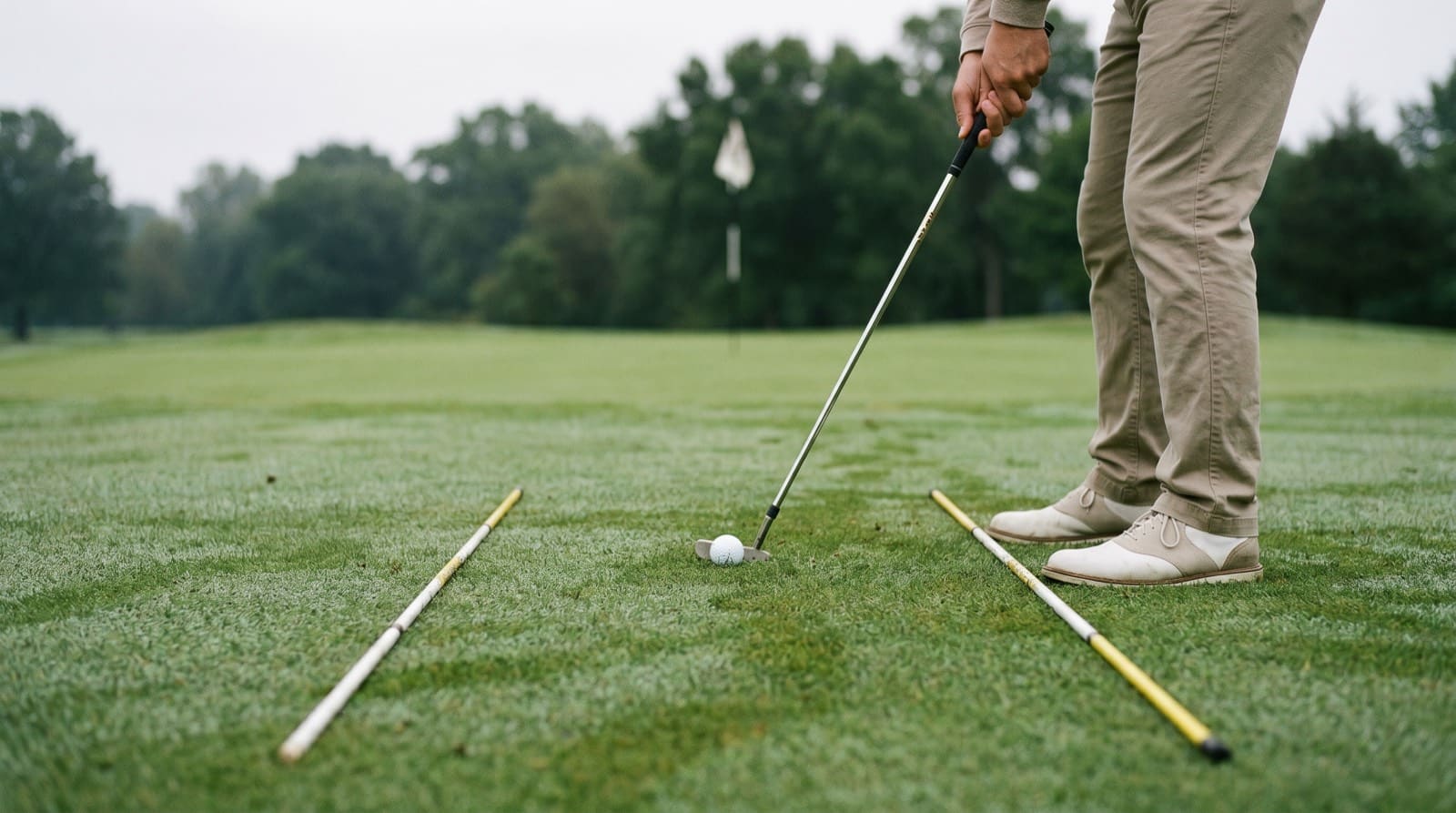
The ground-rails station is the foundation. Lay one alignment stick on your target line, on the ground beyond the ball, and a second along your toes, parallel to the first. Take your stance, then step out and look at where your body actually points versus where it felt like it pointed. Add a third stick across the front of your thighs to check that hips and shoulders match the toe line, not just the feet.
The eye-and-gate station handles putting. Run the dominant-eye check, set your eyes just behind and inside the ball, and use the line on your ball as your aim. Then build a gate of two tees a few inches ahead of the ball, just wider than the ball, and roll putts that must start through the gate. A putt that clips a tee started off your intended line, which is feedback you cannot argue with. A putting mirror does the same job for eye and shoulder position.
The camera station is the tiebreaker. Film yourself down the line with a stick on the ground on the target line. The camera shows the truth that feel hides, and one down-the-line video usually settles whether you are actually aimed where you think. Do this work in your warmup rather than leaving aim to chance, which is exactly the kind of structured, feedback-first checkpoint PracticeCaddie’s plans build into a session instead of hoping you remember it.
Common aim mistakes
- Aiming the body at the flag. The body belongs on the inner rail, parallel to the target line, which points slightly left of the target for a right-hander. Pointing it at the flag aims you right.
- Setting the feet first, face last. The face sets the start line, so it gets aimed first. Build the stance to the face, not the other way around.
- Skipping the intermediate spot. Aiming to a distant target invites parallax error. A spot a foot or two ahead removes it.
- Lifting the head to peek. It drags the eye line and shoulders open. Swivel the head to look, do not lift it.
- Firing at every pin. Broadie’s data says center-green aim beats pin-hunting for almost every amateur. Aim at the fat part and let the ball finish close on its own.
- Checking aim by feel. Feel is exactly what is broken. Verify with sticks or a camera, on the range, until the correct aim feels normal.
Key takeaways
- The clubface starts the ball. TrackMan shows the ball launches very close to the direction the face points, so the face sets your start line and the body shapes the curve. Aim the face first.
- Aim the body parallel to the target line. The ball sits on the outer rail and the body on the inner rail, which points slightly left of the target for a right-hander, per Hogan’s railroad-track model in Five Lessons.
- Pointing your body at the flag aims you right. Because you stand to the side of the line, “aiming at the target” with the body opens the stance and sends the swing right.
- Use an intermediate spot a foot or two ahead. Nicklaus’s Golf My Way method shrinks a 150-yard aim into a 2-foot aim your eyes can actually judge.
- Aim is a scoring lever. Amateurs average about 56 feet from the pin on a 150-yard approach versus 23 feet for pros, and much of that gap is aim and target choice (Broadie).
- Center-green aim beats pin-hunting. Shot Scope shows the average miss is short and right; aim at the fat part and take enough club.
- Check aim with feedback rather than feel. Alignment sticks, a gate of tees, and a down-the-line video expose the error that address feel hides; Titleist found a clear visual aid made putters up to 35% more precise.
Frequently asked questions
Where should I aim in golf, at the target or left of it?
Aim your clubface at the target line and aim your body parallel to it, which for a right-hander means your feet, hips, and shoulders point slightly left of the target, not at it. The ball sits on the target line and your body sits on an inner line parallel to it, like two rails of a railroad track. Pointing your body directly at the flag actually aims your stance right of the target, so parallel is correct, not at.
Why do I aim right of my target without realizing it?
Because you stand to the side of the target line, your eyes feed you a distorted view of where straight actually is. Many right-handers try to point the body at the flag, which rotates the stance open and aims it right of target, then the swing follows the body right. Titleist’s own testing found players are up to 35% more precise on putts when a clear visual aid replaces guesswork, which shows how large the baseline aim error is. A camera or alignment sticks will usually reveal you are aimed farther right than you feel.
Does the clubface or my body control where the ball starts?
The clubface. TrackMan’s launch-monitor research shows the ball starts very close to the direction the clubface points at impact, while the swing path mostly controls the curve. The face is responsible for the large majority of where the ball starts, and more so with the longer clubs. That is why aiming in golf begins with the clubface: set it square to your start line first, then build your body around it.
What is an intermediate target and how do I use it?
An intermediate target is a small mark on the ground, a divot, a discolored blade, a leaf, one to three feet ahead of your ball on the target line. You aim the clubface over that near spot instead of the distant target, then set your body parallel. Jack Nicklaus made it central to his routine because lining up over a spot two feet away is far more accurate than lining up to a flag 150 yards off. Tour players use the same trick on nearly every shot.
How do alignment sticks help my aim?
Alignment sticks turn invisible aim into something you can see. Lay one stick on the ground on your target line and a second along your toes, parallel to the first, to build the railroad-track relationship. Step away and look at where your body actually points versus where it felt like it pointed at address. The gap is usually surprising. Because the error becomes visible, alignment corrects faster than most swing faults, which live on feel.
How do I know if I am aimed correctly?
Feel is unreliable for aim, so check it with feedback. Film yourself down the line with an alignment stick on the ground, or set up to two parallel sticks and look back at your body lines. On the green, use the line printed on your ball as an intermediate aim and a gate of two tees to confirm the ball starts on line. Do this on the range and putting green, and your on-course aim will hold up without needing sticks during play.
Should I aim at the flag on approach shots?
Usually not, unless the pin is in the middle of the green and your dispersion is tight. Mark Broadie’s strokes-gained data shows amateurs average about 56 feet from the pin on a 150-yard approach versus about 23 feet for pros, and much of that gap comes from aiming at flags their dispersion cannot support. Aim at the fat part of the green, allow for your typical miss, and let the occasional shot finish close. Center-green aim lowers scores more than pin-hunting for most golfers.
Related reading
- How to Grip a Golf Club — the grip sets the face, and a mis-aimed face starts the ball off-line no matter how good your alignment; the two work together.
- Golf Stance and Posture — the platform your aim is built on; a stance that points parallel is only useful if your posture lets you rotate down that line.
- Golf Ball Position by Club — the strike half of setup; ball position sets the low point while aim sets the direction.
- Golf Ball Flight Laws — the diagnostic hub; read your start direction and curve to reverse-engineer the face and path behind any miss.
- How to Read Greens in Golf — aim on the green is start-line plus read; this covers the read half that turns a good aim into a made putt.
- How to Fix a Slice in Golf — an open-face, out-to-in miss that a rightward body aim quietly feeds; rule out aim before rebuilding the swing.
- Golf practice plan — where alignment checks and setup work fit into a structured weekly session.
- Golf practice drills, organized by skill area — the companion drill library, with setup steps and success criteria.