
Golf Downswing Sequence: The Order That Actually Makes Speed
Tour players start down from the ground up — pelvis, thorax, arms, club — in about 0.25 seconds. The measured numbers, the myths, and a phone-camera audit.

Quick answer
The downswing runs proximal to distal: the pelvis starts, then the thorax, then the lead arm, then the club — each peaking after the one before it and slowing down to hand speed forward. Tour players complete it in 0.23–0.30 seconds, roughly a 3:1 backswing-to-downswing ratio. The transition begins before the club finishes going back, driven by pressure into the lead foot. Break the order and speed leaks out of the chain.
The four links, in order
| Link | Segment | What it does | Measured reference |
|---|---|---|---|
| 1 | Pelvis | Starts down while the club is still going back | Peak rotation ~503°/s under a 5 handicap vs ~380°/s at 18-plus |
| 2 | Thorax | Accelerates as the pelvis slows; keeps the coil | X-factor separation stretches a few degrees before it shrinks |
| 3 | Lead arm | Accelerates as the torso slows; delivers the shaft | Trail elbow still bent as the lead arm reaches parallel |
| 4 | Club | Peaks last, at or just before impact | Club shaft angular velocity near 2,400°/s in professionals |
Every figure in that table is drawn from the biomechanics and force-plate research cited through this post, and the evidence-grade audit further down flags which of them are published with methods and which are coach-lore.
What the kinematic sequence actually is
The kinematic sequence is the order in which the body’s segments reach peak rotational speed during the downswing: pelvis, then thorax, then lead arm, then club. It is a chain handing speed forward, with each segment peaking higher than the one before and slowing down at the moment the next one accelerates.
All great ball strikers begin by generating speed from their lower body and transferring this speed through their torso, into their arms, and then into the club. — Titleist Performance Institute, kinematic sequence basics
That deceleration is the part most golfers skip past. Each segment actively brakes as its turn ends, and the angular momentum it sheds pushes the next segment along. TPI’s image for this is a child jumping off a parent’s shoulders — the parent slows, the child launches. Physically it means the clubhead ends up rotating several times faster than the pelvis that started the motion, without any single joint in your body having to move at an implausible speed.
The order is style-agnostic. Jim Furyk and Davis Love III look nothing alike and both sequence correctly. A peer-reviewed systematic review of golf-swing biomechanics treats the whole motion this way: the backswing exists to create the joint angles and separation that let an efficient sequence unfold coming down. So a textbook-looking top position with a scrambled downswing order is worth less than an unorthodox top with a clean one.
The order, segment by segment
Pelvis. The first link, and the one the research is clearest about. Callaway and colleagues put 56 golfers in a K-vest and split them by handicap: the low group (under 5) averaged 503°/s of peak pelvis rotation against 380°/s for the high group (18 and up), a gap of 123°/s, with significantly stronger gluteus maximus and medius in the low-handicap group (full text). Cheetham’s earlier tour-versus-amateur comparison, quoted in the same paper, found 477 ± 53°/s in professionals against 395 ± 53°/s in amateurs.
Thorax. The torso picks up as the pelvis brakes. This is where separation between hips and chest gets used rather than just stored — the coil built in the backswing converts into rotational speed here.
Lead arm. The arms come next, which is exactly the part amateurs promote to first. If the arms accelerate before the torso has peaked, they have nothing stable to push against, and clubhead speed becomes a matter of raw muscular effort rather than transferred momentum. Nesbit’s three-dimensional kinematic and kinetic analysis models this directly: well-timed proximal deceleration lets distal segments gain momentum without excessive joint torque.
Club. Last, and fastest. A kinematic study of professional and amateur golfers measured club-shaft angular velocities near 2,400°/second in pros during the downswing, with the cleanest ordering in the best players and progressively worse timing down the handicap ranks.
The transition: what starts down before the club stops going back
The most useful fact about the downswing is that it begins during the backswing. Phil Cheetham’s X-factor stretch paper describes the mechanism: the hips begin rotating toward the target while the shoulders are still completing their backswing, so the separation between them momentarily grows before it collapses toward impact. That brief stretch loads the trunk elastically right when the chain needs it.
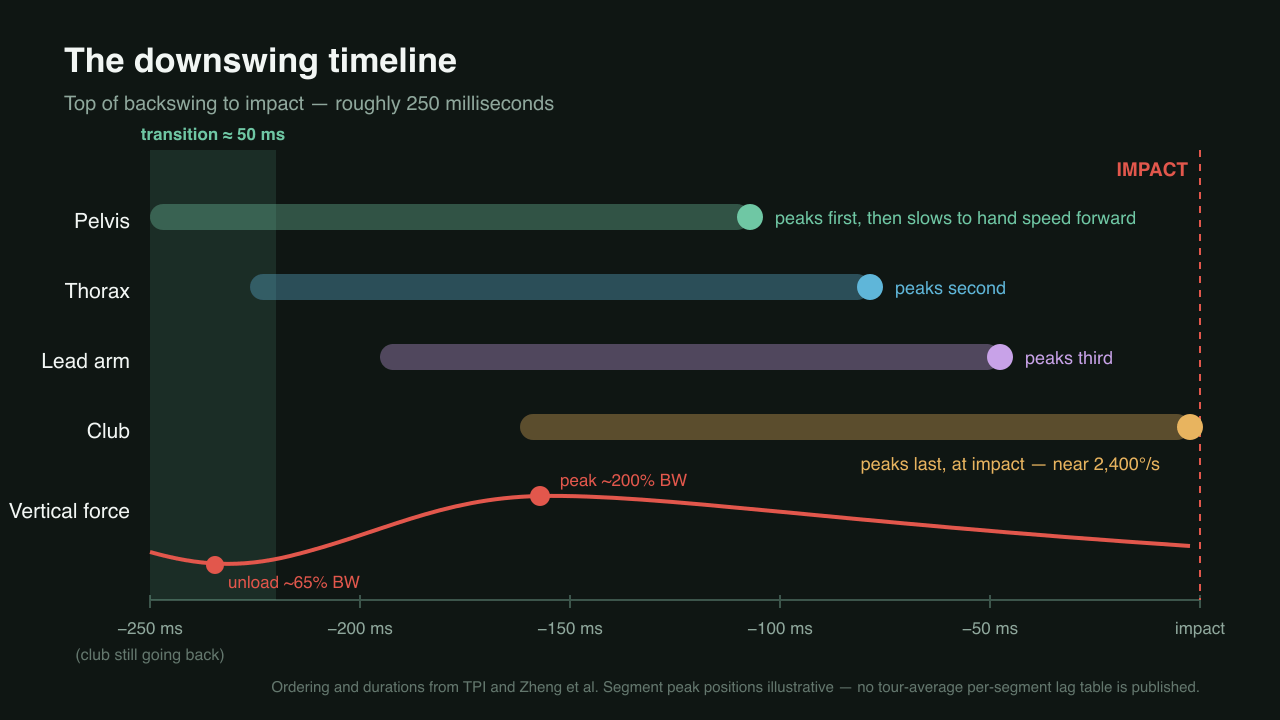
The ground is what makes it possible. TPI’s force-plate work, presented by Dr. Greg Rose and Corey Koller in their ground reaction force analysis, shows tour players unloading during the backswing — vertical force drops to around 65 percent of bodyweight in the biggest hitters — then reloading to a peak near 200 percent of bodyweight coming down. Rose describes the move as a squat and a jump: flex to stretch the legs, then push. That downward unload is why the reload has to be so forceful, and the resulting vertical impulse is what spins the pelvis.
Timing of that push matters as much as its size. TPI’s ground reaction force material treats the direction and timing of a golfer’s push against the ground as its own performance variable, sitting alongside raw magnitude. Two players can produce the same peak force and get very different clubhead speeds if one of them peaks at the wrong moment in the chain. This is the same pressure story covered in weight shift in the golf swing, viewed from the force side rather than the position side.
How long the downswing actually takes
Short. Much shorter than most golfers assume when they talk about “thinking about” a downswing move.
| Source | Population | Downswing duration | Backswing |
|---|---|---|---|
| TPI 3D tour database | Tour pros, driver | 233–296 ms | 0.847 s (SD 0.111) |
| Zheng et al. | Professionals | 0.30 ± 0.05 s | 0.88 ± 0.15 s |
| Systematic review, 2022 | Pooled | ~0.3 s | — |
| Meira review | PGA Tour | — | total swing 1.21 ± 0.14 s |
TPI reports a backswing-to-downswing ratio of about 3.2:1 across that tour database, which is the measured basis for the 3:1 tempo idea covered in golf tempo drills. Cheetham’s biomechanics slide deck adds a finer number: the transition itself, from pelvis change of direction to club change of direction, averages about 0.05 seconds for male tour players and 0.07 seconds for female tour players. Fifty to seventy milliseconds is the whole window in which the sequence is decided.
That has a blunt practical consequence. You cannot steer a 250-millisecond downswing consciously. Whatever pattern you have trained is the pattern that runs, which is why sequencing work belongs in structured practice and never in a mid-round swing thought.
What is actually measured, and what is just repeated
Here is the part almost no downswing article does, and it changes how you should read every other downswing article. Some of these numbers come from published studies with sample sizes and methods. Others get quoted constantly with no traceable source behind them. Chasing an unverified benchmark to two decimal places is a good way to waste six months.
| Claim you will see quoted | Evidence grade | The honest read |
|---|---|---|
| Pelvis → thorax → arm → club ordering | Strong | Consistent across TPI’s database, Nesbit’s 3D modeling, and the 2022 systematic review. |
| Tour downswing 0.23–0.30 s | Strong | Multiple independent sources agree; TPI 233–296 ms, Zheng 0.30 ± 0.05 s. |
| Faster peak pelvis rotation in better players | Strong | Callaway et al., 56 golfers, 503°/s vs 380°/s by handicap, p = 0.000, published with method and sample. |
| Vertical ground force ~65% BW unload, ~200% BW peak | Moderate | TPI force-plate data presented on video with named players, not a peer-reviewed paper with a sample. |
| “89% of pros turn the pelvis first; 60% have the full sequence” | Weak | Widely repeated and attributed to Cheetham’s TPI 3D database, but no publicly archived paper reports the sample or method. Directionally useful, not a benchmark. |
| Exact millisecond lag between each segment’s peak | Not published | No canonical per-segment lag table exists for tour players. Papers report peak times relative to impact and total first-to-last spans of roughly 130–190 ms; the tidy “20 ms per link” figure is inferred from graphs. |
| “Poor sequencing costs you X mph” | Not published | No study has isolated a clean mph cost for a specific sequence error. Any precise number is invented. |
Use the strong rows as targets. Use the weak rows as direction. Treat the bottom two as marketing whenever you see them stated with a number attached.
The three ways the sequence breaks
Sequence errors are one failure wearing different clothes: a link fires out of turn.
| Break | What you see | Where the chain broke | Fix |
|---|---|---|---|
| Upper body first | Steep, out-to-in path; pull and pull-slice | Thorax peaks before the pelvis | Over-the-top fix |
| Club first (casting) | Early release, added loft, weak contact | Club accelerates before the arms finish | Casting fix |
| Stall and flip | Body stops turning, hands take over through impact | Pelvis and thorax decelerate too early | Weight shift and rotation through |
There is a fourth pattern worth naming because it hides behind good intentions: the golfer who has been told to fire the hips and does so with no vertical push and no upper-body resistance. The pelvis spins, the separation collapses, the club gets stuck behind, and the hands rescue it late. The pelvis was first, technically, and the swing still fell apart. Order without force and resistance is choreography.
Postural faults feed all of this. Early extension pushes the pelvis toward the ball instead of rotating it, which caps how much the first link can contribute no matter how early it starts.
Drills that change sequencing, and why they work
The research-supported approach is to change sequencing with external cues — attention on the effect of the motion rather than on the body parts producing it — because the downswing is too fast for internal, joint-by-joint instruction to survive contact with a real swing.
- The inverted-club whoosh. Turn a driver upside down, grip it near the hosel, and swing for maximum noise. Mark Blackburn demonstrates this in his Titleist video on power and sequence: the goal is to make the whoosh happen late, near where the ball would be. An early whoosh is audible proof of casting. Removing the ball and the face-squaring instinct lets the body self-organize into the right order.
- The step drill. Start with feet together, swing the arms back, then step toward the target with the lead foot, plant, brace, and let the arms come through. The step forces a pressure shift and a pelvis-first start without anyone having to say “pelvis first.” Blackburn’s second recommendation in the same video.
- The pause-and-snap. Take the club back to hip height with some wrist hinge, pause completely, then create snap in the clubhead from there. Because the backswing is abbreviated, the only way to generate speed is to use the ground and sequence properly. Vary the speed between reps rather than repeating one tempo.
- The heavy-object toss. Pick up something awkward and heavy and throw it a few yards. Throwing weight forces you to push against the ground first and let the object trail behind that push. That is the downswing, and it is a far better teacher than any positional cue.
How you schedule these matters as much as which you pick. Sequencing is a coordination change, so it degrades under fatigue and reverts to the old pattern late in a session — do the work early, in short blocks, and vary the club between reps. The block versus random practice research explains why varying the shot beats grooving one over and over once the new pattern shows up at all.
Three myths about starting the downswing
“Pull the handle down.” Intended to create lag, and it usually creates the opposite problem. Pulling the handle is an arm-and-hand action, which promotes the third link to first. Lag comes from the clubhead’s inertial resistance to a grip that is already accelerating because the body moved it, so it appears on its own when the order is right.
“Fire the hips.” Correct in direction, dangerous as a standalone instruction. Cheetham’s X-factor stretch and TPI’s force data both describe a pelvis that leads while the chest resists and while vertical force builds. Spin the pelvis with neither and you lose the separation you spent the backswing building. The useful translation is push the ground, and let the pelvis turn because of it.
“Drop the club into the slot.” Shallowing is real, and it is an outcome. A pelvis that rotates and shifts while the torso holds its coil drops the shaft into a shallower plane without any manipulation. Golfers who chase the slot with their arms usually trade a slice for a push-hook. If your path needs work, ball flight laws tell you what to fix before you start moving the club by hand.
How to audit your own sequence with a phone
Slow motion and three frames will catch a gross sequence error without a 3D system anywhere in sight. A single down-the-line camera can resolve which segment moved first, so this protocol checks the order of the chain, which is the part that determines everything downstream.
- Film down the line at 120 fps. Phone at hip height, 10 to 15 feet behind you on the target line. Hit a real 7-iron at full speed. Three swings, not one.
- Find the transition frame. The last frame where the clubhead is still moving away from the target. Cheetham’s pelvis-to-club transition runs about 0.05 seconds for male tour players and 0.07 for female tour players, so at 120 fps the window is roughly six to eight frames wide.
- Check whether the belt buckle beat the club. On that frame, your belt line should already be turning toward the target while the club is still going back. If the club has fully changed direction before the pelvis moves, the chain is running backwards.
- Check the trail elbow at lead-arm-parallel. Trail elbow still bent and near the ribs, shaft trailing the hands. A straight trail arm with the clubhead ahead of the hands is casting.
- Count frames and compute your ratio. Takeaway to transition, divided by transition to impact. Tour is near 3:1 with a downswing of 0.23–0.30 seconds. If you come out well above 4:1, check which end is at fault: a slow backswing and a grab from the top need different work.
Fix the earliest broken link, drill only that for two weeks, then re-film from the same camera position. If the pelvis is late, the step drill is your work. If the pelvis leads and the club still casts, the whoosh drill is. Once the order is clean, the speed work in how to increase golf swing speed and the impact work in how to compress the golf ball both start paying off, because there is finally a chain to deliver them.
Key takeaways
- Order is pelvis, thorax, lead arm, club. Each peaks after the one before it and decelerates to hand speed forward (TPI).
- The downswing takes 0.23–0.30 seconds. TPI’s tour database says 233–296 ms; Zheng et al. measured 0.30 ± 0.05 s. Too short to steer consciously.
- Transition starts before the top. The pelvis turns while the club is still going back, and Cheetham puts that window at about 0.05 seconds for male tour players and 0.07 seconds for female tour players.
- The ground drives the first link. TPI’s force plates show an unload to roughly 65% of bodyweight, then a peak near 200%. Timing of that push matters as much as its size.
- Pelvis speed separates skill levels. 503°/s under a 5 handicap versus 380°/s at 18 and above, alongside significantly stronger glutes in the low group (Callaway et al.).
- Half the popular downswing numbers are unsourced. Per-segment millisecond lags and “sequencing costs you X mph” figures have no published basis. The ordering and the durations do.
- Change sequencing with external cues. Whoosh drills, step drills, and heavy-object tosses beat instructions to move a body part at a specific moment.
Frequently asked questions
What is the correct downswing sequence in golf?
The pelvis moves first, then the thorax, then the lead arm, then the club, each segment reaching peak rotational speed after the one before it and slowing down as it passes speed along. Titleist Performance Institute calls this the kinematic sequence, and it holds across wildly different-looking swings. The order matters more than the positions. When the pelvis leads and each segment decelerates on cue, the club gets a whip-like acceleration into impact without any single joint having to move especially fast.
What should start the downswing?
Pressure into the lead foot and rotation of the pelvis, both beginning while the club is still finishing its backswing. Force-plate work from Titleist Performance Institute shows powerful players unloading to roughly 65 percent of bodyweight during the backswing, then driving to a vertical peak near 200 percent as they change direction. The hands and arms should respond to that, not lead it. Deliberately pulling the handle down usually accelerates the club too early and collapses the sequence.
How long does the downswing take?
Between about 0.23 and 0.30 seconds for tour players. Titleist Performance Institute’s 3D tour database puts the driver downswing at 233 to 296 milliseconds against an average backswing of 0.847 seconds. Zheng and colleagues measured 0.30 plus or minus 0.05 seconds in professionals. That window is too short to steer consciously, which is why sequencing has to be trained as a pattern in practice rather than managed shot by shot on the course.
What is the 3:1 golf tempo ratio?
It is the ratio of backswing time to downswing time, and elite players cluster near it regardless of how fast they swing overall. Titleist Performance Institute reports a ratio of about 3.2 to 1 across its tour database, where the average backswing runs 0.847 seconds against a downswing of 233 to 296 milliseconds. Most amateurs measure slower than 3:1, usually from a lazy backswing paired with a rushed grab from the top rather than a genuinely smooth motion.
Why do I start my downswing with my upper body?
Because the ball is in front of you and the club feels like the thing that has to get there, so the fastest-responding muscles fire first. The shoulders and arms react quicker than the pelvis, and under pressure or fatigue they take over. The result is an out-to-in path, an early release, or both. Retraining it works better with external cues, like making a whoosh late in the swing, than with instructions to move a body part at a certain moment.
Does a good downswing sequence actually add clubhead speed?
It changes how much of your existing strength reaches the clubhead. Callaway and colleagues measured peak pelvis rotation of 503 degrees per second in golfers under a 5 handicap against 380 in golfers of 18 and above, alongside significantly stronger glutes in the low-handicap group. Sequencing acts as a multiplier on that physical capacity rather than a substitute for it. No study has published a clean number for how many miles per hour a specific sequence error costs, so treat any precise figure you see with suspicion.
Should I try to hold lag in the downswing?
Lag is a byproduct of the clubhead’s resistance to a rapidly accelerating grip, so a well-ordered downswing produces it on its own without any conscious holding. Trying to preserve the wrist angle usually stalls the body’s rotation, which then forces a late flip to square the face and costs both speed and strike quality. The productive version of the same goal is to get the pelvis and torso leading properly and let the club trail behind them. Chasing the look of lag directly tends to make contact worse.
Related reading
- How to Swing a Golf Club: The Sequence That Actually Repeats — the full-swing cornerstone this post drills into; start there if you want the whole motion rather than the downswing half.
- How to Grip a Golf Club — the setup fundamental behind face control, and the hub for this whole swing cluster.
- The Golf Backswing: Takeaway, Rotation, and Plane by the Numbers — the loading phase whose coil the downswing sequence spends.
- How to Fix an Over-the-Top Golf Swing and Casting in the Golf Swing — the two most common sequence breaks, each with a 4-week protocol.
- Weight Shift in the Golf Swing and Early Extension in Golf — the pressure and posture faults that stop the first link from doing its job.
- Golf Tempo Drills: The 3:1 Ratio — the timing layer that sits on top of the sequence, with drills that move the ratio.
- How to Increase Golf Swing Speed — where speed training pays off once the chain is ordered correctly.
- Golf practice drills, organized by skill area — the companion library, with setup steps and success criteria for the drills above.
- 30-minute golf practice plan — where to slot a short sequencing block into a real session.