
Golf Swing Tips: 7 Data-Backed Fixes You Can Actually Measure
Seven golf swing tips backed by measured data — GOLFTEC, TrackMan, and peer-reviewed research — each with a checkpoint you can verify on a phone camera.
Quick answer
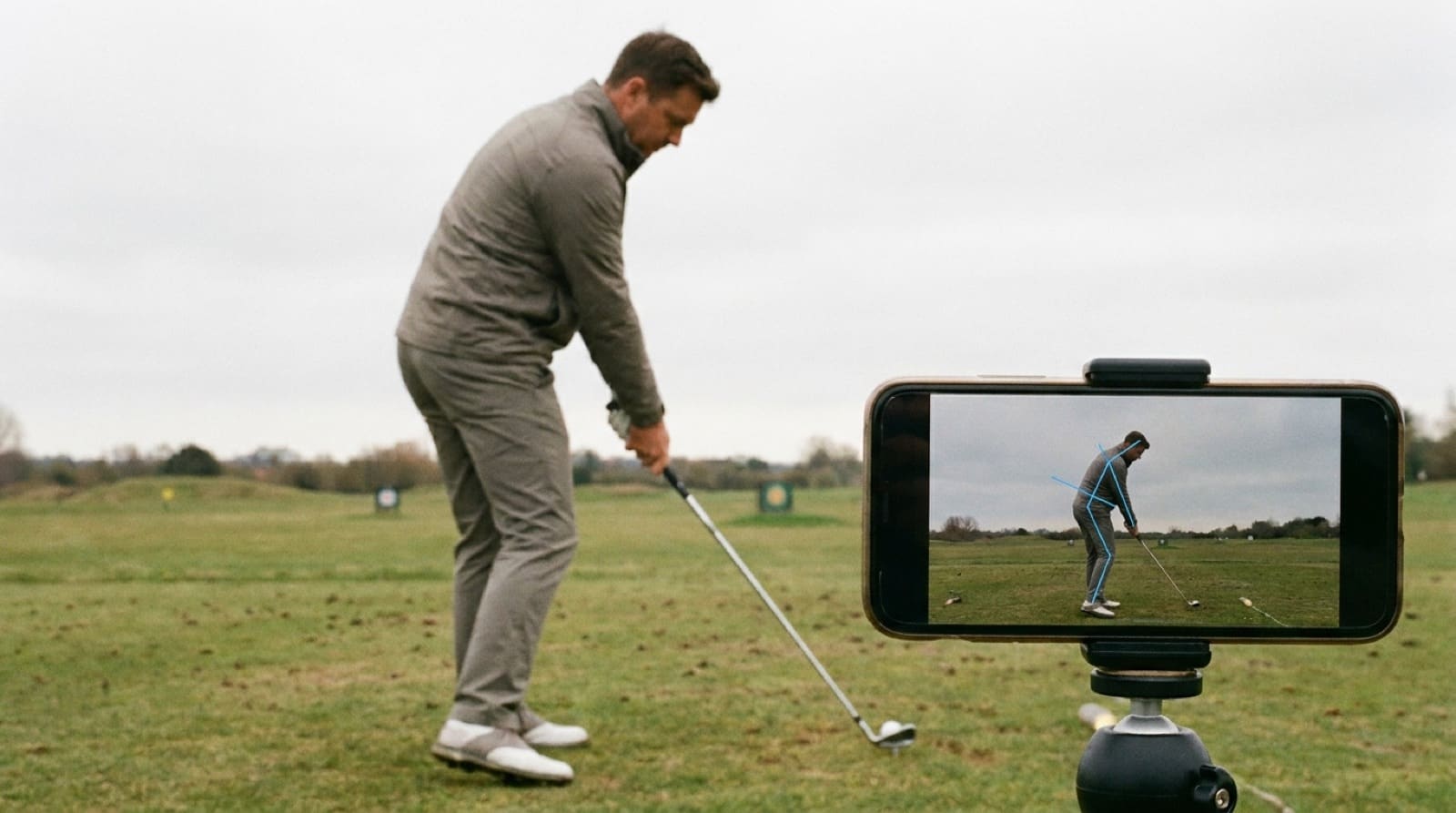
Most swing tips fail because nobody verifies them. The seven below are different in one way: each comes from measured data — GOLFTEC’s motion study of 13,000+ golfers, TrackMan tour and amateur averages, and peer-reviewed motion capture — and each has a checkpoint you can verify on a phone camera. In priority order: control the clubface, fix your setup, get to a better impact position, match attack angle to the club, swing at a 3:1 tempo, sequence from the ground up, and practice so the change sticks.
The seven at a glance
| Tip | The evidence behind it | Your checkpoint | |
|---|---|---|---|
| 1 | Control the clubface | Face sets ~75% (irons) to ~85% (driver) of start direction; grip measurably moves the face (Carson, 2019) | 7 of 10 shots start on your intended line |
| 2 | Fix the setup | Aim and ball-position faults set the start line before the club moves | Address stills match on ball position, stance, aim |
| 3 | Reach a better impact position | Pros at impact: hips 1.6 in toward target, 39° shoulder tilt; 30-handicaps ~16° less tilt (GOLFTEC) | Impact frame: hip toward target, trail shoulder lower |
| 4 | Match attack angle to the club | Tour 6-iron: −3.7°; bogey golfers’ driver: −2.1° (TrackMan) | Divot after the ball; tee survives the driver swing |
| 5 | Swing at 3:1 tempo | Published tour tempos 18/6 to 30/10 frames — all 3:1 (Tour Tempo) | Your frame count divides to 3:1, ±10% |
| 6 | Sequence from the ground up | Skilled players load the lead foot by lead-arm-parallel (n = 63) | Lead-heel pressure early in the downswing, full finish |
| 7 | Practice the change properly | Random practice beats blocked for retention (Shea & Morgan) | Checkpoint passes again two weeks later |
Why most swing-tip lists don’t survive the weekend
Walk onto any range and watch what happens. A player reads five tips, tries all five on the same bucket, feels something click on ball 40, and loses it by Saturday. What each attempt was missing is a checkpoint: a way to confirm the change happened, in a form a camera or a launch monitor can see.
Every tip below carries one. That structure comes from how measured coaching actually works — GOLFTEC’s SwingTRU Motion Study measured 48 distinct body motions across more than 13,000 golfers of all abilities precisely because feel-based checkpoints kept lying to players. The camera doesn’t.
One more rule before the list: work one tip at a time, in the order your miss dictates.
Which tip first? Let your miss decide
| Your dominant miss | Start with | Why |
|---|---|---|
| Slice or ball starts off-line | Tip 1 (face) | Start direction is a face problem before a path problem |
| Contact all over the face | Tip 2 (setup) | Strike variance usually traces to ball position and posture |
| Fat and thin shots, no compression | Tips 3–4 | Low point sits behind the ball; impact position fixes it |
| Good practice swings, bad real ones | Tip 5 (tempo) | Rushed transition wrecks an otherwise sound motion |
| Big effort, modest distance | Tip 6 (sequence) | Power leaks come from order, and order starts at the ground |
| Range hero, course zero | Tip 7 (practice) | The swing is fine; the practice structure isn’t |
1. Control the clubface before anything else
The clubface determines most of where the ball starts — roughly 75 percent of start direction with irons and about 85 percent with the driver (Golf Distillery’s ball-flight-law summary, citing TrackMan and high-speed-camera data, puts the driver split at about 85/15) — which makes face control the highest-leverage fix on this list. TrackMan’s face-to-path model settled this when launch monitors replaced the older “path starts the ball” idea: the ball launches close to where the face points at impact, and the face-to-path gap bends it from there. If your ball starts right of target, your face was open. No drill fixes a fault you haven’t identified, and start direction is the cleanest diagnostic in golf.
The face lever most amateurs should pull first is the grip. A 2019 motion-capture study by Carson and colleagues put professional golfers through weak, neutral, and strong grip conditions across 24 driver swings each and found statistically significant differences in clubface angle at impact — the weak grip delivered a measurably more open face. Grip is also free: changing it requires no speed, no flexibility, and about two weeks of discomfort.
How to apply it. Check your grip against the neutral checkpoints in the full grip guide: two knuckles visible on the lead hand, palms facing each other, club in the fingers. Slicers usually need one turn stronger. Then read your ball flight with the ball flight laws — start direction first, curve second. If the slice persists after the face is controlled, the 4-week slice protocol handles the path.
Checkpoint: 7 of 10 mid-irons start on or within one flag-width of your intended line. Count them; don’t estimate.
2. Fix the setup: it’s the only part of the swing you can do slowly
Setup faults are the cheapest strokes in golf because you fix them at zero miles per hour. Ball position, stance width, posture, and aim are all decided before the swing starts, and every one of them shows up in a still photo. A swing built on a drifting ball position produces contact variance that no amount of in-swing effort corrects.
Three setup checks cover most of the damage. First, ball position by club: stock wedges near center, driver off the lead heel, everything else spaced between. Second, stance and posture: hinge from the hips, arms hanging under the shoulders, weight balanced mid-foot. Third, alignment: the face aims at the start line, the body aims parallel left of it. Amateurs who aim the body at the flag have built a pull or a push into the shot before the takeaway.
How to apply it. Take one face-on and one down-the-line photo at address for each of your stock clubs. Compare against the three checks above. Then re-shoot monthly, because setup drifts — it is the most refit-able part of the swing and the most neglected.
Checkpoint: your address stills match the ball-position and alignment references for three consecutive filming sessions.
3. Get to impact like the measured better players do
Impact position separates handicap levels more cleanly than any backswing style, and GOLFTEC measured the separation. Across the SwingTRU dataset, professionals arrive at impact with their hips 1.6 inches toward the target and their shoulders tilted 39 degrees, trail shoulder down — and the lower the handicap, the closer a player measures to both numbers. The gap at the shoulders is large: GOLFTEC’s follow-up analysis found a typical 30-handicap arrives at impact with about 16 degrees less shoulder tilt than skilled players, trail shoulder too level, which feeds flip contact instead of compression.
The counterintuitive part hides in the backswing. SwingTRU measured pros at 3.9 inches of hip movement toward the target at the top of the backswing — the best players never drift away from the target going back, so the pelvis has a short, simple trip to its impact position. Get hips and shoulders to those positions and the low point moves ahead of the ball, which is where clean iron contact comes from.
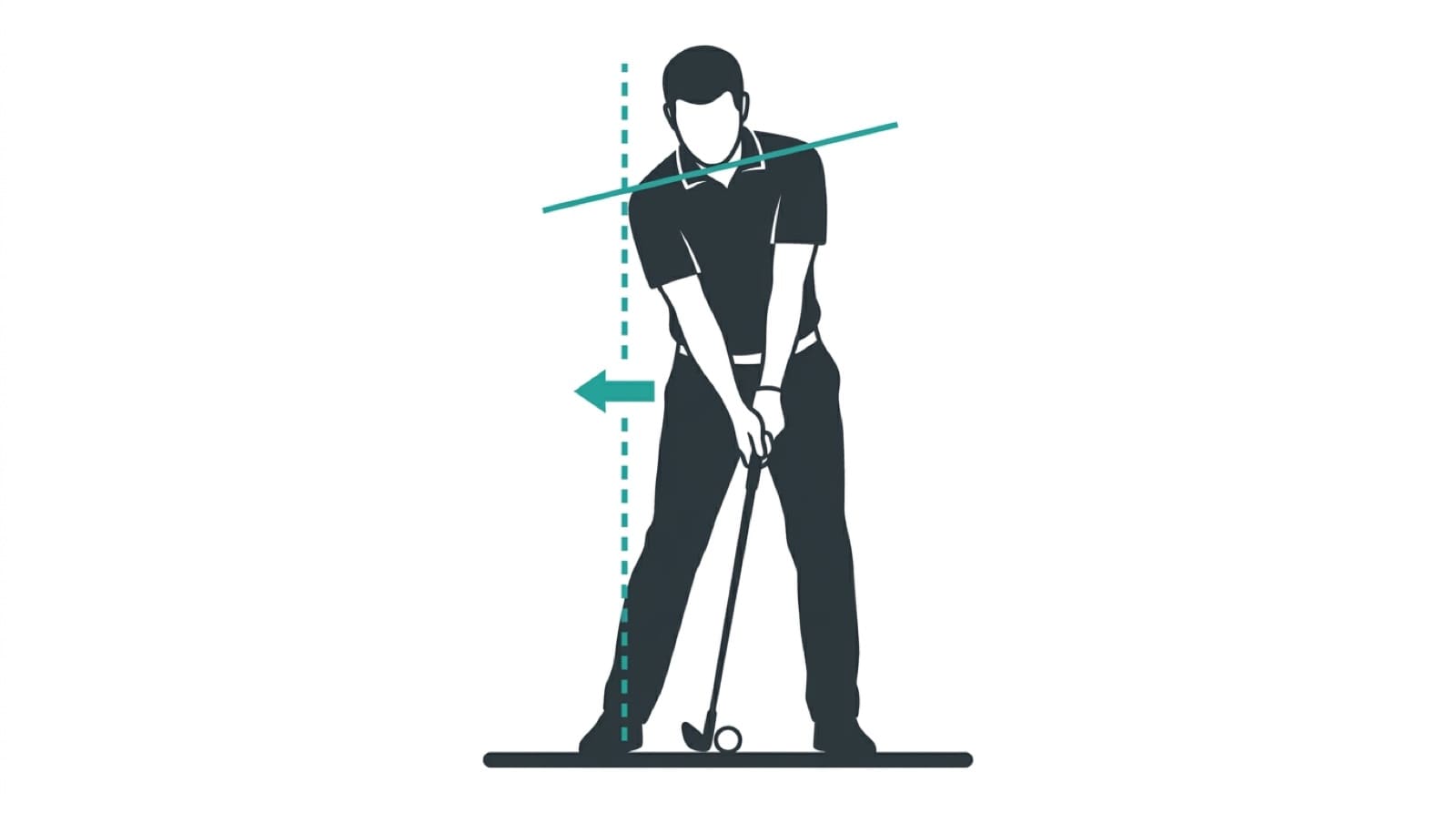
How to apply it. Work the pressure-shift ladder in the weight shift guide — trail side loads in the backswing, pressure moves lead before the arms come down. If your hips slide away from the target going back, run the corridor test in the sway fix first, because a swayed backswing rarely recovers to a toward-the-target impact.
Checkpoint: freeze your face-on impact frame. Lead hip visibly toward the target versus its address line, trail shoulder clearly below the lead shoulder. Two yeses, or this tip stays your project.
4. Hit down with your irons, up with your driver
Attack angle is the most misapplied number in amateur golf because the right answer flips between clubs. TrackMan’s published averages put the PGA Tour at −3.7 degrees with a 6-iron: the clubhead travels downward through the ball, and the divot starts on the target side. With the driver the same dataset runs the other way — the PGA Tour averages −0.9 degrees, the LPGA Tour +2.8, and the LPGA’s distance-per-mph efficiency is the model amateurs should copy, because an upward strike raises launch and lowers spin at any given speed.
Amateurs compress the wrong club. TrackMan’s amateur data shows the average golfer hits down on the driver at −1.8 degrees, and bogey golfers at −2.1 — surrendering carry to a fault that setup largely fixes.
How to apply it. For irons, ball slightly back of the low point with hands ahead: the compression guide covers shaft lean and the irons guide covers the descending strike, club by club. For the driver, ball off the lead heel, spine tilted slightly away from the target, tee height at half a ball above the crown — the full setup is in the driver guide. If fat contact keeps pulling your low point behind the ball, the fat-shot fix is the prerequisite.
Checkpoint: without a launch monitor, use the ground. Iron divots start at or after the ball, 8 of 10. Driver: the tee stays in the ground or leans forward, 8 of 10. With a launch monitor: negative attack angle on irons, zero-or-positive on the driver.
5. Swing at a 3:1 tempo, whatever your speed
Tour tempo is a ratio, and the ratio is 3:1. John Novosel’s frame-count research, published in Tour Tempo, measured broadcast swings at 30 frames per second; the published full-swing tempos run from 18/6 through 21/7, 24/8, and 27/9 to 30/10 — different absolute speeds, identical 3:1 proportion. The finding that matters for amateurs is the deviation pattern: recreational players commonly measure 4:1 or slower, almost always from a careful backswing followed by a rushed, sequence-breaking transition.
Tempo is also the tip most likely to rescue a swing that works in practice and dies over the ball. A consistent 3:1 count gives the transition a schedule, and a scheduled transition is much harder to rush under pressure.
How to apply it. Measure before you train: film face-on at 240 fps, count takeaway-to-top and top-to-impact in a frame-stepper like Kinovea, and divide. Then train with the counting and step-drill progressions in the tempo drills guide — the 8 drills there are ranked by which tempo fault they fix.
Checkpoint: your measured ratio lands between 2.7:1 and 3.3:1 on 7 of 10 filmed swings.
6. Sequence the downswing from the ground up
Skilled golfers fire in a measured, consistent order: pressure shifts into the lead foot, then the pelvis rotates, then the torso, then the arms, then the club. Biomechanists call it the kinematic sequence, and Cheetham, Rose, and Neal’s comparison of tour professionals and amateurs found the professional signature in the consistency of that pelvis-thorax-arm order — the amateurs’ peak timing was far more variable swing to swing. Pressure-plate research points the same direction: a PubMed-indexed study of 63 highly skilled golfers (all handicap 3 or better) documented them loading into the lead foot by the time the lead arm reaches parallel in the downswing.
When the order breaks, the fault has a name. Arms first from the top is casting; upper body first and steep is an over-the-top move; hips thrusting toward the ball instead of rotating is early extension. All three are sequence faults wearing different costumes.
How to apply it. The step-change drill: from the top, feel the lead heel press into the ground before your arms move. The full swing sequence guide builds the whole chain — ground up, one link at a time — and is the right next read if two or more faults above sound familiar.
Checkpoint: on down-the-line video, your hips are visibly open at impact while your shoulders are still closing, and you finish balanced on the lead side for a full three seconds. Falling out of the finish is a sequence tell, not a balance problem.
7. Practice the change so it survives the course
A verified swing change still dies without practice structure, and this is the most measured claim on the list. Shea and Morgan’s 1979 experiment — replicated for four decades since — found that blocked, repetitive practice produces better range performance but worse retention and transfer than random, varied practice. The range hero who can’t take it to the course is a textbook result, and the textbook is block vs random practice.
The working protocol for any tip on this list: two weeks of the relevant drill, mostly in random order (change clubs and targets between reps), with the checkpoint re-filmed at the end of each week. Arccos coaching content pushes the same honesty — coach Ryan Crysler’s 10-ball test to ten different targets exists because uniform-conditions practice flatters you, and the course doesn’t.
How to apply it. Pick drills from the tour-coach drill catalog, slot them into a weekly practice plan, and log the checkpoint result per session. PracticeCaddie bakes that structure into every plan — variability, success criteria, progression.
Checkpoint: the tip’s original checkpoint still passes two weeks after you stopped consciously working on it. That’s retention, and retention is the whole game.
When seven tips are six too many
The honest read of the data above: one verified change at a time. GOLFTEC’s model, TrackMan’s numbers, and the motor-learning literature all describe single-variable measurement, and your practice should too. Stack two changes and the camera can no longer tell you which one moved the ball.
Book a lesson instead of grinding when any of these three holds: your miss goes both ways with the same club (a face and path problem interacting), the checkpoint fails identically for four straight weeks, or contact is erratic enough that you can’t read start direction at all. A coach with a launch monitor compresses months of solo diagnosis into one session — the fault-fix posts in this cluster all carry the same hand-off rule, because self-diagnosis has a floor.
Key takeaways
- The face comes first. It sets roughly 75% of start direction with irons and about 85% with the driver, and grip is the measured, free lever that moves it (Carson et al., 2019).
- Setup is the only zero-mph fix. Ball position, posture, and alignment all show up in a still photo; audit them monthly.
- Impact has numbers. Professionals reach impact with hips 1.6 inches toward the target and 39° of shoulder tilt; 30-handicaps show ~16° less tilt. Both are visible on one frozen frame.
- Attack angle flips by club. Tour 6-iron: −3.7°. Amateur drivers: −1.8 to −2.1° down, when level-to-up wins distance. Read your divots and your tee.
- Tempo is a ratio, 3:1. Published tour tempos run 18/6 to 30/10 frames — count your own before training it.
- Sequence goes ground up. Pressure, pelvis, torso, arms, club. Casting, over-the-top, and early extension are all order faults.
- Random practice retains; blocked practice flatters. Verify each change on camera, then make it survive with varied reps and a two-week retention re-test.
Frequently asked questions
What is the most important golf swing tip?
Control the clubface first. The face determines roughly 75 percent of the ball’s starting direction with irons and about 85 percent with the driver, and a peer-reviewed motion-capture study (Carson et al., 2019) confirmed that grip changes produce statistically significant changes in face angle at impact. Grip and face control are also the cheapest fix on the list: no speed, flexibility, or strength required. Until the ball starts where you aim, path work, tempo work, and speed training are all built on sand.
How can I check my golf swing at home?
Use your phone’s slow-motion camera at 240 fps from two angles: face-on and down-the-line. Freeze the impact frame and check three things — lead hip shifted toward the target, trail shoulder lower than the lead shoulder, and hands ahead of the clubhead with an iron. Then count frames from takeaway to top and top to impact; the tour ratio is 3:1. A free frame-step tool like Kinovea, or your phone’s scrubber, is all the equipment this audit needs.
Should I hit down on the ball with my irons?
Yes. TrackMan’s data puts the PGA Tour average attack angle at −3.7 degrees with a 6-iron — the clubhead is traveling downward through impact, and the divot starts after the ball. The driver is the opposite case: bogey golfers average −2.1 degrees down on the driver, while distance-optimized launch conditions favor a level-to-upward strike, especially at amateur swing speeds. One swing thought covers both: ball back and hands ahead for irons, ball forward and spine tilted away for the driver.
What is the 3:1 golf swing tempo ratio?
Tour players take about three times as long on the backswing as the downswing, a pattern John Novosel documented by frame-counting broadcast footage in Tour Tempo. Published frame counts run from 18/6 through 24/8 to 30/10 at 30 fps — different absolute speeds, same 3:1 proportion. Most amateurs measure at 4:1 or slower, usually from a slow, careful takeaway followed by a rushed transition. The ratio matters more than the speed: fast or slow, elite swings keep the proportion.
Why don’t golf swing tips work for me?
Usually for one of three measurable reasons: you are changing three things at once, you never verified the change actually happened on camera, or you practiced it in a way that does not transfer. Motor-learning research (Shea and Morgan, 1979) shows blocked, repetitive practice inflates in-session performance while producing weaker retention on the course. Pick one tip, verify it on video, and groove it with varied, random-order practice. One verified change beats five felt ones.
How long does it take to see results from a golf swing change?
Plan on three to four weeks of structured practice for a single change to survive on-course pressure — that is the working timeline across the swing-fix protocols in this cluster (slice, sway, casting, early extension). The camera shows change within two weeks; scores lag behind because a new movement degrades under pressure before it stabilizes. Re-film every two weeks and judge progress by the checkpoint, not by one good range session.
Related reading
- How to Grip a Golf Club — the hub for this whole setup-and-face cluster; the neutral checkpoints tip 1 audits against, plus strong/weak variations by miss.
- Golf Ball Flight Laws — the diagnostic engine behind tips 1 and 4; read start direction and curve to know which fault you actually have.
- How to Swing a Golf Club: The Sequence That Actually Repeats — the full ground-up chain that tip 6 samples; setup through finish in one build order.
- Golf Tempo Drills: The 3:1 Ratio — the measurement protocol and eight drills behind tip 5.
- Weight Shift in the Golf Swing — the pressure-shift mechanics underneath tips 3 and 6, with a 4-week fix.
- Block vs Random Practice in Golf — the retention research tip 7 is built on, and how to structure a session around it.
- The weekly golf practice plan — where these checkpoints live between filming sessions: sample 30/60/90-minute structures.