Golf Ball Flight Laws: Why the Ball Starts and Curves Where It Does
The ball starts where the clubface points and curves on the gap between face and path. The modern golf ball flight laws, explained with the measured data.

Quick answer
A golf ball obeys two laws. It starts almost entirely where the clubface points at impact, roughly 75 to 85 percent face and the rest club path. It curves based on the face-to-path gap: a face open to the path peels the ball right, a face closed to the path turns it left. Read your start direction for the face and your curve for the path, and you can diagnose any miss with no launch monitor.
The modern ball flight laws at a glance
| What you want to know | What controls it | The number |
|---|---|---|
| Where the ball starts | Clubface angle at impact | ~75–85% face, 15–25% path |
| Which way it curves | Face-to-path (face angle minus club path) | Face open to path curves right; closed curves left |
| How much it curves | Spin-axis tilt | ±2° plays straight; ±10° is roughly 11–15 yards |
Why this rewrote how golfers read a miss
For most of the last century, teaching ran on a tidy rule: the swing path sent the ball and the face bent it. Swing out to the right and the ball starts right, then an open face adds slice spin to curve it back. The PGA’s original ball flight laws built path in as the primary direction factor and treated the face as a curve-only adjustment.
Radar launch monitors took that apart. Once TrackMan could measure face angle, club path, launch direction, and spin in the same swing, the data showed the ball starts almost exactly where the face points, with path a minor partner. Golf Distillery, citing TrackMan and high-speed-camera data, puts it at about 85 percent face and 15 percent path.
The practical payoff is a cleaner read. Your start direction is a face reading, and your curve is a face-versus-path reading. Every fault in the bag, slice, hook, push, and pull, gets easier to diagnose once you stop crediting the path for the start.
Law 1: the ball starts where the face points
The clubface owns your start line. Across realistic lofts and strikes, the ball launches roughly 75 to 85 percent in the direction the face points and only 15 to 25 percent toward the club path. That split shows up across TrackMan data, the engineering review at Tutelman.com (which lands the ratio between 80:20 and 70:30), and the teaching of Andrew Rice, who states flatly that the ball launches primarily in the direction of the face.
The split shifts with loft. Tutelman’s modeling runs from near 100 percent face influence at small face-to-path angles down to about 60:40 for short irons, where the face sits more vertical and the path gets a bigger vote. A driver, with 9 or 10 degrees of loft, locks the start line to the face even tighter than a wedge does.
Small errors add up downrange. TrackMan defines launch direction as the horizontal angle of the ball’s start relative to your target line, and the offline cost compounds with distance: a ball that starts just 2 degrees left sits about 3.5 yards left at 100 yards and 7 yards left at 200, before any curve. Start it 4 degrees off and you double that. One TrackMan coach keeps players inside a ±2-degree launch window for exactly this reason, because a face that wanders much past 2 degrees forces you to aim off the target to bring it back.
Law 2: the ball curves on the gap between face and path
Curve comes from one number: face-to-path, which TrackMan defines as face angle minus club path. When the face points right of the path, the gap is positive and the ball curves right, a fade or a slice depending on size. When the face points left of the path, the gap is negative and the ball curves left, a draw or a hook. The ball curves away from the path and toward the face.
Size matters as much as sign. On a TrackMan PGA Tour driver carrying 275 yards, 5 degrees of face-to-path bends the ball about 44 yards right, while a 6-iron at 2 degrees curves only about 8 yards. The same gap moves a driver far more than an iron, which is why a slice looks catastrophic with the big stick and merely annoying with a wedge. For elite drivers, TrackMan notes that a single degree of face-to-path is worth about 12 yards of curve at 300 yards, against a tour fairway only 30 to 32 yards wide.
Here is where the old model misled a generation of slicers. If your ball starts at the target and curves hard right, the face was square at impact, that is why it started straight, and the path was the culprit, swinging left, out to in, leaving the face open to that path. As Tutelman puts it: if the ball starts at the target, that is where the clubface was pointing, so to generate slice spin with a square face, the path must be out to in. Start direction tells you the face; the curve tells you the path against it.
Spin axis: the real reason a ball curves
A golf ball spins around a single axis. Tilt that axis and the ball curves, the same way a banked airplane wing turns the plane. TrackMan calls this the spin axis: the tilt of the ball’s rotational axis relative to the horizon, measured in degrees. A positive tilt curves the ball right, a negative tilt curves it left, and a level axis flies dead straight.
Sidespin is a holdover from the two-axis diagrams of the old laws. A real golf ball carries one spin around one tilted axis, and the tilt comes from the face-to-path gap. The lift force always acts perpendicular to that axis, so once the axis tilts, part of the lift points sideways and the ball drifts that way.
The tilt translates to yards predictably. On a 150-yard shot, TrackMan shows a 2-degree axis tilt curving the ball only about 2.2 yards, while 10 degrees bends it about 11 yards; at 200 yards, 10 degrees is worth roughly 15 yards. Anything inside about 2 degrees of tilt plays as straight, because you cannot see curve that small.
The D-plane: where start and curve actually come from
Both laws fall out of one piece of geometry called the D-plane. The idea traces to physicist Theodore Jorgensen’s The Physics of Golf and took its modern shape from launch-monitor work by TrackMan and instructors like Andrew Rice.
The Swing Engineer defines it cleanly. At impact there are two directions you can measure: where the clubhead is moving (the path) and where the face is pointing (the face normal). The plane that contains both of those lines is the D-plane. The ball launches inside that plane, between the two directions and closer to the face, and the spin axis sits perpendicular to the plane. Tilt the plane, and you tilt the spin axis with it.
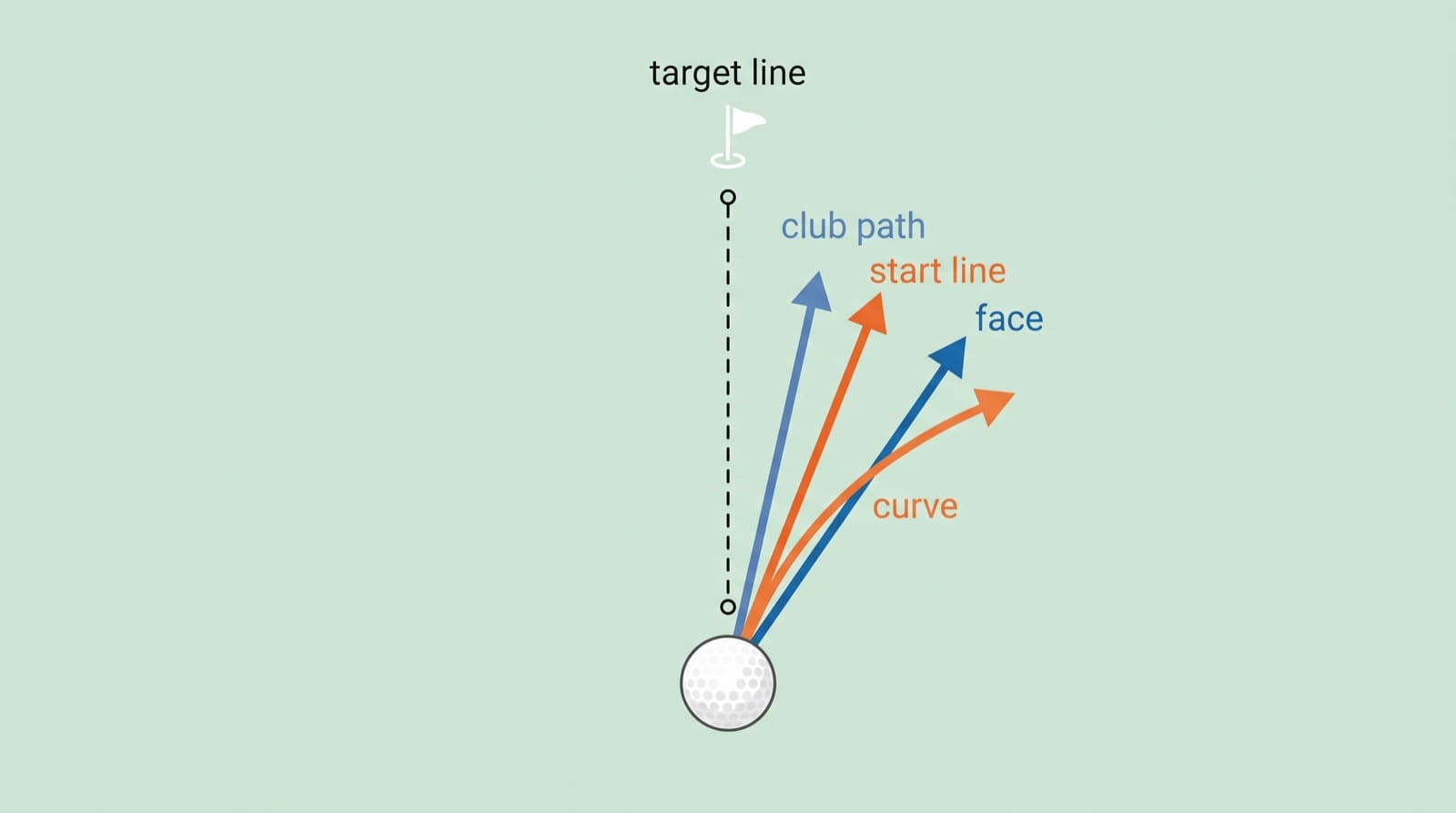
Attack angle tilts the plane too. Andrew Rice shows that with a neutral swing direction, hitting down on the ball pushes the club path right, in to out, while hitting up pulls it left, out to in. PGA Tour players average a little over 4 degrees down with a 7-iron, and the best drivers hit up by 1 to 5 degrees. That is the same reason ball position changes your numbers: the low point you set with ball position feeds straight into your path, and from there into the D-plane.
The nine ball flights, and what each one tells you
Put the two laws together and every shot you can hit falls into nine patterns: three start directions times three curves. For a right-handed golfer, the table below reverse-engineers each one back to what the face and path did. This is the whole point of the ball flight laws. You can stand behind your ball, watch where it starts and how it bends, and know what to fix without a launch monitor.
| Ball flight (right-handed) | Starts | Curves | Clubface vs. target | Face vs. path |
|---|---|---|---|---|
| Push-slice | Right | Right | Open (points right) | Open to path |
| Push | Right | Straight | Open (points right) | Square to path |
| Push-draw | Right | Back left | Open (points right) | Closed to path |
| Straight-fade | At target | Right | Square | Open to path |
| Straight | At target | Straight | Square | Square to path |
| Straight-draw | At target | Left | Square | Closed to path |
| Pull-slice | Left | Back right | Closed (points left) | Open to path |
| Pull | Left | Straight | Closed (points left) | Square to path |
| Pull-hook | Left | Left | Closed (points left) | Closed to path |
The pattern is mechanical once you see it, and it matches the analysis Tutelman lays out flight by flight. The start direction is your face: ball starts right, the face was open; starts left, it was closed; starts at the target, it was square. The curve is your face against the path: bends right, the face was open to the path; bends left, it was closed.
That single read powers most of the fault-fix work on this site. A slice is a face open to the path, usually paired with the out-to-in path you swung over the top. A pull-hook is a face closed to a leftward path. The shots you shape on purpose run on the same rule: a draw needs the face closed to the path, a fade needs it open. And because the face is the bigger lever, a neutral grip, the single biggest control over face angle, is almost always the first fix, ahead of any path rebuild.
Gear effect: when the strike overrides the rule
One thing breaks the clean face-and-path read: where on the face you hit it. Strike the ball off the toe or heel and the clubhead twists around its center of gravity, adding its own spin. This is gear effect, and on a driver it can flip the curve you would expect from face-to-path alone.
Andrew Rice sums up the direction of it: heel hits encourage fades or reduce hooks, and toe hits encourage draws or reduce slices. Many amateurs, he notes, swing for a draw yet strike off the heel and watch it fade anyway. Gear effect hits the driver hardest, because its deep face and rearward center of gravity give the head room to twist; an iron, with its center of gravity pushed close to the face, barely shows it. So if your ball curves the opposite way the face-and-path read predicts, check your strike location before you blame your swing.
How to read your own ball flight (no launch monitor)
You can run the whole diagnosis on any range with no technology, using your eyes and the two laws. This is the read PracticeCaddie’s plans are built to train, because fixing the right link in the chain beats grinding on the wrong one.
- Read the start direction first. Watch the first 10 to 15 yards, before any curve sets in. Right of target means an open face, left means closed, on-line means square. That is your face, full stop, because the face owns roughly 75 to 85 percent of the start.
- Read the curve second. Now watch the back half of the flight. Bending right means the face was open to your path; bending left means it was closed. The amount of bend tells you how big the gap is.
- Match it to the nine flights. Cross your start and your curve in the table above. A ball that starts right and curves further right is a push-slice: an open face with a path even further left of it. Now you know what both pieces did.
- Fix the face before the path. The face sets the start and most of the curve, so it is the higher-leverage fix. Start with grip and face awareness, and only rebuild the path once the face behaves.
- Confirm with a drill, then re-check the start line. Groove the change with feedback, not feel, and re-read your start direction next session to see whether the face actually moved.
Common mistakes reading ball flight
- Blaming the path for the start. A ball that starts well right means an open face. The path barely touches the start line, so reach for the grip and the face first.
- Chasing curve before start direction. Square the face to fix where the ball starts, and most of the slice usually leaves with it.
- Treating sidespin as something you add. There is one spin axis, and you tilt it by changing the face-to-path gap. Swiping across the ball just changes your path.
- Ignoring strike location. A toe or heel hit can reverse the curve through gear effect, especially on the driver. Read your strike before your swing.
- Diagnosing in wind or off a bad lie. Read your flight on calm shots off clean lies. Wind and slopes lie to you about face and path.
- Rerouting the swing to cure a face problem. Most slicers have a workable path and an open face, so a neutral grip moves the ball more than a path rebuild does.
Key takeaways
- The ball starts where the face points, roughly 75 to 85 percent face and 15 to 25 percent path (TrackMan, Tutelman).
- Curve comes from face-to-path, the face angle minus the club path. A face open to the path bends the ball right, a closed face bends it left (TrackMan).
- The ball curves away from the path and toward the face. A square face that still slices means an out-to-in path.
- One tilted spin axis makes the ball curve. About 2 degrees of tilt plays straight, and 10 degrees is worth 11 to 15 yards (TrackMan).
- The same face-to-path curves a driver far more than an iron: 5 degrees bends a tour driver about 44 yards and a 6-iron about 20 (TrackMan).
- Read start direction for the face and curve for the path, and you can diagnose any miss without a launch monitor.
- Fix the face first. It owns the start and most of the curve, which makes a neutral grip the highest-leverage change for most golfers.
Frequently asked questions
What are the golf ball flight laws?
The modern golf ball flight laws describe what sends the ball and what bends it. The clubface controls start direction: the ball launches roughly 75 to 85 percent in the direction the face points at impact. The face-to-path relationship, the gap between face angle and club path, controls curve: a face open to the path curves the ball right for a right-hander, a closed face curves it left. Launch monitors like TrackMan confirmed these, replacing the older idea that swing path set the starting direction.
What determines the starting direction of a golf shot?
The clubface determines start direction. TrackMan and golf-physics analysis show the ball starts roughly 75 to 85 percent toward where the face points and only 15 to 25 percent toward the club path. The face’s share is even higher for low-lofted clubs like the driver and a bit lower for short irons, where the face sits more vertical. So a ball that starts well right of your target points to an open clubface at impact, since the path barely affects the start line.
What makes a golf ball slice or hook?
Curve comes from the face-to-path gap. A slice happens when the clubface is open to the swing path, which tilts the spin axis to the right and bends the ball that way for a right-hander. A hook is the opposite: a face closed to the path tilts the axis left. The ball always curves away from the path and toward the face. The size of the gap sets the size of the curve, and the driver shows it most because of its low loft and high speed.
What is the D-plane in golf?
The D-plane is the geometry behind ball flight. At impact, two directions can be measured: where the clubhead is moving (the club path) and where the face is pointing (the face normal). The plane that contains both lines is the D-plane. The ball launches inside that plane, between the two directions and closer to the face, and the spin axis sits perpendicular to it. The concept traces to physicist Theodore Jorgensen and was popularized by TrackMan and instructor Andrew Rice.
Is sidespin real?
Sidespin is a misnomer. A golf ball spins around a single axis, and what older teaching called sidespin is really that one axis tilted off horizontal. TrackMan measures the tilt as spin axis. When the axis tilts, the lift force points partly sideways and the ball curves toward the low side. You change the tilt by changing the face-to-path gap at impact. Thinking in one tilted axis, instead of separate backspin and sidespin, matches the physics and makes curve easier to predict.
What is spin axis in golf?
Spin axis is the tilt of a golf ball’s rotational axis relative to the horizon, measured in degrees by launch monitors like TrackMan. A positive value means the ball curves right, negative means left, and zero means dead straight. The face-to-path gap creates the tilt. The numbers are intuitive: on a 150-yard shot, 2 degrees of tilt curves the ball about 2.2 yards, while 10 degrees bends it about 11 yards. Anything within roughly 2 degrees plays as a straight shot.
How do I diagnose my ball flight without a launch monitor?
Use the two laws and your eyes. First read the start direction in the first 10 to 15 yards: right means an open face, left means closed, straight means square. That is your clubface. Then read the curve: bending right means the face was open to your path, bending left means closed. Match the start-and-curve combination to the nine ball flights to see what both the face and path did. Then fix the face first, since it controls the start and most of the curve.
Related reading
- How to Grip a Golf Club — the face is your biggest control over start direction, and the grip is your biggest control over the face; start here.
- How to Fix a Slice in Golf — a slice is a face open to the path; this is the 4-week, face-then-path protocol.
- How to Fix an Over-the-Top Golf Swing — the out-to-in path half of the slice, rerouted with a path-first plan.
- How to Hit a Draw and How to Hit a Fade — shaping shots on purpose by setting the face-to-path gap.
- Golf Ball Position by Club — ball position sets your low point, which sets your attack angle and feeds your path.
- Golf Stance and Posture — the setup platform that lets you deliver a repeatable path and face.
- Golf practice drills, organized by skill area — the companion drill library, with setup steps and success criteria.
- 30-minute golf practice plan — where to slot face-and-path work into a short session.