
How to Stop Swaying in the Golf Swing: Causes, Drills, and a Fix
A sway is your hips sliding away from the target in the backswing, so you drift off the ball and hit it fat, thin, and short. What causes it, and how to stop.
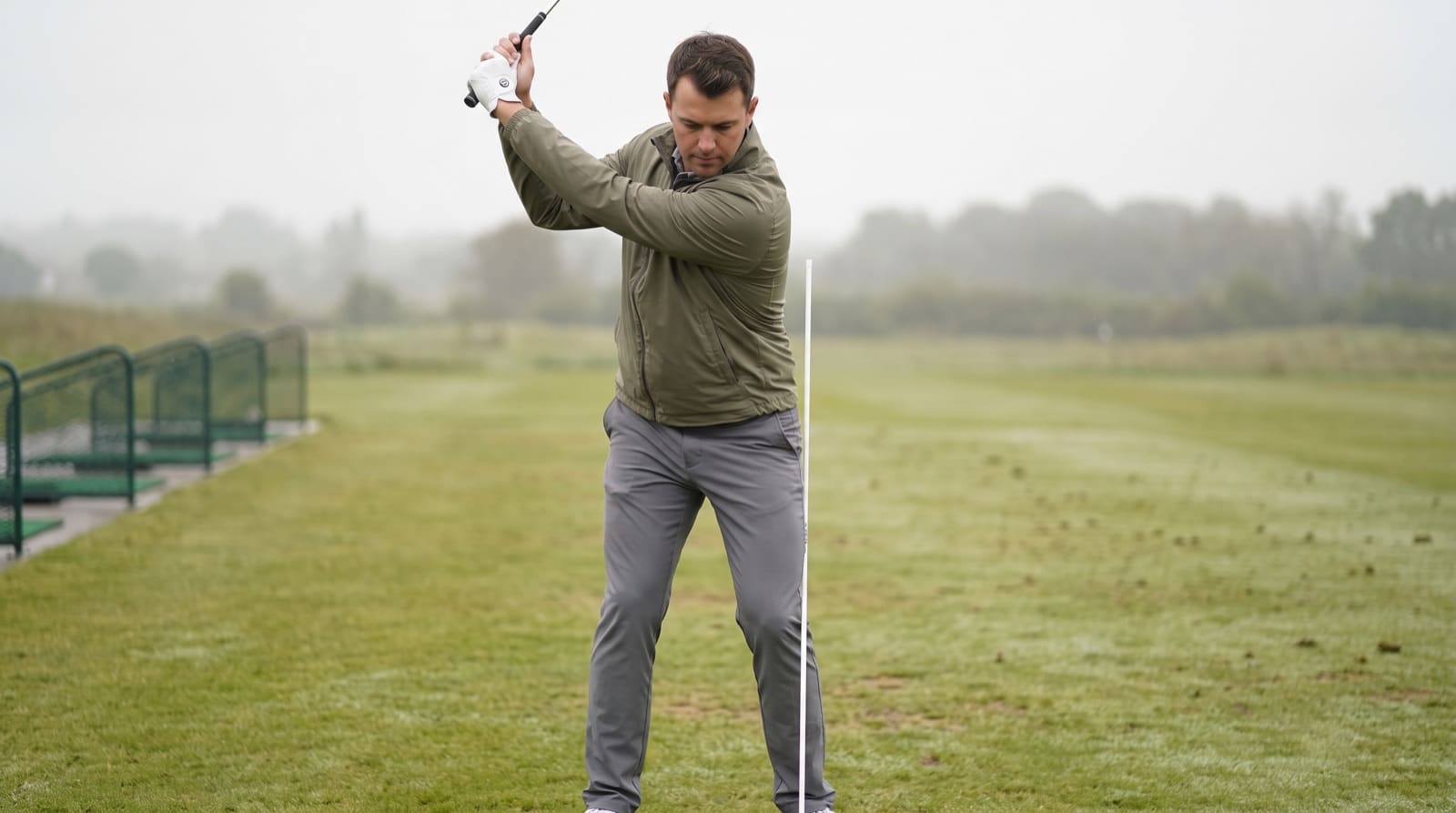
Quick answer
A sway is your lower body sliding sideways, away from the target, during the backswing. A sound pivot turns around a braced trail leg; a sway drifts off that base. You end up off the ball, the low point moves, and you hit it fat, thin, and short. Fix it in order: set a stable base, load a braced trail leg, then retrain the move under varied practice. Give it three to four weeks before you judge it.
Sway diagnostic: find your pattern, then your fix
| Your pattern at the top | What you see on video | Root cause | Highest-leverage first fix |
|---|---|---|---|
| The trail-hip slide | Trail hip pushes past the outside of the trail foot; knee rolls outside the foot | “Load onto your back foot” read as a lateral push | Token under the outer trail foot + feet-together |
| The whole-body drift | Head, chest, and hips all move off the ball together, away from target | “Make a big turn” chased as a sideways slide | Trail-hip corridor line + turn-in-a-barrel feel |
| The mobility-locked sway | Hips slide because they can’t turn; often a big left-to-right difference | Limited hip internal rotation | Hip screen first, then setup |
| The sway-and-slide | Sways back, then lunges toward the target coming down; fat then thin | Recovering from a poor backswing position | Press-and-screw + lead-hip-back drill |
Why a sway costs you clean contact and distance
A sway breaks the one job a backswing has: to load energy over a stable base so you can deliver it. A sound pivot turns your pelvis around a braced trail leg and shifts pressure into the inside of that foot, then drives into the lead side coming down, so the club bottoms out in front of the ball. Slide the pelvis sideways instead and you move the center of the whole swing arc off the ball.
The strike side is pure geometry. When your body drifts away from the target and can’t re-center in time, your weight hangs back and the low point of your arc falls behind the ball. Golf Distillery’s breakdown makes the mechanism plain: with weight stuck on the back foot at impact, the bottom of the arc sits behind the ball, which produces thin shots and a weak flight. Iron contact needs the club still descending at the ball, and TrackMan’s tour averages put a PGA Tour 6-iron at a 3.7-degree downward attack angle, a strike that only happens when the weight has moved forward. Hang back and that descending blow turns into a fat shot when the club digs first, or a thin one when you save it and catch the ball’s equator.
The power side suffers just as much. Efficient players build speed by loading pressure into a braced trail leg and then unwinding in sequence into the lead side. A golfer whose hips have slid to the outside of the trail foot has no stable post to push against, so the arms take over and the ball comes off weak. Titleist Performance Institute puts it bluntly: a lack of internal hip rotation is one of the first things that kills speed, and it feeds the sway-and-slide fault directly.
There’s a body cost too. The reverse spine tilt that often rides along with a sway, where the upper body leans toward the target while the hips slide away from it, loads the lower back in a bent, rotated position. TPI calls reverse spine angle “the number one cause of lower back pain in golf.” Fixing the sway protects your back as much as your scorecard.
What a sway actually is
Strip the jargon and a sway is a translation problem. Titleist Performance Institute defines it as “any excessive lower body lateral movement away from the target during your backswing.” Address should start with your weight roughly centered, load into a braced trail side as you turn, then finish almost entirely on the lead leg. A sway swaps the turn for a sideways drift, so the load never stabilizes.
The cleanest way to hold the correct picture comes from an old Jackie Burke maxim, relayed in Caledonia Golf’s sway breakdown: “you don’t shift your weight in the golf swing, you turn your weight in the golf swing.” Pressure moves into the trail side as a result of rotation, not because you shoved your hips at the rough. When golfers read weight shift as a lateral move, the pelvis slides and the trail knee rolls past the outside of the foot.
Good players keep the move small. Athletic Motion Golf’s 3D motion-capture work measures elite pelvis motion at only about an inch and a half of lateral shift into the trail side, spiking pressure early while rotation does the rest. The pelvis loads without drifting off the ball. That’s the target the drills below rebuild.
Sway versus slide versus reverse pivot
Three faults get lumped together, so it helps to separate them. A sway is lateral motion away from the target in the backswing. A slide is the mirror image: TPI defines it as excessive lower-body lateral movement toward the target in the downswing, where the lead hip drives past the ball instead of rotating. A reverse pivot is a weight-flow error, weight onto the lead foot going back and onto the trail foot coming down. Many golfers who sway then slide to recover, which is why the two-way miss shows up as a fat shot one swing and a thin one the next.
What actually causes a sway
Most sways are a good instruction taken one step too far. “Load your weight onto your back foot” and “get behind the ball” were meant to stop you spinning out or coming over the top. Read literally, they turn into a sideways push: the whole pelvis and torso drift away from the target, and the trail knee slides past the outside of the foot. “Make a big turn” backfires the same way when a golfer chases extra range by swaying farther instead of rotating deeper.
The second cause is physical, and it’s the one most range work ignores. TPI reports that the average PGA Tour player has over 45 degrees of internal hip rotation on both sides, and that “if you suffer from a sway or slide in your golf swing and lack the power you really want, the first thing you need to check is your internal hip rotation.” When a hip cannot turn far enough, the body finds the motion wherever it can, and sliding sideways is the easy cheat. Drilling the swing without opening the hip just welds the compensation deeper, the same screen-first logic behind the early-extension protocol.
Setup feeds it too. Starting with an open stance or your weight already leaning back leaves the trail side in its own way, so the body slides sideways to find room to turn. Square the base and add a small trail-ward spine tilt at address, and the pivot has somewhere to go without a slide.
How to check your own swing: the trail-hip corridor test
You can diagnose a sway with a phone and one drawn line, no launch monitor required. PracticeCaddie’s corridor test isolates the fault in about 60 seconds. Film face-on, in landscape, from roughly hip height, and make one normal swing with a mid-iron. Then scrub to the top of the backswing and freeze.
Draw a vertical line straight up from the outside of your trail hip at address. That line is your corridor wall. In a centered load, your trail hip stays inside it or barely touches it at the top, and your trail knee stays stacked over the inside of your foot. If the hip has slid past the line by more than a couple of inches, or the knee has rolled to the outside of the foot, you have swayed. The pelvis translated when it should have turned.
Add a pressure check to confirm it. Set a range token or a tee peg under the outer edge of your trail shoe and make your backswing. If you feel it dig in at the top, your weight has rolled to the outside of the foot, the signature of a sway. Save both the clip and the result. That’s your Week 0 baseline, and re-shooting the same frame in four weeks is the honest way to know the fix took.
The drills that stop a sway
The fastest fixes use a physical constraint so your body finds the centered load on its own. Run them in order, check your work on video, and treat the rep counts as targets to hold yourself to. Frame every cue as an external one, aim for the token, the stick, the balanced finish, because Wulf, Lauterbach and Toole (1999) found an external focus produced better golf-shot accuracy and retention than focusing on your own body parts.
1. The feet-together drill (the core constraint)
Stand with your feet almost touching, make slow three-quarter swings, and try to finish in balance. A sway makes you fall off the ball, so the narrow base forces you to turn around a stable center. Start with no ball, then hit soft half-shots with a 9-iron, aiming for 8 of 10 that finish balanced. It’s the highest-leverage drill for a sway because it removes the lateral slide that feeds the fault, then you widen back to your normal stance carrying the same feel.
2. The trail-hip corridor drill (feedback at the wall)
Set an alignment stick in the ground, or a chair, just outside your trail hip. Make backswings and try to rotate your pelvis without letting the hip press out into the stick. A sway bumps the stick immediately; a rotation loads without touching it. This turns the corridor test into a live feedback loop, so you feel the difference between turning and sliding rather than guessing at it. Keep the trail knee stacked over the inside of the foot as you load.
3. The braced trail-leg load (feel the ground)
Put a range token or a tee peg under the outer edge of your trail shoe and hit shots keeping pressure on the inside of the foot, so the token stays quiet. Feel your trail glute load like the start of a deadlift while the knee stays over the instep. This builds the stable post you rotate around. Keep the cue external and aimed at the ground, like “press the inside of the trail foot down,” so the load holds up better under speed.
4. Press-and-screw the trail foot (rotate, don’t push)
As you take the club back, press your trail foot into the ground and feel it screw slightly inward, as if turning the toes toward your midline. That torque loads the trail side through rotation instead of a sideways shove, so pressure builds without the pelvis drifting off the ball. Coming down, feel the pressure move into the lead foot as you unwind. This is where sway work overlaps with the broader weight-shift sequence every solid ball-striker runs.
5. Turn in a barrel (rotate the upper body over a stable base)
Cross your arms over your chest in golf posture and turn your upper body over a quiet lower body, keeping a small trail-ward spine tilt so your head stays behind the ball. Imagine your hips turning inside a barrel that stops them sliding sideways. This teaches the torso to coil over the trail leg while the pelvis rotates in place, the exact opposite of dragging your whole body off the ball.
The four-week plan that makes it stick
A drill that works on the range means nothing if the sway returns on the first tee. Sequence the work so the centered pivot survives contact with a scorecard.
- Week 0: measure and diagnose. Run the corridor test, save the clip, and check your hip rotation for a mobility limit.
- Week 1: set the base and turn without a ball. Square the stance, add the setup tilt, and run feet-together swings with no ball, 30 reps a day.
- Week 2: add the club and brace the trail leg. Half-swing 9-irons with the token under the outer foot; goal is 8 of 10 with the knee over the instep.
- Week 3: sequence the ground and randomize. Add press-and-screw, then hit an 18-shot list rotating club and target so no two shots match.
- Week 4: pressure-test and play. Three cold shots to a 30-yard window, then nine holes logging every fat, thin, or short miss.
The randomized block in week three is doing the heavy lifting. Shea and Morgan’s contextual-interference research showed that blocked practice, the same club to the same target, produces faster gains on the range but worse retention, while random practice transfers better to new situations. Forty balls with a 7-iron can look cured under the lights and revert the moment you switch clubs on the course. Mixing club and target from week three onward is what carries the fix outside. For the full logic, see block versus random practice.
Don’t trade a sway for a slide
Here’s the honest read most sway advice skips: chase the fix too hard and you swap one lateral fault for another. Golfers told to “stop moving off the ball” often freeze the lower body, then jam the hips toward the target coming down to make up for the lost load, which is a slide. AMG’s 3D data shows the pelvis moving only about an inch and a half into the trail side in elite swings, so the target is a small, braced load with the hip still turning inside it. Aim for a loaded trail leg with the hip turning inside it, and favor rotation whenever you’re unsure. A sway that over-corrects into a slide will still drag the low point around and can steepen your path into an over-the-top move.
When to stop self-coaching and get screened
Self-coaching handles most sways. Two situations are worth a session with a TPI-certified coach or a sports physiotherapist.
- A turn you physically cannot make. When you can’t load the trail side no matter how many feet-together reps you run, limited hip internal rotation may be the real bottleneck. TPI’s guidance is to check internal rotation first, and a seated screen isolates a locked hip in one visit. The fix is usually a targeted mobility drill, not another swing thought.
- Back pain that shows up with the fault. A sway plus reverse spine tilt loads the lumbar spine in a bent, rotated position. If your pattern comes with soreness, get assessed before you drill under speed.
A single screen or launch-monitor lesson is a small one-time cost, and it earns its keep when the missing piece is the diagnosis rather than the drill.
Common mistakes
- Fixing the top without fixing the base. If you set up open with your weight leaning back, the sway is baked in before the club moves. Square the stance and add the setup tilt first.
- Grinding technique while a mobility limit is locked. If a hip can’t turn, the body keeps sliding to find the range. Screen and open the hip before adding reps.
- Chasing “no movement.” Freezing the lower body trades the sway for a slide or a stalled, arms-only swing. Load small and braced, and let the hip turn inside it.
- Filming face-on only once. The fault hides from feel and returns quietly. Re-shoot the same frame every couple of weeks against your baseline.
- A month of block practice. Same club, same target, and the pivot looks fixed on the range and reverts on the first tee. Week three has to go random.
Key takeaways
- A sway is your lower body sliding away from the target in the backswing, defined by TPI as excessive lateral movement, so you drift off the ball and the low point falls behind it.
- It feeds fat, thin, and weak shots because the club bottoms out behind the ball and you lose the braced trail-side post that delivers speed.
- Diagnose it face-on in 60 seconds with the trail-hip corridor line and a token under the outer trail foot, then save the clip as your baseline.
- The feet-together drill is the highest-leverage fix because a sway costs you balance; aim for 8 of 10 swings that finish balanced.
- Keep the trail-side load small and braced. AMG’s data shows about an inch and a half of pelvis shift in elite players, so over-correcting into a locked lower body just becomes a slide.
- Check your hips before you blame your swing. TPI ties the sway-and-slide fault to limited internal hip rotation, so a mobility limit may be the real driver.
- Transfer beats reps. Random, mixed-club practice from week three carries the fix to the course; use three to four weeks as your first review window and eight to twelve to make it automatic.
Frequently asked questions
What is a sway in the golf swing?
A sway is excessive lateral movement of your lower body away from the target during the backswing, the way Titleist Performance Institute defines it. Your hips and pelvis slide sideways, off the ball, and you lose the braced trail leg that a good backswing loads. That moves the center of your swing arc, so the low point falls in the wrong place and your strike gets unpredictable. A sway is why many amateurs load onto the outside of the trail foot and then hang back or lunge coming down.
What causes swaying in the golf swing?
Usually a good cue taken too literally. ‘Load your weight,’ ‘get behind the ball,’ and ‘make a big turn’ all get read as a sideways push, so the pelvis slides off the ball during the backswing. The second driver is physical: TPI ties the sway-and-slide fault directly to limited internal hip rotation, and the average tour player has over 45 degrees of it in each hip. When your hips cannot turn, your body slides to find the range of motion.
How do I know if I’m swaying?
Film your swing face-on and pause at the top. Draw a vertical line up the outside of your trail hip at address, then check the top-of-backswing frame. In a centered load, your trail hip stays inside that line and your trail knee stays stacked over the inside of your foot. If the hip has slid past the line by more than a couple of inches, or the knee has rolled outside the foot, you have swayed. A token under the outer edge of your trail shoe confirms it: feel it dig in and your weight has drifted outside.
What is the best drill to stop swaying?
The feet-together drill, because a sway makes you lose balance and fall off the ball, so your body has to turn around a stable center to stay upright. Stand with your feet almost touching, make slow three-quarter swings, and try to finish balanced. Start with no ball, then hit soft half-shots with a 9-iron, aiming for 8 of 10 that finish in balance. Then widen to your normal stance and keep the same centered feel. It removes the lateral slide that feeds the fault.
Is swaying the same as a slide?
They are mirror images at opposite ends of the swing. TPI defines a sway as excessive lower-body lateral movement away from the target in the backswing, and a slide as the same excessive lateral movement toward the target in the downswing. A sway breaks your load going back; a slide leaks your rotation and speed coming down. Many golfers who sway then over-correct with a slide to recover, which is why the miss can be a fat shot one swing and a thin shot the next.
How long does it take to stop swaying?
Give it three to four weeks of structured work, two or three sessions a week, as your first review window. Because a sway is usually propped up by a setup habit and sometimes a mobility limit, treat eight to twelve weeks as the horizon for making the centered pivot automatic. Block practice hides progress: 40 balls with the same club can look cured on the range and fall apart on the first tee. The randomized, mixed-club practice from week three onward is what carries the fix onto the course.
Related reading
- Weight Shift in the Golf Swing — the trail-to-lead pressure move a sway distorts; the positive pattern every drill here rebuilds.
- How to Grip a Golf Club — the setup cornerstone for the whole swing cluster; a neutral grip keeps the hands out of the rescue moves a sway forces.
- Reverse Pivot in Golf — the weight-flow fault that often travels with a sway; same feet-together fix, different root.
- Early Extension in Golf — the other posture-and-mobility fault; the same screen-first logic decides whether the hip or the technique leads.
- How to Fix an Over-the-Top Golf Swing — the path fault a sway-and-slide recovery often steepens into.
- How to Stop Topping the Golf Ball — the thin-and-top misses a behind-the-ball low point produces.
- How to Increase Golf Swing Speed — where the braced trail-side load you rebuild here turns into distance.
- Block vs Random Practice in Golf — why the week-three random phase is what transfers the fix to the course.
- Golf practice drills, organized by skill area — the companion drill library with setup steps and success criteria.
- 30-minute golf practice plan — where the feet-together, token, and press-and-screw drills fit into a tight session.