
How to Compress the Golf Ball: Shaft Lean, Low Point, and the Impact Numbers That Matter
Compressing the golf ball is efficient impact, not effort: forward shaft lean, a low point ahead of the ball, and low spin loft. The numbers and drills.

Quick answer
Compressing the golf ball is efficient impact, not extra effort. With an iron, three conditions produce it: forward shaft lean (hands ahead of the clubhead), a low point ahead of the ball, and low spin loft so more of your energy becomes ball speed instead of spin. On a launch monitor it reads as a higher smash factor — around 1.38 for a tour 6-iron. At a given swing speed, how cleanly you deliver the club decides how much of it becomes ball speed.
Tour vs amateur — the impact numbers
| Metric | Club | PGA Tour | Typical amateur |
|---|---|---|---|
| Smash factor | Driver | 1.48–1.50 | commonly 1.42–1.45 |
| Smash factor | 6-iron | ~1.38 | ~1.28–1.34 |
| Attack angle | 6-iron | −3.7° | neutral to positive |
| Attack angle | Driver | −0.9° | −1.8° to −2.1° (hitting down) |
| Dynamic loft | 6-iron | 20.2° | several degrees higher |
| Spin loft | Driver | 14.8° (scratch) | 17.3°–18.3° (10–15 handicap) |
| Spin loft | 6-iron | 24.3° | higher (added loft) |
The tour figures and the amateur driver numbers come from TrackMan’s tour and Combine data, all cited in the sections below; the remaining amateur ranges are typical coaching-observed values. The pattern is consistent: tour players deliver less loft, a more descending iron strike, and lower spin loft, which is why their strikes carry a higher smash factor at the same or lower effort.
What “compressing the ball” actually means
Compressing the golf ball means delivering the club so the collision is efficient: the ball flattens hard against the face and rebounds with high ball speed for the club speed you brought. The physics behind it is real. At impact the ball flattens dramatically against the face, stores that deformation as elastic energy, then springs back off the face as it returns to shape. The USGA’s own breakdown of the club-ball collision describes the ball being squashed against the face for the few hundred microseconds the two are in contact. That contact lasts roughly 0.0004 to 0.0005 second at driver speeds, a consensus range from high-speed measurement rather than one exact measured constant.
The efficiency of that collision has a ceiling. The USGA caps a driver face’s coefficient of restitution — the ratio of separation speed to approach speed — at 0.822, which limits how efficiently a conforming face can return energy to the ball for a given clubhead speed. Modern drivers are engineered to sit right at that limit, which is why tour driver smash factors cluster so tightly near the top.
The everyday proxy for all of this is smash factor, defined by TrackMan as ball speed divided by club speed. A driver smash of 1.50 means 100 mph of club speed produced 150 mph of ball speed. TrackMan puts a well-struck driver around 1.48 to 1.50, a tour 6-iron near 1.38, and a pitching wedge near 1.25 — irons read lower because their loft converts more energy into spin. When coaches say a shot was “compressed,” a high smash factor is the measurable version of that feel.
The three impact ingredients: shaft lean, low point, and spin loft
TrackMan describes iron impact with three linked numbers, and compression is what happens when all three line up. Dynamic loft is the actual loft the face delivers at impact, which forward shaft lean reduces below the club’s stamped loft. Attack angle is whether the clubhead is moving down or up through the ball. Spin loft is the gap between the two — roughly dynamic loft minus attack angle — and it governs how energy splits between ball speed and spin.
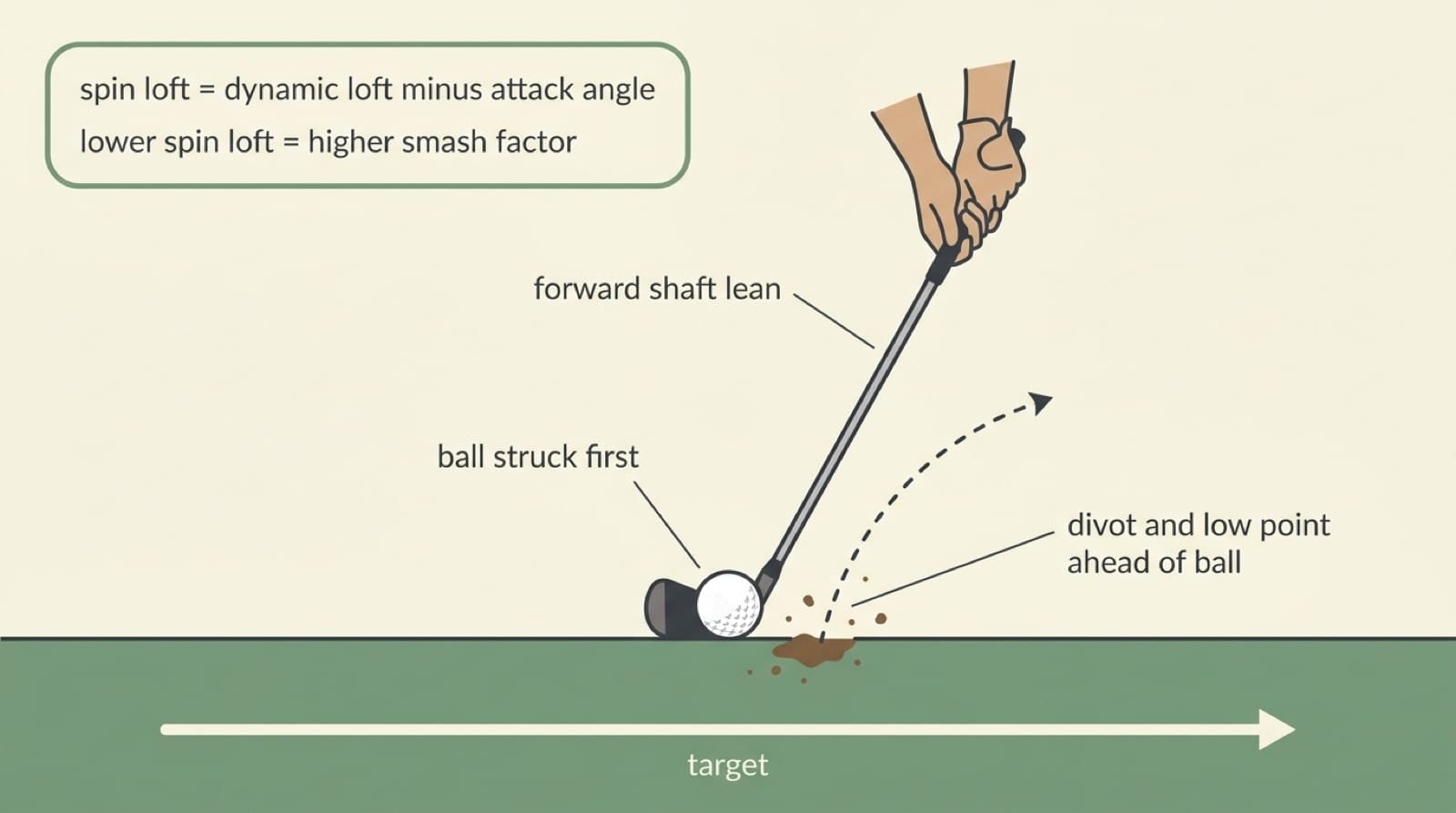
TrackMan is explicit about the payoff: all else equal, lower spin loft produces lower spin and a higher smash factor, which is why some coaches use spin loft itself as the measure of compression. Deliver a 7-iron with 30 degrees of dynamic loft and a steep minus-six attack angle and spin loft climbs toward 36 degrees — lots of spin, weak ball speed. De-loft that same club to 26 degrees with a moderate minus-four attack angle and spin loft drops near 30 degrees, which raises ball speed and usually carry, with no extra swing speed. TrackMan’s dynamic-loft guidance ends on the point directly: “learn to de-loft the club face into impact and you are well on your way to being able to compress the golf ball.”
The three numbers come from body motion, not hand manipulation. Forward shaft lean and a forward low point come from getting your weight and pressure to the lead foot before impact, then keeping the wrist angles instead of throwing the clubhead at the ball. GOLFTEC’s coaching on moving your low point forward frames it as driving the lower body toward the target so the lead hip clears past the lead ankle at impact, which pulls the bottom of the arc ahead of the ball. The weight-shift move is the engine underneath all three metrics.
Where the low point belongs
For an iron, the visible signature of compression is a divot that starts after the ball, not before it. That happens when the low point of your swing arc — the deepest point of the clubhead’s path — sits ahead of the ball, a common coaching checkpoint being three to five inches for a mid-iron, so the club is still descending when it meets the ball and only bottoms out past it. The ball compresses fully against the descending face during that ball-first contact, and the club only reaches the turf and takes its divot afterward.
Tour attack-angle data confirms the descending strike. TrackMan reports a PGA Tour 6-iron attack angle of about −3.7 degrees, and the numbers steepen through the short irons. Amateurs frequently arrive neutral or even positive with irons, which parks the low point under or behind the ball. From there the club either digs turf first (fat) or catches the ball on the way up (thin). Both are low-point failures, and the fix order lives in the fat-and-thin low-point guide.
“Hit down to make it go up”: the myth, corrected
The old maxim has a kernel of truth for irons and becomes actively wrong for the driver. With an iron, a descending strike is required for ball-first contact — but “hit down” gets misread as “chop steeply,” and an overly steep attack angle just inflates spin loft, spikes spin, and drops smash factor. The target is a moderate descent of three to five degrees with mid-irons, driven by the low point sitting forward, not by hacking down at the ball.
With the driver the slogan reverses. TrackMan’s attack-angle research shows that a teed driver wants a level-to-upward strike to maximize launch and carry, and that hitting steeply down actually lowers launch and shortens the drive. The ball rises because of loft and impact geometry, never because you scoop or lift it with the hands. Reframed honestly: hit down with irons so you strike the ball first, hit up slightly with the driver, and in both cases let the loft launch the ball. The driver setup guide covers the ascending strike in detail.
Why compression is a scoring skill, not a feel
Approach play is where scores separate, which is exactly where compression lives. Mark Broadie’s strokes-gained work in Every Shot Counts established that approach shots are one of the biggest drivers of the scoring gap between amateurs and better players, and analysts summarizing his data call improving approach play the fastest way to lower scores. A player who compresses irons produces more predictable distances, tighter dispersion, and more greens hit, and strokes-gained models reward every one of those.
The distance cost of poor compression is easy to see in ball speed. Swing a 7-iron at 80 mph and a tour-like smash factor of 1.33 yields about 106 mph of ball speed. Drop the smash to 1.25 through a thin or scooped strike and ball speed falls to 100 mph. A common coaching rule of thumb is that each 1 mph of mid-iron ball speed is worth roughly two yards of carry, so that six-mph loss costs around 12 to 13 yards — enough to turn a shot at the flag into a front-edge miss. Treat that yardage figure as a directional approximation, not a precise constant, since carry depends on launch and spin too.
Better compression also tightens dispersion, not just distance. Thin strikes fly low and release; fat strikes lose speed into the turf; heel and toe contact tilts the spin axis and curves the ball offline. Each of those leaves the ball in a worse spot than a compressed strike from the same yardage, which is the strokes-gained penalty showing up shot by shot.
The compression scorecard: measure it on a launch monitor
Feel is a poor judge of compression, so here is a PracticeCaddie framework that turns it into a pass-or-fail test. Any launch monitor that reports smash factor and attack angle can run it — TrackMan, FlightScope, and Foresight all do, as do some consumer units like Rapsodo or Garmin, depending on the model. The targets below are editorial practice targets — reachable for an improving amateur — built from TrackMan’s tour and optimizer data. The driver attack-angle range runs into positive numbers on purpose, because a teed driver should be struck level to slightly upward, not down like an iron.
| Club | Target smash factor | Target attack angle | Target spin loft | Pass condition |
|---|---|---|---|---|
| Driver | ≥ 1.46 | −1° to +3° | 13–16° | 6 of 10 balls inside all three |
| 6-iron | ≥ 1.35 | −3° to −5° | 22–26° | 6 of 10 balls inside all three |
| Pitching wedge | ≥ 1.22 | −4° to −6° | 38–42° | 6 of 10 balls inside all three |
Run 10-ball sets and change one cue at a time — weight to the lead foot, or hold the trail-wrist angle a beat longer. If smash factor climbs, iron attack angle settles into the club’s target range, and dynamic loft drops below static loft, compression is improving. If smash factor falls or dynamic loft rises, you are adding loft through impact by scooping or hanging back. The scorecard converts a vague sensation into a number you can chase weekly, and it doubles as the Week 0 and Week 4 measurement in the program below.
Faults that kill compression
Five faults account for most weak, ballooning, high-spin iron shots. Each one raises spin loft or moves the low point backward, and each has a metric signature you can spot on a launch monitor.
| Fault | What it looks like | Metric signature | First fix |
|---|---|---|---|
| Casting / early release | Clubhead passes the hands before impact | High dynamic loft, low smash | Static-impact + “stop fast” drill |
| Flipping / scooping | Hands behind the ball at impact, weak high flight | High spin loft, low smash | Handle-forward punch shots |
| Early extension | Hips thrust to the ball, torso stands up | Thin strikes, low point back | Hold-your-depth, hips-back rod drill |
| Hanging back | Weight stuck on the trail foot through impact | Low point behind the ball | Towel-behind-ball, step-through |
| Adding loft on purpose | Trying to “help” the ball up, ballooning irons | High dynamic loft, ballooning flight | De-loft cue, knockdown shots |
Casting — releasing the wrist angle too early — is the most common of the five, and it adds loft while lengthening the swing radius, which drags the low point backward. Early extension, the stand-up-through-impact move that Titleist Performance Institute coaches screen for, lifts the whole arc late and forces a compensating flip. Both push spin loft up and smash factor down, which is why generic cues like “keep your head down” rarely help — they do not touch the mechanic that actually moved the low point.
Drills that train compression
Run these in order, each with a success criterion, and check the result against a divot, a phone video, or a launch monitor. Feel-only reps are how the old pattern hides.
1. Static-impact rehearsal (build the position)
Set up in an exaggerated impact position: belt buckle toward the lead ankle, hips slightly open, weight mostly on the lead foot, shaft leaning toward the target so the hands sit ahead of the clubhead. From that feel, hit short 8-iron shots. This is the position coach Chris Ryan uses to teach compression — strike the ball first with a face that has not added loft and a shaft leaning forward, and you have compressed it. Goal: crisp, ball-first contact with a divot starting after the ball on 8 of 10.
2. Towel behind the ball (low-point fix)
Place a folded towel a hand’s width behind the ball, perpendicular to your target line, and hit ten 8-irons without clipping it on the way down. Catch the towel and your low point is behind the ball. The feedback is binary, which is what makes it fast, and getting the swing center forward is the single largest lever in the whole fix. Goal: 8 of 10 clean, with divots starting on or just ahead of the ball. It carries straight over from the fat-and-thin fix.
3. Lead-arm-only ground strike (forward low point)
Take the trail hand off, hold the club with the lead arm only, shift your whole body toward the target, and brush the turf about three to five inches ahead of the ball. GolfDNA teaches this as a low-point checkpoint. If you cannot strike the ground ahead of the ball consistently, you are holding tension or failing to shift — slow down and let the weight move first. Goal: 15 consecutive brushes of the turf ahead of the ball.
4. Handle-forward punch shots (de-loft the strike)
Play a shorter, more compact swing, feel the hands ahead of the clubhead at impact, and hit low, penetrating mid-irons. The reduced swing gives your shift and rotation less room to break down, so ball-first contact and forward shaft lean come easier. The lower, boring flight is compression you can see. Goal: 7 of 10 low, penetrating shots with ball-first contact.
5. Impact bag (feel shaft lean safely)
Set an impact bag where the ball would sit and drive the club into it from a half-swing, arriving with a flat or slightly bowed lead wrist, weight forward, and the shaft leaning toward the target. The bag does not give like a ball, so any scoop or flip is obvious in the feel. Slow, deliberate reps groove the sensation of compressing through the ball rather than flipping at it. Goal: a consistent, solid thump with the shaft leaning forward.
6. Launch-monitor smash protocol (measure the change)
Run the compression scorecard above as a drill. Hit 10-ball sets, change one cue at a time, and watch whether smash factor rises, iron attack angle moves into its target range, and dynamic loft drops. Andrew Rice, a TrackMan University contributor, uses the same data-first approach for the driver, targeting a low spin loft near 11 degrees for maximum efficiency. Goal: meet the scorecard targets on 6 of 10 balls.
A four-week compression program you can run
Drills work in week one and quit by week four when the change never meets variable conditions. This plan mirrors the howTo steps on this page and matches how PracticeCaddie’s AI plans sequence a ball-striking fix when a golfer reports weak, high, or fat iron contact in onboarding.
- Week 0: measure. Ten 7-irons on a launch monitor, recording smash factor, attack angle, and dynamic loft — or, with no monitor, a face-on video and a note of where each divot starts. Baseline only, no fix yet.
- Week 1: build the impact position. Three 30-minute sessions. Static-impact rehearsals and impact-bag reps, half-swing 8-irons. Block practice is correct here; you are acquiring a position.
- Week 2: low point forward. Three 30-minute sessions. Towel-behind-ball (10 reps), lead-arm-only ground strikes (15 reps), handle-forward punches (10 reps). Re-film or re-measure at the end of the week.
- Week 3: random. Three 45-minute sessions. Pre-write an 18-shot list rotating club and target so no two shots repeat, applying the Week 1 impact feel and Week 2 low-point cue on every swing. See block vs random practice for why this decides whether the change travels.
- Week 4: re-measure and play-test. Re-run the Week 0 test and compare, then play nine holes logging strike quality on every iron.
- Maintenance: re-check monthly. A short launch-monitor set or a divot check. Two sessions of regression triggers a one-session Week 1 and Week 2 reset.
If four weeks brings no measurable change, the usual causes are a genuine mobility limit — restricted lead-hip or thoracic rotation blocking the forward shift — or an equipment fit issue like a lie angle or length that corrupts ground contact. A single launch-monitor lesson (typically $75 to $150) or a lie-and-length check can rule those out faster than more range time.
Common mistakes and compression myths worth killing
- Trying to lift or scoop the ball up. Loft launches the ball; helping it up throws your weight back, moves the low point behind the ball, and produces the exact weak, thin shot you feared.
- Confusing “compression” with “swing harder.” Compression is efficiency. A clean 7-iron strike at 80 mph with a 1.33 smash makes about 106 mph of ball speed, more than a badly scooped strike at 85 mph and a 1.20 smash (about 102 mph). Fix delivery before you chase clubhead speed.
- Hitting down steeply. More descent is not more compression. Past about five degrees with a mid-iron, you inflate spin loft and lose ball speed. Moderate descent from a forward low point is the goal.
- Hitting down on the driver. A teed driver wants a level-to-upward strike. Steep-down driver contact lowers launch and shortens the drive, the opposite of compression.
- Reading smash factor in isolation. You can raise smash by killing loft, but too little spin loft with an iron flies low and will not hold a green. Chase smash factor and appropriate spin together.
- Feel-only practice. Compression is measurable. Without a divot, a video, or a launch monitor, feel rewards the scoop because it feels effortless. Keep a number on every session.
Key takeaways
- Compression is efficient impact, not raw power. It shows up as a high smash factor and low spin loft, and two golfers at the same swing speed can produce very different ball speeds depending on delivery.
- Three iron ingredients: forward shaft lean, a low point ahead of the ball (a three-to-five-inch checkpoint for a mid-iron), and low spin loft. TrackMan treats lower spin loft as the measure of compression itself.
- Tour irons are struck descending. A PGA Tour 6-iron attack angle is about −3.7 degrees, placing the low point ahead of the ball; amateurs often arrive neutral or positive.
- The driver is the exception. Compress it with a level-to-upward strike and centered contact — hitting down steeply lowers launch and costs distance.
- It is a scoring skill. Per Broadie’s strokes-gained work, approach play is one of the biggest scoring differentiators, and a smash factor drop from 1.33 to 1.25 on a 7-iron costs roughly 12 to 13 yards of carry.
- Measure it. Run the compression scorecard on a launch monitor, targeting smash factor near tour ranges with appropriate spin loft, and re-test at Week 0 and Week 4.
Frequently asked questions
What does it mean to compress the golf ball?
Compressing the golf ball means delivering the club so the collision transfers energy efficiently: the ball flattens hard against the face and rebounds with high ball speed for the club speed you brought. On a launch monitor it shows up as a high smash factor (ball speed divided by club speed) and a low spin loft, which is the gap between the face’s delivered loft and the club’s direction of travel. In plain terms, a compressed strike feels solid and flies penetrating rather than weak and ballooning, because more of your energy became forward speed instead of spin.
How do I compress the golf ball with my irons?
Deliver the iron with forward shaft lean and a descending blow so the low point of your swing sits a few inches ahead of the ball. Get your weight and pressure onto the lead foot before impact, keep the hands ahead of the clubhead, and avoid flipping the wrists through the strike. Done right, you hit the ball first and take a divot that starts after it. On a launch monitor this reads as a negative attack angle around minus four degrees, a dynamic loft lower than the club’s static loft, and a smash factor near tour ranges.
Do you compress a driver the same way as an iron?
No. Irons are struck with a descending blow because the ball sits on the ground, so the low point must be ahead of the ball. A driver is teed up, and TrackMan data shows the ball should be struck level to slightly upward to maximize launch and carry. You still compress a driver through centered contact and low spin loft, but the attack angle goal is the opposite of an iron. Hitting steeply down on a driver lowers launch and costs distance rather than adding compression.
What smash factor is good compression?
Smash factor is ball speed divided by club speed, and higher means more efficient energy transfer. For a driver, TrackMan reports tour players around 1.48 to 1.50, so an amateur above roughly 1.46 is compressing well. Irons run lower because their loft converts more energy into spin: a tour 6-iron averages about 1.38 and a pitching wedge about 1.25. For a mid-iron, an amateur within about 0.03 to 0.05 of the tour number signals solid contact. Values well below that usually mean thin, fat, or off-center strikes.
Can you compress the ball with a slow swing speed?
Yes. Compression is an efficiency skill, not a power skill. Two golfers swinging a 7-iron at the same 80 mph can produce very different ball speeds depending on how cleanly they deliver the club. A centered strike with forward shaft lean and low spin loft turns more of that 80 mph into ball speed, while a scooped, off-center strike wastes it. Chasing more clubhead speed before you can deliver the club efficiently just adds speed to a leaky collision. Fix the delivery first, and the same swing carries farther.
What is the best drill to learn compression?
Start with the static-impact rehearsal, then train the low point. For static impact, set up with your belt buckle toward the lead ankle, hips slightly open, weight on the lead foot, and the shaft leaning forward, then hit short shots from that feel to register solid, ball-first contact. Follow it with the towel-behind-the-ball drill: place a folded towel a hand’s width behind the ball and hit shots without clipping it, which forces the low point ahead of the ball. Together they build forward shaft lean and a forward low point, the two mechanics compression depends on.
Related reading
- How to Grip a Golf Club — the setup cornerstone that feeds face control and clean contact across the bag; compression starts from a neutral, quiet grip.
- How to Stop Hitting Fat Shots (and Thin Shots) — the low-point fix underneath compression; fat and thin are the failures that happen when the low point sits behind the ball.
- Casting in Golf: Fix the Early Release — the early wrist release that adds loft and raises spin loft, the most common compression killer.
- Weight Shift in the Golf Swing — the trail-to-lead pressure move that drives the low point forward and enables shaft lean.
- Early Extension: The Swing Fault Fix — the stand-up-through-impact move that lifts the arc and forces a compensating flip.
- Golf Ball Position by Club — the setup lever that sets where the low point can sit for each club.
- How to Hit a Driver — the ascending-strike exception; why the driver compresses on a level-to-upward hit, not a descending one.
- Ball-Striking Drills for Golf — the wider contact-drill library that the compression drills above slot into.
- Golf Ball Flight Laws Explained — the diagnostic hub that connects every contact and curve fault.
- Golf practice drills that actually transfer — the companion drill library, organized by skill area with setup steps and success criteria.
- The 30-minute golf practice plan — how to fit the compression drills into a tighter window.