
How to Hit Off Uneven Lies: Ball Above, Below, Uphill, and Downhill
Ball above your feet, below your feet, uphill, downhill: what each slope does to your ball flight, the setup fix for each, and how to read the blends.

Quick answer
Read every sloped lie on two separate axes. The across-slope tilt (ball above or below your feet) changes your swing plane and face angle, so it decides direction and you fix it with aim plus how you reach the ball. The along-slope tilt (uphill or downhill) changes effective loft, so it mostly decides distance and you fix it with club selection and shoulder tilt. Match your shoulders to the hill, swing at 70 to 80 percent, and take what the slope gives you.
The four lies at a glance
Find the row that matches your ball. Directions are for a right-handed golfer; reverse them if you play left-handed, or read them as “toward the high side” and “toward the low side” and they work for everyone.
| Lie | What the slope changes | Typical miss (RH) | The correction |
|---|---|---|---|
| Ball above feet | Flatter swing plane, toe-up lie angle closes face | Starts left, draws further left | Grip down 1–2”, stand taller, aim right, accept the draw |
| Ball below feet | Steeper plane, less face rotation, face stays open | Starts right, fades further right | Widen, add knee flex, weight in heels, aim left, hold your posture |
| Uphill | Adds effective loft: higher launch, more spin | High, short, and left | One more club, ball slightly forward, shoulders parallel to slope |
| Downhill | Takes loft off: lower launch, less spin, more roll | Low, long, and right | One club less, ball slightly back, shoulders parallel to slope, weight forward |
Two things are worth noticing in that table before you read another word. The two sidehill rows are a direction problem. The two up-and-down rows are a distance problem. They are different mechanisms with different fixes, and that separation is the whole framework.
Every lie is two slopes at once
Golf instruction almost always teaches uneven lies as four discrete situations to memorize. The course rarely hands you one. Stand on any real fairway that tilts and you get a blend: the ball is a little above your feet and the green is a little uphill. The four-lies model has no answer for that, because a blend is not one of the four.
Score the ground on two independent axes instead.
The across-slope axis runs perpendicular to your target line, and it is the one that moves the ball sideways. When the ball sits above your feet, the club’s toe rides high, and a toe-high lie angle points the face left of where it looks like it is pointing. The plane change stacks on top of that. PGA professional Dan Hansen measured his own swing on TrackMan and found the shaft plane at impact was roughly 10 degrees flatter with the ball above his feet than below them. A flatter plane means more hand and arm rotation through the ball, which closes the face faster. Closed face plus closed lie angle sends the ball left. Below your feet, both effects invert and the ball leaks right.
The along-slope axis runs parallel to your target line, and it is the one that moves the ball’s trajectory and number. An upslope tilts the face back and adds effective loft, so the ball climbs and lands short. A downslope leans the face forward and takes loft off, so the ball stays low and runs. Both of them wreck your yardage if you club for the distance on your rangefinder. This axis carries a smaller left-right tendency too — measured, and covered below — but its primary job is loft and distance, and that is what you club for.
So the read is two questions, answered in order:
- Across my stance, is the ball above, below, or level? That sets your aim and how you reach the ball: grip down for a ball above your feet, get lower for one below your feet.
- Along my stance, is the target up, down, or level? That sets your club and your shoulder tilt.
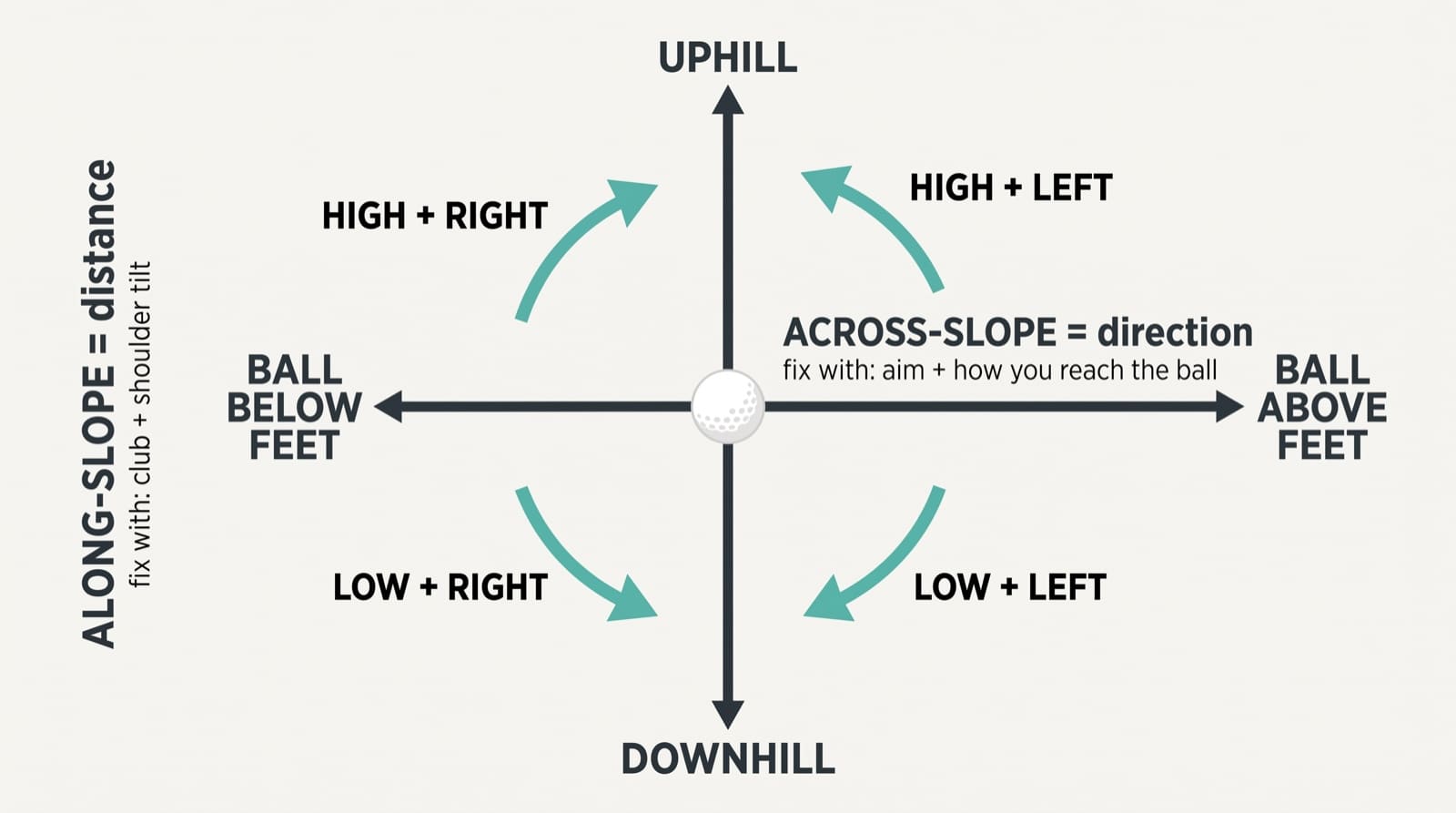
The corrections mostly stay out of each other’s way. Aiming right for a ball above your feet does nothing to your trajectory. Clubbing up for an upslope does nothing to your start line. You apply both, and they stack. That is why the two-axis read handles the blended lies the four-lies model cannot: a ball slightly above your feet on a slight upslope is one club more and a little aim right, and you did not need a fifth rule to work that out.
What the slope actually does to your body
Before the four lies individually, one finding that applies to all of them. A 2018 biomechanics study by Blenkinsop and colleagues, The Effect of Uphill and Downhill Slopes on Weight Transfer, Alignment, and Shot Outcome during Golf Shots, put golfers on uphill and downhill lies and measured what changed. Three results are worth carrying to the course.
Gravity wins, and you should plan for it. Mean center of pressure sat about 9 percent of stance width closer to the lower foot throughout the swing compared with a flat lie. Players also widened their stance and moved the ball toward the higher foot without being told to, which is your own body confirming what Butch Harmon teaches. That downhill drift is why Harmon’s rule for every uneven lie is to stand wider, lean into the slope, and swing at “70 or 80 percent” rather than full speed.
Your speed survives; your launch changes. Ball speed held roughly steady across flat, uphill, and downhill lies, while launch angle and spin moved significantly. The distance an upslope costs you is a trajectory effect, which is why clubbing up recovers it and swinging harder makes it worse.
The sideways miss comes from spin. Uphill shots went left, downhill shots went right, and the study attributed that dispersion to sidespin rather than to players consistently misaligning at address. Your aim was already fine; the ball curved anyway. The remedy is to pick a deliberate start line off the target and let the curve bring it back.
One caveat worth stating plainly: this study tested uphill and downhill lies only. Every finding above belongs to the along-slope axis, and none of it was measured on a sidehill lie. The sidehill evidence in this post comes from Hansen’s TrackMan work instead.
Ball above your feet: flatter plane, closed face
The friendliest of the four, and the one where a heavy strike is the standing risk.
Setup. Grip down an inch or two. That single adjustment does most of the work, because the ball is effectively closer to you and the club is now too long for the distance it has to travel. Stand a little taller, widen your stance, and set your weight slightly toward your toes at address — Harmon’s point is that gravity will drag you back onto your heels during the swing anyway, so starting toward the toes leaves you centered at impact rather than falling backward off the hill.
Aim. Right, and further right than feels reasonable. Hansen’s TrackMan work makes the mechanism concrete: the flatter plane closes the face relative to the path, the ball starts near where the face points, and it curves away from the path. So it starts left and keeps going left. His instruction is to aim the whole body “to right field,” take one more club to make up for choking down, and then commit.
Swing. Around your body, like a baseball swing, because the slope has already decided that for you. The error is fighting it: aiming at the flag, sensing the ball is about to go left, and holding the face off mid-swing. That is how a pull turns into a two-fairway hook. Take the draw the slope is offering and point it somewhere useful.
The fat shot. If the ball comes out heavy and short, you did not grip down enough. The swing bottomed out behind an elevated ball. Make two rehearsal swings and watch where the club brushes the ground; if the mark is behind where the ball sits, choke down further and rehearse again until it isn’t.
Ball below your feet: steeper plane, open face
The hardest of the four for most amateurs, because it asks you to hold an uncomfortable position through impact.
Setup. Widen your stance, add real knee flex, and sit your weight into your heels. Harmon’s phrasing is to squat down and lean your rear end into the slope to lower your center of gravity. MyGolfSpy’s ball-below-feet guide adds a quieter lower body and a more compact swing, on the grounds that a full lash from a squat is a balance experiment you will lose.
Aim. Left. Reaching down for the ball forces the club onto a steeper, more upright plane, and an upright plane rotates the face less. The face arrives open, the ball starts right, and it fades further right. Both Harmon and MyGolfSpy give the same instruction: aim left, expect the ball to move right, and stop trying to save it with your hands.
Swing. Stay down. This is the whole shot. Harmon’s swing thought is to maintain the flex in your knees, because that is what keeps you in your posture. The moment your legs straighten looking for comfort, the low point of your swing rises above a ball that is already below you, and you top it. Hold the knee flex and the rest of this lie becomes manageable.
The thin shot. If the ball came off the leading edge, you stood up, and your low point rose with you. Rehearse the swing while feeling your belt buckle stay at the same height from address to follow-through, and hit the next one at 70 percent.
Uphill lies: added loft, higher, shorter, left
Setup. Shoulders parallel to the slope, which for a right-hander means the lead shoulder sits higher than the trail shoulder. Ball slightly forward. Harmon’s summary is to set up with the slope and then swing up the slope, and the Blenkinsop players did the ball-forward part by instinct, moving the ball toward the higher foot on their own.
Club. At least one more. The upslope tilts the face back and adds effective loft, so the club launches the ball higher than its usual trajectory and lands it short of its usual number. Harmon and other instructors give the same rule of thumb: longer club uphill. How much longer is your call, because no published research puts a number on it.
Aim. A little right. The hands and arms release up the slope through impact, which closes the face, and the Blenkinsop data confirms the leftward result on real swings.
The fat shot, again. The signature uphill miss, and Harmon traces it to level shoulders. If your shoulders match the horizon while the ground rises, your body is tilted backward relative to the hill and the club drives steeply into the slope behind the ball. There is a second version of the same error worth knowing about: a review of TrackMan data comparing professional and amateur golfers notes that an uphill shot with a low launch angle lands almost immediately after launch, so a steep, low strike into rising ground doesn’t even get the chance to fly.
Downhill lies: delofted, lower, longer, right
The one where amateurs post the big number, and the reason is that a downhill lie punishes the exact instinct it provokes.
Setup. Shoulders parallel to the slope again, which now means the lead shoulder sits lower. Ball slightly back. Weight forward and staying forward. Harmon’s instruction is to match the shoulders to the hill even though a steep downslope makes that physically awkward, then swing down the slope with it.
Club. One less. The downslope leans the face forward and takes loft off, so the ball launches lower and runs out. Plan for roll rather than carry, especially into a firm green.
Aim. A little left. Your arms extend down the slope through impact, which holds off face rotation and leaves the face open, and the Blenkinsop study found the rightward miss on real downhill swings.
The topped shot. Hanging back is the instinct here, because the ground falling away in front of you feels like something to lean against. It puts the low point of your swing behind a ball that is already below it, and the club catches the ball’s equator on the way past. Weight forward, ball back, shoulders on the hill. If you flinch away from the slope, you top it.
Stacking the two axes: the lies you actually get
Here is the read working on a lie the four-lies model has no row for.
You’re 155 yards out. Your 8-iron number. The ball sits noticeably above your feet on a fairway that also climbs maybe five degrees to a green above you.
Across-slope: ball above feet, so grip down an inch, stand taller, weight toward the toes, and aim right of the flag. Expect a draw.
Along-slope: uphill, so shoulders tilt with the hill, ball slightly forward, and club up for the added loft. That’s one club for the slope, plus another for choking down on the grip, which shortens the club you’re actually swinging.
Result: a 6-iron, aimed right of the flag, swung at 75 percent, drawing back toward the middle of the green. Two reads, two corrections, stacked into one shot. Treat that 6-iron as a starting estimate you refine with your own results — the direction of each correction is well established, the size of it is yours to calibrate, and the practice section below is how you learn your own numbers.
The other version of this shot is an 8-iron aimed at the flag and hit hard, and it tends to come out short, left, and heavy. Every one of those three results traces back to a slope the player read as flat ground with a bad swing on it.
What’s measured, and what’s just taught
This part matters, because a lot of uneven-lie advice is repeated with a confidence the evidence does not support. Here is an honest audit of the numbers in this post.
| Claim | Status | Source |
|---|---|---|
| Uphill sends the ball left, downhill sends it right | Measured on real swings | Blenkinsop et al. 2018 |
| Ball speed barely changes on slopes; launch and spin do | Measured | Blenkinsop et al. 2018 |
| Center of pressure shifts ~9% of stance width downhill | Measured | Blenkinsop et al. 2018 |
| Ball above feet flattens the plane ~10° vs below feet | Measured, one golfer | Dan Hansen, TrackMan |
| “Take one more club uphill, one less downhill” | Teaching heuristic, not measured | Harmon and instructors broadly |
| “Swing at 70 to 80 percent on any slope” | Teaching heuristic, not measured | Harmon |
| “Aim one club-length right per X degrees of slope” | No traceable primary source | — |
| Strokes lost per round from uneven lies | No published data exists | — |
| Percentage of course shots played from non-flat lies | No published data exists | — |
The bottom four rows are the useful ones. Searching both the sport-science literature and the analytics platforms turns up no study relating degrees of slope to yards of curve, and no strokes-gained breakdown by slope. Arccos’s strokes-gained-by-club analytics, for instance, reports by club rather than by lie. So anyone quoting you a precise per-degree formula is quoting instinct.
The heuristics still earn their keep. “One more club uphill” is good advice from good teachers with decades of eyes on the shot, and the direction of every effect above is measured and real. Treat them as directionally useful starting points and calibrate them against your own results. The honest read: trust the direction of every rule in this post, and test the magnitude on your own course.
Common mistakes
- Clubbing for the yardage alone. Your rangefinder tells you 155. The slope tells you the ball will launch higher and land shorter. The slope wins, and clubbing for the number by itself is a reliable way to come up short of an elevated green.
- Aiming at the flag and then steering. From every one of the four lies, the ball wants to curve. Aiming at the target and then fighting the curve mid-swing produces a much bigger miss than the curve you were afraid of. Aim off and commit.
- Leaving your shoulders level with the horizon. On an upslope this drives the club into the hill and you hit it fat; on a downslope it puts your weight behind the ball and you top it. Match the shoulders to the ground you’re standing on.
- Standing up out of the squat. The one mistake that defines ball-below-feet. Straightening your legs mid-swing raises the low point above a ball that is already below your feet, and the leading edge finds the equator.
- Skipping the grip-down with the ball above your feet. The club is too long for an elevated ball, so the swing bottoms out behind it. Two rehearsal swings tell you exactly how much to choke down. (With the ball below your feet the fix inverts: keep the club’s length and get down to it with your knees.)
- Swinging at full speed. Gravity is already pulling you down the hill, and the Blenkinsop data shows your pressure drifting about 9 percent of stance width that way whether you plan for it or not. A 70 percent swing from a balanced base beats a 100 percent swing from a stumble.
- Treating a blended lie as a single lie. Reading only the sidehill component of a lie that also climbs is how you make a good swing and still come up short of the green.
How to practice uneven lies when your range is flat
Ranges are flat. Courses tilt. That gap is the practical reason uneven lies feel hard: your reps come from level ground, and your score gets decided on ground that moves under you.
- Find the slope you already have. Nearly every facility has a bank at the edge of the range, a rise beside the chipping green, or a slope near the practice area. Drop 10 balls on it. That is the entire equipment list.
- Rehearse before you swing. On any sidehill lie, make two practice swings and watch where the club brushes the turf. Then set your reach so the brush mark sits under where the ball would be: choke down for a ball above your feet, add knee flex for one below. It costs nothing and it targets the fat and thin shots these lies produce.
- Rotate lies every shot. Hit one from flat, one from an upslope, one with the ball above your feet, one from a downslope, then repeat. It will feel worse than blocked practice, and that is the contextual-interference effect doing its job. Shea and Morgan’s 1979 study is the origin point: random practice looked worse during the session and transferred better afterward. Uneven lies are a transfer skill by definition, since you never get the same slope twice.
- Play the real thing during a quiet hour. An on-course practice round is the only place you get authentic lies with authentic consequences. Drop a second ball on every sloped lie you find and play the two-axis read on it out loud.
- Score the read as its own skill. Before each shot, say the two axes and your two corrections out loud. Then hit it. Count how many times out of 10 you correctly named the miss the ball then produced. Reading a lie and striking it are separate skills, and the read is the one you can own on a practice bank in an afternoon.
Where this pays off on the card is upstream of the swing, in the tee shot that put you there. Shot Scope’s data found golfers who miss tee shots right find trouble on 7 of 10 drives — trees, fairway bunkers, deep rough — and trouble is where the awkward stances live. Scott Fawcett’s DECADE system makes the same argument from the other end, pointing out that even a tour player’s shot pattern from 190 yards is about 28 yards wide, so playing to a centered target rather than a tucked pin keeps you out of the positions where slopes compound your misses. Fewer uneven lies is a strategy problem; playing the ones you get is a skill problem. You want both.
PracticeCaddie’s plan builder rotates lie, club, and target across a session and holds you to a numeric success criterion per drill, which is the structure the read-scoring drill above needs to work. For a session template to drop the slope work into, see the golf practice plan guide.
Key takeaways
- Read the ground on two axes. Across-slope (ball above or below feet) sets direction, fixed with aim plus how you reach the ball. Along-slope (uphill or downhill) sets loft and distance, fixed with club plus shoulder tilt. Real lies blend the two; apply both corrections and they stack.
- Ball above feet goes left; ball below feet goes right. Dan Hansen’s TrackMan test measured roughly 10 degrees of swing-plane difference between the two, which is what changes how fast the face closes.
- Uphill goes high, short, and left. Downhill goes low, long, and right. Blenkinsop et al. 2018 confirmed the left-right pattern on real swings and traced it to sidespin, which is why aiming off beats aiming harder.
- Club for the trajectory the slope creates. Ball speed barely changes on a slope; launch and spin do. Take one more club uphill, one less downhill, and expect swinging harder to recover the yardage to make it worse.
- Match your shoulders to the ground. Level shoulders against an upslope is the fat shot. Level shoulders against a downslope is the top. Set up with the slope and swing along it, per Butch Harmon.
- Widen the base and swing at 70 to 80 percent. Your center of pressure drifts about 9 percent of stance width toward the lower foot regardless of your intentions, so build a stance that survives it.
- Trust the direction of every rule here; test the magnitude yourself. No published research links degrees of slope to yards of curve or to strokes lost, and “one club per X degrees” has no traceable source. The mechanisms are real; the precise numbers are instructor experience.
Frequently asked questions
How do you hit a golf ball when it’s above your feet?
Grip down an inch or two, stand a touch taller, widen your stance, and aim toward the high side of the slope. The ball being closer to your body flattens your swing plane, which speeds up how fast the clubface closes, and the toe-up lie angle points the face that way too. Butch Harmon’s advice is to accept the resulting draw rather than fight it: aim off, then make a normal swing at about 70 to 80 percent. Failing to grip down is what causes the fat shot from this lie.
How do you hit a golf ball when it’s below your feet?
Widen your stance, add knee flex, sit your weight into your heels, and aim toward the low side of the slope. Reaching down to the ball forces a steeper, more upright swing plane with less clubface rotation, which leaves the face open and leaks the ball away from the hill. The one thing that matters most is holding your knee flex through impact. Standing up out of that squat raises the swing’s low point and produces the thin or topped shot this lie is famous for.
Do you take more club or less club on an uphill lie?
More club, and usually at least one. An uphill lie tilts the clubface back, which adds effective loft, so the ball launches higher, spins more, and lands shorter than your normal number for that club. Butch Harmon’s instruction is to take a longer club, play the ball slightly forward, and set your shoulders parallel to the slope. Golfers routinely come up short here because they club for the yardage instead of the trajectory. The reverse applies downhill, where the slope delofts the club.
Which way does the ball curve on an uneven lie?
For a right-handed golfer, ball above your feet and uphill lies both tend to send the ball left, while ball below your feet and downhill lies both tend to send it right. A 2018 biomechanics study by Blenkinsop and colleagues confirmed the uphill-left and downhill-right pattern on real swings, and found the misses came from sidespin rather than from players aiming badly. Reverse the directions for a left-handed golfer, or think of it as the ball moving toward the high side on an upslope and the low side on a downslope.
Why do I hit it fat from an uphill lie?
Butch Harmon’s answer is your shoulders. If they stay level with the horizon while the ground rises, your body is tipped backward relative to the slope, so the club digs steeply into the hill behind the ball. His fix is to set your shoulders parallel to the slope and swing up the hill with it. A related error is a low, steep strike into rising ground, which per a launch-monitor review of TrackMan data can put the ball into the turf almost immediately after launch.
How do you practice uneven lies if your driving range is flat?
Use the ground you already have. Most facilities have a sloped bank near the range, the chipping green, or the car park edge that you can drop balls on, and an on-course practice round during a quiet hour is the most realistic option there is. Rotate lie types between shots instead of grinding one, since the contextual-interference research shows that interleaving feels worse during a session and transfers better to the course. Rehearsal swings that show you where the club bottoms out matter more than ball count.
How much does a slope actually change the shot?
The direction of every effect is well documented, but the size of it is not. No published study links degrees of slope to yards of curve or yards of distance lost, and the familiar rules like one more club uphill are teaching heuristics from instructor experience rather than measured formulas. What is measured: roughly a 10-degree swing-plane change between ball-above-feet and ball-below-feet in one TrackMan test, and a center-of-pressure shift of about 9 percent of stance width toward the lower foot on slopes.
Related reading
- How to Grip a Golf Club — the cornerstone of face control this whole cluster hangs off; gripping down is the primary adjustment for a ball above your feet, so a neutral grip you can shorten without changing is worth owning first.
- Golf Stance and Posture — the setup platform every slope adjustment modifies; know your neutral stance width and spine angle before you start widening and squatting off them.
- Golf Ball Position by Club — the ball-forward and ball-back corrections for uphill and downhill lies are moves off your normal position, so you need to know where normal is.
- Golf Ball Flight Laws Explained — the diagnostic hub for start line and curve; the face-to-path relationship that explains why a toe-up lie angle sends the ball left.
- How to Stop Hitting Fat Shots (and Thin Shots) — the low-point fault behind the two signature uneven-lie misses; slopes move your low point, and this is the mechanism.
- How to Stop Topping the Golf Ball — the specific miss that ball-below-feet and downhill lies produce when you lose your posture.
- Golf Course Management Tips — the strategy layer; the cheapest way to play uneven lies well is to hit fewer shots from them.
- Strokes Gained Explained for Amateurs — the framework behind the DECADE shot-pattern argument above, and why centering your pattern beats chasing pins.
- Block vs Random Practice in Golf — the motor-learning research behind rotating lie types instead of grinding one slope.
- Golf practice drills, organized by skill area — the companion drill library with setup steps and success criteria to build the slope work into a full session.