
How to Hit a Draw in Golf: Setup, Drills, and a 4-Week Protocol
Tour distance leaders draw it. Five drills and a 4-week protocol that build an on-demand draw, plus the checkpoints that stop it collapsing into a hook.
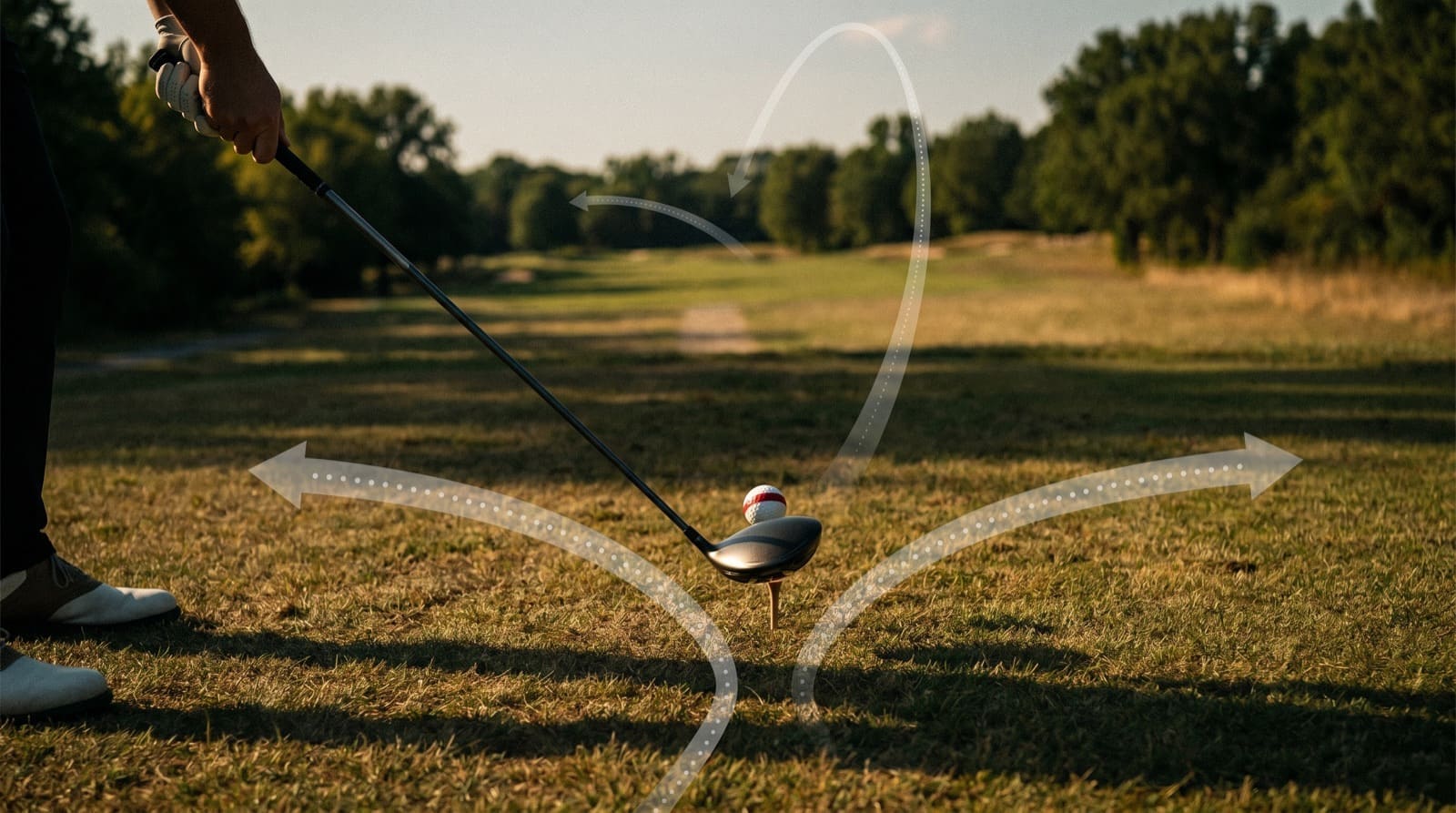
Quick answer
A draw is a controlled right-to-left ball flight (right-handed) where the clubface stays square to the target while the body and swing path travel 2 to 5 degrees right of target. The 1- to 3-degree face-to-path gap produces 5 to 15 yards of left-curving flight. Tour distance leaders rely on the draw — the shape adds carry and run when struck cleanly. The setup does the work; the swing follows.
Draw vs other shapes — face, path, and ball flight at a glance
| Shape | Face vs target | Path vs target | Face-to-path | Typical 7-iron curve | Typical driver curve |
|---|---|---|---|---|---|
| Power draw | Square to target | 2–4° right of target | Closed by 1–3° | 3–6 yards left | 8–15 yards left |
| Hook | Closed by 4°+ | Often in-to-out | Closed by 4°+ | 8–15 yards left | 20–40+ yards left |
| Straight | Square | Square | Within 1° | 1–3 yards either way | 3–8 yards either way |
| Power fade | Square to target | 2–4° left of target | Open by 1–3° | 3–6 yards right | 8–15 yards right |
| Slice | 4°+ open to path | Often out-to-in | Open by 4°+ | 8–12 yards right | 20–40+ yards right |
The point of the table: a draw and a hook are the same shape at different magnitudes. The same is true for a fade and a slice. Three degrees of face-to-path is the difference between an intentional shape and a round-killer.
Why some tour players favor a draw
Per Golf Analytics’ 2024 PGA Tour ball-flight study, professionals hit a draw on about 28% of all driver shots versus 50% fades — nearly a 2:1 fade preference at Tour level. Tour average sits at +1.1 degrees of fade spin axis. The fade is the Tour’s default. The draw belongs to a smaller, distance-forward subset.
That subset matters. The Tour’s longest hitters lean draw. Bubba Watson built two Masters titles on his iconic right-to-left curve, captured in Golf Digest Middle East’s “Bend It Like Bubba”, and his 320-yard carries are inseparable from the shape. Bryson DeChambeau plays draw-biased single-length irons and has driven for the longest yardage average on Tour during his peak seasons. Jon Rahm has detailed his stock high-draw setup with the driver — closed stance, ball forward, face on target. Patrick Reed built his career on a “Slinger” low draw — feet 30 metres right, soft grip, aggressive hand rotation. Even Rory McIlroy, fade-biased with the driver per the same Golf Analytics dataset, plays his irons and fairway woods 40% draw to 20% fade — the draw is his scoring shape inside the bag.
The case for a draw clusters into three measurable advantages:
- More carry and roll-out at the same swing speed. Draws typically launch lower with reduced backspin on the same delivery, which extends roll-out on dry fairways. Watson’s draw routinely produces total distances that a comparable-speed fade has trouble matching — the tradeoff that built the scoring run defining his career.
- Course-fit on dogleg-lefts. A draw matches the corner; a fade fights it. On a tight dogleg-left tee shot, a draw cuts the corner and shortens the approach. A fade leaves a longer second shot or risks the right-side trouble.
- Wind penetration. Lower spin and lower launch on a draw cut through headwinds better than a high fade. Players who win major championships in firm, windy conditions — links golf in particular — frequently lean draw with the driver for that reason.
The case for a draw is mechanical. The shape adds carry, matches dogleg-left routing, and penetrates wind better than a fade. Adding it to a bag that already has a reliable stock shape gives you a distance and routing tool the bag did not have before.
What a draw actually is (the modern ball-flight law)
TrackMan’s research on club path is unambiguous about how golf ball flight works under the modern law: the ball starts roughly where the clubface points (about 75% of start direction on a 7-iron, more on driver) and curves away from the swing path. Two consequences follow.
First, to make the ball start right of the target — the visual signature of a draw — the clubface must be square to the target while the body and swing path move right of it. A draw’s face is closed relative to its path, but square to the target line. This is the geometry that throws amateurs off: their feet point right, their face follows their feet, and they end up hitting a push. The face-and-path offset is the entire game.
Second, the magnitude of curve scales linearly with face-to-path mismatch. The math TrackMan publishes — the same math cited in our fade build-out — is that on a 300-yard driver carry, every 1 degree of face-to-path mismatch produces about 12 yards of curve.
A 2-degree mismatch produces a 24-yard power draw — enough to feel intentional, not enough to leak into trouble. A 4-degree-plus mismatch is a hook. The draw and the hook are the same swing — three degrees of face-to-path apart.
If you currently sit at 5 degrees or more of face-to-path closed (a banana hook), this article is not the work — neutralizing your grip and quieting your release is. The hook fix is the inverse of the four-week slice-fix protocol: face-to-path is the same lever, the direction of the correction flips. Come back here once your typical mismatch lives under 3 degrees. Building a draw on top of a hook does not work; you have to bring the face under control first.
The draw setup — five changes from your stock swing
Setup does most of the work. Hank Haney’s Australian Golf Digest piece on saving five shots lays the geometry out directly: close the body, leave the face on target, swing along your feet, keep the arms moving fast through impact. The five changes:
1. Close the stance 3 to 5 degrees right of target
Aim feet, knees, hips, and shoulders right of target. The standard amateur draw offset runs about 25 to 30 feet right of target from 140 yards (about 3 to 4 degrees). Scale up for driver, scale down for short irons. The closed stance sets the in-to-out path automatically; you do not have to manipulate it from the top.
2. Leave the clubface aimed at the target
This is the move most amateurs miss. The face stays square to the target line, not to your feet. From your perspective, the face looks slightly open relative to your stance.
From the ball’s perspective, that is exactly the face-square-to-target / path-right-of-target offset that produces a draw. The two-line setup — one for feet, one for face — is the entire trick.
3. Move the ball half a ball-width back
Move it only half a ball-width, maybe one. A slightly back ball position lets the clubhead arrive on the in-to-out path before it reaches the low point, producing the hot, low-spinning strike that makes a draw run on landing. Reed’s “Slinger” low draw uses an even more pronounced back ball position to flight the ball under the wind.
4. Strengthen the grip a quarter-turn
Most golfers play a neutral grip with two knuckles visible on the lead hand at address. For a draw, slide the lead hand a quarter-turn clockwise (right-hander) until a third knuckle becomes visible. Hank Haney’s draw prescription is the same — a stronger grip biases the face toward closing through impact, contributing draw curvature without forcing the hands to manipulate the face under speed.
5. Release the toe past the heel through impact
The signature feeling of a draw is active hands. Through the strike, the trail forearm rotates over the lead forearm and the toe of the club passes the heel before the clubhead reaches waist height in the follow-through. Haney’s same playing-lesson notes describe it directly: keep the arms moving fast so the clubface closes before impact, producing the right-to-left curve. The hold-off action that produces a fade becomes an active rolling action that produces a draw. If your hands stay quiet through the ball the way they do on a fade, you will get a push instead of a draw.
These five changes compound. Run all five together and most golfers will start producing a consistent right-to-left curve within a session. Run only two or three of the five and the result is usually a push, a thinned fade, or a confused mishit.
Five drills that teach a controlled draw
Drills isolate one variable — face control, path control, or release timing — so you can repeat it under low cognitive load before stacking it back into a full swing. Run them in this order.
1. The two-line alignment drill (setup geometry)
Lay one alignment stick along your toe line, pointing 3 to 5 degrees right of the target. Lay a second stick along the ball-target line, pointing at the target. Address the ball with feet on stick #1 and clubface aimed down stick #2. Take 20 slow reps just settling into the offset before hitting any ball.
Success criterion: you can step into the dual-line setup in under five seconds without mental friction.
2. The aim-right, hit-square half-swing (face control)
7-iron, half swing — club at 9 o’clock back, finish at 3 o’clock through. Aim feet 10 degrees right of a flag at 50 yards (the drill amplifies the stock 3–5° offset for clearer feedback). Face at the flag. Hit 20 wedge-distance shots.
Success criterion: 16 of 20 shots start right of the flag and curve back toward it. If they start at the flag and stay straight, your face is moving with your feet — re-check setup #2. If they curve hard left, your hands fired closed early — re-check setup #5.
3. The headcover-inside-the-ball drill (path)
This is the slice gate drill, mirrored. Place a headcover or foam noodle one ball-width inside the target line — closer to the heel of your stance, further from the target line — about a foot in front of the ball. Hit mid-iron half-swings without clipping the headcover. The geometry forces the club to swing along your closed stance line (in-to-out relative to target) instead of cutting across it.
Success criterion: 10 swings without contact.
4. The active-release finish (release control)
Hit 7-irons with one rule: at the finish, the toe of the club points toward the ground and the back of the lead hand faces the sky. The clubhead crosses the lead arm at chest height with no hold-off. Done correctly, the forearms feel like they are rotating through the ball, not stalling at it.
Success criterion: repeat the position 8 of 10 with a smooth motion, no body-stall on the way through.
5. The draw ladder (random, calibrated)
Three targets at 100, 130, and 160 yards. Hit nine shots, randomized — never two of the same target in a row. Goal on every shot: ball starts right of the target and curves back to it. Score 1 point for each shot finishing within 10 yards of the target with left-curving flight; 0 for a push, a pull, or a curve in the wrong direction.
Success criterion: 6 of 9 first time; 8 of 9 by week four. This is the random-practice phase that makes the draw transfer to the course — see Block vs Random Practice in Golf for the motor-learning research underneath.
A four-week protocol — from no-shape to on-demand draw
Drills work in week one and stop working by week four if they never face varied conditions. The plan below mirrors the howTo schema on this page and is the same sequence PracticeCaddie’s AI plans use when a user asks for a shot-shaping build.
- Week 0 — measure. Phone video, down-the-line. Five drives, five 7-irons, no draw attempt. Record start direction, curve in yards, current grip strength. You cannot know whether the protocol worked without a baseline.
- Week 1 — face. 30 minutes, three sessions. Two-line alignment drill (drill #1) and the aim-right, hit-square half-swing (drill #2). Block practice is correct here — you are acquiring a new motor pattern. No driver yet.
- Week 2 — path. 30 minutes, three sessions. Headcover-inside-the-ball drill (drill #3) and the active-release finish (drill #4). Re-film at the end of week 2 — start direction should now sit clearly right of the target and curve should be 5 to 15 yards back to the left.
- Week 3 — random. 45 minutes, three sessions. Draw ladder (drill #5) plus a 9-shot variety set on full 7-iron (low/medium/high crossed with draw/straight/fade). The draw has to survive variability before it transfers to the course. See Block vs Random Practice in Golf for the research underpinning this step. The 3:1 backswing-to-downswing rhythm covered in Golf Tempo Drills helps the active release fire on time under random conditions.
- Week 4 — pressure. 45 minutes, three sessions. Each session ends with a “first-tee” simulation: three driver draws to a fairway target, no warm-up, success defined as a left-curving ball finishing inside 30 yards of target. Play one nine-hole round at week’s end and tag every draw attempt’s outcome on your scorecard.
- Maintenance. Re-film every two weeks for two months. The draw is fragile under pressure; the only counter is honest measurement.
If at the end of week four your draw has not shown up reliably, the issue is almost always the grip drifting back toward neutral under pressure — your hands want to hold what they have always held. A single TrackMan or FlightScope session ($75 to $150) typically isolates the variable in 30 minutes.
When NOT to hit a draw
Four situations where a fade or a straight ball wins:
- Hard right-to-left wind. The wind already adds curve; a draw compounds it into a wide, hook-prone slide. Hit a fade into the wind and let the wind straighten it.
- Dogleg-right tee shot with no left-side bailout. A draw fights the hole geometry. A fade matches the corner.
- Pin tucked right with bailout right, hazard left. The draw’s natural miss is left; a right pin with bailout long-right favors a high straight ball or a fade — playing a draw here puts the miss in the hazard.
- Wedges from inside 100 yards. Distance control matters more than shape. A high straight wedge with backspin checks better than a draw, which runs out and risks long misses.
Treat the draw as a situational tool. The fade earns its keep on more holes for more amateurs; the draw earns it on the holes where carry and routing matter most.
Common mistakes
- Aligning feet and face right. Produces a push instead of a draw. The two-line setup is non-negotiable: feet right, face on target.
- Over-strengthening the grip. Past three knuckles on the lead hand, you cross into hook-grip territory. The draw grip is strong by one knuckle off neutral, never extreme.
- Trying to roll the wrists at the ball. A draw is body-led, with hands active through the strike rather than before it. Hand-led draws collapse into snap hooks.
- Block-practicing the draw for four weeks. Same target, same shot, 50 reps — the range looks great, course transfer does not happen. Week 3 random practice is the difference.
- Switching to draw for one round, then abandoning after a single bad result. Motor patterns take four to six weeks of structured exposure. One hook in a Saturday round is a data point, not a verdict.
Key takeaways
- Tour distance leaders draw it. Per Golf Analytics’ Tour ball-flight data, the long-hitter cohort — Bubba Watson, Bryson DeChambeau, Jon Rahm — leans draw with the driver, while the Tour as a whole sits +1.1° fade.
- The mechanics: clubface square to the target, body and swing path 2 to 5 degrees right of target, face-to-path closed by 1 to 3 degrees.
- TrackMan math: 1 degree of face-to-path equals about 12 yards of curve at 300 yards. A 2-degree draw is intentional; a 4-degree-plus draw is a hook.
- Setup does the work. Five changes — closed stance, square face, half-ball back, quarter-turn stronger grip, active release — produce a draw without manipulating the swing path from the top.
- Five drills, in order: two-line setup → aim-right/hit-square half-swing → headcover-inside path → active-release finish → draw ladder under random conditions.
- Four-week protocol: Week 0 baseline → Week 1 face → Week 2 path → Week 3 random → Week 4 pressure. Re-film every two weeks for two months as maintenance.
- The draw is the distance shape; the fade is the dispersion shape. For most amateurs the fade is the safer default; the draw is the second shape in the bag, deployed on dogleg-lefts and into the wind.
Frequently asked questions
What is the difference between a draw and a hook?
A draw and a hook come from the same swing pattern — clubface closed relative to swing path — but at different magnitudes. A draw has a face-to-path mismatch of 1 to 3 degrees, producing about 5 to 15 yards of curve depending on the club. A hook has a 4-degree-plus mismatch, producing 20 to 40 yards of curve and a recovery shot from the trees. The draw is intentional; the hook is incidental. If your ball curves 30 or more yards left on a normal swing, you have a hook — fix the face-to-path before chasing an on-demand draw.
Should I aim right of the target or at it?
Aim your body right of the target — feet, knees, hips, and shoulders all point 3 to 5 degrees right. Aim your clubface directly at the target. The two-line offset is what produces a draw; aligning both the same direction produces a push. Hank Haney’s stock prescription is a closed stance with the feet roughly 25 to 30 feet right of target from 140 yards, with the clubface still pointed at the flag. Scale proportionally for longer or shorter shots.
Can I learn a draw if I currently hook the ball?
Not directly. Layering a draw on top of a hook does not work because the underlying mechanics are the same — face closed to path — and adding more closed-face setup turns a 30-yard hook into a 50-yard one. Bring your face-to-path under 3 degrees first by neutralizing the grip and slowing the hand release through impact. Once your stock shot curves only slightly left or runs straight, the draw build-out is a setup change away. Strengthening the grip on a hooker pushes you the wrong direction.
Will I gain distance with a draw vs a fade?
A small amount on average — typically 5 to 15 yards of total distance on a 270-yard driver — because a draw’s flatter spin axis produces lower launch and less backspin, which lengthens roll-out. Bubba Watson and Bryson DeChambeau both publicly play draws and have spent careers among the Tour’s distance leaders. The trade is dispersion: draws disperse wider than fades shot-for-shot. The draw is the distance shape; the fade is the dispersion shape. Most amateurs benefit more from dispersion than from carry.
How long does it take to add a draw to my bag?
Roughly four weeks of structured practice — three 30 to 45 minute sessions a week — to get the draw firing reliably on the range. Add another two to four weeks for it to transfer to the course under pressure. The four-phase progression (face, then path, then random, then pressure) is non-negotiable; skipping the random-practice phase in week 3 produces a draw that lives only on the range. Re-film every two weeks for two months after the protocol ends, because the draw is fragile under pressure and tries to revert into a push.
Is a draw or a fade better for amateurs?
For most amateurs, a fade is the safer default — tighter dispersion and a more recoverable miss, since the natural fade miss is a straight push while a hook ends up in a hazard. The draw earns its keep on dogleg-left holes, into headwinds, and on tee shots where carry distance matters more than fairway width. A controlled draw is a powerful tool to add to a bag that already has a reliable stock shape. Amateurs without a reliable stock shape should build a fade or a straight ball first, then add a draw as the second shape in the bag.
Related reading
- How to Hit a Fade in Golf: Setup, Drills, and a 4-Week Protocol — the symmetric companion piece. Most amateurs should build a fade first; the draw is the second shape.
- How to Fix a Slice in Golf: Causes, Drills, and a 4-Week Practice Plan — the four-week protocol that gets you under 3 degrees of face-to-path. If your stock shot is a slice, run this before adding a draw.
- Block vs Random Practice in Golf: What the Research Actually Says — the motor-learning research behind the week-3 random-practice phase of this protocol.
- Golf Tempo Drills — the 3:1 backswing-to-downswing rhythm that lets the active release fire on time under speed.
- Golf practice drills that actually transfer to the course — the broader drill catalog curated against the same skill-acquisition literature.
- Golf practice drills (guide) — the deeper drill library organized by skill area, with setup steps and success criteria.
- Driving range practice plan — how to structure the 30 to 45 minute sessions in this protocol.
- How to Grip a Golf Club — the face-control fundamental underneath every shot shape; grip strength is the first draw lever.