
How to Swing a Golf Club: The Sequence That Actually Repeats
The golf swing is a ground-up energy sequence: pelvis, torso, arms, club. The setup that enables it, and how to learn it so it repeats under pressure.
Quick answer
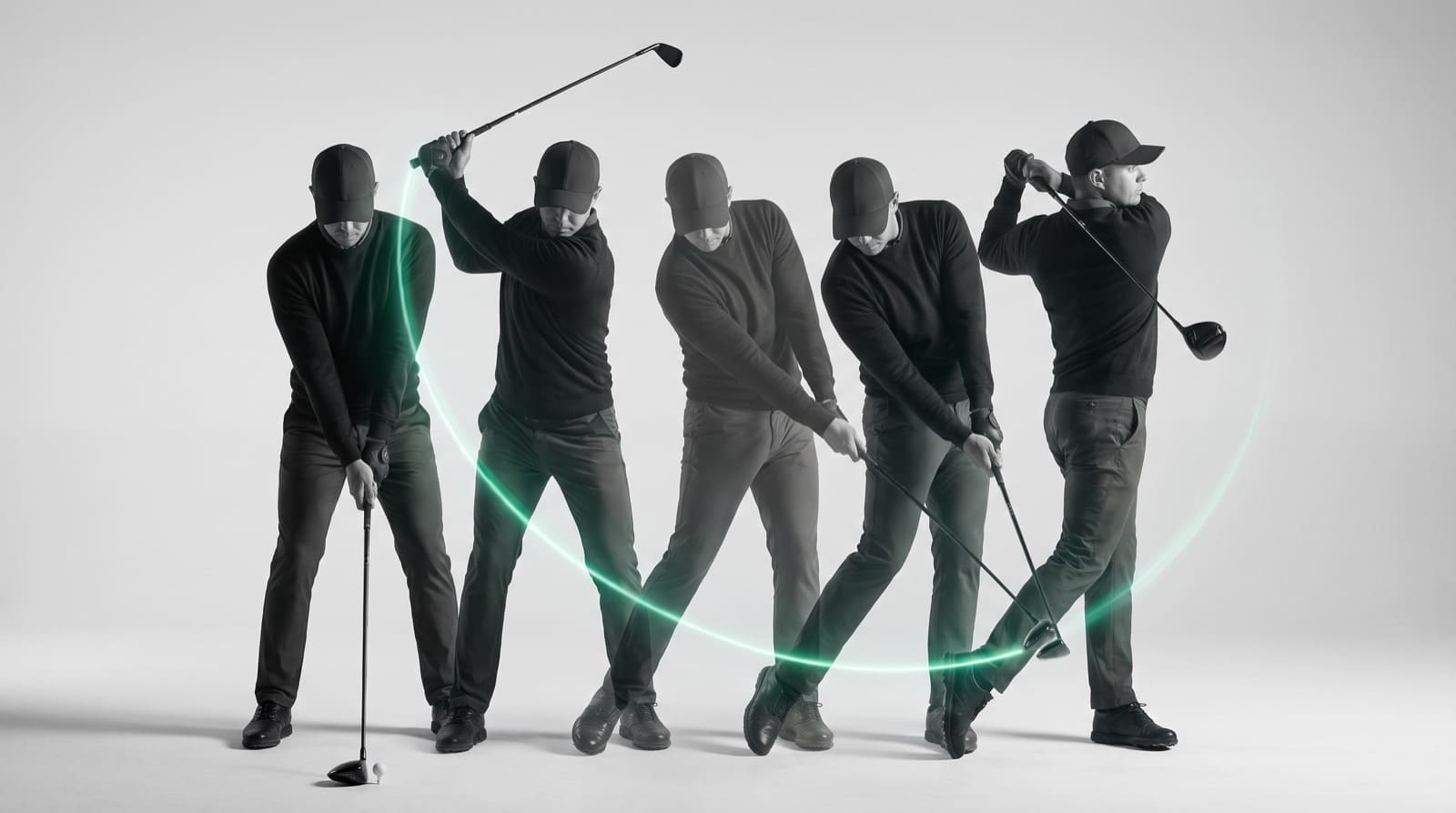
A golf swing is a ground-up energy sequence. The pelvis starts the downswing, then the torso, then the lead arm, then the club, a wave that unspools in a fraction of a second. Learn it in order: build a neutral setup, groove contact with slow reps, train the pressure shift onto your lead foot, then add speed and randomize. Feels beat positions, because the swing is too fast to steer joint by joint.
The swing: tour pro vs typical amateur
| Variable | Tour pro | Typical amateur |
|---|---|---|
| Downswing sequence order | pelvis → torso → lead arm → club | often reversed (arms and club fire first) |
| Low point (irons) | ahead of the ball, ball-first | behind the ball (fat and thin) |
| Trunk rotation at the top | ~60° | shorter, less coil |
| Club-shaft speed through the ball | ~2,400°/second | markedly lower |
| Weight on lead foot at impact (iron) | ~80% | hanging back on the trail foot |
| Lead wrist at impact | flat-to-flexed (forward shaft lean) | extended and flipping (scoop) |
| Driver angle of attack | +3° to +5° up (the distance optimum) | flat or negative, costing 15–25 yards |
Every figure above is drawn from the biomechanics, wrist-sensor, and shot-tracking research cited through this post. The pattern is consistent: what separates the pros is how well the sequence is timed and ordered.
Why the full swing is worth building well
The full swing is where scores are won or lost. Mark Broadie’s Strokes Gained analysis of PGA Tour data, summarized by instructor Andrew Rice, ranks shot categories by how much they separate players: approach shots outside 100 yards matter most, driving is second, the short game third, and putting fourth. For most amateurs, ball-striking has the higher ceiling for cutting strokes than any putting drill.
Distance follows the same logic. Arccos driving data, summarized by Skillest, puts the average male amateur at 224.1 yards off the tee, with roughly 2.5 yards of total distance riding on every 1 mph of clubhead speed. Efficient sequencing raises speed without extra strength, and a clean strike turns that speed into carry. That is the payoff for learning the motion properly instead of patching it.
What a golf swing actually is
A golf swing is a coordinated chain of body segments transferring energy from the ground, through the body, into the club, and finally the ball. TPI co-founder Dave Phillips uses a four-horse-race analogy: when the gate opens at the top, the lower body leaves first, then the trunk, then the lead arm, then the club. Each “horse” is a body segment on a 3D velocity graph.
The positions coaches talk about, top of the backswing, impact, finish, are snapshots of that moving chain. They are useful to rehearse in slow motion. But you cannot consciously steer through them in real time, because the whole downswing happens too fast to adjust once it starts. Physical therapist Jared Bickle describes an efficient sequence as a wave that grows as it travels: each segment peaks higher than the one before, and each slows down in time to hand its speed to the next. Break the order and the wave collapses, which is what casting, scooping, and over-the-top moves really are.
That is the mental model to carry into every drill below: you are building one motion.
The setup that makes a good swing possible
Setup is static, which makes it the cheapest part of the swing to fix and the one everything else depends on. Get these four right before you worry about the swing itself:
- Grip. A neutral grip lets the lead wrist work flat-to-flexed through impact, which is what squares the face and supports forward shaft lean. The full walkthrough is in How to Grip a Golf Club — the setup fundamental that controls the clubface.
- Posture and stance. Stand tall, hinge from the hip joints with a neutral spine, soften the knees, and feel your weight in the middle of your feet. That athletic base is what lets the pelvis rotate and shift. See Golf Stance and Posture.
- Ball position. Where the ball sits sets your low point: center-ish for irons so the club is descending at impact, forward off the lead heel for the driver so it is moving up. Details in Golf Ball Position by Club.
- Aim. Aim the clubface at a start line first, then build your body parallel to it. A well-sequenced swing pointed the wrong way still misses. See How to Aim in Golf.
Setup gets its own posts because it deserves the time. Rush it and you spend the rest of the swing compensating.
The swing in five phases
With the platform set, here is what each phase is trying to do. Treat these as checkpoints to rehearse slowly. In the swing itself they go by too fast to think about.
Takeaway. Start slow and smooth, keeping the arms and body connected so the clubface does not fan open early. The pace you set here is the pace the rest of the swing inherits.
Backswing and top. Turn the shoulders against a more stable lower body to build coil. Kinematic studies of skilled players show trunk rotation of about 60° at the top with a big shoulder turn. You are storing elastic energy in the torso, while the arms just carry the club along.
Transition. This is where good swings are made. Pressure begins shifting toward the lead foot while the club is still finishing its backswing. Athletic Motion Golf’s 3D work with tour players shows the arms already accelerating early in the downswing, far sooner than most golfers assume, so there is no time to consciously “hold lag.” The move is a small, early pressure shift toward the target.
Downswing and impact. The body clears while the arms drop the club in front of the chest. By impact, tour players carry roughly 80% of their pressure on the lead foot with an iron, hands slightly ahead of the ball over the lead thigh. HackMotion’s wrist data shows pros reduce lead-wrist extension by about 20–25° into impact, arriving flat-to-flexed. That forward shaft lean is what compresses the ball.
Finish. Rotate all the way through to a balanced finish, weight fully on the lead side, chest facing the target. A finish you can hold is a report card: fall backward or spin out and the problem started earlier in the chain.
You can see all of this on your phone. Film face-on and down-the-line in slow motion, and check the top, impact, and finish against the checkpoints above. That free feedback loop is worth more than any tip.
The one sequence good swings share
Strip away the style differences between tour players and the same graph appears underneath: pelvis, then thorax, then lead arm, then club, each peaking and decelerating in order.
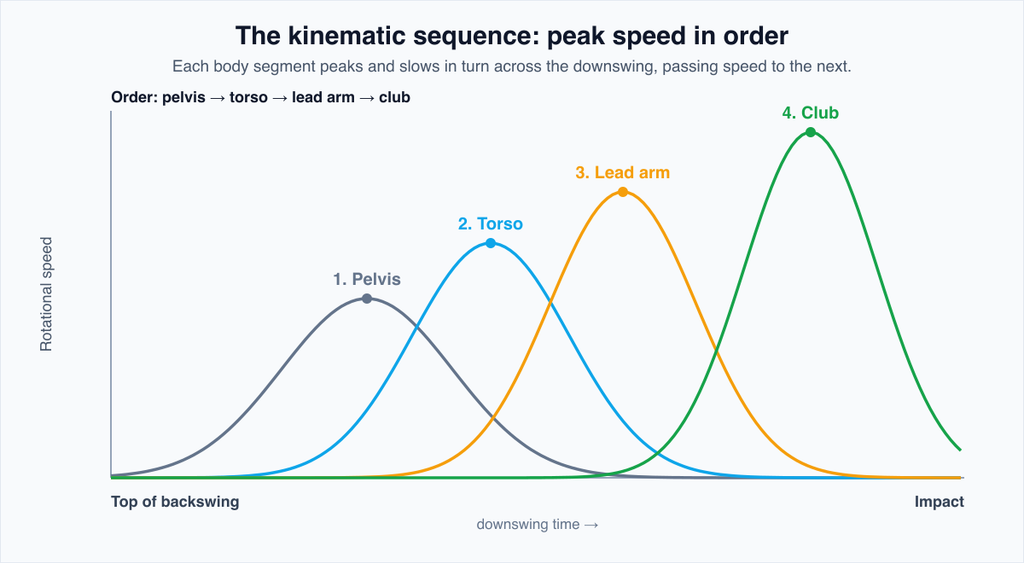
The numbers behind that wave are fast. A kinematic study of professional and amateur golfers measured club-shaft angular velocities near 2,400°/second in the pros during the downswing, with the highest speeds and the cleanest ordering in the best players and progressively worse timing down the handicap ranks. Pelvis speed matters too: research links lower handicaps to faster peak pelvis rotation and stronger glutes, which is the engine that starts the whole chain.
The practical takeaway is simple. Because the pelvis leads and the club follows, you cannot fix the swing by manipulating the club or hands alone. Get the body sequence close and even an unusual-looking swing strikes it well. Get it backward and no amount of hand-timing saves you.
The beginner faults that break the sequence
Most beginner misses are the same problem wearing different clothes: the sequence reversed, or the low point landed in the wrong spot. Here is how the common faults map to a cause and a first fix.
| Fault | What it looks like | Root cause in the sequence | First fix (and where to go deeper) |
|---|---|---|---|
| Over the top | Pull, then slice; steep, outside-in path | Upper body and arms fire before the pelvis | Start the downswing from the ground — over-the-top fix |
| Casting | Weak, high, no compression | Wrists release early, losing shaft lean | Hold the hinge, arrive hands-first — casting fix |
| Early extension | Blocks, thin shots, hips thrust to the ball | Pelvis moves toward the ball, killing arm space | Keep the hips back and rotating — early-extension fix |
| Reverse pivot | Hang-back, fat and thin, weak fade | Weight never loads the trail side, then falls back | Load trail then lead — weight-shift fix |
| Scoop / fat & thin | Chunks and skulls, no divot ahead of ball | Low point behind the ball; hands lag the club | Shift pressure forward, hands lead — fat-and-thin fix |
| Slice | Ball starts left, curves hard right | Open face plus out-to-in path | Square the face, then the path — slice fix |
Notice the pattern in the “first fix” column: the same two moves, a proper pressure shift and a ground-up start, resolve most of the list. That is why chasing faults one at a time is slower than building the sequence. Fix the root and several symptoms leave together.
What the research says about learning a swing
How you practice shapes how well the swing holds up on the course. Three findings from motor-learning research should govern every session.
- Aim your attention at the club and target. Gabriele Wulf’s decades of work, reviewed recently in Psychology of Sport and Exercise, shows an external focus (the club, the target, the divot) produces better performance and faster learning than an internal focus on your own limbs. “Brush the grass ahead of the ball” beats “flex your lead wrist,” even though both aim at the same mechanic.
- Groove first, then vary. Shea and Morgan’s 1979 study established the contextual-interference effect: blocked reps feel productive and improve you fast in the moment, but random, varied practice retains and transfers far better. Beginners need some blocked practice to acquire the movement, then should shift to varied clubs and targets to make it stick. The science behind that pivot is in Block vs Random Practice in Golf.
- Space the sessions. Cepeda and colleagues’ 2006 meta-analysis in Psychological Bulletin documented a large spacing effect (d ≈ 0.78): the same reps spread across the week out-learn one massed session. Three 45-minute sessions beat one 135-minute grind.
Positions are snapshots of a motion that lasts under a second. You learn the motion by training it as a whole, with attention on the club and the target, in short spaced sessions that force you to rebuild the swing each time. — synthesized from Wulf (external focus), Shea & Morgan (contextual interference), and Cepeda et al. (spacing)
This is also why “grooving one position at a time” fails. The swing is a fast, continuous chain; freezing one link teaches your body a stiff, over-controlled move that breaks under pressure. Train the flow.
A build order you can actually run
PracticeCaddie teaches the swing in a sequence-first order, so contact and the pressure shift come before speed and shape. The six steps:
- Build the setup platform (grip, posture, ball position, aim).
- Groove contact with slow, blocked half swings.
- Train the pivot and pressure shift onto the lead foot.
- Add the ground-up sequence feel.
- Set the wrist and forward shaft lean.
- Randomize it and take it to the course.
Work top to bottom. Do not move to speed and shot-shaping until contact is a reliable 6 of 10, because adding speed to a broken low point just grooves the miss faster. If you want the pace of your motion measured while you build it, Golf Tempo Drills: The 3:1 Ratio is the next fundamental worth training, and How to Increase Golf Swing Speed covers adding speed once the sequence is sound.
When to stop reading and get a lesson
Self-teaching gets most golfers to a repeatable, functional swing. Book a lesson when you hit one of three walls: a two-way miss (both a hook and a slice in the same round) that you cannot predict, a pattern that gets worse the harder you swing, or a fault you have drilled for a month with no change on film. A coach with a launch monitor or 3D system diagnoses in one session what guesswork takes months to circle. That is money well spent.
Key takeaways
- The swing is a ground-up sequence. Pelvis, then torso, then lead arm, then club, all inside a fraction of a second. Efficient ball-strikers share this order; most amateurs reverse it.
- Setup is the cheapest fix. Grip, posture, ball position, and aim are static, so nail them first. Everything downstream compensates for a bad setup.
- Pressure shift is the master fundamental. Roughly 80% of your weight on the lead foot by impact moves the low point ahead of the ball and compresses it. It fixes fat, thin, and weak contact at once.
- Feels beat positions. The swing is too fast to steer joint by joint. External cues (club, ball, divot) learn faster than internal ones, per Wulf’s research.
- Practice like the science says. Block to groove, then random to transfer. Space three short sessions across the week rather than one long one (d ≈ 0.78 spacing effect).
- Most faults share a root. Over-the-top, casting, early extension, reverse pivot, and scooping mostly trace to a broken sequence or a misplaced low point. Fix the root and several symptoms clear at once.
Frequently asked questions
How do you swing a golf club for beginners?
Build it in order, and groove contact before speed. Start with a neutral grip, an athletic posture hinged from the hips, and the ball positioned for the club. Then make half swings that brush the grass just ahead of the ball until you can strike it cleanly 6 times out of 10. Only after contact is reliable should you add a full backswing and speed. Learning the swing as one flowing motion beats trying to hit a series of static positions, because the real swing happens in under a second.
What is the correct sequence of the golf swing?
The downswing fires from the ground up: the pelvis starts down first, then the torso, then the lead arm, then the club. 3D motion-capture data from TPI and Athletic Motion Golf shows this order in efficient ball-strikers, and the whole downswing is over in a split second. Each segment speeds up and then slows down in turn, passing energy to the next like a wave down a rope. When the arms or club fire first, the sequence reverses and you get over-the-top slices and weak contact.
How long does it take to learn a golf swing?
Clean contact on half swings is realistic in a few focused weeks. A full swing that repeats under pressure usually takes several months of regular practice, and it never fully stops being maintained. The strongest lever is how you space the work: three 45-minute sessions across a week out-learn one long marathon session, because motor skills consolidate between sessions, not within them. Expect fast early gains in contact, then slower, steadier gains in consistency and distance as the sequence becomes automatic.
Should I learn swing positions or swing feels?
Feels win for most golfers, because the swing is too fast to steer position by position. Motor-learning research from Gabriele Wulf shows an external focus, on the club and the ball flight, produces better results and faster learning than an internal focus on body parts. So ‘brush the grass ahead of the ball’ or ‘push the ground away’ works better than ‘flex your lead wrist 15 degrees.’ Positions are useful as slow-motion checkpoints while you rehearse, but you cannot consciously hit them in a swing that lasts under a second.
What is the most important golf swing fundamental?
Pressure shift with face control. Getting your weight onto the lead foot by impact, roughly 80% for an iron, is what moves the low point ahead of the ball and lets you compress it instead of scooping. Pair that with a clubface controlled by a neutral grip, and most beginner faults shrink at once: fat shots, thin shots, and the weak slice. Almost every damaging miss traces back to hanging on the trail foot or an open face, so those two fundamentals earn your first attention.
Why do I hit the ball fat, thin, or slice as a beginner?
Those misses usually share one root cause: the sequence broke down and the low point ended up in the wrong place. Hanging back on the trail foot moves the low point behind the ball, giving you fat and thin shots. Starting the downswing with the upper body and arms throws the club over the top and across the ball, producing the pull-slice. Fixing the pressure shift and starting the downswing from the ground fixes several misses at once, which is why sequence beats chasing each fault separately.
Can I learn to swing a golf club at home?
Yes for the pattern, with limits on contact. Mirror work, slow rehearsals, and pressure-shift drills all transfer well to a living room, and they build the pivot and sequence that everything else depends on. Rehearse the setup, the ground-up start, and the finish in balance. For actual ball contact you need a net or a mat with real feedback, because swinging into space teaches nothing about strike. Pair 10 minutes of daily rehearsal at home with range sessions for contact and you build the swing faster than range-only work.
Related reading
- How to Grip a Golf Club — the setup fundamental this whole swing is built on; the grip controls the face, and the face controls the ball.
- Golf Stance and Posture and Golf Ball Position by Club — the other two legs of the setup platform that make a good sequence possible.
- Golf Downswing Sequence — the downswing half of this post at full depth; segment order, the 0.23–0.30 second window, ground force timing, and a phone audit for a broken link.
- Ball-Striking Drills for Golf — the low-point and compression drills that turn the sequence in this post into flush contact.
- How to Hit a Driver — the same sequence with the setup changes (ball forward, spine tilted, upward attack) that the longest club needs.
- Strokes Gained Explained for Amateurs — the data that shows why building the full swing pays off more than most putting work.
- Block vs Random Practice in Golf — the motor-learning research behind grooving contact first, then varying reps to make the swing transfer.
- Golf practice drills, organized by skill area — the companion drill library with setup steps and success criteria for every phase above.
- Practice plan by handicap — how much of your time the full swing should get at your level.