
How to Hit a Stinger in Golf: Setup, Technique, and When to Use It
The stinger is golf's low, wind-cheating shot: ball back, hands forward, very low spin, cut-off finish. How to build one, and when it beats a punch shot.

Quick answer
A stinger is a low, penetrating shot that launches under the wind and runs out on landing. You build it by playing the ball back of center, pressing your hands forward to take loft off the club, making a compact three-quarter swing, and cutting the finish off low. It works best into wind, on firm turf, and on tight tee shots. It also needs long-iron speed, so most amateurs score better with a knock-down version.
Which low shot do you actually need
Three shots all fly lower than normal, and they are built differently. Pick the row that matches your situation before you pick a club. The stinger is the hardest and the most distance-preserving; the knock-down is the everyday workhorse; the punch is the escape shot.
| Shot | Trajectory | How you build it | Best for | Who it’s for |
|---|---|---|---|---|
| Stinger | Low launch, low spin, big roll | Ball back, hands forward, very low dynamic loft, shallow strike, cut finish | Keeping near-full distance low into wind; firm tee shots | Strong ball-strikers with long-iron speed (hardest) |
| Knock-down | Low-to-mid, controlled, moderate roll | One more club, ball slightly back, weight lead side, ~80% swing, low finish | Into-wind approaches; holding a number down | Any golfer — the practical everyday low shot |
| Punch | Low, higher spin, stops sooner | Ball well back, big shaft lean, steep down (−10° to −15°), deep divot | Escaping under branches when you need it down then stopped | Any golfer, for recovery and trouble |
The angle-of-attack numbers for the punch come from a punch-versus-knock-down-versus-stinger comparison, which contrasts the steep, high-spin punch against the shallow, low-spin stinger. The rest of this post is about the stinger. If you skipped straight here for a low approach into the wind, the knock-down at the bottom of the club-selection section is probably the shot you actually want.
Why a stinger flies low and runs
The stinger is a compression trick, and the mechanism is loft. Leaning the shaft forward at impact reduces the club’s dynamic loft, the effective loft the face presents to the ball, while the strike stays only slightly downward. That pairing keeps spin loft small, and small spin loft is what produces the low, boring flight.
Spin loft is the difference between dynamic loft and angle of attack, and it is the primary lever on how much the ball spins. Per TrackMan’s spin-rate guide, a larger spin loft produces more spin while a smaller spin loft produces less spin and a higher smash factor. The guide offers a rule of thumb from PGA Tour player Jason Dufner of roughly 1,000 rpm of backspin per club number, so a stock 7-iron spins near 7,000 rpm. Take loft off the club at impact and that number falls.
Low spin is the half of the equation golfers miss. A ball can launch low and still climb: if you hit down steeply but leave near-normal loft on the face, spin loft stays high, and the ball starts low then balloons up, especially into a headwind. A Golf Digest film study of tour stingers makes this the central point, noting that pros need a very low spin loft and achieve it by both hitting down on the ball and delofting the club so the two roughly cancel. Tiger Woods says the same thing in plainer terms in his Golf Digest stinger lesson: he hits down “a little,” and warns that getting “really steep” puts too much backspin on the ball so “it can balloon if there’s any kind of breeze in your face.”
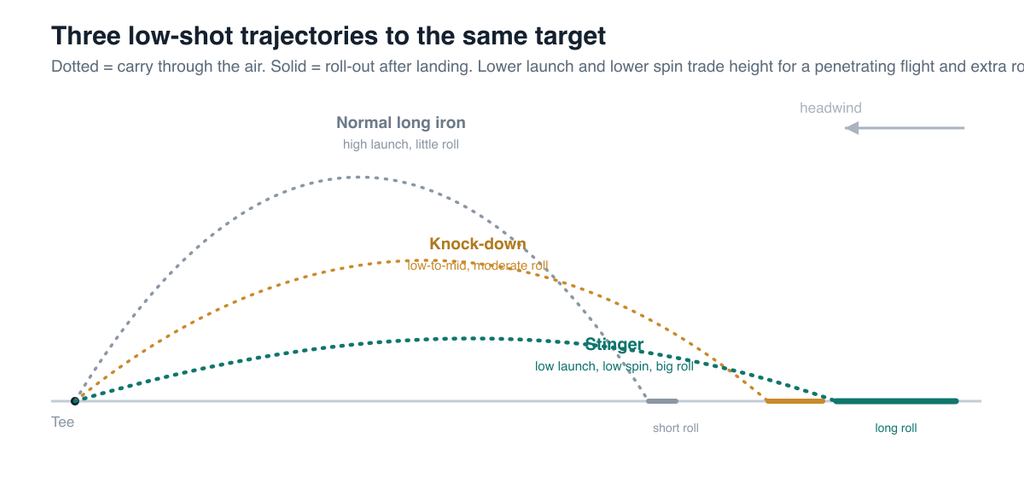
A low, low-spin ball also fights wind better: less backspin means less aerodynamic lift and drag, and the flatter flight spends less time exposed to the wind. That is the whole point of the shot: TrackMan’s launch explainer notes launch angle is governed largely by dynamic loft and angle of attack, and the ball starts very close to where the face points. Control those and you control the flight.
Where the stinger came from
The stinger golf shot is Tiger Woods’s signature. He hit it with a 2-iron off a tee on windy, firm major-championship setups, and his low bullet became the shot every range rat wanted to copy. In his own lesson he describes standing a little closer to cover the ball better, playing it back, keeping his weight forward instead of loading the trail foot, and cutting the finish off fast. He also flags a physical demand most golfers underrate: it “takes good forearm strength to control the club” through that abbreviated finish, and “the lower I want the ball to fly, the faster I’ll stop the swing.”
Henrik Stenson is another low-bullet specialist. He built a career around his 3-wood off the tee, and the PGA Tour once reported that the face of one of his 3-woods had caved in. Watch Stenson’s 3-wood and you see the same picture as Tiger’s iron: a forward-leaning shaft through impact and a flat, driving flight, whatever the club in hand.
The setup: ball back, hands forward, weight left
Most of a good stinger is built before the club moves. Five setup pieces close most of the predictable error, and the first two do the heavy lifting.
| Fundamental | What good looks like | What most amateurs do | First fix |
|---|---|---|---|
| Ball position | An inch or two back of your normal spot | Centered, or shoved way back | Move it back a little, not to the trail foot |
| Hands / shaft | Pressed forward at address, held forward through impact | Handle shoved forward late from a normal grip | Set the forward lean at address so the face stays square |
| Weight | About 60% on the lead side and it stays there | Hanging back to help the ball up | Keep weight forward; the low point works ahead of the ball |
| Backswing | Compact, three-quarter, around 80% effort | Full and fast | Shorten it; control beats speed on this shot |
| Finish | Short, low, arms left, clubhead near the ground | Full, high wrap-around | Cut it off; the lower the target, the shorter the finish |
The single most common setup fault is faking the forward lean. If you take a normal grip and then jam the handle toward the target at the last second, the face opens and the ball leaks right into a weak block or fade. HackMotion’s stinger guide recommends a neutral grip with two knuckles visible and holding the lean through impact rather than flipping, so the face stays square to a slightly in-to-out path and the ball draws a touch. Set the shaft forward when you take your grip, not on the way down.
The swing: compact, covering, cut off
The stinger swing is short, and the shortness is the point. A compact three-quarter backswing at about 80 percent gives you a repeatable low point and a square face, which is worth far more here than the last few miles per hour of clubhead speed.
Through the ball, cover it. Rotate your chest over the ball as your lead side clears, keep the clubhead lagging behind your hands, and strike with a shallow descending blow rather than a steep chop. GOLF.com’s five-step stinger method with mini-tour pro Zac Radford frames it well: keep the arms relaxed with no tension, lead with the hands, and swing “low and left” through impact. Radford notes the descending strike effectively turns a 5-iron into a 4 or even a 3-iron at impact by delofting the face, and that a slightly forward ball position helps minimize spin off the face and adds rollout.
Then cut the finish. Stop the hands soon after impact into a short, low finish with the clubhead staying near the ground. Tiger’s cue is to feel as if you stop the swing immediately after contact, and the more you shorten it, the lower the ball flies. The low finish works as a cue for the delivery: cutting the swing off short helps you rehearse a delofted, hands-ahead strike without an early release.
Club selection and the amateur reality
The classic stinger club is a long iron, and the reason is base loft. A 2, 3, or 4-iron or a driving iron starts with little loft, so delofting it at impact delivers the low launch the shot needs. A wedge can be punched low, but a long iron’s lower base loft is what delivers the classic distance-preserving, running stinger, which is why the shot lives at the long end of the bag.
Here is the honest part. The long iron is exactly the club most amateurs struggle to hit, and the true full-speed stinger asks for tour-level ball speed on top of that. The Golf Digest film study says it directly: most golfers “just don’t have the ball speed to hit a true stinger like these guys.” Arccos’s long-irons-versus-hybrids analysis adds the data: hybrids carry larger, deeper heads and a center of gravity set back to launch the ball higher and make solid contact easier, and golfers hit more greens and hit it longer with a hybrid than a long iron when playing off the deck. Forcing a 2-iron stinger when you cannot flush a 4-iron is a losing trade.
The practical version keeps almost all of the benefit and drops most of the risk: the knock-down. A knock-down breakdown from Rx Golf Network lays out the recipe: take one or two more clubs than the distance calls for, play the ball slightly back, put more weight on your lead leg, choke down, and swing at about 80 percent with a low, dragging finish. The Golf Digest study calls the same move a “stinger-inspired shortcut”: more club, ball back, shaft forward, swing softer. Played with a driving iron or a strong hybrid, that knock-down gets you a low, wind-cheating ball you can actually repeat.
When to hit it, and when to walk away
Reach for a low shot when height is working against you. Four situations point to it:
- Into a headwind or a strong crosswind. A high ball gets knocked down and short into the wind, and shoved offline across it. A low, low-spin shot holds its line and keeps its distance.
- On a tight tee shot. When a fairway matters more than the last 15 yards, a stinger off a long iron or driving iron is a more controlled alternative to a driver for finding the short grass.
- Under overhanging branches. A low runner escapes trouble that a normal trajectory cannot.
- On firm, fast, links-style turf. A low ball that lands running chases extra yards the ground gives you for free.
Walk away when the air is calm and you have room. For most golfers a normal full shot carries a more predictable distance and stops sooner than a shot built to run out. The stinger trades some distance control for wind resistance and roll, so spend it only when that trade pays. And on a tight or bare lie with no wind reason to hit it, the low-percentage delofted strike is not worth the risk over a stock shot. As PracticeCaddie’s course-management guidance puts it, the smart play is usually the shot that keeps the ball in play.
Common mistakes
- Faking the shaft lean. Shoving the handle forward from a normal grip opens the face and leaks the ball right. Set the forward lean when you take your grip and hold it through impact.
- Hitting down too steeply. A steep chop spikes backspin, and the ball balloons up into the wind you were trying to beat. Hit down only slightly and let the forward shaft lean take the loft off.
- Playing the ball too far back. An inch or two back of normal is enough. Jammed against the trail foot, the club meets the ball too early in its arc, the strike gets too steep, and you thin or block it.
- Finishing full. A high, wrap-around finish usually means the club released early and added loft and spin before impact. Cut the swing off low and left; a shorter finish reflects the delofted delivery you want.
- Choosing the wrong club. A wedge or short iron can be punched low, but the higher base loft makes the distance-preserving running stinger harder to produce, and a full-speed 2-iron stinger is a losing bet if you cannot flush the club normally. Match the club to the shot and to your speed.
- Swinging too hard. The stinger is a control shot. Overswinging wrecks the strike and the low point. Compact and 80 percent beats long and violent.
How to practice it: the gate drill
Groove the low flight against a fixed height target, then a fairway-width corridor, so you know the shot is real before you trust it on the course. Two short sessions beat one long one, and a numeric gate beats a vague feel.
- Build the launch on a tee. Tee a long iron or driving iron low and hit 15 to 20 stingers focused only on the low, driving flight: ball back, hands forward, compact swing, cut finish. The tee reduces the turf-interaction variable so you can focus on repeating the delofted contact and abbreviated finish.
- The gate test. Push an alignment stick into the ground about 20 yards ahead and set a second stick or a rope across it at roughly head height, making a low window. Hit 10 shots that must stay under the window and finish inside a fairway-width corridor. Count how many pass both. Treat 6 of 10 as the bar for a course-ready shot, and re-test it every few weeks. Below that, keep it out of your on-course plan and lean on the knock-down.
- Add wind and lies. Once the gate test holds, practice the shot into a real breeze and off fairway lies rather than a tee, changing the target each rep. Performance dips when you add that variability, which is the contextual-interference effect doing its job: variable practice feels worse and transfers to the course far better than grooving one shot off a tee.
PracticeCaddie’s plan builder bakes that progression in: it rotates club, target, and lie across a session, sets a numeric success criterion per drill like the gate test above, and tracks whether the shot is holding up over time. For a full session template to drop the gate drill into, see the golf practice plan guide.
Key takeaways
- The stinger is a loft trick. Forward shaft lean delofts the club so it launches low, and a shallow strike keeps spin loft small so it stays low instead of ballooning. Per TrackMan, spin loft is dynamic loft minus angle of attack, and smaller spin loft means less spin.
- Set the ball back, the hands forward, and the weight left. An inch or two back, shaft leaning at address, roughly 60% weight on the lead side. Build the lean at address so the face stays square.
- Swing compact and cut the finish off. Three-quarter backswing at about 80%, cover the ball, and stop the hands into a low, left finish. The lower you want it, the shorter the finish.
- Hit down only a little. Tiger Woods warns that a steep strike adds backspin and balloons the ball in any breeze.
- Long irons are the classic club, and the hardest. A 2, 3, or 4-iron or driving iron has the low base loft the shot needs, but Arccos data shows most golfers hit more greens and more distance with a hybrid.
- Most amateurs should hit a knock-down. More club, ball slightly back, shaft forward, swing at 80%. A driving iron or hybrid knock-down gets the wind-cheating benefit with far less risk than a full-speed long-iron stinger.
- Use it when height hurts you. Into wind, on tight tee shots, under branches, or on firm turf that rewards roll. In calm air with room, a normal shot stops closer.
- Earn the shot before you spend it. If you cannot pass the gate test 6 of 10 from a tee, keep the stinger out of your round and play the knock-down instead.
Frequently asked questions
What is a stinger in golf?
A stinger is a low, penetrating shot that launches well under a player’s normal trajectory, peaks at a fraction of the usual height, and runs out on landing. It is built by playing the ball back, leaning the shaft forward to take loft off the club, and making a compact swing with an abbreviated finish. Popularized by Tiger Woods with a 2-iron, it is used mainly to cut through wind, hold a tight tee shot in the fairway, or stay under trouble. It keeps close to full distance but on a much flatter flight.
How do you hit a stinger?
Play the ball an inch or two back of center, press your hands forward so the shaft leans toward the target, and keep about 60 percent of your weight on your lead side. Make a compact three-quarter backswing at roughly 80 percent effort, then cover the ball with your chest and strike it with a shallow descending blow, hitting down just slightly rather than steeply. Cut the follow-through off low and left instead of finishing high. The forward shaft lean delofts the club to launch it low, and the short finish is your cue for holding that delivery.
What club should you use for a stinger?
The classic stinger club is a long iron, typically a 2, 3, or 4-iron or a driving iron, because the low base loft makes a low launch easier to deliver. Tiger Woods hit his famous stinger with a 2-iron off a tee. A driving iron or a strong hybrid is a more forgiving choice for most golfers, and Henrik Stenson built a career on a 3-wood version off the tee. A wedge can be punched low, but a long iron’s lower base loft is what produces the classic distance-preserving, running stinger.
Why does a stinger fly so low?
A stinger flies low because the forward shaft lean reduces the club’s dynamic loft at impact while the strike stays only slightly descending, which keeps spin loft small. Spin loft is dynamic loft minus angle of attack, and per TrackMan a smaller spin loft produces less backspin. Low launch plus low spin is what makes the ball bore forward instead of climbing and ballooning. A steep, high-spin strike launches low but then balloons up, so the delofted, shallow-strike combination is what holds the flight down and adds roll.
When should you hit a stinger instead of a normal shot?
Reach for the stinger when height works against you: into a headwind or a strong crosswind where a high ball gets knocked down or pushed offline, on a tight tee shot where finding the fairway matters more than the last 15 yards, under overhanging branches, or on firm links turf where a low runner chases extra yards. When the air is calm and you have room, a normal full shot carries more predictably and stops sooner. The stinger trades a little distance control for wind resistance and roll, so use it when that trade pays.
Can an average golfer hit a stinger?
A true full-speed long-iron stinger is hard, because it needs the clubhead speed to launch a 2 or 3-iron and the strike quality to control a delofted face. A Golf Digest film study notes most amateurs lack the ball speed for the real thing. The practical version is a knock-down: take one or two more clubs, play the ball slightly back, lean the shaft forward, and swing easier at about 80 percent. A driving iron or hybrid knock-down gets most of the low, wind-cheating benefit with far less risk.
Related reading
- How to Hit Long Irons in Golf — the classic stinger club; get comfortable flushing a long iron first, because the stinger is a delofted version of that same strike.
- How to Hit a Fairway Wood — the 3-wood is Stenson’s stinger club off the tee; the shallow, forward-leaning strike here is the low-bullet cousin.
- How to Hit a Hybrid — the forgiving club most amateurs should use for a low knock-down instead of a long iron, per the Arccos data in this post.
- How to Compress the Golf Ball — the shaft-lean and low-spin-loft mechanics behind the stinger, with a launch-monitor scorecard and a 4-week program.
- Golf Ball Position by Club — where the ball sits changes where contact happens relative to the low point; the stinger’s back-of-center position helps you deliver forward shaft lean and less dynamic loft.
- How to Grip a Golf Club — the cornerstone of face control; a neutral grip held through impact is what keeps the delofted face square instead of leaking right.
- Golf Ball Flight Laws Explained — the diagnostic hub for start line and curve, so you can read why a mishit stinger blocks or balloons.
- Golf Course Management Tips — when to take the low, safe shot over the hero shot; the strategy layer that decides when the stinger is the right call.
- How to Hit a Bump and Run — the short-game version of the same idea: minimum air, maximum ground, for when a low runner is the percentage play.
- Block vs Random Practice in Golf — the motor-learning research behind the tee-to-lies practice progression in the gate drill above.
- Golf practice drills that transfer to the course — the companion drill library with setup steps and success criteria to build the gate test into a full session.