
Reverse Pivot in Golf: Causes, Drills, and a 4-Week Fix
A reverse pivot tilts your upper body toward the target at the top, so you hang back and hit it fat, thin, and short. The cause, and the drills that undo it.

Quick answer
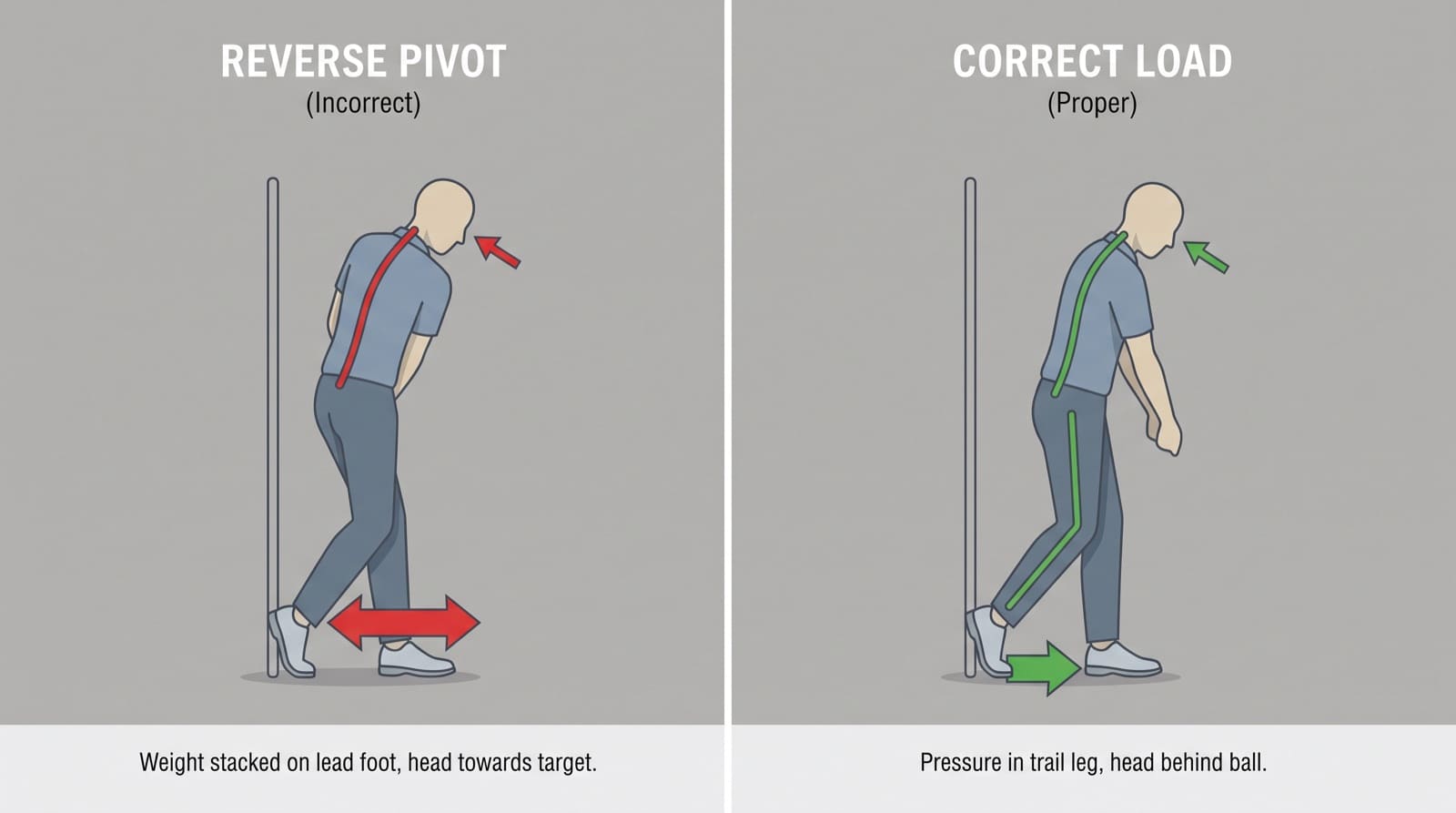
A reverse pivot is a backswing where your weight drifts toward the target and your upper body tilts toward the target at the top, the reverse of a good load. So you hang back coming down, the low point falls behind the ball, and you hit it fat, thin, and short. Fix it in order: tilt away at address, load the trail side, then retrain the downswing shift under varied practice. Give it three to four weeks of structured work before you judge it.
Reverse pivot diagnostic — find your pattern, then your fix
| Your pattern at the top | What you see on video | Root cause | Highest-leverage first fix |
|---|---|---|---|
| The lead-lean | Head and chest tilt toward the target, weight already on the lead foot | “Keep your head still” over-cooked; no trail-side turn | Feet-together drill + trail-glute load |
| The sway-and-tip | Hips slide toward the target as the club goes back | Trying to stay “centered,” so the body sways with little turn | Trail-post drill (load into a braced trail leg) |
| The get-behind-it tilt | Hips slide away from the target, upper body counter-leans toward it | Misreading “get behind the ball” as a lateral slide | Setup tilt away + rotate-in-a-barrel feel |
| The reverse spine angle | Upper spine bends back toward the target, head closer to target than hips | Limited hip or thoracic mobility, so you bend from the low back | Mobility screen first, then setup tilt |
Why a reverse pivot costs you distance and clean contact
A reverse pivot is one of the most expensive faults in the swing because it breaks the two things a golf swing is built to do: load energy, then deliver it. A sound pivot moves pressure into the trail leg during the backswing, then drives that pressure into the lead side before impact, so the club bottoms out in front of the ball. Reverse that order and the bottom of your arc sits behind the ball instead.
The strike side is pure geometry. When your weight hangs back on the trail foot through impact, the low point of your swing moves behind the ball, and TrackMan lists low point among the numbers amateurs should track. Iron contact depends on the club still descending at the ball: TrackMan’s averages put PGA Tour pros around a 3.7-degree downward attack angle with a 6-iron, a strike that only happens when the weight has moved forward. Hang back and that descending blow turns into a fat shot when the club hits the ground first, or a thin shot when you save it and catch the ball’s equator.
The power side is just as costly. Efficient players build speed by shifting pressure toward the lead foot in transition while the body unwinds in sequence, the pattern peer-reviewed work on how amateurs deliver energy to the driver ties to ground force and clubhead speed. A golfer stuck on the trail foot has no stable base to push against, so the arms take over and the ball comes off weak and low.
There is a body cost too. Titleist Performance Institute calls the reverse spine angle that usually rides along with a reverse pivot “one of the prime causes of lower back pain in golfers,” because it loads the lumbar spine while it is bent toward the target. Fixing the pivot protects your back as much as your scorecard.
What a reverse pivot actually is
Strip away the jargon and a reverse pivot is a weight-and-tilt problem. Golf Distillery’s breakdown puts it plainly: the golfer moves body weight “in the opposite way” from the correct pattern, drifting toward the front foot in the backswing and then falling back onto the rear foot in the downswing. Address should start with weight roughly even, load into the trail side going back, then finish almost entirely on the lead leg. A reverse pivot flips the first half, so the second half has nothing to deliver.
The upper body has its own version of the fault, and Titleist instructors gave it a precise name. TPI defines a reverse spine angle as “any excessive upper body backward bend (trunk leaning towards the target)” at the top of the backswing. Their tell is simple: if your head finishes closer to the target than your hips at the top, your spine is tilted the wrong way. That position makes it, in TPI’s words, “very difficult to start the downswing in the proper sequence.”
Good players build the pattern the other way. Their pressure shifts into the inside of the trail foot early, the pelvis moves only a small amount, and the upper spine stays tilted slightly away from the target so the head sits behind the ball. Athletic Motion Golf’s 3D motion-capture work measures that early trail-side pressure spike, with the pelvis moving on the order of an inch and a half, enough to load without swaying. Hold that picture, because the drills below are all built to reproduce it.
What actually causes a reverse pivot
Most reverse pivots are a good instruction taken one step too far. “Keep your head down” and “keep your head still” are the usual culprits: freeze the head over the ball and the only way to complete a backswing is to tip the upper body toward the target while the weight leaks to the lead foot. The cue was meant to stop you lifting, and it welds your pivot in reverse.
“Get behind the ball” backfires the same way. GOLF Top 100 Teacher Tony Ruggiero describes a student who tried to get behind it by sliding his hips backward in the backswing, which destabilized his lower body and forced his upper body to tilt back toward the target to stay balanced. An attempted trail-side load became a lateral slide plus a reverse tilt, the textbook reverse-pivot shape.
The third cause is physical. When your hips or thoracic spine cannot turn far enough, your body finds range of motion wherever it can, and the low back is the easy cheat. Titleist Performance Institute notes that golfers who lack that mobility rotate from the lower back, which leaves the head closer to the target at the top. When a mobility limit is feeding your pivot, drilling the swing without opening it up just installs the compensation deeper, the same lesson that drives the screen-first approach in the early extension protocol.
How to check your own swing in 60 seconds
You can diagnose a reverse pivot with a phone and a wall, no launch monitor required. Film face-on, in landscape, from about hip height, and make one normal swing with a mid-iron. Then scrub to the top of the backswing and freeze.
Look for three things. First, draw a vertical line up from the inside of your trail leg: in a good load your trail leg stays braced and roughly vertical, while a slide pushes it past the line toward the target. Second, check your head against the ball: it should be behind the ball or over it at the top, and never shifted toward the target. Third, compare your shoulders to your hips: your lead shoulder should be lower than your trail shoulder, working down and behind the ball, so the top of your spine tilts away from the target.
If your head has drifted forward, your lead shoulder is high, and your weight looks planted on your lead foot, you have found your reverse pivot. Save that clip. It is your Week 0 baseline, and re-shooting the same frame in four weeks is the honest way to know the fix took.
The drills that fix a reverse pivot
The fastest fixes use a physical constraint so your body discovers the correct load on its own. Run them in order, check your work on video, and treat the rep counts as practical targets to hold yourself to.
1. The feet-together drill (the core constraint)
Stand with your feet touching, make slow three-quarter swings, and try to finish in balance. A sway or a reverse tilt makes you fall off the ball, so the drill forces you to turn around a stable center and load the trail side. Start with no ball, then hit soft half-shots with a 9-iron, aiming for 8 of 10 that finish balanced. It is the highest-leverage drill for a reverse pivot because it removes the slide that feeds the fault.
2. The setup tilt (fix the fault before it starts)
At address, tilt your upper spine slightly away from the target so your lead shoulder sits higher than your trail shoulder, the setup shown in this Titleist tip on driver spine tilt. This pre-sets the head-behind-the-ball look you want at the top and gives your pivot somewhere to go. Rehearse it in a mirror until the tilt feels normal. A reverse pivot that starts from a tilted-forward address never had a chance, so this is half the battle for the lead-lean pattern.
3. The trail-post load (feel the ground)
Push a shaft into the ground just outside your trail hip, or use a chair. As you swing back, feel pressure move into the inside of your trail foot and your trail glute load like the start of a deadlift, without letting your hip drift into the shaft. Hold the feel with an external cue: think “press the trail heel into the ground” rather than “load your hip.” Motor-learning work by Wulf, Lauterbach and Toole (1999) found an external focus produced better golf-shot accuracy and retention than an internal one.
4. The step-through drill (retrain the downswing shift)
Hit shots and let your trail foot step past your lead foot in the follow-through, so your weight has to move onto the lead side through impact. This walk-through finish cures the hang-back directly by rewarding a forward pressure shift. Start at half speed with a wedge and build up. Goal: 8 of 10 shots that finish with your weight stacked on a braced lead leg and the trail foot swinging through.
5. The pump drill (sequence the pressure)
From the top, pump the transition two or three times: feel pressure move into your lead foot while the club stays back, then fire through on the last one. The drill grooves the “shift, then turn” order so the lower body leads and you stop throwing your weight backward. Pair each pump sequence with a normal swing to lock the feel. This is where reverse-pivot work overlaps with the broader weight-shift sequence every solid ball-striker runs.
Don’t over-shift and trade a reverse pivot for a sway
Here is the honest read most reverse-pivot advice skips: aim for a feel, a small braced load into the trail side, and ignore the weight percentages floating around online. Plenty of tips tell you to jam “80% of your weight onto your back foot” at the top, but the trustworthy 3D data points somewhere much smaller. Athletic Motion Golf’s pressure work shows elite players moving the pelvis only about an inch and a half into the trail side, spiking pressure early while the turn does the rest. There is no reliable published percentage for how much weight sits on the trail foot at the top, so anyone quoting one is guessing.
Over-shift and you swap one fault for another. Drive too hard off the ball and your hips slide, which is a sway, and the sway drags the low point around just like the reverse pivot did. The target is a loaded, braced trail leg with the hip turning inside it. When in doubt, favor rotation and keep the move small.
When to stop self-coaching and get screened
Self-coaching handles most reverse pivots. Two situations are worth a session with a TPI-certified coach or a sports physiotherapist.
- A turn you cannot make. When you cannot load the trail side no matter how many feet-together reps you do, a hip or thoracic-mobility limit may be the real bottleneck. A TPI screen isolates which joint is stuck in one visit, and the fix is usually a targeted mobility drill.
- Back pain that shows up with the fault. Reverse spine angle loads the lower back, so if your pivot comes with soreness, get assessed before you drill under speed. Treat the pain as a signal to slow down and get screened.
A single launch-monitor or TPI-screen lesson is a small one-time cost, and it earns its keep when the missing piece is the diagnosis.
Common mistakes
- Fixing the top without fixing address. If you start tilted toward the target, your pivot is already reversed before the club moves. Set the away-tilt first.
- Grinding trail-side load while a mobility limit is locked. If you physically cannot turn, the body keeps cheating from the low back. Screen and open the hips and mid-back first.
- Chasing a weight percentage. Loading too far turns a reverse pivot into a sway. Keep the pelvis move small and favor rotation.
- Only filming face-on once. The fault hides from feel and returns quietly. Re-shoot the same frame every couple of weeks against your baseline.
- Block practice for a month. Same club, same target, 40 balls. The pivot looks fixed on the range and reverts on the first tee. Week three has to go random.
Key takeaways
- A reverse pivot loads your weight toward the target and tilts your upper body toward it at the top, so you hang back and the low point falls behind the ball, per Golf Distillery’s breakdown.
- It feeds fat, thin, and weak shots because the club bottoms out behind the ball and you have no lead-side base to deliver speed.
- The reverse spine angle that rides with it is a prime cause of lower-back pain, according to TPI, so this is a fix for your body as well as your ball flight.
- Diagnose it face-on in 60 seconds with a trail-leg line and a head-behind-the-ball check, and save the clip as your baseline.
- The feet-together drill is the highest-leverage fix because a slide or reverse tilt makes you lose balance: aim for 8 of 10 swings that finish balanced.
- Keep the trail-side load small and braced. AMG’s 3D data shows only about an inch and a half of pelvis shift in elite players, so over-loading just trades the reverse pivot for a sway.
- Transfer beats reps. Random, mixed-club practice from week three carries the fix to the course; use three to four weeks as your first review window and eight to twelve to make it automatic.
Frequently asked questions
What is a reverse pivot in golf?
A reverse pivot is a backswing where your weight drifts onto your lead foot and your upper body tilts toward the target, the opposite of a proper load. A good pivot moves pressure into your trail leg going back, then drives into the lead side coming down. When you reverse it, you hang back through impact and the bottom of your swing arc falls behind the ball. That is why a reverse pivot produces fat shots, thin shots, and a weak, low ball flight that leaks distance.
What causes a reverse pivot?
Usually a swing thought taken too far. ‘Keep your head down’ or ‘stay centered’ can freeze your lower body so you never load the trail side, and the upper body tilts toward the target to compensate. GOLF Top 100 Teacher Tony Ruggiero notes that many golfers also misread ‘get behind the ball’ and slide their hips away from the target, which tips the upper body back the other way. Limited hip or thoracic-spine mobility is the third driver: when you cannot turn, you bend from the lower back.
How can you tell if you have a reverse pivot?
Film your swing face-on, pause at the top of the backswing, and draw a vertical line up the inside of your trail leg. In a good load, your head sits behind the ball, your lead shoulder points down and slightly behind it, and your trail leg stays braced. In a reverse pivot, your head has moved toward the target, your lead shoulder is high, and your weight looks stacked on your lead foot. When the top of your spine sits closer to the target than your hips, that is the classic reverse spine angle.
What is the best drill to fix a reverse pivot?
The feet-together drill, because it makes a slide or a reverse tilt almost impossible. Stand with your feet touching, make slow three-quarter swings, and try to finish in balance; if you sway or tip toward the target, you fall off the ball, so your body learns to turn around a stable center. Start with no ball, then hit soft half-shots with a 9-iron, aiming for 8 of 10 that finish balanced. Widen back to your normal stance and keep the same centered feel.
Is a reverse pivot the same as a reverse spine angle?
They usually show up together, though each describes a different part of the fault. A reverse pivot is the weight error: onto your lead foot in the backswing, then hanging back coming down. A reverse spine angle, as Titleist Performance Institute defines it, is the upper-body version, excessive backward bend so the trunk leans toward the target at the top. Most golfers who reverse pivot show some reverse spine angle too, and TPI calls it a prime cause of lower-back pain, so it is worth fixing for your spine as much as your strike.
How long does it take to fix a reverse pivot?
Use three to four weeks of structured work, two or three sessions a week, as your first review window. Because the reverse pivot is often propped up by a setup habit and sometimes a mobility limit, treat eight to twelve weeks as the horizon for making it automatic. Block practice hides progress: 40 balls with the same club can look cured on the range and fall apart on the first tee. The randomized, mixed-club practice from week three onward is what carries the new pivot onto the course.
Related reading
- Weight Shift in the Golf Swing — the trail-to-lead pressure move a reverse pivot breaks; the positive pattern every drill here rebuilds.
- How to Grip a Golf Club — the setup cornerstone for the whole swing cluster; a neutral grip keeps the hands out of the reverse-pivot rescue move.
- Early Extension in Golf — the other posture-loss fault; the same screen-first logic decides whether mobility or technique leads.
- How to Fix an Over-the-Top Golf Swing — the path fault that often pairs with a stalled, hang-back downswing.
- How to Stop Topping the Golf Ball — the thin-and-top misses a behind-the-ball low point produces.
- How to Increase Golf Swing Speed — where the lead-side drive you rebuild here turns into distance.
- Block vs Random Practice in Golf — why the week-three random phase is what transfers the fix to the course.
- Golf practice drills, organized by skill area — the companion drill library with setup steps and success criteria.
- 30-minute golf practice plan — where the feet-together, step-through, and pump drills fit into a tight session.