
How to Hit a Fairway Bunker Shot: Ball-First Contact, Club Choice, and the Escape Math
A fairway bunker shot is ball-first, not a splash: dig in, choke down, take one extra club, clear the lip. The club math and the escape call, shot by shot.
Quick answer
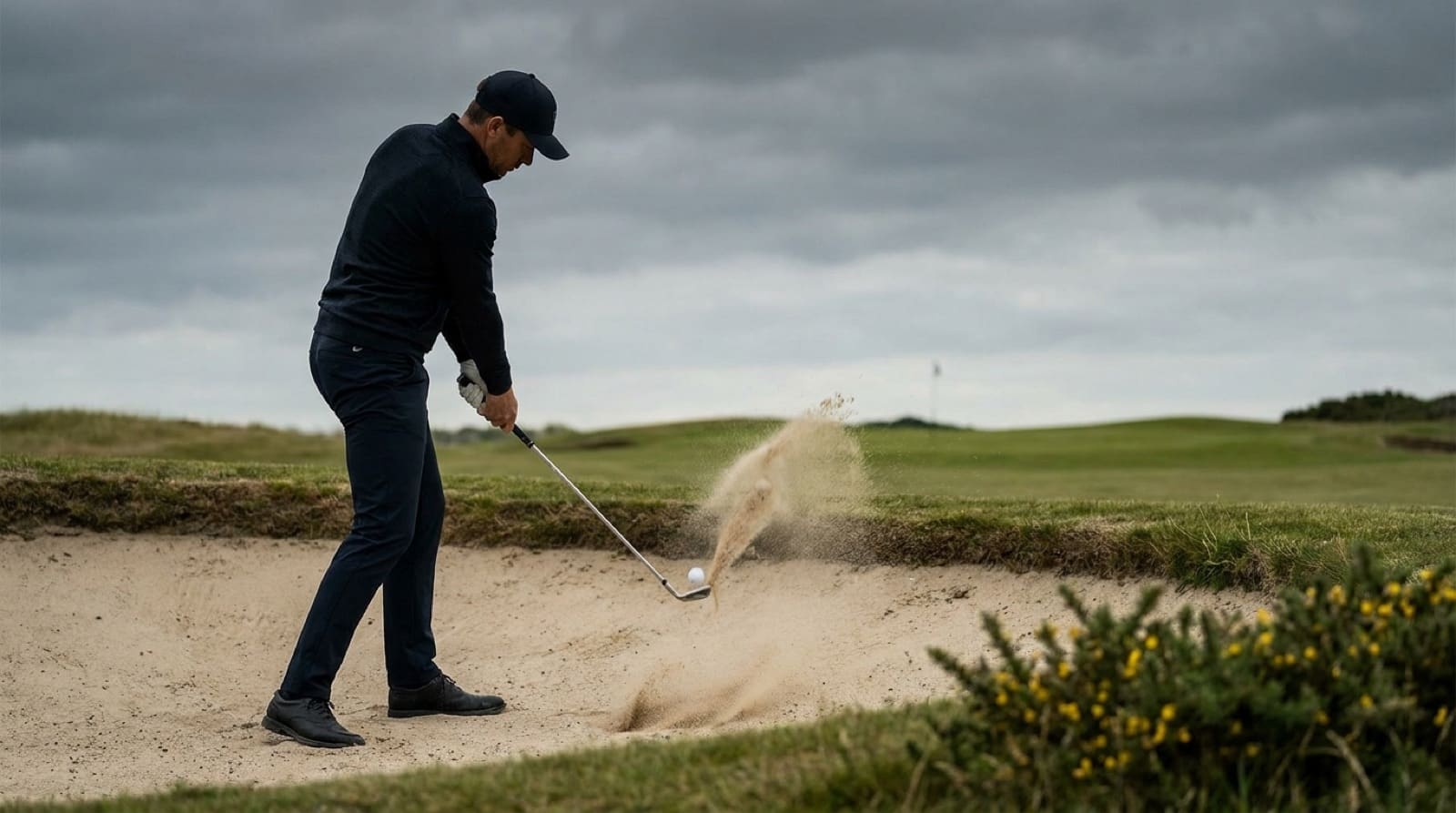
A fairway bunker shot is a clean, ball-first strike, not a greenside splash. Work your feet in for a stable base, choke down about an inch, play the ball center-to-back with 60 percent of your weight forward, and take one extra club that still clears the lip. Swing three-quarters with quiet legs and bias the strike slightly thin. Clearing the lip is priority one — when the lip or lie is bad, lay up, because amateurs hit the green from sand only about 26 percent of the time.
Fairway bunker vs. greenside bunker — opposite strikes
The two sand shots share a name and almost nothing else. Sorting out which one you are hitting is the first decision, because the greenside technique — the one most golfers know — is exactly wrong from a fairway bunker.
| Greenside bunker | Fairway bunker | |
|---|---|---|
| The job | Get it up and soft onto the green | Advance it, ideally to the green or a safe zone |
| Contact | Splash — sand first, an inch or two behind the ball | Clean — ball first, minimal sand |
| Face | Open, extra loft | Square, normal loft |
| Feet | Dug in deep for a low base | Worked in just enough to stop slipping |
| Lower body | Some, to power the splash | Quiet — a slip ruins the strike |
| Club | Highest-lofted wedge | One more club than the yardage, enough to clear the lip |
| Safe miss | A little heavy | A little thin |
Everything below is the fairway-bunker column. If you want the splash shot, the setup and the four-week protocol for it live in How to Hit a Bunker Shot in Golf.
Sand is the most expensive fairway lie in golf
Before the technique, the reason to care. A fairway bunker is one of the costliest places your ball can sit short of a hazard. Shot Scope’s analysis of approach misses found that from 50 to 150 yards, only 4.4 percent of bunker approaches finish within 15 feet, against 14.7 percent from the fairway, and 66.7 percent come up short. Push out to 150–210 yards and it gets bleak: 90.3 percent of bunker shots finish short and none get inside 15 feet.
Golf Monthly, reporting the same Shot Scope dataset, puts the headline number plainly: the average amateur hits the green in regulation just 26 percent of the time from a bunker, versus 55 percent from the rough. Analyst Lou Stagner’s fairway bunker study reaches the same conclusion from the strategy side and reduces it to a mantra — “Hit it long. Avoid sand. Save strokes.” Being in the bunker is worse than being in the rough, and it is not close.
The good news is that most of the damage comes from two avoidable errors: catching sand before the ball, and picking a club that cannot clear the lip. Fix those two and the shot becomes ordinary.
Why you hit the ball first
A fairway bunker shot behaves like an approach shot that happens to start from sand, and the strokes-gained framework treats it that way. Mark Broadie’s PGA Tour research splits sand into two buckets by distance to the green: inside about 30 yards is a greenside bunker, and beyond that it counts as a fairway bunker in the approach category. The goal is distance and proximity, so the strike has to be efficient — and sand caught before the ball is the enemy of efficiency.
The physics is simple. When the leading edge plows into loose sand first, it has to move a mass of particles out of the way, which bleeds energy and slows the clubface before it ever reaches the ball. The result is lower ball speed, a lower launch, and unpredictable spin — the exact combination that leaves the ball short and, worse, buried in the face of the lip. Ball-first contact keeps the strike clean, so the club’s loft and speed launch the ball the way they do from turf.
This is why nearly every good instructor tells you to bias the strike slightly thin. Titleist coach Mark Blackburn’s fairway bunker setup lesson calls it his “secret nugget” — he is deliberately trying to catch the ball a touch thin, out of the bottom groove, because full compression risks catching sand first in this environment. Golf Digest frames it the same way: err on the side of thin, pick the ball off the sand, and accept a slightly low strike over a fat one. Thin advances the ball; fat does not.
Broadie’s difficulty data shows why the penalty for getting it wrong is so steep. Beyond about 34 yards from the hole, the average score from sand is higher than from the rough at the same distance, and even at 25 yards, tour players get up and down 42 percent of the time from sand versus 54 percent from the fairway. Sand is harder at every distance; the strike is what closes or widens that gap.
The setup: five adjustments for ball-first contact
Good fairway bunker contact is mostly a setup problem. Make these five changes and the swing largely takes care of itself.
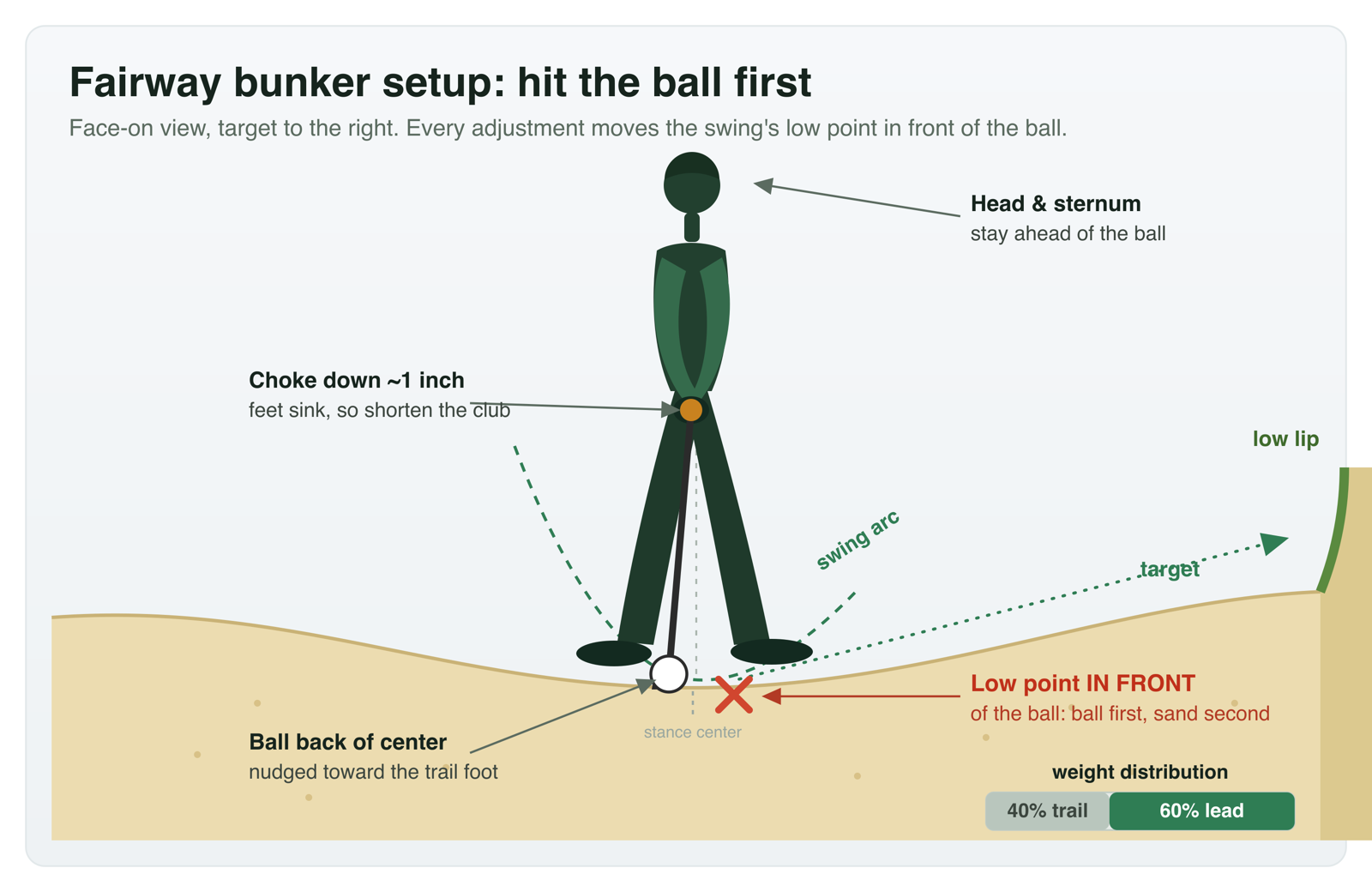
1. Set a stable base, dug in only for grip. Work your feet into the sand just enough to stop them slipping. Golf Monthly and PGA professional Brian Schippel’s fairway bunker lesson both stress a solid, quiet lower body — a slip under load is the single fastest route to a fat or thin miss. Do not dig in as deep as you would for a greenside blast; you want traction, not a trench.
2. Choke down about an inch. Working your feet in lowers your height, so shorten the club to match. Rory McIlroy, in his fairway bunker instruction, says he “always chokes down on the club just to guarantee the strike,” and grips a touch tighter so the clubhead does not twist if it grazes sand after impact. HackMotion’s technique guide makes the same point: dig the feet in, then choke down to match the new position, or you will bottom out too low.
3. Ball center-to-back, weight and head forward. Play the ball center to slightly back of center — middle of the stance for a mid-iron, a touch further back for longer irons. Then set about 60 percent of your weight on the lead side with your sternum and head ahead of the ball. This trio moves the low point of your swing forward, in front of the ball, which is the whole mechanism behind ball-then-sand contact.
4. Stay tall. Blackburn’s image is a “dagger under your chin” that you must not stab by dipping; HackMotion uses a chin resting “on a shelf.” Both cue the same thing: keep your height through the strike. Any downward wobble drops the club into the sand behind the ball.
5. Quiet legs, three-quarter swing. Make a smooth three-quarter swing at roughly 80 percent effort, powered by a full shoulder turn and soft arms rather than leg drive. Schippel prescribes exactly this — a three-quarter backswing and an extra club — because the quiet lower body means you cannot generate full distance and the club has to make up for it.
Club selection: clear the lip, then club up
Club choice is where most fairway bunker rounds are won or lost, and it follows a strict order.
Clearing the lip is priority number one. Golf.com’s fairway bunker guide states it flatly: the higher the lip, the more lofted the club must be, and if you are between clubs, take the more lofted one. A slightly thin strike from sand launches lower than a flush shot from grass, so a club that barely clears a lip from the fairway may catch it from the bunker. When in doubt, more loft.
Then take one extra club. Once lip clearance is safe, club up by one to offset the shorter swing, the forward weight, and the choke-down. Golf Digest’s “Taking Down Fairway Bunkers” makes the same swap: a 7-iron where the shot would call for the 8 from grass. Schippel’s rule is the same: if it is a 9-iron from turf, take the 8. Rory says it plainly — always take more club so you can swing smoother and guarantee the strike, never harder.
Hybrids and woods only earn their place on a clean lie with a low lip. The old rule against long clubs from sand has softened. Blackburn notes that with no lip in front, a 5-wood or hybrid can be easier than an iron, because their cambered, rounded soles glide through sand instead of digging. Golf.com agrees you can “lean on lofted hybrids” when lie and lip allow. On a buried lie or against any real lip, that door closes.
A reachable-distance reality check
Here is the part amateurs skip: the yardage on the sprinkler head is a lie from a bunker. Stagner’s data shows a mid-handicap’s median distance from a fairway bunker is roughly capped regardless of the number on the pin — a 10-handicap from 140–149 yards has a median distance of about 125 yards, and hits about the same distance from anywhere in the 130–209 yard range. You are not going to reach a 200-yard green from a bunker with your normal 200-yard club. Club up, aim at the fat of the green or a comfortable layup number, and let the reachable distance — not the hopeful one — pick your target.
The escape decision: go, lay up, or pitch out
The hardest fairway bunker skill is a decision: whether the green is even on the table. Two variables settle it — the lip and the lie — and the following is our own read on how they combine, built to turn Broadie’s cost-of-a-bad-lie math into a call you can make in ten seconds over the ball.
| Lie \ Lip | Low lip | Tall lip |
|---|---|---|
| Ball sitting up, clean | Go. Club up one, clear the lip, play a normal advancing shot to the fat of the green. | Escape mode. Take the loft that clears the lip even if it will not reach the green; advance as far as the lip allows. |
| Nestled / slightly down | Advance conservatively. One extra club, expect a lower, shorter result, aim safe. | Lay up. Wedge or short iron that clears the lip and returns you to short grass at a full number. |
| Buried / plugged | Chunk it out. Square a lofted club, take plenty of sand, and advance it back to safety. | Pitch out sideways. Get the ball back to the fairway; do not flirt with the lip or a hazard. |
The strokes-gained logic behind the bottom-right cells is decisive. When only about 26 percent of amateur bunker shots find the green anyway, and 90 percent finish short from long range, an aggressive attempt at a bad lie is a low-odds, low-reward gamble. Golf.com’s advice on a buried ball is to “take your medicine and chunk the ball out”; Schippel’s is to “put a wedge back in the fairway” and try to get up and down. A conservative escape caps your loss at roughly the half-stroke the bunker already cost you. A failed hero shot that stays in the sand — or finds water — pays that price twice.
This is the same recovery-lie math that governs trees and other trouble; the framework behind it is in Strokes Gained Explained for Amateurs, and the wider on-course version lives in Golf Course Management Tips.
Common mistakes
Trying to lift the ball out. The instinct to help the ball over the lip — scooping, hanging back, flicking the wrists up — moves the low point behind the ball and produces the fat shot you were afraid of. Trust the loft. Golf.com’s cue is to make a normal pivot and let the club do the work, not to react to the lip on the way down.
Too much lower body. Leg drive that works on firm turf invites a slip in sand, and a slip guarantees a mishit. McIlroy plays it deliberately “flat-footed” with quiet legs; Schippel warns the trail foot can slip if you use it for power. Turn your shoulders, keep your feet planted.
Over-clubbing into the lip. Seeing 175 to the pin, grabbing the 175 club, and trying to ram it out of a bunker with a tall lip in front is how a manageable bunker becomes a double bogey. Check the lip before the yardage. If your reaching club will not fly the lip, it is the wrong club.
Fat and thin contact. Both come from a mismanaged low point. Fat is the low point behind the ball — usually from dipping or hanging back. Thin past the point of usefulness is the head lifting early. The center-to-back ball position, forward weight, and tall chest fix both, and a slightly thin strike is the intended result, not a fault.
Practice it before you need it
Two things make fairway bunker contact trainable rather than hopeful.
Draw a low-point line. HackMotion’s low-point line drill is the whole shot in one rep: draw a line in the sand, set a ball on it, put 60 percent of your weight on the lead leg with the ball slightly back, and practice striking the sand at or just after the line. If your divot starts before the line, your low point is behind the ball — the fat pattern. The sand shows you the truth on every rep, which is why it beats any swing thought.
Vary every rep. Ten fairway-bunker 7-irons in a row will flatter you and vanish on the course. Alternate lies and clubs — clean lie, nestled lie, different lips, different targets — so every rep forces a fresh read and setup, exactly what the course asks. The motor-learning reason blocked reps flatter you while varied reps transfer is laid out in Block vs Random Practice in Golf.
If you would rather build the session yourself, the golf practice plan guide and the driving range practice plan both have room for a ball-first contact block.
Related reading
- How to Hit a Bunker Shot in Golf — the greenside splash shot this post is the mirror of: open face, sand-first, and a four-week protocol to double your sand saves.
- How to Grip a Golf Club — the pillar for this cluster; a firm, square grip is what keeps the delofted, ball-first strike from twisting in the sand.
- How to Hit Irons — the descending, ball-first strike a fairway bunker shot borrows, club by club, on flat ground first.
- How to Compress the Golf Ball — the low-point-ahead-of-the-ball mechanic underneath clean contact, with the launch-monitor numbers.
- How to Hit Off Uneven Lies — bunkers are rarely flat; the slope adjustments stack on top of the ball-first setup here.
- How to Hit a Punch Shot in Golf — the other escape shot, and the same recovery-lie math for deciding whether to advance or bail.
- Strokes Gained Explained for Amateurs — why a fairway bunker costs about half a stroke and why the lay-up is often the higher-value play.
Key takeaways
- Hit the ball first. A fairway bunker shot is a clean iron strike; caught sand steals ball speed and launch, and a fat one rarely clears the lip. Bias slightly thin, per Golf Digest and Blackburn.
- Set up for a forward low point. Feet worked in for traction, choke down about an inch, ball center-to-back, 60 percent of your weight forward, head ahead, stay tall.
- Clear the lip first, then club up. Loft to fly the lip is priority one; one extra club offsets the quieter, shorter swing. When between clubs, take more loft.
- Your reachable distance is shorter than the pin says. Stagner’s data shows a 10-handicap’s median from 140–149 yards in sand is about 125 yards, and roughly flat across 130–209 yards. Aim at what you can reach.
- Sand is the costliest fairway lie. Amateurs hit the green 26 percent of the time from a bunker versus 55 percent from the rough (Shot Scope via Golf Monthly); even tour pros hit it only just over 50 percent of the time.
- Read the lip and the lie, then decide. Clean lie and low lip: go. Buried lie or tall lip: lay up or pitch out. A failed hero shot that stays in the sand costs far more than a conservative escape.
- Quiet the lower body. Leg drive invites a slip; play it flat-footed with a full shoulder turn, as Rory McIlroy does.
Frequently asked questions
How do you hit a fairway bunker shot?
You hit it ball-first, like a clean iron off turf, not with a greenside splash. Work your feet into the sand for a stable base, choke down about an inch, play the ball center to slightly back, and put roughly 60 percent of your weight on the lead side with your head ahead of the ball. Take one extra club that still clears the lip, keep your legs quiet, and make a smooth three-quarter swing. The safe miss is a touch thin, never fat behind the ball.
What is the difference between a fairway bunker shot and a greenside bunker shot?
They are opposite strikes. A greenside bunker shot is a splash: you open the face and hit the sand an inch or two behind the ball so a cushion of sand lifts it out soft and high. A fairway bunker shot is a clean, ball-first strike, because you need distance and any sand caught before the ball dumps speed and launch. Greenside play uses the sand as the impact medium; fairway bunker play avoids the sand and catches the ball first, closer to how you hit an iron off grass.
Why do you hit the ball first in a fairway bunker?
Because sand caught before the ball steals distance and height. When the leading edge plows through loose sand first, it displaces particles and decelerates the clubface, so the ball comes off slower and lower, often failing to clear the lip. Ball-first contact keeps the strike efficient, so the club’s loft and speed launch the ball the way they would from turf. Golf Digest sums up the mindset as erring on the side of thin, picking the ball off the sand rather than digging into it.
What club should you use from a fairway bunker?
Start with the lie and the lip, not the yardage. Clearing the lip is priority one, so choose a club with enough loft to fly the lip on a slightly thin strike; if you are between clubs, take the more lofted one. Once lip clearance is safe, club up by one, because the quieter, shorter swing costs distance. Lofted hybrids and higher fairway woods with cambered soles can work on clean lies with a low lip, but on a buried lie or a tall lip, a wedge back to the fairway is the smart play.
How much distance do you lose from a fairway bunker?
More than most amateurs expect. Analyst Lou Stagner’s shot-tracking data found that a 10-handicap from 140 to 149 yards in a bunker has a median distance of about 125 yards, and that players around that level hit roughly the same distance from anywhere in the 130 to 209 yard range. In practice you cannot scale distance from sand the way you can from grass, so club up, aim for the fat part of the green or a safe layup zone, and treat the yardage on the sprinkler head as optimistic.
When should you lay up from a fairway bunker instead of going for the green?
Lay up or pitch out whenever the lip, the lie, or the distance makes the green a low-percentage target. Amateurs hit the green from a bunker only about 26 percent of the time, versus 55 percent from the rough, per Shot Scope data, and from 150 to 210 yards, 90 percent of bunker shots finish short. If the ball is buried, the lip is tall, or you would need your longest club, move the ball back to short grass and take your medicine. A failed hero shot that stays in the sand costs far more than a conservative escape.
Where should the ball be in your stance for a fairway bunker shot?
Center to slightly back of center. For a mid-iron, play it roughly in the middle of your stance; for longer irons, move it a touch further back to guarantee the club reaches the ball before the sand. Pairing that ball position with about 60 percent of your weight on the lead side and your head ahead of the ball shifts the low point of the swing in front of the ball, which is what delivers clean, ball-then-sand contact instead of a fat strike behind it.