
How to Hit a Punch Shot in Golf: The Escape Shot and the Wind Shot
The punch shot is golf's escape club: more club, ball back, hands ahead, three-quarter swing, low finish. The wind math, and when to call on it over a fade.
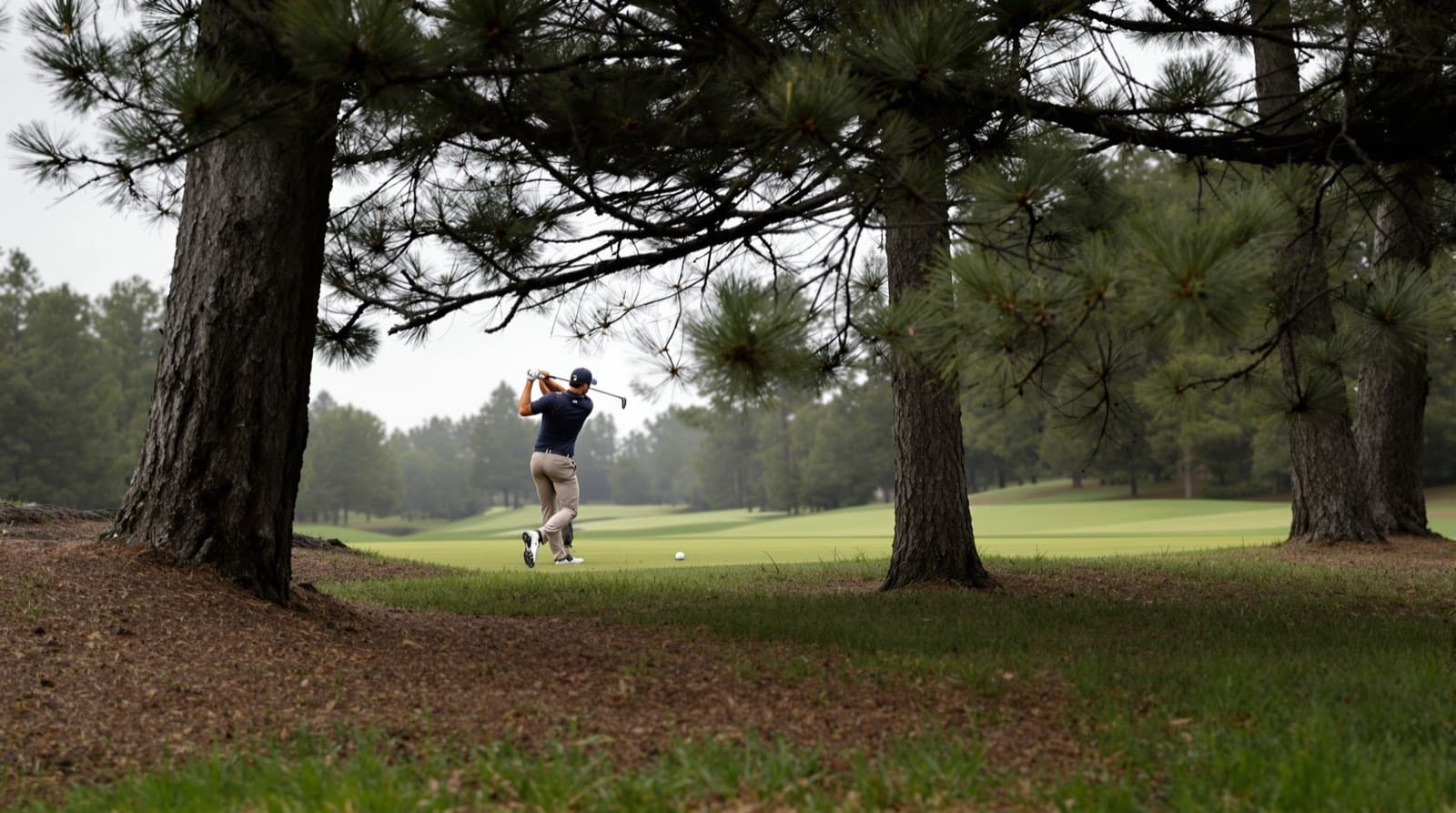
Quick answer
A punch shot is a deliberately low iron shot used to escape trouble or beat wind. Take more club, play the ball an inch or two back, press your hands forward, choke down, swing three-quarters at 70 to 80 percent, and cut the finish off low. Expect about 10 yards less than a full shot in calm air. The low, low-spin flight is what makes it hold its line into wind.
The three jobs a punch shot does
The same shot solves three different problems, and each one sets a different dial. Decide which job you are doing before you pull a club — it changes the loft you can afford and how much distance you are allowed to give away.
| Job | The constraint | Club choice | Swing | Distance matters? |
|---|---|---|---|---|
| Escape — out of trees, under branches | A hard ceiling and a narrow gap | Lowest loft that still clears the first obstacle | Half to three-quarter, very low finish | No — safety only |
| Wind — into a headwind or crosswind | Apex and spin, not obstacles | One to two extra clubs, less loft | Three-quarter, 70–80% effort | Yes — you still want the green |
| Control — firm turf, tucked pin, awkward number | Roll-out and spin | One extra club, choke down | Three-quarter, smooth | Yes — precision over power |
Everything below is the same technique tuned to whichever row you are in. If your ceiling is open and only the wind is a problem, you want the middle row — the knock-down — and most of this post’s setup still applies at a milder dose.
Why a punch shot flies low
The punch is a loft trick, not a swing-hard trick. Leaning the shaft forward at impact reduces dynamic loft, the effective loft the face actually presents to the ball, and lower dynamic loft is what produces a lower launch. TrackMan defines dynamic loft as the vertical orientation of the clubface at maximum compression, and notes the two failure modes directly: too much dynamic loft sends the ball too high and costs distance, while too little sends it too low and leaves you with excessive roll-out that is hard to control.
The second half of the mechanism is spin. TrackMan’s spin-loft guide defines spin loft as the angle between the clubhead’s direction of travel and the face orientation at impact, well approximated by dynamic loft minus attack angle. Higher spin loft produces more spin and a lower smash factor; lower spin loft produces less spin and more efficient energy transfer. The punch setup narrows spin loft by delofting the face while keeping the strike descending, so the ball comes off lower and with less backspin.
Low spin is the part amateurs miss. A ball can launch low and still climb: hit down steeply with normal loft still on the face and spin loft stays high, so the ball starts low, then rises and stalls. That is the ballooning miss, and it is worst into wind.

The setup: six dials, in order
Every credible instruction source converges on the same recipe with different vocabulary. MyGolfInstructor’s knockdown guide lists six steps — more club, ball back, weight forward, choke down, slower rotation, low finish — and David Leadbetter’s punch-out lesson gives essentially the same sequence with harder numbers: at least two clubs more, choke down at least two inches, ball about two inches back, a three-quarter or half swing, and a short follow-through.
Club. Take more than the yardage says. Leadbetter’s caveat is the one golfers skip: the club still has to have enough loft to clear whatever sits immediately in front of the ball. Instructor Mel Sole makes the same point about hitting under branches in his knockdown tip, where he deliberately avoids a 3 or 4-iron and uses a 5-iron instead, because a very straight-faced club delofted further at impact may never get the ball off the ground.
Ball position. An inch or two back of normal. Moving the ball back means the club reaches it earlier in the arc, before the low point, which delofts the face and steepens the strike. It also shifts your club path to the right for a right-hander — coach Tyler McGhie’s TrackMan demonstration of flighted irons shows a path as much as 7 degrees right with an 8-degree downward attack angle from a ball-back setup, which is why punch shots so often come out as low draws. Aim for that curve rather than fighting it.
Hands and weight. Handle forward toward the inside of the lead thigh, about 60 percent of your weight on the lead side, sternum over or slightly ahead of the ball. Sole calls hands-leading impact the whole secret: let the clubhead pass the hands and the loft comes back, the ball goes up, and it hits the branch you were trying to avoid.
Grip and stance. Choke down an inch or two and narrow the stance slightly. Choking down shortens the lever and removes speed without you having to think about slowing down, which is far more reliable than trying to swing softly at full length.
Swing length and effort. Three-quarters back, 70 to 80 percent effort, soft arms. Todd Kolb’s low punch lesson frames the mistake directly: golfers facing a 125-yard shot into wind grab their usual 9-iron and try to rip it, the ball shoots straight up, and the wind eats it. Less loft and less effort beats the same loft and more effort every time.
Finish. Chest height or lower, clubhead below the hands. The low finish is a checkpoint, not a style choice — a high finish usually means the release already happened.
The wind math
Two numbers are worth carrying in your head. The traditional heuristic, endorsed by MyGolfInstructor, is one extra club per 10 mph of headwind. Coach Andrew Rice’s tested wind formula is more granular: a headwind adds roughly one yard per mph per 100 yards of shot, and a tailwind gives back only about half that. His worked example is a 140-yard shot into a 20-mph headwind, which plays like about 168 yards — and then he takes one more club on top of that and plays a knock-down.
That last step is the interesting one. Rice adds club specifically so he can swing shorter, because wind performance is highly sensitive to trajectory and higher shots are punished far more than lower ones.
| Shot | Headwind | Plays like (Rice formula) | Club plan |
|---|---|---|---|
| 140 yd | 10 mph | ~154 yd | Club for 154, then one more, knock-down |
| 140 yd | 20 mph | ~168 yd | Club for 168, then one more, knock-down |
| 180 yd | 15 mph | ~207 yd | Club for 207, then one more, knock-down |
| 140 yd | 10 mph tailwind | ~133 yd | Club for 133, expect extra roll-out |
The asymmetry — headwind hurting roughly twice as much as tailwind helps — is physics, not folklore. Drag rises with the square of relative airspeed, so as the Golf Science Journal notes in its review of wind effects, doubling the ball’s speed relative to the air roughly quadruples the drag force. A headwind adds the wind’s speed to the ball’s effective airspeed for the entire flight; a tailwind subtracts it, but the ball is decelerating and descending anyway, so the gain shows up mostly as extra roll rather than extra carry. Headwinds also raise apex and steepen landing angle, which is exactly what a punch shot is built to prevent.
The escape decision: what it costs to be in the trees
This is where the punch shot stops being a technique question and becomes a scoring one. Mark Broadie’s PGA Tour strokes-gained analysis puts a number on a recovery lie. In his own words:
“Most recovery shots are in the range between 150 and 300 yards from the hole. In this range, the average number of strokes to complete the hole is 0.6 strokes greater from a recovery position than from the fairway and 0.4 greater than from the rough.”
— Mark Broadie, professor at Columbia Business School and author of Every Shot Counts, “Assessing Golfer Performance on the PGA TOUR”
Those are tour players, whose recovery skills are better than yours.
Read that as a price tag. Being blocked out costs a little over half a shot once. The failure mode that wrecks scorecards is paying it twice — the hero shot that clips a trunk and leaves you in the same trees, or finds a hazard and adds a penalty on top. A conservative punch that returns the ball to short grass caps your loss at roughly that 0.6; a failed hero shot uncaps it.
The three-number window test
The honest read on most trouble shots is that golfers pick the club first and discover the window afterward. Here is the check to run in the other order — three numbers, measured before you touch a club. This is our own framing, built to make Broadie’s recovery penalty actionable rather than abstract:
- Ceiling. How high can the ball get before it hits something? Estimate in club lengths above the ball, not in feet. Under two club lengths at the point where the ball will be passing the obstacle means escape mode, full stop.
- Gap. How wide is the corridor at the narrowest point, and how far away is that point? A gap you would confidently hit from the tee at 10 yards becomes a coin flip at 60.
- Carry to safety. Not carry to the green — carry to the nearest patch of short grass with a clean next shot. This is usually far shorter than golfers assume, and it is the only distance that has to be true.
If all three numbers are comfortable, play the shot you want. If any one of them is marginal, the punch to safety is the play, and the strokes-gained math says the difference between a good escape and a great one is small compared with the difference between escaping and not.
| Situation | Ceiling | Gap | Play |
|---|---|---|---|
| Under one low branch, open ahead | Tight | Wide | Punch forward, low-lofted iron, full escape distance |
| Deep in trees, several trunks | Tight | Narrow | Punch sideways to the fairway, mid-iron, distance irrelevant |
| Light rough, clear line, windy | Open | Wide | Knock-down at the green, one extra club |
| Behind a trunk, hazard long | Tight | Narrow | Punch backwards or sideways; do not flirt with the hazard |
Course-strategy context for this decision lives in Golf Course Management Tips, and the framework behind the numbers is in Strokes Gained Explained for Amateurs.
Punch, knock-down, or stinger?
The three shots differ by degree, not by kind. All three deloft the face and shorten the swing; they differ in how far they push each dial.
| Knock-down | Punch | Stinger | |
|---|---|---|---|
| Primary use | Approach into wind | Escape from trouble | Tee shots and long approaches into wind |
| Extra club | One | Two or more | Varies — long iron or driving iron |
| Ball position | Slightly back | An inch or two back | Back of center |
| Swing | Smooth three-quarter | Half to three-quarter | Compact, ~80% effort |
| Finish | Low | Very low, cut off | Cut off low and left |
| Trajectory | Low-to-mid | Low | Very low, very low spin |
| Distance kept | Most of it | Whatever is left over | Near full |
| Difficulty | Easy — any golfer | Moderate | Hard — needs long-iron speed |
The stinger is the hardest of the three and needs long-iron speed most amateurs do not have. If you have been trying to hit one and getting a ballooning 4-iron instead, read How to Hit a Stinger for the full breakdown of that shot, then come back and use the punch for the situations that actually show up on your card.
Common mistakes
Swinging harder into the wind. The most expensive mistake in this entire post. Extra speed with an unchanged release adds dynamic loft and spin, and the ball climbs. Take more club and swing softer.
Leaving the ball forward. A shortened swing with a normal ball position still delivers normal loft. Ball position is doing most of the work here, so if you only change one thing, change that.
Flipping the clubhead past the hands. This undoes every other adjustment in a hundredth of a second. Both Leadbetter and Sole flag it as the failure that sends the ball into the branch.
Aiming straight at a narrow gap. A ball-back setup tends to shift path right for a right-hander, so the low punch often draws. McGhie’s TrackMan numbers show that path moving as much as 7 degrees. Aim for the curve you are actually going to hit.
Picking a club with too little loft. The 3-iron that will not clear the first branch is not a low shot, it is a second penalty. Sole’s 5-iron rule is the safer default.
Never practicing it. Sole’s observation is that almost nobody practices trouble shots on the range, which is why the shot feels foreign the one time per round it is needed.
How to practice the punch shot
Two things make this trainable rather than hopeful.
Use a physical gate. Titleist’s wedge trajectory drill builds a gate roughly 4.5 feet high and 7 feet in front of the ball out of alignment sticks and a pool noodle, then asks the player to launch under it. Raise or lower the gate to represent the ceiling you want to train. The constraint does the coaching — you cannot fake your way under a noodle, and you will find the ball position and shaft lean that work faster than any swing thought will get you there.
Interleave it, do not block it. Hitting thirty punch 7-irons in a row will look great on the range and disappear on the course. The contextual-interference research — Shea and Morgan’s 1979 study is the classic — found that random practice orders produce worse performance during practice and better retention and transfer afterward. Alternate: full 7-iron, punch 7-iron under the gate, knock-down 8-iron, full wedge. Each switch forces you to reselect the setup, which is exactly what the course asks. The full argument is in Block vs Random Practice in Golf.
A workable session is 30 balls: 10 full shots, 10 punches under a gate with three different clubs, and 10 alternating unpredictably between the two, calling the shot out loud before each one.
Build it into a real practice plan
If you would rather build the session yourself, the golf practice plan guide and the driving range practice plan both have templates with room for a trajectory-control block.
Related reading
- How to Hit a Stinger in Golf — the extreme version of this shot: long iron, very low spin loft, near-full distance, and an honest assessment of who can actually hit it.
- How to Grip a Golf Club — the pillar for this whole cluster; grip pressure and face control decide whether a delofted punch stays on line.
- How to Compress the Golf Ball — the physics underneath the punch: forward shaft lean, low point ahead of the ball, and what low spin loft actually does at impact.
- Golf Ball Flight Laws Explained — why a ball-back punch draws, and how to read your start line and curve to fix it.
- How to Hit Irons — the descending strike and ball-first contact the punch depends on, club by club.
- How to Hit Off Uneven Lies — trouble shots rarely come from flat ground; the setup adjustments for slope stack on top of the punch setup.
- Golf Course Management Tips — the wider decision framework the escape math sits inside.
Key takeaways
- The punch is a loft trick, not a speed trick. Forward shaft lean lowers dynamic loft, which lowers launch, and narrower spin loft lowers spin. TrackMan’s spin-loft definition is the mechanism.
- Take more club, not more effort. At least one extra for a knock-down, two or more for a genuine escape, per Leadbetter.
- Expect about 10 yards less than a full shot with the same club in calm air, from McGhie’s TrackMan comparison — then calibrate your own number on a range session.
- Wind hurts about twice as much as it helps. Rice’s formula: a headwind adds roughly 1 yard per mph per 100 yards, a tailwind gives back half.
- A recovery lie costs about 0.6 strokes versus the fairway and 0.4 versus the rough at 150–300 yards on the PGA Tour, per Broadie. Pay it once, not twice.
- Run the three-number window test — ceiling, gap, carry to safety — before choosing a club, and let any marginal number push you to the conservative escape.
- Ball-back setups draw. McGhie measured path shifting up to 7 degrees right; aim for the curve rather than fighting it.
- Practice it under a gate, interleaved with full shots. Shea and Morgan (1979) is the reason blocked reps flatter you and random reps transfer.
Frequently asked questions
What is a punch shot in golf?
A punch shot is an iron shot played deliberately low, with a shortened backswing, a delofted clubface, and an abbreviated follow-through. It is used to escape from under trees, to fly through a narrow gap, or to keep the ball beneath a strong wind. You build it by taking extra club, moving the ball back of center, pressing the hands forward, choking down on the grip, and swinging at roughly 70 to 80 percent with a low finish.
What is the difference between a punch shot and a knockdown?
They sit on the same spectrum and differ by degree. A knockdown is a mild trajectory reduction used on approach shots to hold a number down in wind, usually one extra club and a smooth three-quarter swing. A punch is the more aggressive version used to escape trouble: two or more extra clubs, the ball further back, more forward shaft lean, and a shorter, lower finish. A knockdown still targets a green; a punch mostly targets safety.
How much distance do you lose on a punch shot?
In calm conditions, a punch shot with a given club travels roughly ten yards shorter than a full swing with the same club, according to a TrackMan-based comparison from coach Tyler McGhie. That is a starting estimate, not a personal number, because the loss depends on how far you shorten the swing. Into a headwind the arithmetic can flip, since the lower, lower-spin flight resists wind better than a full shot that balloons and stalls.
How much club should you take into the wind?
The common rule of thumb is one extra club for every 10 mph of headwind. Coach Andrew Rice’s tested wind formula is more precise: a headwind adds roughly one yard per mph per 100 yards of shot, while a tailwind subtracts about half that. A 140-yard shot into a 20-mph headwind plays near 168 yards. Rice then takes one more club on top of that number and plays a knock-down, because low flights lose less to wind.
Why does swinging harder into the wind make it worse?
Swinging harder usually adds dynamic loft and spin rather than distance, because most golfers release the club more aggressively when they speed up. Per TrackMan, spin loft is roughly dynamic loft minus attack angle, and more spin loft produces more spin. More spin plus a higher launch means more lift and a higher apex, so the ball spends longer in the part of the flight where a headwind does the most damage. It climbs, stalls, and lands short.
Should you punch out sideways or try the hero shot?
Usually punch out. Mark Broadie’s PGA Tour strokes-gained data shows that between 150 and 300 yards, a recovery lie costs about 0.6 strokes more than the fairway and 0.4 more than the rough. That is the price of being in the trees once. A failed hero shot that leaves you in the trees again, or in a penalty area, pays that price twice or worse. Take the punch when the gap is narrow, the ceiling is low, or the miss is a hazard.
What club is best for a punch shot?
Pick the lowest-lofted club that still clears whatever sits immediately in front of the ball. For most escape shots that means a 5, 6, or 7-iron rather than a 3 or 4-iron. Instructor Mel Sole makes exactly this point about hitting under branches: a very straight-faced club, delofted further at impact, may not get the ball off the ground at all. Under an open sky with only wind to beat, drop to a longer iron and take extra club instead.