
How to Fix a Hook in Golf: Causes, Drills, and a 4-Week Plan
A hook means a clubface closed to your swing path. What actually causes that mismatch, the drills that correct it, and a 4-week plan that makes it stick.
Quick answer
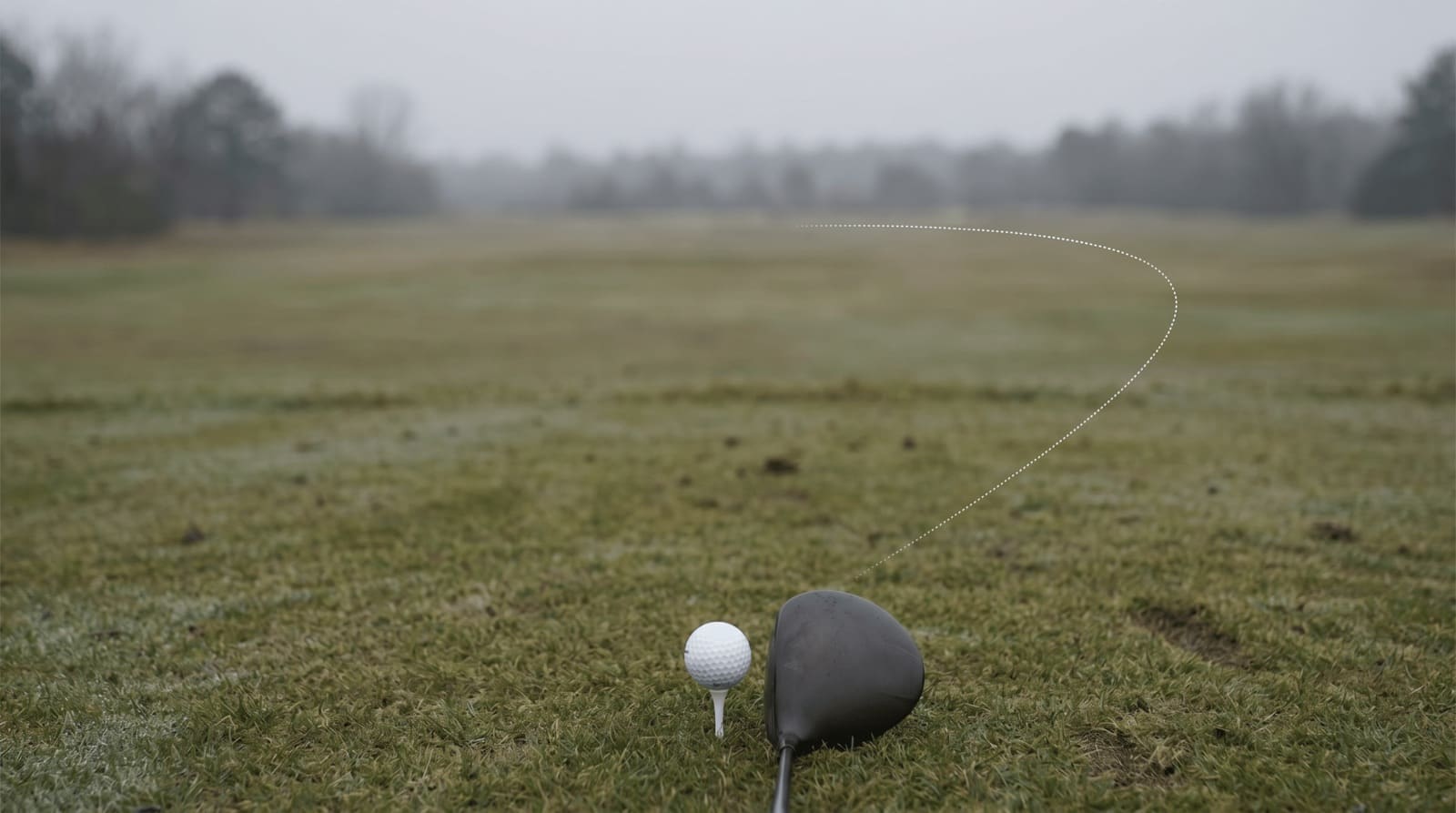
A hook curves hard right-to-left because the clubface is closed relative to your swing path at impact, tilting the ball’s spin axis left. The fix order for most players: weaken the grip first (a strong grip is the usual cause), neutralize an in-to-out path second, keep rotating through impact so the hands can’t flip the face shut, then rehearse under random practice so it holds on the course. Plan on several weeks of measured work to make it hold.
Hook diagnostic — find your pattern, then your fix
| Type of hook | Ball flight | Most likely cause | Highest-leverage first fix |
|---|---|---|---|
| Pull-hook | Starts left, curves further left | Closed face (strong grip or bowed lead wrist), often a stall-and-flip | Weaken grip; keep rotating through impact |
| Push-hook | Starts right, curves hard left | In-to-out path with the face closed to that path | Neutralize the path (swing more left); check aim |
| Snap hook / duck hook | Low, starts right or at target, dives left | Steep in-to-out, shut and delofted face, early flip; head ahead of ball | Ball forward, head behind it; quiet the flip |
| Two-way miss | Hooks and blocks/slices unpredictably | Inconsistent grip, wrist, and release timing | Stabilize grip and face first, then path |
| Driver-only hook | Hooks driver, irons fine | Long shaft and low loft magnify a closed face; ball too far back | Ball position forward; same grip and path work |
Read your own hook in three swings
You do not need a launch monitor to know whether your hook is a face problem or a path problem. Modern ball-flight laws say the ball starts close to where the face points and curves away from the path, so the start direction and the curve reverse-engineer your impact for you.
- Lay an alignment stick on the ground aimed at a target. Hit three shots and watch where each ball starts relative to the stick. That start line is roughly where your face pointed at impact.
- Watch the curve. How hard it bends left tells you how closed the face was relative to your path.
- Map it. Starts left and curves left is a pull-hook, a face-and-release problem you attack with the grip. Starts right and curves left is a push-hook, a path problem. Low and diving left is a snap hook, usually ball position plus a flip.
Why a hook is the better player’s miss
Slices dominate the amateur game. GOLFTEC, the largest swing-data teaching network, frames the slice as the first fault most new students walk in with, almost always an over-the-top, out-to-in path. Shot Scope, from a database of millions of tracked shots, found that golfers who mostly miss tee shots right send 7 of 10 of those drives into trouble.
The hook shows up later, in stronger players. Once a golfer is told to swing more from the inside and turn the face over to escape a slice, it is easy to overshoot, as Mustard Golf lays out: the path moves past neutral, the face keeps closing, and the same player now fights a hook. Ben Hogan is the canonical case. He spent years removing what he called his “evil” left miss, and the fix, per Golf Digest’s film study, was to weaken both hands, roll the face open in the takeaway, and cup his lead wrist at the top so his powerful release squared the face instead of shutting it.
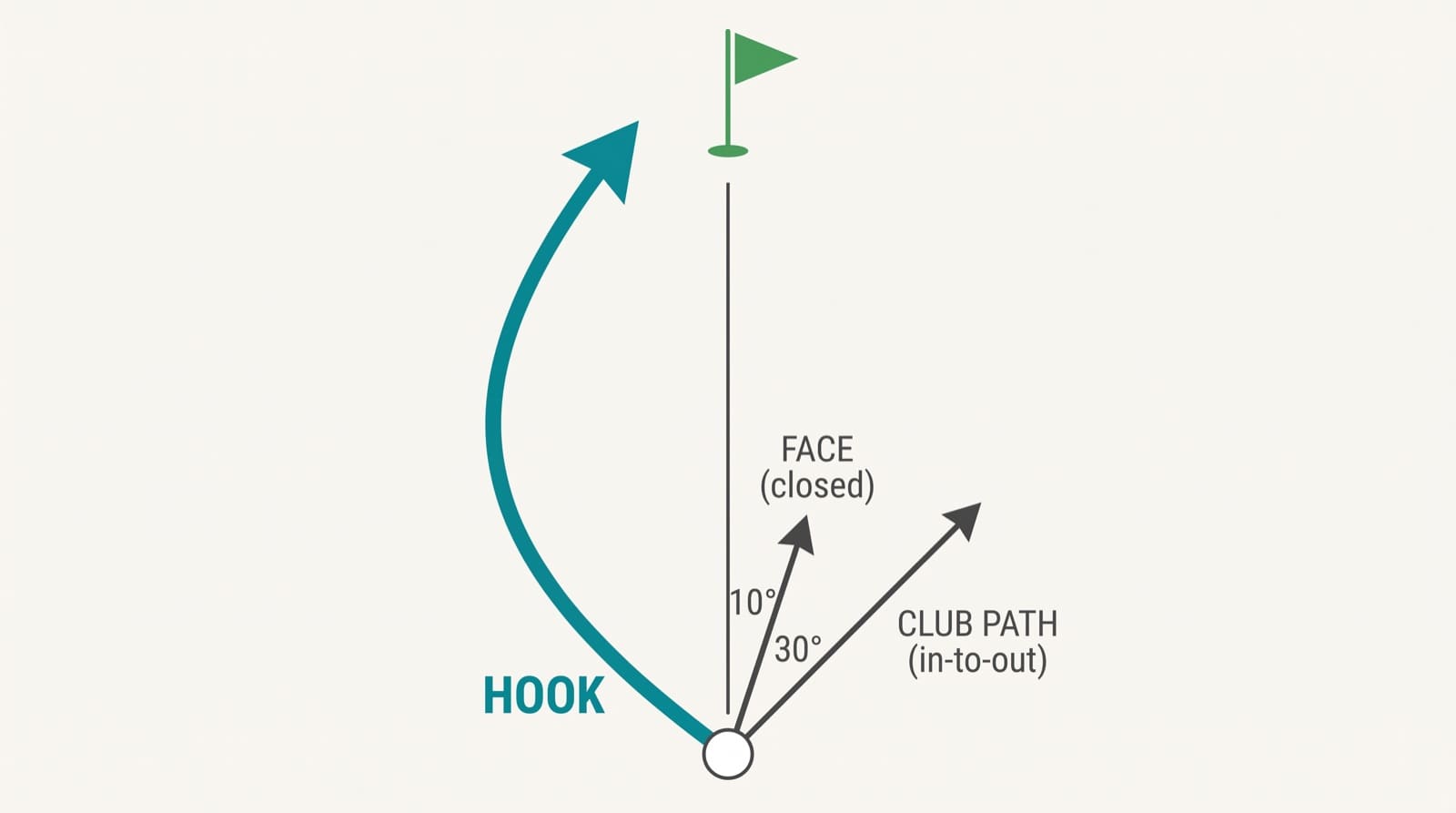
Mechanically, every hook is the same shot. TrackMan states the rule plainly: assuming centered contact, the ball curves toward the face angle and away from the club path. When the face points left of the path, the value they call face-to-path goes negative and the ball hooks. The curve scales fast with distance. TrackMan’s own example: at a 300-yard carry, 1 degree of face-to-path produces about 12 yards of curve, which is why elite players hold that number near 1 degree to keep the ball on a 30-to-32-yard-wide fairway. At driver speed, a face only a few degrees shut to the path is a tee shot in the trees. Because the face drives both the start line and the curve, it is the first thing to fix, and the grip is the fastest way to change it.
The fix order: face, then path, then release
There is one correct sequence, and doing it out of order is why most hook fixes stall.
- Face first. Coach George Gankas calls the clubface the “number one reason” he sees behind hooks, whether it comes from the grip, the address position, or the wrists. A grip change is the fastest, lowest-effort face fix. It moves the face toward square without touching your swing, and you can feel it inside ten minutes.
- Path second. Once the face delivers closer to square, neutralizing an in-to-out path helps. Before the face cooperates, swinging more to the left just produces a pull, which is why Mustard Golf pairs the path advice with a grip change rather than selling it alone.
- Release third. A body that stops rotating lets the hands take over and flip the face closed. Gankas describes this “stall out” as a hook engine in its own right, because any slowdown through impact closes the face. The cure is to keep the chest turning so the hands stay quiet.
Setup sits underneath all three. Aiming well right of target or playing the ball too far back bakes an in-to-out path and a closed face into your address, so the diagnostic above and the Common mistakes section both flag it.
Five drills that actually move the needle
Most hookers already know one or two of these. The ones who fix it permanently run them in order, set each goal around a 65 to 70% hit rate (the challenge point where a drill teaches most, covered in block vs random practice), and re-test against video.
1. The grip neutralizer (face fix)
From Me and My Golf. Hold your lead hand out with the clubface pointing straight up and the back of your hand also facing up, so the face and wrist agree. Set the club in front of you with the thumb running slightly down the trail side of the handle and only one to two knuckles visible. Trail hand goes more on top. Hit half-swing wedges. Goal: 7 of 10 starting straight or curving gently right, never left.
2. The strong-grip acid test (face fix)
From GolfWRX. A trail hand jammed too far under the club, especially in a deep interlock, drags the face closed. Check it: if adding the trail hand makes the grip feel locked and shut, slide it more on top until the pinky is barely hanging on. This keeps the compression of a moderately strong lead hand while removing the trail-hand closing force.
3. The inside-ball path drill (path fix)
From a Titleist Team Titleist coaching thread. Set a second ball about three inches inside and behind your gamer ball. If your path is too far from the inside, you clip the back ball first, which is instant feedback. Goal: 7 of 10 mid-irons struck without touching the inside ball.
4. The lead-hip slide (path and rotation)
From Scratch Golf Academy’s pull-hook and snap-hook breakdown. Put a chair or bag just behind your lead hip. In the downswing, slide that hip 5 to 7 inches toward the target while keeping its depth against the chair, then rotate. A lead hip that stays back and rotates lets the club swing left through impact instead of getting stuck behind you on an in-to-out arc.
5. The low-and-left release (release fix)
From the same Titleist thread. Through impact, feel the heel of the club skimming low and tracking left of your target so the toe cannot snap shut. To find the edges of neutral, alternate: hit a few intentional banana slices that start left and curve right, then a few draws, and settle in the middle. That deliberate two-way swing teaches your hands the range of face control.
The snap hook is a different animal
The snap hook, or duck hook, is one of the most penal ball flights in golf: low, fast, and diving into the left rough almost off the clubface. Three faults stack to produce it, per the Titleist and Mustard Golf breakdowns: a steep in-to-out path, a face shut and delofted at impact, and an early hand flip, often with the head drifting in front of the ball and the hips thrusting toward it (early extension). The de-lofting is what makes it launch low and run like it has topspin.
The emergency fixes are setup-heavy. Move the ball forward, inside the lead heel with the driver. Keep your head behind it. Make space by getting the tailbone back so the hips stop crowding the ball. Then layer the low-and-left release on top. A snap hook that only appears at full speed is a timing problem, and that is the one pattern where a lesson beats another month of solo reps.
The four-week protocol that makes it stick
Drills work in week one and quietly stop working by week four, because the change never meets variable conditions. This protocol mirrors the howTo on this page and is the same face-first sequence PracticeCaddie’s AI planner applies when a player flags a hook in their assessment.
- Week 0 — measure. Phone video down-the-line. Five drivers, five 7-irons. Record start direction, curve in yards, and lead-hand knuckle count. No fix yet.
- Week 1 — face. 30 minutes, three sessions. Grip neutralizer and the acid test, then half-swing 9-to-3 wedges. Block practice is right here, because you are acquiring a new motor pattern. No driver yet.
- Week 2 — path. 30 minutes, three sessions. Inside-ball drill with mid-irons, lead-hip slide, then driver. Re-film at week’s end: start direction should shift right and the curve should shrink from “snap” to “gentle draw.”
- Week 3 — release and random. 45 minutes, three sessions. Low-and-left release feel, then a pre-written 18-shot list rotating club and target. No two consecutive shots match. The fix has to survive variability before it transfers, which is the whole point of random over block practice.
- Week 4 — pressure. 45 minutes, three sessions. Each session ends with three first-tee simulations, one swing each, fairway-or-bust. Play one nine-hole round and record your hook rate.
- Maintenance. Re-film every two weeks for two months. The hook tries to return under speed; honest measurement is the only reliable counter.
When to skip the protocol and book a lesson
Self-coaching handles the common “strong grip plus over-rotated face” hook. Three patterns are faster to fix with a one-hour TrackMan or FlightScope lesson:
- A snap hook that only appears at full speed. A change that holds at 80% and breaks at 100% is a sequencing problem, best diagnosed under load.
- A two-way miss with no consistent shape. If you hook one swing and block the next, the face-to-path relationship is unstable, and a launch monitor isolates the variable in one session.
- A hook that survived two prior self-fixes. The pattern is grooved deep enough that supervised re-patterning beats another month of solo repetition.
A single launch-monitor lesson can save weeks of guesswork in the cases where the diagnosis matters more than the drill.
Common mistakes
- Chasing the path before the face is fixed. Swinging more to the left with a still-shut face produces a pull, which convinces players the advice was wrong. Grip first.
- Over-weakening the grip into a slice. One to two knuckles is the neutral most coaches teach. Drop below one and you have traded a hook for an open-face slice. Stop at the knuckle count that produces a straight ball or tiny draw on the half-swing test.
- Block practice for four weeks. Fifty reps of the same shot makes the range look great and the course look the same as ever. The week-3 random phase is non-negotiable.
- Skipping the baseline. Without week-0 video, you cannot tell at week 4 whether anything changed.
- Ignoring aim and ball position. Aiming right and playing the ball too far back builds the hook into your setup before you swing.
Key takeaways
- The face causes the hook. A clubface closed to the path tilts the spin axis left; the ball starts near the face and curves away from the path (TrackMan).
- Grip is the highest-leverage fix. A strong grip (three-plus knuckles) is the most common cause; neutralize to one or two knuckles with the trail hand more on top.
- TrackMan’s math: 1 degree of face-to-path is about 12 yards of curve at 300 yards, so a few degrees shut is a tee shot in the trees.
- Fix order is face, then path, then release. Swinging left before the face is square only makes a pull.
- The snap hook is a stack of in-to-out path, a shut and delofted face, and an early flip; it is setup-heavy to fix.
- Hooks are the better player’s miss, usually arriving after a slice fix is overcooked.
- Four weeks of structured practice — face, path, release, then random and pressure — is what makes the fix transfer to the course.
Frequently asked questions
What causes a hook in golf?
A hook comes from a clubface closed relative to your swing path at impact. The ball starts near where the face points and curves away from the path, so a face left of the path sends it hooking. The most common cause is a grip that is too strong, with three or more knuckles showing on the lead hand. An overly in-to-out path and a stall-and-flip release through impact are the next two culprits.
Should I fix my grip or my swing path first?
Fix the grip first for most players who hook. The clubface controls the large majority of where the ball starts and curves, and a strong grip is the most common reason it arrives closed. Weakening to one or two visible knuckles changes face delivery without rebuilding your swing, and you can install it in a session or two. Path work comes second: swinging left with a still-shut face only turns the hook into a pull.
How do I stop hitting a snap hook (duck hook)?
A snap hook is low and dives hard left because three faults stack: a steep in-to-out path, a face shut and delofted at impact, and an early hand flip, often with the head drifting ahead of the ball. Move the ball forward, keep your head behind it, and feel the club exit low and left so the toe cannot snap shut. Keep your chest rotating instead of stalling, and check that you are not aimed well right of target.
Why did I start hooking after fixing my slice?
This is common. Most slice fixes tell you to swing from the inside and rotate the face closed, and it is easy to overshoot. Once the path moves past neutral to in-to-out and the hands keep closing the face, the miss flips from slice to hook. Dial the corrections back toward the middle: ease the grip to one or two knuckles, soften the in-to-out feel, and let body rotation square the face. Re-baseline with video to see where neutral is.
Does weakening my grip really fix a hook?
Often, yes. A strong grip, with the lead hand rotated so three or more knuckles show and the trail hand under the club, makes the face want to close through impact. Rotating both hands toward neutral, so you see one or two knuckles with the trail hand more on top, reduces that closing tendency directly. Ben Hogan famously weakened both hands to remove his hook. Pair the change with half-swing wedges so you feel the new face position before adding speed.
How long does it take to fix a hook?
It varies by player, and no study pins down an exact timeline. Plan on several weeks of structured practice, around two to three sessions a week, and use this four-week protocol to measure progress rather than guess at it. Full retraining often takes a couple of months, because the new grip and path only hold up under random, variable practice rather than repeated reps of one shot. A hook that survives a structured month under speed points to a sequencing issue worth a lesson.
Related reading
- Golf Ball Flight Laws: Why the Ball Starts and Curves Where It Does — the diagnostic hub for every miss; read your start line and curve to reverse-engineer the face and path behind your hook.
- How to Fix a Slice in Golf — the hook’s mirror image; if you overcooked this fix, you landed on a hook, and the two posts share a face-then-path logic.
- How to Grip a Golf Club — the cornerstone fix here; a strong grip is the most common hook cause, and this covers neutral, strong, and weak in detail.
- How to Hit a Draw — once the hook is gone, this is how you keep a controlled, on-purpose right-to-left shape without tipping back into a hook.
- Block vs Random Practice in Golf — the motor-learning research behind the week-3 transfer phase that turns a range fix into a course fix.
- Golf practice drills, organized by skill area — the companion drill library with setup steps and success criteria.