
How to Stop Hitting Fat Shots (and Thin Shots): Fix Your Low Point
Fat and thin shots are the same fault: a swing low point stuck behind the ball. Which cause to fix first, the drills, and a 4-week protocol to move it ahead.

Quick answer
Fat and thin shots are the same fault: your swing’s low point sits behind the ball when it should sit ahead of it. A fat shot digs the turf first; a thin shot rides high and catches the ball’s equator. The fix: reset setup (ball forward of center, weight forward, handle target-side), shift pressure to the lead foot (towel-behind-ball and step drills), then rehearse under random practice. Three to four weeks moves the needle; eight to twelve makes it stick.
Fat and thin diagnostic: find your pattern, then your fix
| Your miss | What it looks like | Low-point signature | Highest-leverage first fix |
|---|---|---|---|
| The classic chunk | Club thumps turf behind the ball, shot flies short and weak | Low point behind the ball, arc digging into the turf | Towel-behind-ball pressure drill |
| The blade (thin) | Low screamer, stings the hands, sails over the green | Low point behind the ball, arc riding too high | Same pressure shift, plus stop trying to lift the ball |
| The alternating fat-then-thin | Chunk one swing, blade the next, same club | Low point wandering behind the ball, arc height unstable | Divot-line drill for a repeatable bottom |
| The hang-back fat | Weight stuck on the trail foot, falling back through impact | Swing center behind the ball at impact | Step-through drill |
| The early-extension thin | Standing up through impact, hips drifting toward the ball | Arc lifted late in the downswing | Hold your depth (see the early-extension fix) |
Why you hit fat and thin shots
Fat and thin are one problem wearing two masks. The lowest point of your swing arc, the spot where the clubhead reaches the bottom of its path, is supposed to sit a few inches in front of the ball for an iron. When it sits behind the ball instead, everything downstream goes wrong. If the arc digs into the turf behind the ball, you hit it fat. If your body senses that early ground contact and lifts to avoid it, the club rides high and you blade it thin.
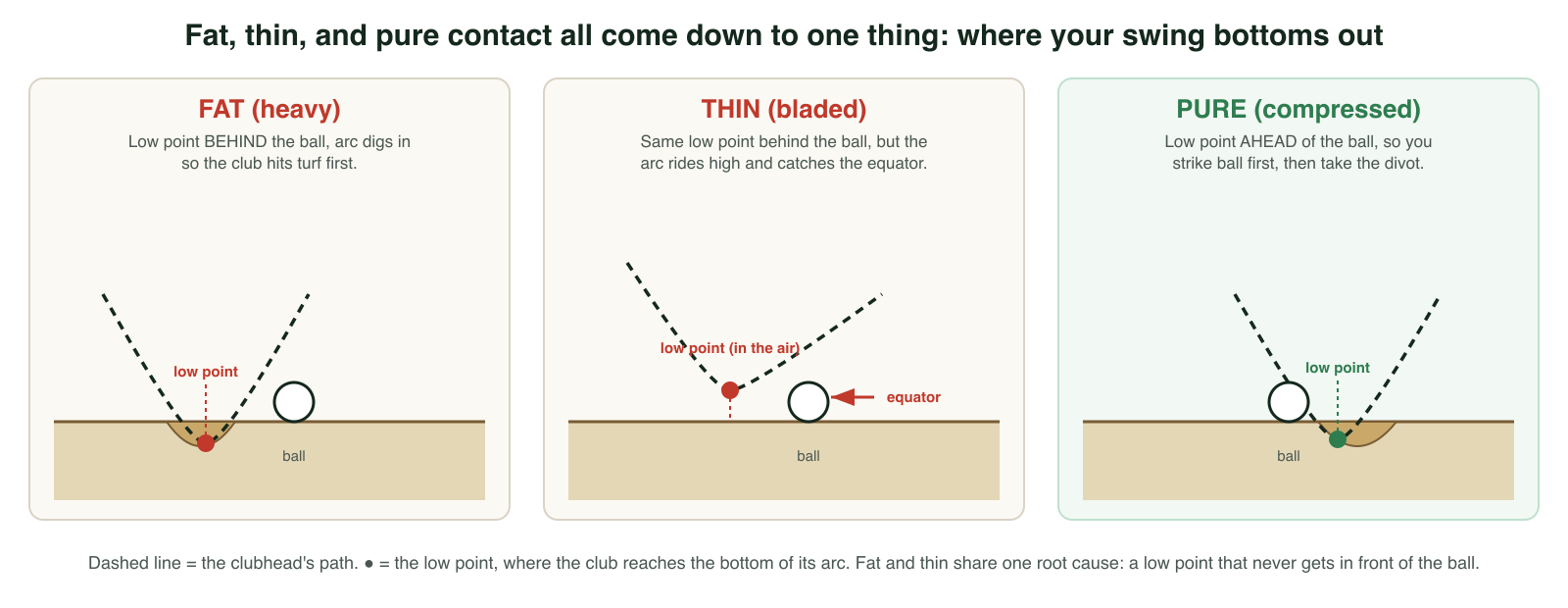
Launch-monitor data shows what a good iron strike looks like. TrackMan’s published averages put a PGA Tour player’s 6-iron attack angle at about −3.7 degrees: the club is still moving down and forward at impact, which places the low point ahead of the ball and produces a divot that starts after it. The same TrackMan data shows amateurs mismanage attack angle as handicap climbs, hitting down too much with the driver (bogey golfers average −2.1 degrees with a club they should hit up on), a sign of how little control most players have over where the arc bottoms out.
The biomechanics point at weight transfer. In the peer-reviewed Journal of Strength and Conditioning Research, Queen and colleagues (2013) measured ground reaction forces and found that low-handicap golfers transferred vertical force from the trail foot to the lead foot earlier and more forcefully than high-handicap golfers. A 2026 systematic review in Sports Medicine (Watson et al.) pooled 24 studies and found moderate-to-strong links between how a golfer uses the ground and both clubhead speed and skill level. The translation is simple: good ball strikers get their pressure onto the lead foot early, which slides the swing center, and the low point, in front of the ball. Weight stuck on the trail foot leaves the arc bottoming out behind it.
Two hand-and-body faults make it worse. Casting, releasing the wrist angle too early in the downswing, adds loft and lengthens the swing radius, which drags the low point backward (the mechanism behind the casting fix). Early extension, where the hips thrust toward the ball and the torso rises through impact, lifts the whole arc late and is a common source of thin contact (see the early-extension fix). Both faults move the low point the wrong way, which is why generic advice like “keep your head down” rarely helps.
Low-point migration: why the miss flips swing to swing
The alternating chunk-then-blade pattern confuses people because the two shots feel like opposite problems. Same fault, though. When the low point sits behind the ball, tiny variations in posture, release, or intention decide whether the arc clips the turf first or rides over it. Adam Young, who wrote The Practice Manual and specializes in strike, calls the steep-shallow, thin-fat framing a myth worth busting: the shared variable is where the club bottoms out relative to the ball, and steepness is a red herring. Stabilize the low point in front of the ball and both misses drop out together. Chase them as separate faults and you spend a season fixing one while the other comes back.
When thin is your dominant miss
The shared low-point story explains the alternating pattern, but some golfers almost never chunk it: every miss is a blade. That profile usually stacks a vertical fault on top of the horizontal one. TrackMan treats low point as three-dimensional: the arc has a location relative to the ball and a height relative to the turf, and a swing whose bottom sits acceptably forward can still catch the equator if the entire arc rides too high.
The usual lifter is early extension. The Titleist Performance Institute, which has screened more than 90,000 golfers, reports 67% show early extension, while 99% of the 100-plus tour professionals it measured do not. When the pelvis pushes toward the ball in the downswing, the torso rises, the effective swing radius shortens, and the leading edge arrives at the ball’s equator instead of its back.
Hanging back feeds the same result from the other side. GOLFTEC’s SwingTRU data measured the best players with their hips 3.9 inches toward the target at the top of the backswing versus 2.3 inches for high handicappers, and a swing center stuck on the trail side forces the compensation Titleist instructor Mark Blackburn describes: with pressure and the head hanging behind the ball, the player flips the clubhead at the bottom, adding loft and catching the ball on the way up. Ball position cuts both ways here. A ball too far forward normally chunks first, while Titleist’s ball-position guidance notes a ball well back of center meets the club still descending steeply, where the lower face catches it thin.
If the always-thin profile fits, re-order the drills. Start with the chair drill for early extension: back of a chair against your glutes at address, half-speed swings keeping contact from backswing through follow-through. Add Butch Harmon’s weight-forward drill: trail foot up on its toes, most of your weight lead-side, half and three-quarter shots. Then run the towel and divot-line drills below to confirm the low point, and see the full early-extension fix if the chair drill keeps failing.
The fix order: setup, pressure shift, then transfer
Most articles hand you ten drills and let you guess. The order matters more than the list.
- Setup first. Ball position, weight at address, and handle lean decide where the low point can geometrically sit. A bad setup forces your body to compensate mid-swing. Setup installs in two range sessions with no swing change at all.
- Pressure shift second. Once setup is right, the next failure point is weight hanging on the trail foot. The towel-behind-ball and step-through drills move pressure to the lead side faster than any verbal cue, because the feedback is physical.
- Transfer to the course third. Block practice makes everything look fixed on the range. The new low point only holds up when the last phase of practice is random. See block vs random practice for why this decides whether the fix travels to your scorecard.
Setup is the lowest-cost change with the biggest geometric payoff. Nudging the ball back to center or leaning the handle toward the target moves where the low point needs to be without you changing your swing. After that, pressure shift is the next-biggest lever. Path and tempo matter, but not before these two are in place.
Drills that fix your low point
Run them in order, with a measurable success criterion, and check the result against a divot or a phone video. Feel-only reps are how the pattern hides.
1. Towel behind the ball (pressure-shift fix)
Place a folded towel a hand’s width behind the ball, perpendicular to your target line. Hit ten 8-irons without clipping the towel on the way down. Catch the towel and your low point is behind the ball. Goal: 8 of 10 clean, with a divot that starts on or just ahead of the ball. The drill is fast because the feedback is binary, and getting the swing center forward is the largest single lever in fixing both fat and thin.
2. The step-through drill (weight transfer)
Start with your feet together. As you swing down, step your lead foot toward the target and finish with your weight fully on it. Hit fifteen 7-iron half-swings. The forced step makes it impossible to hang back, so the low point has to move forward. It is a classic footwork drill that coaches still teach because it bypasses conscious cues and installs the pressure shift physically. Hit one normal-stance shot right after to lock the feel.
3. Divot-line drill (arc-height fix)
Draw a short line across your target line where the ball would sit, or use a strip of tape on a mat. Without a ball, make ten swings that brush the ground so the mark starts just ahead of the line. Then put a ball on the line and keep the divots starting ahead. This trains a repeatable bottom, which is the antidote to the alternating fat-then-thin pattern. Goal: 7 of 10 divots starting ahead of the line.
4. Handle-forward punch shots (compression fix)
Play a shorter backswing, feel the hands slightly ahead of the clubhead at impact, and hit low, punchy 8-irons. The reduced swing gives your weight shift and rotation less room to break down, so ball-first contact comes easier. Adam Young’s work on iron-strike consistency leans on this kind of constrained, feedback-rich rep. Build the compressed feel small, then grow it into full swings.
5. External-focus cueing (make it stick)
Swap body-part cues for ground-and-ball cues. Instead of “shift your hips” or “hit down,” think “brush the grass past the ball” or “start the divot ahead of the line.” Motor-learning research supports this directly: Wulf, Lauterbach and Toole (1999) found an external focus produced better golf accuracy and retention than an internal one, and the Chua et al. (2021) meta-analysis put hard numbers on it across skills: external focus beats internal for performance (Hedges’ g = 0.26), retention (g = 0.58), and transfer (g = 0.58). Where you aim your attention is part of the drill.
The four-week protocol that makes it stick
Drills work in week one and quit by week four when the fix never meets variable conditions. This plan mirrors the howTo steps on this page and matches how PracticeCaddie’s AI plans sequence a contact fix when a golfer reports fat or thin shots in onboarding.
- Week 0: measure. Film one face-on 8-iron. Hit ten and note where each divot starts relative to the ball. Lay a line across your target line as a reference. No fix yet, just a baseline.
- Week 1: setup. Three 30-minute sessions. Half-swing 8-irons. Confirm ball just forward of center, 55% weight on the lead foot at address, handle leaning slightly target-side. Block practice is correct here; you are acquiring a pattern.
- Week 2: pressure shift. Three 30-minute sessions. Towel-behind-ball (10 reps), step-through (15 reps), then handle-forward punches (10 reps). Re-film at the end of the week. Expect divots starting to shift ahead of the ball.
- Week 3: random. Three 45-minute sessions. Pre-write an 18-shot list rotating club and target so no two shots repeat. Apply the Week 1 setup and Week 2 pressure cue on every swing.
- Week 4: pressure. Three 45-minute sessions, each ending with a first-tee simulation: three 8-irons cold to a 20-yard window, pass or fail. Play one nine-hole round and log every fat and thin shot.
- Maintenance: re-check every two weeks. Hit five 8-irons and confirm the divots start ahead of the ball. Two sessions of regression triggers a one-session Week 1 and Week 2 reset.
If four weeks brings no measurable change, the cause is usually mobility or equipment, covered below.
In-round recovery: when the chunks start mid-round
When fat or thin shots show up on the third hole, the urge to rebuild your swing is almost always wrong. The faster reset is to find what changed in the last hole or two.
- Setup drift. Did the ball creep forward? Did your weight settle back onto the trail foot because you were guiding the shot? Walk the full setup checklist on the next swing: ball just forward of center, weight 55/45 forward, handle target-side.
- The lift instinct. Under nerves, golfers try to help the ball up, which throws the low point backward. Pick one external cue, “brush the grass past the ball,” and let the rest run on instinct.
- Tempo. Fat and thin both tend to come with a rushed downswing that outruns the weight shift. Slow the downswing by 10 to 15% so the pressure shift has time to happen. The tempo drills post covers the 3:1 ratio behind this.
The step-through drill doubles as an on-course reset. Take one rehearsal swing where you actually step through to the lead foot before your next shot. It reinstalls the pressure shift in ten seconds, no verbal cue required.
When equipment or mobility is the real cause
Self-coaching handles the typical setup-and-pressure pattern. Two situations call for outside help sooner rather than later.
- Mobility limits. If your weight feels permanently stuck back and pressure drills make no dent, restricted hip internal rotation, tight ankles, or limited thoracic rotation may be blocking the shift. These same limits drive early extension, which the Titleist Performance Institute screen tests for. A TPI-certified coach or a physio can find them in one session.
- Equipment fit. Clubs an inch or two too long, or a wrong lie angle, corrupt the geometry of ground contact and can bake in fat or thin misses no drill will fix. A 30-minute lie-and-length check at a fitting bay (typically $50 to $100, often credited toward a purchase) rules this out.
A single launch-monitor lesson usually runs $75 to $150 and can save four to eight weeks of guessing when the diagnosis matters more than the drill. This is also why the approach game is worth the practice time: as Mark Broadie’s strokes-gained work established, approach shots are the single biggest driver of the scoring gap between amateurs and better players, and fat and thin contact does most of its damage right there.
Common mistakes
- Trying to lift the ball. The loft on the club launches the ball. Helping it up throws your weight back and the low point behind the ball, which produces the exact thin shot you feared.
- Fixing weight without fixing setup first. Driving your weight forward over a ball played three inches too far back turns a fat shot into a thin one. Setup is the template; pressure is the correction. Run them in order.
- Only moving the ball back. Ball position is a real lever but a small one. If your pressure hangs back, no ball position saves the strike.
- Block practice for four straight weeks. Same club, same target, 50 reps. Range contact climbs, course contact does not. The Week 3 random phase is non-negotiable.
- Skipping the Week 0 baseline. Without a starting divot pattern on video, you cannot tell at Week 4 whether anything changed. Half of “no progress” is bad memory of the starting point.
- Chasing fat and thin as separate faults. They share a low point behind the ball. Fix that once and both misses shrink together.
Key takeaways
- Fat and thin are one fault. Your swing’s low point sits behind the ball; the work is moving it a few inches in front, where good iron strikes bottom out.
- A fat shot digs turf first; a thin shot rides high over that same rearward low point and catches the ball’s equator. Same cause, two masks.
- Weight transfer is the engine. Per Queen et al. (2013) and a 2026 Sports Medicine review, better ball strikers move pressure to the lead foot earlier and harder, which drags the low point forward.
- A tour 6-iron attack angle is about −3.7 degrees (TrackMan): the club is descending at impact, with the low point ahead of the ball.
- Fix order: setup, pressure shift, transfer. Drills run out of order create new misses.
- The towel-behind-ball drill is the fastest single fix because the feedback is binary and getting the swing center forward is the largest lever.
- Cue it externally. Wulf et al. (1999) and the Chua et al. (2021) meta-analysis show ground-and-ball cues beat body-part cues for retention and transfer.
Frequently asked questions
What causes fat and thin golf shots?
Both come from the same fault: the low point of your swing arc, where the club reaches the bottom of its path, sits behind the ball instead of ahead of it. A fat shot happens when the arc digs into the turf behind the ball and the club hits ground first. A thin shot happens when that same rearward low point rides high through impact, so the leading edge catches the ball’s equator. The usual culprits are weight hanging on the trail foot, casting the club early, and early extension. Move the low point forward and both misses shrink together.
How do I stop hitting behind the golf ball?
Get your swing’s low point in front of the ball, which mostly means getting your weight and pressure onto the lead foot before impact. Peer-reviewed force-plate research shows better ball strikers shift pressure to the lead side earlier and harder than higher handicaps. The fastest drill is the towel behind the ball: place a folded towel a hand’s width behind the ball and hit shots without clipping it. That single constraint pulls the swing center forward and stops the club bottoming out early. Fix setup first, then train the pressure shift, then test it under random practice.
Why do I hit a fat shot then a thin shot with the same club?
Because your low point is parked behind the ball, and small changes in arc height flip the miss. When the low point sits behind the ball, one swing digs the turf early (fat) and the next swing your body instinctively lifts to avoid the ground, so the club rides high and blades it (thin). The root cause never changed. Coaches call this low-point migration: the bottom of the arc wanders around the ball instead of sitting reliably ahead of it. The fix is the same for both misses, which is why chasing them separately fails.
Should I move the ball back to stop hitting fat shots?
A little, but ball position is a smaller lever than weight shift, and moving it too far back trades a fat shot for a thin one. For a mid-iron, play the ball just forward of center, roughly under the logo on your shirt. If your ball has crept forward over time, nudging it back toward center helps because it matches where your low point actually is. But if your weight hangs on the trail foot, no ball position saves you. Reset ball position as step one, then train the pressure shift that moves the low point forward.
How long does it take to fix fat and thin shots?
Most golfers see meaningful improvement in three to four weeks of structured practice, at two to three sessions a week of 30 to 45 minutes. Lasting change usually takes eight to twelve weeks, because the new low point has to survive variable conditions. Block practice on the range can hide the problem inside a session and let it return on the course. The random-practice phase, rotating clubs and targets so no two shots repeat, is the part that decides whether the fix shows up on your scorecard.
What is the fastest drill to stop chunking irons?
The towel-behind-the-ball drill. Place a folded towel a hand’s width behind the ball, perpendicular to your target line, and hit 8-irons without clipping the towel on the way down. If you catch the towel, your low point is behind the ball and the club is bottoming out early. Most golfers improve within ten reps because the feedback is binary: you either hit the towel or you don’t. Pair it with a divot check, aiming for a divot that starts on or just ahead of the ball. It trains fat and thin out at the same time.
Why do I only hit thin shots, never fat?
An always-thin miss usually means the whole swing arc rides too high through impact, on top of any low-point problem. The two usual lifters are early extension, where the hips push toward the ball and the torso stands up, and a scoop, where the clubhead passes the hands and the arc bottoms out early and high. TPI reports 67% of more than 90,000 screened golfers show early extension. For that profile, start with posture drills, the chair drill and Harmon’s weight-forward drill, before the towel work.
Related reading
- How to Stop Topping the Golf Ball — the third member of the contact-fault triad; topping is another low-point problem, and the fixes overlap.
- How to Grip a Golf Club — the setup cornerstone that feeds low-point and face control across the bag.
- Casting in Golf: Fix the Early Release — casting adds loft and drags the low point backward, a direct cause of fat and thin contact.
- Early Extension: The Swing Fault Fix — the stand-up-through-impact move that lifts the arc and produces thin shots.
- Weight Shift in the Golf Swing — the pressure-transfer engine behind moving the low point forward.
- Golf Ball Position by Club — the setup lever that sets where the low point can sit.
- How to Fix a Slice in Golf — sister four-week protocol; the same measure-then-drill structure layers on top of this contact work.
- Golf Ball Flight Laws Explained — the diagnostic hub that connects every fault-fix post, contact included.
- Golf practice drills that actually transfer — the companion drill library, organized by skill area.
- The 30-minute golf practice plan — how to fit the contact protocol into a tighter window.