Golf Ball Position: Where to Place the Ball for Every Club
Ball position sets the low point of your swing, which controls strike and launch. Where to play the ball for every club in the bag, wedge through driver.
Quick answer
Play the ball forward for longer clubs and back toward center for shorter ones. The driver sits opposite your lead heel so you can hit up on it; wedges sit near the center so you hit down. Ball position sets the low point of your swing arc, which controls your angle of attack, strike, and launch. A shift of barely a quarter inch changes the result, so a quick setup check often fixes more than a swing change.
Golf ball position by club
| Club | Ball position (right-handed) | Stance width | Angle of attack |
|---|---|---|---|
| Driver | Opposite the lead heel | Widest | Hit up (positive) |
| Fairway wood | Just back of driver, forward of center | Wide | Level to slightly down |
| Hybrid / long iron | ~1.5 ball-widths forward of center | Shoulder-width | Slightly down |
| Mid-iron (5–6) | ~1 ball-width forward of center | Just inside shoulders | Down |
| Short iron (8–9, PW) | Just forward of center | Narrow | Down |
| Wedge | Center of stance | Narrowest | Down (steepest) |
What ball position actually controls
Ball position is a low-point tool. The golf swing travels on an arc, and the bottom of that arc, the low point, sits roughly under your lead shoulder, a few inches target-side of stance center for a right-handed golfer. Where you place the ball decides where the clubhead is in that arc when it arrives.
TrackMan describes this as the low point landing before the ball or after it. With an iron you want the low point after the ball, so the club is still descending and you strike ball first, turf second. With the driver you want the low point before the ball, so the clubhead is climbing when it makes contact.
Move the ball back and you catch it earlier, on a steeper, descending part of the arc. Move it forward and you catch it later, where the club is shallow or climbing. That single geometric fact drives your angle of attack, and angle of attack drives almost everything else.
Three impact numbers ride on ball position. Your angle of attack, the up-or-down direction of the clubhead at contact. Your dynamic loft, the actual loft delivered at impact. And your start line, because the club path and face are both still rotating through the arc. The grip is the other half of this setup picture: it sets the face, while ball position sets the strike. Get the grip neutral first, then ball position has far less to fight.
The ball-position chart, club by club
The simplest reliable method keeps one reference point and changes everything else around it. GOLFTEC teaches setting the ball off your lead foot and widening the stance as the club gets longer, so the ball moves toward center as your stance narrows for short irons. A common rule of thumb is roughly half an inch of movement per iron, but the lead-foot anchor matters more than counting fractions.
Driver: opposite the lead heel
Play the driver the most forward of any club, opposite the inside of your lead heel, with your widest stance and the ball teed high. The forward spot lets the clubhead pass its low point and start climbing before it reaches the ball, which is how you produce the upward strike that adds carry. A driver creeping back toward center is the most common reason amateurs hit down on it and lose distance. If you are chasing speed and distance, ball position is the cheap setup half of the equation, and swing-speed training is the other.
Fairway woods and hybrids: just forward of center
Fairway woods sit a touch behind the driver, still forward of center, because you are striking the ball off the ground rather than off a high tee. The goal is a level or barely descending strike that sweeps the ball away. Hybrids and long irons play slightly back of the fairway-wood spot. If your fairway woods balloon high and short, the ball is usually too far forward; nudge it back toward center to lower the launch.
Mid and long irons: about one ball forward of center
Mid-irons play roughly one ball-width forward of center. This keeps the low point target-side of the ball so you compress it with a descending blow and take a divot that starts at the ball. As the iron gets longer, the ball creeps slightly forward and the stance widens; as it gets shorter, the ball moves back toward center and the stance narrows.
Short irons and wedges: center
Short irons and wedges play at or just forward of stance center with your narrowest stance. The central position produces the steepest, most descending strike in the bag, which is what generates the spin and control you want from scoring clubs. Playing a wedge too far forward is a frequent cause of fat, chunked pitches.
What the launch-monitor data says about attack angle
Tour data shows exactly how different the strike is from club to club, which is the whole argument for moving the ball. According to TrackMan, PGA Tour players average a driver attack angle of -0.9 degrees, while their 6-iron averages -3.7 degrees. The clubs demand different low-point relationships, and ball position is how you supply them.
The driver is the outlier that proves the point. LPGA Tour players average a positive driver attack angle of +2.8 degrees, hitting up on the ball, and TrackMan states plainly that “to maximize distance with your driver, hitting up on the ball (positive Attack Angle) is a must.” Titleist Performance Institute makes the same case: an ascending strike is what lets you raise launch and cut spin at the same time.
Dynamic loft tracks the same story. TrackMan lists the PGA Tour driver dynamic loft at 12.8 degrees and the LPGA driver at 15.5 degrees, with the 6-iron up at 20.2 degrees. Ball position is one of the levers that delivers those numbers, because the further forward you catch the ball, the more the club has rotated open into climbing loft.
The sensitivity is the part most amateurs underestimate. A peer-reviewed study of ball position in elite golfers (Kim et al., 2018, Journal of Sports Science & Medicine) cites work by Zhang and Shan (2014) finding that a variation of about 0.6 cm in ball position can change the vertical launch angle by roughly 3 degrees.
About 0.6 cm of ball position is worth roughly three degrees of launch. That is why a setup error reads like a swing flaw, and why moving the ball is the first thing to test before anything mechanical.
For the driver specifically, the launch numbers you are aiming for depend on your speed. Golf.com, using True Spec Golf’s preferred parameters, lists an average swing speed of 84–96 mph wanting roughly 13–16 degrees of launch and 2,400–2,700 rpm of spin. A forward ball position and an upward strike are how you reach those numbers without changing clubs.
Ball too far back vs too far forward
Ball-position errors produce predictable misses, which makes them easy to diagnose once you know the pattern. The club arcs in-to-out before the low point and out-to-in after it, and the face is rotating from open to closed across that same window.
| Ball-position error | Where the club is in its arc | Strike tendency | Start line (right-handed) |
|---|---|---|---|
| Too far back (toward trail foot) | Caught before the low point, steep | De-lofted, low, risk of thin | Starts right (push) |
| Too far forward (toward lead foot) | Caught at or after the low point | Added height, risk of fat irons | Starts left (pull) |
A ball too far back gets caught early on a steep, descending path with the face still open to it, which is why it tends to start right and fly low. WhyGolf summarizes the face effect cleanly: a back ball position points the face farther right for a right-hander, a forward position points it farther left.
A ball too far forward gets caught late, where an iron should already be climbing, which adds dynamic loft and can produce fat contact when the club bottoms out behind the ball. With the driver, too far forward is a frequent slice trigger because the club is moving out-to-in by the time it reaches the ball. Before you rebuild a swing to cure a slice, move the ball and retest; the full sequence is in the slice-fix protocol, and the same logic applies to topped and thin shots.
Ball position is also one way skilled players shape shots on purpose. Playing it back of center encourages an in-to-out path and a draw; playing it forward encourages an out-to-in path and a fade, always paired with the matching grip and face.
Single vs graduated ball position: the two schools
Two philosophies have competed for decades. The single, or static, approach keeps the ball in one place relative to the lead foot for every full shot. Ben Hogan taught a version of this in Five Lessons, playing the ball opposite the inside of the lead heel and adjusting the stance, mainly its width, as the clubs get longer or shorter.
The graduated, or zonal, approach moves the ball progressively back as clubs shorten. Modern launch-monitor instruction leans this way, because the tour data above shows each club needs a different angle of attack, and one fixed position cannot deliver a positive strike with the driver and a descending strike with a wedge. A review of Hogan’s method notes that a strict constant position is hard to repeat and does not adapt to different clubs and lies.
The honest read is that the two schools are closer than they sound. GOLFTEC’s lead-foot method is a graduated system in practice, but it feels like a single reference because you only learn one anchor and let stance width move the ball. For most amateurs that is the easiest path to repeatable contact: one reference point, a wider stance for longer clubs, a narrower stance for short ones.
How to set and check your ball position
You can dial in ball position with no launch monitor and no lesson, using your divot and your start line as the feedback. It is the same sequence as the steps on this page.
- Find your low point first. Make three rehearsal swings that brush the turf without a ball and note where the club scuffs the grass, roughly under your lead shoulder. That is the bottom of your arc.
- Anchor the ball to your lead foot. Set it about one clubhead-width inside your lead heel for a mid-iron, then change stance width per club instead of re-placing the ball.
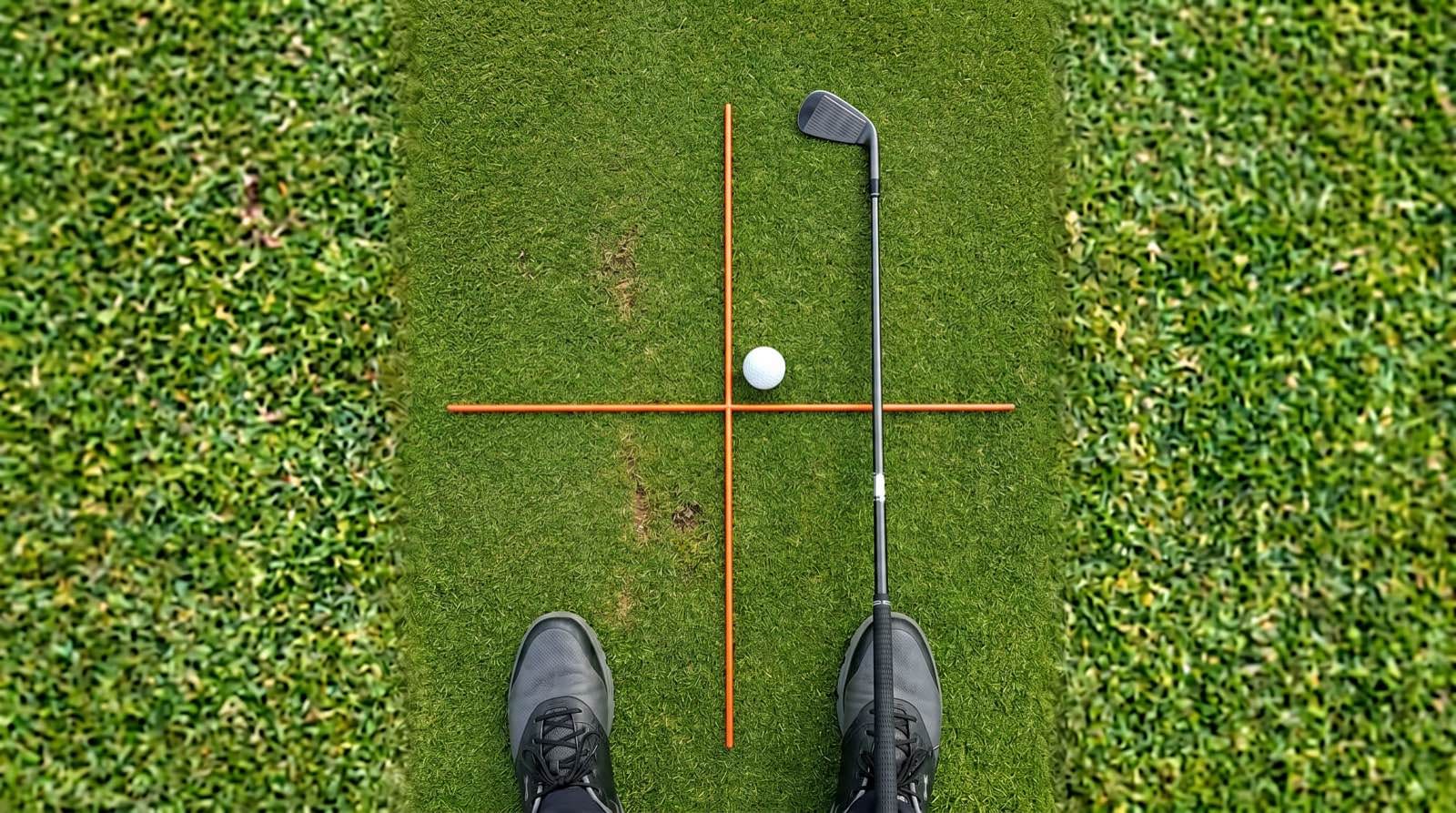
- Lay down two alignment sticks. One along the target line, one perpendicular at the ball, so the position repeats every shot.
- Match each club to its spot. Driver opposite the lead heel with the widest stance, irons graduating back as the stance narrows, wedges at center.
- Read the divot. For irons it should start at or just after the ball, never behind it. A divot behind the ball means the ball is too far back or your weight hangs back.
- Range-test against start line and strike. Low and right means too far back; fat or starting left means too far forward. Adjust half a ball at a time.
A new ball position feels strange before it feels right, the same way a grip change does. Groove it the way the motor-learning research suggests, by varying your clubs and targets instead of raking ball after ball from one spot, and confirm it with ball-striking drills that score low-point control.
Common ball-position mistakes
- One ball position for every club. A wedge and a driver need opposite strikes. Anchor to your lead foot and let stance width move the ball.
- Driver creeping back to center. A ball that drifts back produces a downward strike, which adds spin and cuts carry. Keep it opposite the lead heel.
- Wedges played too far forward. The most common cause of chunked pitches. Scoring clubs want a central ball and a descending strike.
- No reference point. Players who eyeball ball position rebuild it differently every swing, then blame the swing. Use alignment sticks until it is automatic.
- Hanging back to “help” the ball up. Trying to lift an iron moves the low point behind the ball and produces the thin shot you were trying to avoid. Trust the loft and hit down.
- Changing ball position and grip at the same time. Change one variable at a time so you know which one moved the ball flight.
Key takeaways
- Ball position sets the low point of your swing arc, which controls angle of attack, dynamic loft, and start line (TrackMan).
- Driver opposite the lead heel, wedges at center, with everything graduating between. The longer the club, the more forward the ball.
- The driver is the only club you hit up on. LPGA Tour players average a +2.8-degree driver attack angle, and hitting up is what maximizes carry (TrackMan).
- Tour irons strike down: the PGA Tour 6-iron averages a -3.7-degree attack angle, which a center-to-slightly-forward ball position delivers.
- Small errors read as big flaws. About 0.6 cm of ball position is worth roughly 3 degrees of launch (ball-position study, Kim et al. 2018).
- Diagnose by the miss. Low and right means too far back; fat or starting left means too far forward.
- Anchor to your lead foot and change stance width, the practical version of the graduated method that most launch-monitor instruction recommends.
Frequently asked questions
Where should the golf ball be in my stance for each club?
Ball position moves forward as clubs get longer. Play the driver opposite your lead heel so you can hit up on it. Fairway woods and hybrids sit just forward of center, mid-irons about one ball-width forward of center, and short irons and wedges at or just forward of center. The simplest method, taught by GOLFTEC, is to keep the ball a clubhead-width inside your lead foot and change your stance width club to club, so the ball drifts toward center as your stance narrows.
What is the correct ball position for a driver?
Play the driver opposite the inside of your lead heel, the most forward position in your bag, with your widest stance and the ball teed high. That forward spot lets the clubhead reach the ball after the low point of your swing, so you strike it on the upswing. TrackMan data shows LPGA Tour players average a positive driver attack angle of +2.8 degrees, and hitting up is what lowers spin and raises launch for more carry. A driver played too far back gets a downward strike that adds spin and leaks distance.
How does ball position affect ball flight?
Ball position sets where the clubhead is in its arc at impact, which controls your angle of attack, dynamic loft, and the path-and-face relationship. A ball played too far back is caught earlier and more steeply, de-lofting the club and starting the ball right for a right-hander. A ball too far forward is caught later, adding height and starting the ball left. Golf biomechanics research (Zhang and Shan, 2014) found that a change of about 0.6 cm in ball position can shift the launch angle by roughly 3 degrees.
Should ball position change for every club or stay the same?
Both methods exist. Ben Hogan’s Five Lessons taught a constant ball position opposite the lead heel, with the stance adjusted, mainly its width, as clubs get longer or shorter. Most modern launch-monitor instruction favors a graduated approach, where the ball moves progressively back as clubs shorten, because each club needs a different angle of attack. The practical compromise that GOLFTEC teaches keeps the ball anchored to your lead foot and lets stance width do the work, so the ball naturally sits more forward for longer clubs and nearer center for short ones.
Does ball position cause a slice or hook?
It can. The clubhead travels in-to-out before the low point and out-to-in after it, and the face is still rotating through that arc. A ball too far forward is caught late on an out-to-in path with the face open to it, a common slice pattern, while a ball too far back can start the ball right or produce a push. Before rebuilding your swing, test a ball-position change first. Pair it with a neutral grip, since the grip and ball position are the two setup factors that most affect the face.
How do I check my ball position without a launch monitor?
Use your divot and your start line. For irons, the divot should begin at or just after the ball, not behind it; a divot that starts behind the ball means the ball is too far back or your weight hangs back. Lay one alignment stick along your target line and another perpendicular to mark the ball, so the position is repeatable. Then read ball flight: shots that start low and right suggest the ball is too far back, while fat contact or shots that start left suggest it is too far forward.
Why do I hit my irons fat or thin?
Fat and thin shots are low-point errors, and ball position is the first thing to check. Fat contact, where the club hits the ground before the ball, often comes from a ball played too far forward or weight hanging on the trail foot, so the swing bottoms out behind the ball. Thin or topped shots often come from a ball too far back or a low point that arrives early. The fix is to set the ball so the low point of your arc falls slightly target-side of it, which GOLFTEC and most instructors place under the lead shoulder.
Related reading
- How to Grip a Golf Club — the other half of the setup picture; the grip sets your face, ball position sets your strike.
- Golf Stance and Posture — the third setup fundamental; stance and posture set the platform that grip and ball position deliver from.
- How to Fix a Slice in Golf — move the ball before you rebuild the swing; this is the full 4-week path and face protocol.
- How to Stop Topping the Golf Ball — thin and topped shots are low-point errors, and ball position is the first check.
- Ball-Striking Drills — drills that score low-point control once your ball position is set.
- How to Increase Golf Swing Speed — the speed half of driver distance; ball position is the free setup half.
- Block vs Random Practice in Golf — how to groove a ball-position change so it holds up on the course.
- Golf practice drills, organized by skill area — the companion drill library, with setup steps and success criteria.
- 30-minute golf practice plan — where to slot setup and ball-striking work into a short session.