
How to Stop Topping the Golf Ball: Causes, Drills, and a Four-Week Fix Protocol
Topping happens when your swing's low point sits behind the ball. What pushes it back there, the drills that move it forward, and a four-week protocol.
Quick answer
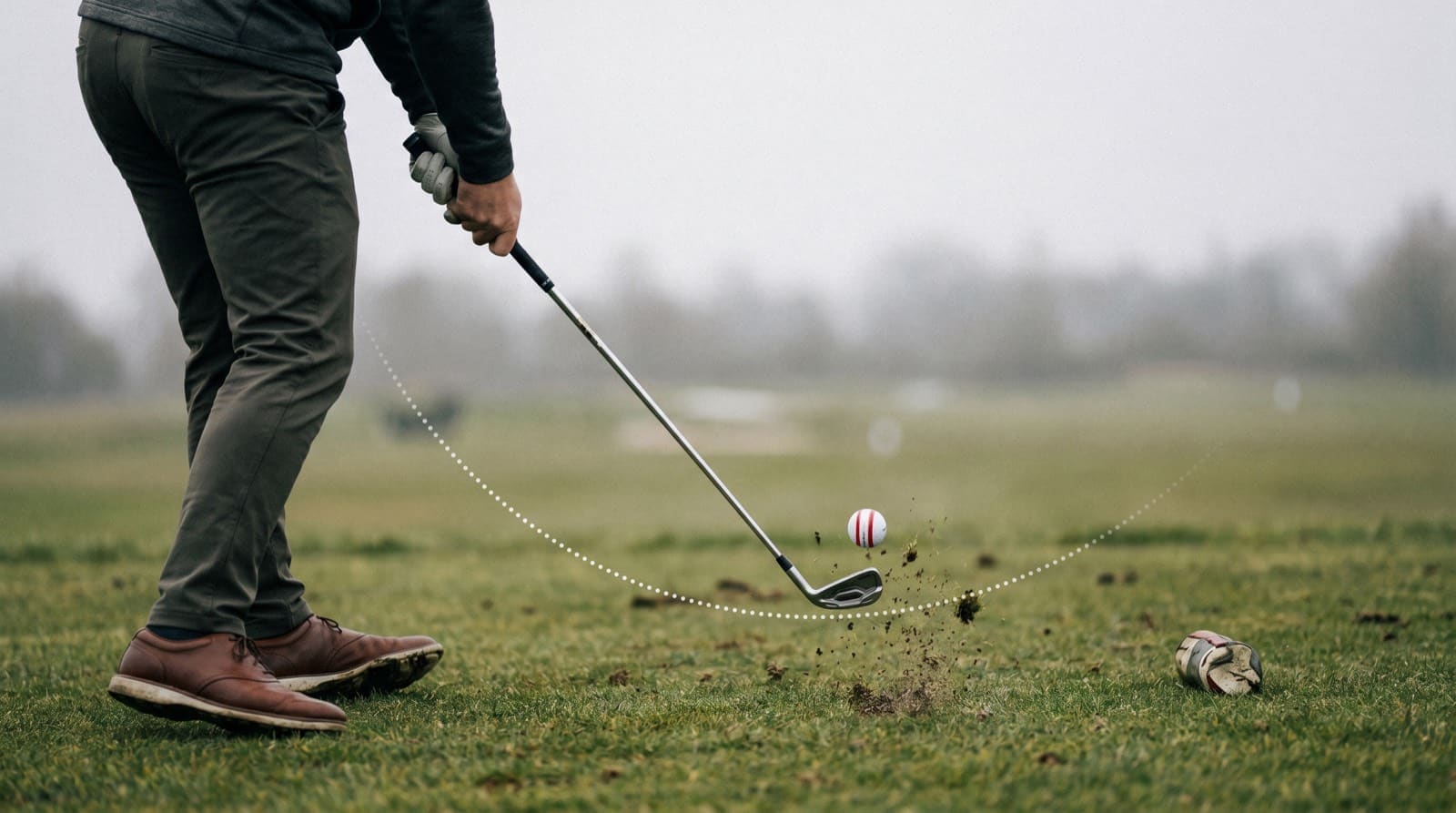
Topping happens when the low point of your swing arc sits behind the ball instead of ahead of it. The fix order that works for most amateurs: set up so the low point can be ahead of the ball (ball position, posture, weight 55/45 forward), then transfer weight to the lead foot through impact (water bottle drill), then rehearse under random practice (rotating clubs and targets). Three to four weeks of structured work moves the needle for most players; eight to twelve makes it permanent.
Topping diagnostic — find your pattern, then your fix
| Type of topped shot | Ball flight | Most likely cause | Highest-leverage first fix |
|---|---|---|---|
| The classic top | Worm-burner with no carry | Weight stuck on back foot, low point behind ball | Water bottle drill (weight forward) |
| The thin skull | Low rocket, sometimes flies far | Early extension; club ascending at impact | Wall posture drill; TPI early-extension cues |
| The driver-only top | Tops driver, irons fine | Tee too low; ball too far back in stance | Tee up higher; move ball forward to lead heel |
| The chunk-then-top | Alternating fat and topped shots | Inconsistent ball position session-to-session | Tee-line ball-position drill |
| The pressure top | Tops only on first tee or under load | Tempo speeds up; weight stays back | Tempo cue; in-round reset (slow downswing) |
Why amateurs top the ball
Topping is a low-point problem. The lowest point of your swing arc sits behind the ball when it should sit ahead of it, so the club is climbing when it reaches the ball and clips the equator. Three biomechanical patterns push the low point in the wrong direction: weight stuck on the back foot, early extension, and a ball position that forces both.
Early extension — the swing fault Titleist Performance Institute defines as the hips and lower body thrusting toward the ball during the downswing while the torso rises — disrupts low-point control geometrically. As the chest and shoulders rise to make room for the trapped arms, the entire club arc rises with them. If the arc is rising faster than the club is descending toward the ball, the contact point migrates up the ball.
The peer-reviewed biomechanics literature confirms the weight-transfer half of the picture. Okuda, Gribble, and Armstrong (2010), in the Journal of Sports Science and Medicine, compared skilled (handicap 0.8) and low-skilled (handicap 30.8) golfers and found that skilled golfers showed earlier pelvic rotation and faster weight transfer to the lead side during the downswing. Queen, Butler, Dai, and Barnes (2013), in the Journal of Strength and Conditioning Research, measured peak ground reaction forces and found that low-handicap golfers (under 9) generated greater vertical force transfer from the trail foot to the lead foot — and earlier timing of those peaks — than high-handicap golfers. Translation: tour-quality strikes have weight forward and on the ground earlier in the swing.
The strike-geometry data from launch-monitor research lines up with the biomechanics. TrackMan’s published averages put PGA Tour pros at an average attack angle of −3.7 degrees with a 6-iron — the club is moving downward and forward at impact, which is what places the swing’s low point ahead of the ball. Amateurs who instinctively try to “lift” their irons swing at a much shallower or near-neutral attack angle, and that raises the low point relative to the ball.
The on-course consequence is a stroke leak. Mark Broadie’s strokes-gained framework measures every mishit against the proximity-to-hole baseline for that shot type, and a topped iron is one of the costliest categories — a topped 7-iron from 150 yards usually travels under 100 yards and leaves the player a longer next shot than the original.
The fix is mechanical. Telling yourself to “stop looking up” rarely works because looking up is the symptom of weight that is already in the wrong place.
The fix order: setup, weight transfer, then transfer-to-course
Most articles list every drill in the world and let you guess. The order matters more than the drill set.
For 80%+ of amateur toppers, the order that works is:
- Setup first. Ball position, weight at address, and forward spine bend determine where the swing’s low point can geometrically live. A bad setup makes correct mechanics nearly impossible — the body is forced to compensate. Setup fixes install in two range sessions and require no swing change at all.
- Weight transfer second. Once the setup template is correct, the next failure point is weight remaining on the back foot through impact. The water bottle drill installs weight forward faster than any verbal cue can, because the feedback is binary.
- Transfer to course third. Block-practice drills make everything look great on the range. The fix only sticks when the last phase of practice is random — see Block vs Random Practice in Golf for why this matters more than the drills themselves.
Why this order? Because setup is the lowest-cost change that produces the largest geometric improvement. Moving the ball one ball-width back in your stance shifts where the low point needs to sit by a corresponding amount — without you changing a single thing about your swing. After setup is locked, weight transfer becomes the next-largest lever. Path and tempo work matter, but not before the first two are in place.
Five drills that actually fix topping
Most toppers know about every one of these drills. The ones who fix it permanently run them in the right order, with measurable success criteria, and re-test against video.
1. The water bottle drill (weight transfer fix)
Place a half-full water bottle a foot behind the ball, perpendicular to your target line. Hit ten 8-iron shots — full swing — without striking the bottle on the follow-through. If the bottle gets clipped, weight is staying back through impact. Goal: 8 of 10 shots cleared, with a divot starting ahead of the original ball position. The drill is fast because the feedback is binary, and weight forward is the largest single lever in fixing topping. Many tour-level coaches use a variant of this drill for the same reason.
2. The towel-line low-point drill (low-point fix)
Lay a folded golf towel on the grass two inches behind the ball, parallel to your target line. Hit ten 8-iron half-swings — the goal is to miss the towel on the way down and take a divot starting ahead of the ball. The towel is a soft, immediate constraint: clip it and you know the low point was behind the ball; miss it and the strike is ahead. Coaches use chalk lines, strings, or divot boards for the same purpose. Goal: 7 of 10 reps with a divot beginning ahead of the original ball position.
3. The wall posture drill (early extension fix)
Stand with your rear glutes touching a wall, club in hand, in your normal address posture. Make slow downswing rehearsals. Your rear should stay in contact with the wall through the simulated impact position — if it leaves the wall, your hips are thrusting toward the ball and you are early-extending. This is the same posture-preservation cue TPI publishes for early extension, simplified for at-home use. 30 reps a day, no club required, no range time required.
4. The tee-line ball position drill (setup fix)
Stick a tee in the ground where your lead heel sits at address. Hit ten 8-irons checking that the ball is positioned roughly even with the tee — not forward of it. Most amateurs who top creep the ball forward over time without noticing. The tee gives you an external reference that is more reliable than feel. Variation: use two tees, one at lead heel and one at trail heel, to also lock stance width. Goal: ten consecutive shots with consistent ball position and stance width, then move on to drill 1 or 2.
5. The step-through release drill (weight transfer + tempo)
Address the ball with feet together. As you start the downswing, step your lead foot toward the target — finish on the lead foot with the trail foot fully released. Hit fifteen 7-iron half-swings. The forced step makes weight transfer impossible to skip. The drill traces back to Sam Snead’s tempo-and-balance work and modern coaches still teach it because the motion bypasses every conscious cue and installs the weight shift physically. Pair with a normal-stance swing immediately after to lock the feel.
The four-week protocol that makes it stick
This is the part most articles skip. Drills work in week one and stop working by week four because the fix is never exposed to variable conditions. The plan below mirrors the howTo schema on this page and matches the sequence PracticeCaddie’s AI plans use when a user reports a topping problem in onboarding.
- Week 0 — measure. Phone video face-on. Hit ten 8-irons. Where does the divot start? Lay a tee on the grass perpendicular to the target line as a reference. Note: divot ahead of the line, on the line, or behind it. No fix yet — only a baseline.
- Week 1 — setup. 30 minutes, three sessions. Tee-line drill with half-swing 8-irons. Confirm ball position even with the lead heel, stance width about 16 inches between insteps, 55% weight forward at address, and 30 to 35 degrees of forward spine bend. Block practice is correct here — you are acquiring a setup pattern.
- Week 2 — weight transfer. 30 minutes, three sessions. Water bottle drill (10 reps), then towel-line drill (10 reps), then step-through (15 reps). Re-film at the end of Week 2. Expect divots to begin shifting ahead of the original ball position.
- Week 3 — random. 45 minutes, three sessions. Pre-write an 18-shot list rotating club (wedge through hybrid) and target. No two consecutive shots match. Apply the Week 1 setup and the Week 2 weight transfer on every swing. The fix has to survive variability before it transfers to the course. (See Block vs Random Practice in Golf for the research underpinning this step.)
- Week 4 — pressure. 45 minutes, three sessions. Each session ends with a “first-tee” simulation: three 8-iron shots cold to a 30-yard target window, pass/fail. Play one nine-hole round at the end of the week. Log how many shots you topped per round. Most golfers see meaningful change here.
- Maintenance — re-film every two weeks. The pattern tries to come back under stress. Re-film a face-on swing every other Sunday. Two consecutive sessions of regression triggers a Week 1 or Week 2 reset for a single session.
If at the end of Week 4 your topping rate has not measurably reduced, the issue is almost always one of two things: a mobility limitation that prevents proper weight transfer, or an equipment fit issue (shaft length or lie angle). Both are addressed in the next section.
In-round recovery: when topping starts mid-round
When topping shows up on the third hole of a round, the instinct to make a swing change is almost always wrong. The faster reset is to identify what changed in the last hole or two — not to rebuild the swing.
Three checks, in order:
- Setup drift. Did the ball creep forward in your stance? Did your stance widen because you were trying to “stay still”? Walk through your full setup checklist on the next shot — ball position, stance width, weight 55/45 forward, posture.
- Tempo speed. Topping correlates with an accelerated downswing. If you are nervous, anxious, or pressing, your downswing tempo is faster than your range tempo. Consciously slow the downswing by 10 to 15% — the weight-transfer sequence then has time to actually happen. The tempo drills post covers the 3:1 backswing-to-downswing ratio in more detail.
- Single focus. Pick one cue — “weight forward” — and let everything else run on instinct. Trying to monitor four mechanics simultaneously under pressure produces cognitive overload and worse outcomes. The slice-fix companion piece — How to Fix a Slice in Golf — uses the same single-focus principle for in-round recovery.
The step-through drill above also doubles as an on-course reset. Take one practice swing where you actually step through to the lead foot before addressing your next shot. The motion is small, takes ten seconds, and physically reinstalls weight transfer in a way no verbal cue can.
When topping signals a deeper issue
Self-coaching works for the typical setup-and-weight-transfer topping pattern. Three patterns benefit more from a one-hour TrackMan or FlightScope lesson than from another month of self-practice:
- Two-way miss with no consistent shape. Topping in one round and chunking in the next means low-point control is unstable across sessions. A coach with a launch monitor isolates the variable in 60 minutes.
- Topping that survives the four-week protocol. If Week 4 shows no meaningful improvement, a mobility limitation is often the underlying cause. The TPI screen tests for hip internal rotation, ankle dorsiflexion, and thoracic spine rotation — three mobility deficits that make proper weight transfer biomechanically harder. A TPI-certified coach or sports physiotherapist can identify these in one session.
- Equipment-driven topping. If your clubs are 1 to 2 inches longer than fit for your height and arm length, you stand farther from the ball than you should and the geometry of weight transfer is corrupted. A 30-minute clubfit at a fitting studio (typically $50–$100, often credited toward purchase) catches this.
A single launch-monitor session typically costs $75 to $150 and saves four to eight weeks of practice when the diagnosis matters more than the drill choice.
Common mistakes
- Trying to “lift the ball up.” Iron play requires hitting down on the ball. The loft on the club face does the lifting. Trust the loft.
- Fixing weight without fixing setup first. Drilling weight forward against a setup with the ball positioned three inches too far forward turns a top into a chunk. Setup is the geometric template; weight is the dynamic correction. Run them in order.
- Ignoring posture loss in the takeaway. Many amateurs lose forward spine bend by the top of the backswing, then spend the entire downswing trying to find it again. The wall drill above traps this early.
- Block practice for four weeks. Same shot, same target, 50 reps. Range performance climbs, course performance does not. The Week 3 random-practice phase is non-negotiable.
- Skipping the baseline. Without Week 0 video, you cannot tell at Week 4 whether anything changed. Half of perceived “no progress” comes from poor memory of how bad the original pattern was.
- Switching drills weekly. Drill rotation feels productive but starves any single pattern of the reps it needs. Pick the five drills above and stick with them through Week 4.
Key takeaways
- Topping is a low-point problem. Your swing’s lowest point sits behind the ball; the work is to fix the geometry that puts it there.
- The three root causes are weight stuck on the back foot, early extension, and ball position too far forward. Compensations like lifting up and chicken-winging are symptoms, not causes.
- Tour-quality strikes generate higher peak lead-foot force earlier in the downswing than amateur strikes, per Queen et al. (2013) and Okuda, Gribble & Armstrong (2010). The weight-transfer gap is where most topping originates.
- The fix order: setup, then weight transfer, then transfer-to-course. Drills run out of order produce new misses.
- The water bottle drill is the highest-leverage single drill because the feedback is binary and weight forward is the largest lever.
- Random practice in Week 3 is what makes the fix transfer. Block-only practice for four weeks produces a range-only fix.
- If Week 4 shows no improvement, mobility or equipment is the variable. A TPI screen or a launch-monitor lesson is worth more than another month of self-practice.
Frequently asked questions
What causes topping the golf ball?
Topping happens when the low point of your swing arc sits behind the ball, so the club is already ascending when it reaches the ball and strikes the upper hemisphere. The dominant root causes for amateurs are weight stuck on the back foot through impact, early extension (hips thrusting toward the ball, torso rising), and a ball position that is too far forward in the stance. Lifting the upper body and chicken-winging the lead arm are usually compensations the body invents to make contact, not the original cause.
How do I stop topping my driver versus my irons?
The fix is similar but the geometry differs. Iron strikes need the club’s low point to land one to three inches ahead of the ball — you compress the ball, then take a divot. Driver strikes work the opposite way: the low point should sit slightly behind a teed ball so you catch it on the upswing. If you top your driver but strike irons clean, raise the tee height so half the ball sits above the crown, move the ball forward to your lead heel, and feel a slight upward strike. Different geometry, different fix.
Can the wrong ball position cause topping?
Yes — and it is one of the most common hidden causes. Ball position too far forward forces your weight to stay back to reach the ball, which raises the swing’s low point behind it. For mid-irons, the ball should sit roughly even with the lead heel. For short irons and wedges, move it back one to two inches inside the lead heel. For long irons and hybrids, slightly forward of center. A simple test: hit five shots with the ball moved one ball-width back from your normal position. If contact improves, your prior position was too forward.
Is topping the ball a sign of lifting up?
Lifting up is usually the symptom, not the root cause. When weight stays back during the downswing, the body senses it cannot reach the ball cleanly and the upper body extends upward as a compensation — chest rises, head moves back, lead arm chicken-wings through impact. Fixing the lifting motion in isolation rarely sticks because the underlying weight-transfer or posture issue is unaddressed. Work on weight forward at impact (the water bottle drill) or on maintaining forward spine bend (the wall drill) and the lifting compensation drops out on its own within two to three sessions.
How long does it take to stop topping the ball?
Most golfers see meaningful improvement in three to four weeks of structured practice — two to three sessions a week, 30 to 45 minutes per session. Permanent change usually takes eight to twelve weeks because the new motor pattern needs to survive variability. Block practice on the range can mask the issue inside a session and let topping return on the course. Random practice with rotating clubs and targets in Week 3 onward is the phase that decides whether the fix transfers to your scorecard.
What’s the fastest drill to fix topping at the range?
The water bottle drill. Place a half-full water bottle one foot behind the ball, perpendicular to your target line. Hit ten 8-iron shots without striking the bottle on your follow-through. The constraint forces weight to the lead foot through impact and prevents the back-foot finish that produces topped shots. Most golfers improve within ten reps because the feedback is binary — you either hit the bottle or you don’t. Pair it with a divot check: a divot starting ahead of the original ball position is the target outcome.
Related reading
- Block vs Random Practice in Golf: What the Research Actually Says — the motor-learning research behind the Week 3 transfer phase of this protocol.
- How to Fix a Slice in Golf: Causes, Drills, and a 4-Week Practice Plan — sister fix protocol; the four-week structure layers cleanly on top of the contact work above.
- 10 Golf Practice Drills Tour Coaches Actually Use — the broader drill library; the topping drills above slot into a session alongside putting and wedge work.
- Golf Tempo Drills: Three Tour-Tested Routines — the tempo cue used in the in-round reset section, with deeper tempo-ratio research.
- Driving Range Practice Routine: 3 Plans by Handicap — how to drop the topping drills into a Tuesday/Thursday/Saturday cadence at the right weekly volume.
- Golf practice drills that actually transfer to the course — the companion drill library, organized by skill area.
- The 30-minute golf practice plan — fitting the topping protocol into a tighter window.
- How to Grip a Golf Club — the grip-and-setup cornerstone that feeds low-point control across the bag.