
Golf Stance and Posture: The Setup That Fixes Your Contact
Your stance sets your base and your posture sets your spine angle. How to build an athletic, repeatable setup for every club, plus the faults to watch for.
Quick answer
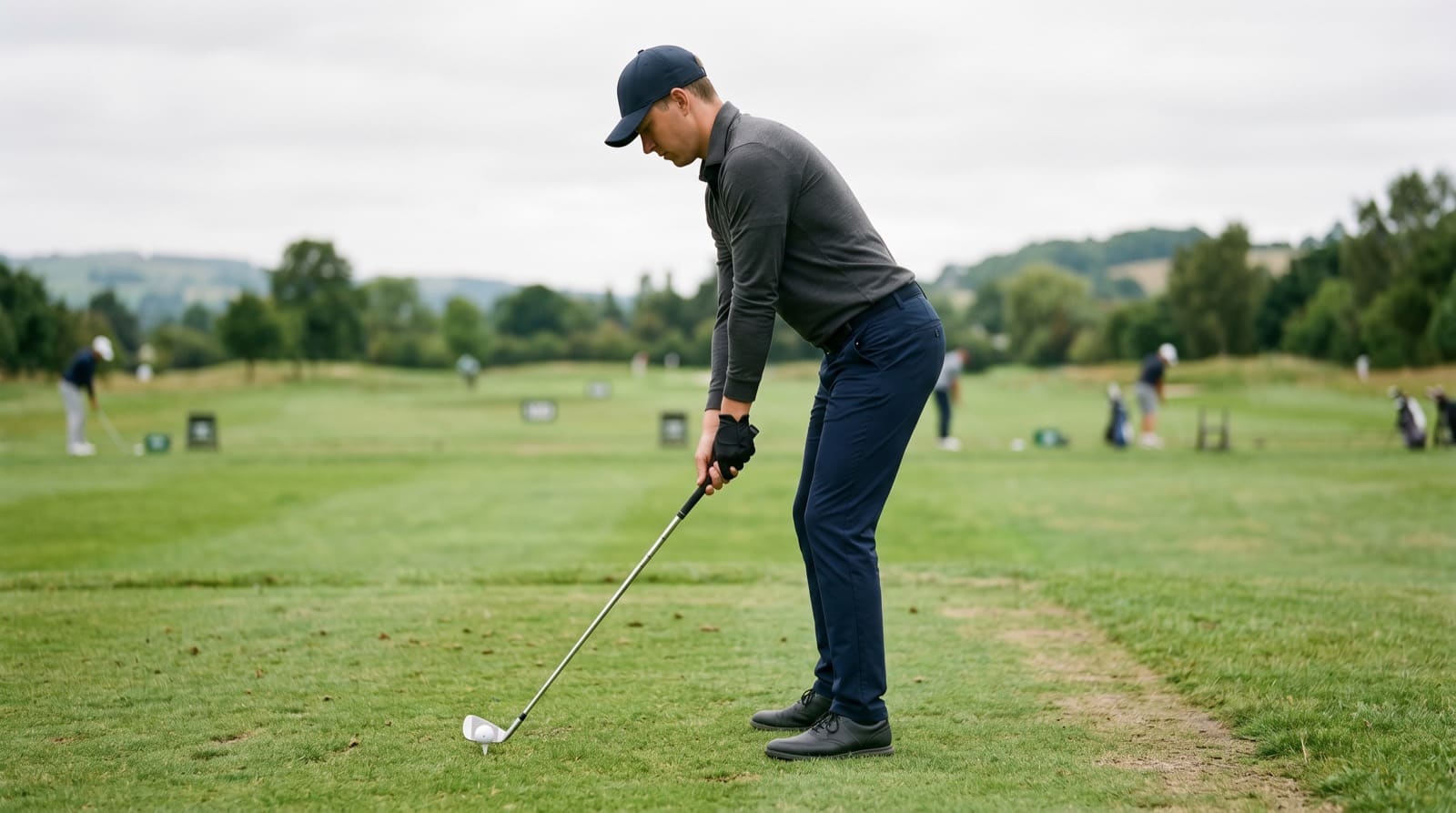
Your stance is your base and your posture is your spine angle, and together they decide how well you rotate and where the bottom of your swing arc falls. Hinge from your hips, keep the spine near neutral, add a slight knee flex, and let the arms hang. Set your feet about shoulder-width for a mid-iron, wider for the driver, narrower for wedges. A setup you can hold through impact is what makes contact repeatable.
Golf setup by club
| Club | Stance width | Ball position | Weight at address |
|---|---|---|---|
| Driver | Widest | Opposite the lead heel | Slightly trail-side, spine tilted back |
| Fairway wood / hybrid | Wide | Forward of center | Even to slightly trail |
| Mid-iron (5–7) | Shoulder-width | ~1 ball forward of center | Even |
| Short iron (8–PW) | Just inside shoulders | Center | Even |
| Wedge | Narrowest | Center | Even to slight lead |
What stance and posture actually control
Stance and posture are the two halves of your setup that decide whether your swing has a stable platform to work from. Your stance, the width and angle of your feet, sets your balance and how freely your hips can turn. Your posture, the angle of your spine, sets your swing plane and the bottom of your arc. Get them wrong and you spend the whole swing compensating.
Posture matters because the angle you tilt over at address is the angle your body wants to return to at impact. Titleist Performance Institute, the body that certifies thousands of golf-fitness and instruction professionals, frames a neutral, hip-hinged setup as the foundation that lets you rotate fully and apply force into the ground without straining your back. Lose that angle on the way down and your low point moves, which is the hidden cause behind a lot of fat and thin contact.
Posture is a low-point tool. The spine angle you set at address is the angle your body tries to return to at impact, so a golfer who holds that angle strikes the same spot every swing, while one who stands up chases a low point that keeps moving.
Stance does the same job for rotation and balance. Too narrow and you cannot stay stable while you turn hard; too wide and your hips stop short of a full turn. The grip is the third leg of the setup picture: the grip sets the face, ball position sets the strike, and stance and posture set the platform that delivers both. Fix the setup first and most swing faults have far less to feed on.
Athletic posture: hinge from the hips
Good posture is a hip hinge, not a slouch. From a tall stance, push your hips back and tilt your upper body forward from the hip joints while keeping your spine long. The tilt comes from the hips, not from rounding your shoulders or arching your lower back. How far you tilt depends on your build, since your leg length, arm length, and torso all change it, which is why a single “perfect” posture number does not exist. The reliable check is that your arms hang clear of your thighs with a little room to swing.
The simplest way to feel a true hinge is the toe-touch move that Titleist Performance Institute uses as a screen. Stand with your feet together and reach for your toes by sending your hips back, not by curling your spine. If you can only reach your toes by rounding your back, tight hamstrings are forcing your thoracic spine to do the hinging, which is the root of poor address posture.
Knee flex is where amateurs over-correct. You want only a slight softening of the knees, enough to feel athletic and balanced. GOLFTEC and Golf Distillery both make the same point: too much knee bend stands your spine up, and an upright spine flattens your swing plane and invites casting. The flex should feel like a result of hinging, not an active squat.
Your arms finish the picture by hanging. Let them drop naturally under your shoulders so the butt of the club sits roughly a hand’s width from your body for an iron. Reaching for the ball pulls you onto your toes; jamming the arms in kills your width. Hanging arms keep the swing arc wide and repeatable, which is half of consistent ball striking.
Stance width by club
Stance width is a trade between stability and rotation, and the right answer changes with the club. For a mid-iron, shoulder-width, measured to the inside of your heels, is the working default. It gives you a stable base while still letting your hips turn back and through. A quick checkpoint: hold a club across the front of your shoulders, then set your feet so the shaft frames the inside edge of each foot.
The driver needs more. It is the longest club and the one you swing the fastest, which generates the most rotational force, so the base widens to keep you balanced through a bigger turn. Widen each foot outward from your iron stance until it feels noticeably more stable without feeling planted. That wider platform is also what lets you keep your spine angle while you swing up on the ball, which matters for driver distance.
Wedges and short irons go the other way. Narrow the stance so your lower body quiets down and your contact gets more precise, since touch matters more than power on scoring shots. The common mistake is narrowing too far and getting wobbly, so keep enough width to stay balanced over a short, controlled swing.
Foot angle is the detail most golfers skip. In his classic Five Lessons, Ben Hogan taught turning the lead foot out about a quarter-turn toward the target while keeping the trail foot square. That lead-foot flare lets your hip clear through impact, which is especially useful if your hips are tight, and the square trail foot supports a full backswing turn without swaying off the ball.
Where your weight goes at address
Weight distribution is the most-argued point in the setup, so it is worth being honest about the disagreement. The traditional cue is to feel athletic and ready with pressure toward the balls of your feet. The counter-argument, made clearly by RotarySwing, is that starting on the balls of your feet pulls you even further forward as you swing down, which feeds early extension and forces you to stand up to make room.
The fix both camps can agree on is balance. Set up, then rock gently from your toes to your heels and settle where you feel completely stable with no strain in your feet, the spot you could hold all day. For most golfers that balance point lives through the middle of the foot, not out on the toes and not back on the heels. If you have to brace to stay steady, your weight is in the wrong place.
Front-to-back balance is one axis; left-to-right changes by club. For irons, set up with your weight roughly even between your feet, which supports the slightly descending strike a center-ball iron wants. The wedges sit even to a touch lead-side for a steeper, more controlled hit. The driver is the outlier, which gets its own section below.
The driver setup: tilt to hit up
The driver is the one club in the bag you want to strike on the way up, and the setup is built to make that happen. Play the ball forward, opposite your lead heel, take your widest stance, and add a small amount of spine tilt away from the target so your lead shoulder sits higher than your trail shoulder. Pair that with a touch more weight on the trail side at address. Those three changes move the bottom of your arc behind the ball so the clubhead is climbing at impact.
The payoff is measurable in launch data. According to TrackMan, PGA Tour players average a slightly negative driver attack angle while LPGA Tour players average a positive +2.8 degrees, and TrackMan states plainly that hitting up on the driver is what maximizes distance for a given speed. Titleist Performance Institute makes the same case: an ascending strike raises launch and cuts spin at the same time, which is the recipe for carry.
The setup tilt is what physically allows it. Without a little spine tilt and a forward ball, you are asked to hit up on a ball your body is positioned to hit down on, and the usual result is a scoop or a stand-up move through impact. The honest read is that the driver feels like a different setup than your 7-iron because it is one, and that is the point. Ball position does half the work here, covered in full in the ball-position guide.
Common posture faults and what they cost
Most posture problems fall into a few recognizable patterns, and each one has a predictable cost. Titleist Performance Institute screens for two spine faults by name. C-posture is a rounding of the upper back and shoulders at address, which restricts how far you can turn your shoulders and shows up as inconsistent contact. S-posture is the opposite, an excessive arch in the lower back from pushing the tailbone out too far, which over-tightens the lower back and is tied to early extension.
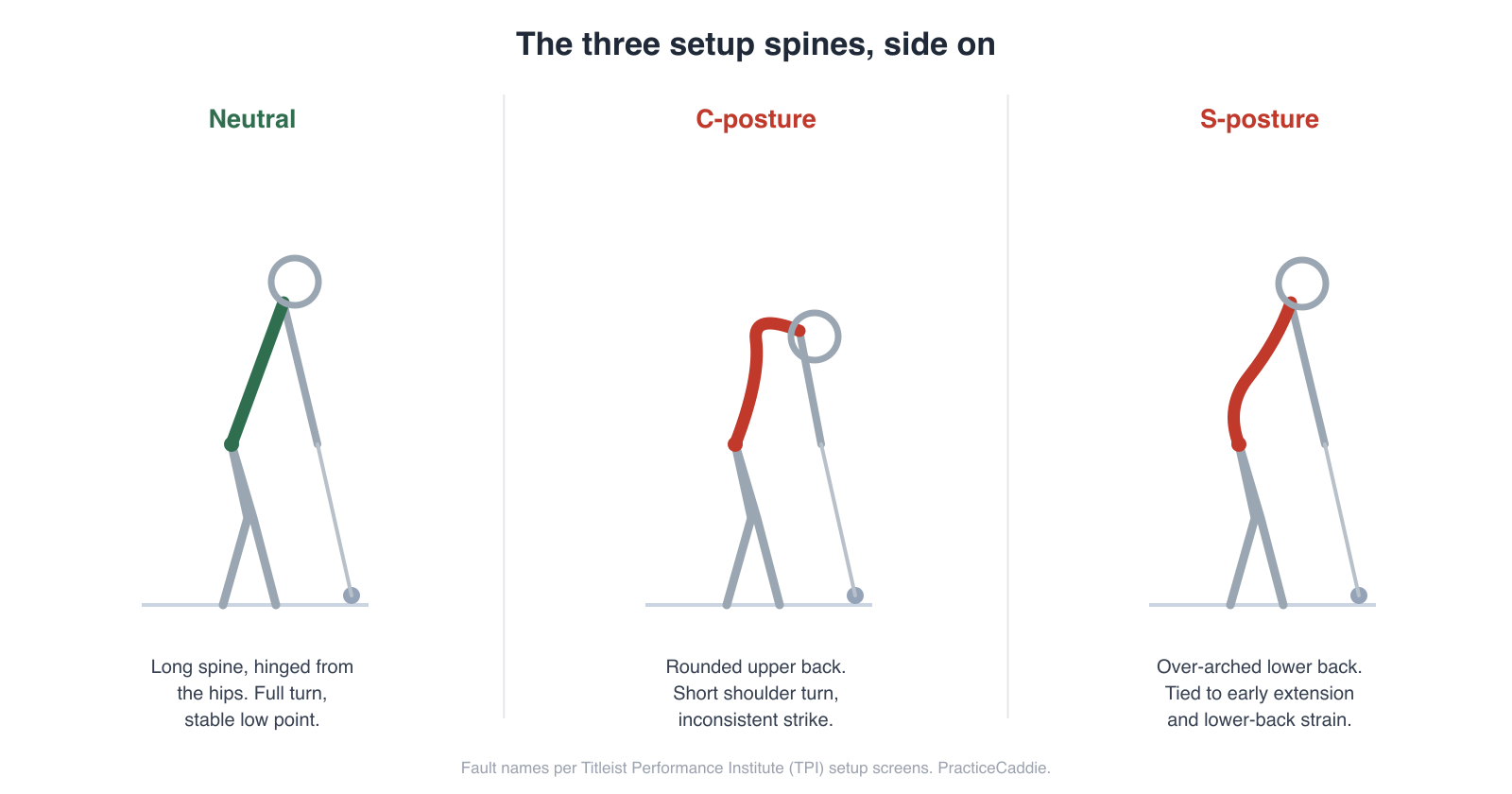
Early extension is the fault that ties posture to ball striking most directly. Defined as the lower body thrusting toward the ball in the downswing, it is among the most common faults instructors see, and coach Adam Young describes it as a loss of the posture you set at address. The cost is a moving low point, which produces the thins, tops, and blocks that feel like swing problems but start at setup.
The table below maps the common setup faults to what they look like and what they cost, so you can find your pattern before you fix it.
| Setup fault | What it looks like | What it costs |
|---|---|---|
| C-posture | Rounded upper back, head dropped forward | Short shoulder turn, inconsistent strike |
| S-posture | Over-arched lower back, tailbone pushed out | Early extension, lower-back strain |
| Weight on the toes | Pressure out over the balls of the feet | Standing up through impact, thin contact |
| Too much knee flex | Squatting, upright spine | Flat plane, casting, hooks and blocks |
| Standing too tall | Not enough forward tilt, arms cramped | Steep, handsy swing, lost width |
How to set your stance and posture
This is the order that works, built from the feet up. It takes about a minute and turns a vague “athletic position” into six checkpoints you can repeat.
- Set your feet and stance width. Shoulder-width for a mid-iron, wider for the driver, narrower for wedges. Flare the lead foot out about a quarter-turn; keep the trail foot near square.
- Hinge from your hips. Push your hips back and tilt forward from the hip joints with a long spine, not a rounded back. Tilt enough that your arms hang clear of your thighs.
- Add a slight knee flex. Soften the knees just enough to feel balanced. Let it come from the hinge, not an active squat.
- Find your balance point. Rock toe to heel and settle mid-foot, where you feel stable with no strain.
- Let your arms hang. Drop them under your shoulders, butt of the club about a hand’s width from your body for an iron.
- Tilt for the driver. For the driver only, add a little spine tilt away from the target so the lead shoulder sits higher, with slightly more weight on the trail side.
You do not need a launch monitor or a lesson for any of this. A mirror and a phone camera give you all the feedback the setup requires.
How to practice setup so it actually sticks
A new posture feels strange before it feels right, the same way a grip change does, so it has to be trained rather than just understood. The fastest feedback comes from your eyes. Set up in front of a mirror for face-on and down-the-line checks, or film a few setups on your phone, because you cannot feel a rounded spine nearly as well as you can see it.
Use references so the position repeats. Lay one alignment stick along your toes and a second to mark ball position, then build your setup the same way every time until the checkpoints become automatic. Tour players run subtle foot waggles and rehearsals before a shot for exactly this reason, to keep finding their balance instead of freezing into a stiff, off-balance stance.
How you cue yourself matters more than most golfers think. Motor-learning research by Wulf, Lauterbach and Toole (1999) found that an external focus of attention, thinking about the club or the target rather than your body parts, produced better golf-shot accuracy and retention than an internal focus on the mechanics. So once you understand the positions, train them with an external cue, like “frame the ball between your feet,” rather than narrating your hip angle mid-swing.
Then groove the change the way the block-versus-random-practice research suggests, by varying clubs and targets instead of raking ball after ball from one spot. PracticeCaddie’s structured plans bake that variability in by default, and you can confirm the setup is working with ball-striking drills that score low-point control.
Common stance and posture mistakes
The faults table above covers the postures themselves. These are the process errors that let those faults creep back in.
- One stance for every club. A driver and a wedge need different widths and ball positions. Widen for the long clubs, narrow for the short ones.
- Reaching for the ball. Standing too far away cramps the arms and steepens the swing. Let the arms hang under the shoulders and stand a club’s-hang away.
- Skipping the balance check. Setting up without finding your mid-foot balance point is how weight drifts onto the toes or heels without you noticing.
- Rebuilding posture by feel every time. Without a mirror or alignment sticks, you set up a little differently every swing, then blame the swing. Use references until it repeats.
- Changing grip and posture together. Move one setup variable at a time so you know which one changed your ball flight.
Key takeaways
- Posture is a hip hinge, not a slouch. Tilt from the hip joints with a long spine, hinging from the hips rather than rounding the back, per TPI.
- Stance width scales with the club. Shoulder-width for mid-irons, wider for the driver, narrower for wedges.
- Find a mid-foot balance point. Most early extension and stand-up moves trace back to starting on the balls of the feet (RotarySwing).
- Keep knee flex minimal. Too much knee bend stands the spine up and flattens the plane (GOLFTEC).
- The driver gets spine tilt. Lead shoulder higher than the trail shoulder sets the upward strike; LPGA players average a +2.8-degree driver attack angle (TrackMan).
- C-posture and S-posture are the two named spine faults. TPI screens for both, and S-posture is directly linked to early extension.
- Train setup with an external focus. Cueing the club or target beats narrating body parts, per Wulf et al. (1999).
Frequently asked questions
What is the correct golf posture?
Good golf posture starts with an athletic hip hinge. Bend forward from your hip joints, not your waist, keep your spine close to neutral, and add only a slight knee flex. Your arms should hang naturally under your shoulders, and your weight should sit balanced over your feet. Titleist Performance Institute defines this neutral setup as the position that lets you rotate fully while protecting your lower back. Most posture problems come from rounding the upper back, called C-posture, or over-arching the lower back, called S-posture.
How wide should my golf stance be?
Stance width scales with the club. For mid-irons, set your feet about shoulder-width, measured to the inside of your heels, which balances stability against the freedom to rotate. Widen the base for the driver, since the longest club generates the most rotational force and needs a steadier platform. Narrow it for wedges and short irons, where control matters more than power. A simple check: hold a club across your shoulders, then step until the shaft frames the inside of each foot for a mid-iron.
Should my weight be on the balls of my feet at address?
Instruction splits on this. The common cue is to feel pressure toward the balls of your feet in an athletic, ready position. Others, including RotarySwing, argue weight should sit through the center of your ankles at a true balance point, because starting on the balls of your feet pulls you further forward in the downswing and feeds early extension. The practical test is balance: set up, then rock gently until you find the spot where you feel stable with no strain. For most golfers that point is mid-foot, not the toes.
What is the difference between C-posture and S-posture?
Both are spine faults that Titleist Performance Institute screens for. C-posture is a rounding of the upper back and shoulders at address, often with the head dropped forward, and it restricts shoulder turn and is linked to inconsistent contact. S-posture is the opposite extreme, an excessive arch in the lower back from sticking the tailbone out too far, which over-tightens the lower back and is tied to early extension. Neutral posture sits between them: a long, relatively flat spine hinged from the hips.
How does posture cause fat and thin shots?
Posture sets your spine angle, and your spine angle sets the bottom of your swing arc. If you lose that angle in the downswing, your low point moves and contact suffers. Standing up out of posture, often through early extension, pulls the club up and leads to thin or topped shots, while collapsing or hanging back can drop the low point behind the ball for fat contact. A stable, athletic setup you can hold through impact is what keeps the low point in the same place every swing.
How is the driver setup different from irons?
The driver is the one club you want to hit on the way up, so the setup changes. Play the ball forward, opposite your lead heel, widen your stance, and add a touch of spine tilt away from the target so your lead shoulder sits higher than your trail shoulder. That tilt and a slightly trail-side weight bias let the clubhead reach the ball after the low point, on the upswing. TrackMan data shows LPGA Tour players average a positive driver attack angle of +2.8 degrees, which is what hitting up looks like.
How do I practice golf posture so it sticks?
Set up in front of a mirror or a phone camera so you get instant feedback on your spine and stance, since you cannot feel posture as well as you can see it. Lay an alignment stick along your toes and another to mark ball position so the setup repeats. Motor-learning research by Wulf and colleagues found that an external focus, thinking about the club or target rather than body parts, transfers better than internal cues. Then groove the change with varied, randomized reps instead of raking balls from one spot.
Related reading
- How to Grip a Golf Club — the first piece of the setup; the grip sets your face while stance and posture set your platform.
- Golf Ball Position: Where to Place the Ball for Every Club — the strike half of the setup, and the natural partner to stance width.
- How to Fix a Slice in Golf — a stand-up, over-the-top move often starts in posture; check setup before rebuilding the swing.
- How to Stop Topping the Golf Ball — thin and topped shots are low-point errors, and losing posture is a prime cause.
- How to Increase Golf Swing Speed — a stable, athletic base is what lets you add speed without losing balance.
- Block vs Random Practice in Golf — how to groove a setup change so it holds up on the course instead of fading by the first tee.
- Golf practice drills, organized by skill area — the companion drill library, with setup steps and success criteria.
- Golf practice plan — where setup and ball-striking work fit into a structured weekly session.