
How to Release the Golf Club: Timing, Face Control, and the Data
Your release sets the clubface, and the face owns 85% of your start line. What the data says about lag, rate of closure, and training release timing.

Quick answer
The release is the wrist uncocking, forearm rotation, and body rotation that square the face through impact. It sets your start line: face angle drives about 85 percent of where a driver starts, while holding lag is worth roughly 1.6 percent of clubhead speed. Your clubface is rotating at 1,800 to 3,600 degrees per second near impact, so timing beats effort. Diagnose from ball flight, then train it with external cues.
The three release numbers that actually matter
| Metric | Typical range | What it tells you | Source |
|---|---|---|---|
| Rate of closure at impact | 1,800–3,600 °/sec | How wide your timing window is | MacKenzie via GOLF.com |
| Shaft twist component (PGA Tour) | 650–2,500 °/sec | How much of your closure is forearms vs body | MacKenzie via GOLF.com |
| Face contribution to start line | ~85% driver, ~75% irons | Why the release owns your direction | GolfWRX ball-flight laws |
| Speed gain from delaying release | ~1.6% (44.0 → 44.7 m/s in model) | Why lag is a poor distance strategy | Sprigings & MacKenzie, delayed release simulation |
| Tour 6-iron attack angle | −3.7° | The descending strike a good release produces | TrackMan |
| Lead-wrist change to impact | 15–30° less extension than address | The flexion that squares the face without adding loft | HackMotion |
Read that table once and the whole topic reorganizes itself. The release is a face-control skill wearing a distance costume.
What does it mean to release the golf club?
The release is the coordinated uncocking of the wrists, rotation of the forearms, and rotation of the body that accelerates the clubhead and squares the clubface through impact. It is the last link in the chain that carries energy from your body to the club.
Golfers talk about it as one move, usually a wrist snap. Biomechanically it is three motions happening together in the last few hundredths of a second before impact: the wrists uncocking from radial toward ulnar deviation, the lead wrist moving from extension toward flexion, and the forearms rotating so the face turns from open to square. A systematic review of golf swing biomechanics in the peer-reviewed literature describes the downswing as a phase where joint angles and angular velocities change dramatically in the final milliseconds, with the wrists acting as the last link in the chain.
That last-link position is the whole story. Everything upstream, the downswing sequence of pelvis into torso into arms, exists to deliver the club into a window where the release can finish the job. When the sequence is good, the release is largely something that happens to you. When the sequence breaks, the hands start trying to rescue the shot, and that rescue is what golfers experience as a bad release.
There is no single correct pattern. A 2025 study of 84 elite male golfers classified them into four on-plane wrist release styles: two delayed-release patterns, an early-release pattern, and a recocking pattern where the wrists partially re-hinge before impact. All four appeared among high-level players. The delayed styles showed longer transitions and more complete proximal-to-distal sequencing, which sounds like a verdict until you get to the finding that matters most.
The lag myth, with the actual number attached
The study found no statistically significant difference in clubhead speed between the four release styles.
Simulation agrees. Sprigings and MacKenzie’s forward-dynamics model of the delayed release tested applying resistive wrist torque to hold the wrist angle deep into the downswing against letting it uncock more conventionally. The delayed strategy reached about 44.7 metres per second at impact against 44.0 for the conventional one, which the paper reports as a 1.6 percent improvement and describes as substantially smaller than earlier simulation studies had claimed. They also found that adding an active wrist torque after the delay helped a little more, which is the honest nuance most lag content skips.
Convert 1.6 percent into golf terms and it is a few yards on a driver. Meanwhile the cost of chasing it is real: forearm tension, a narrower timing window, and a face that arrives wherever the hands happen to leave it. The casting guide covers the fault at the other extreme, and the same principle applies from both directions. Lag is an output of sequencing, and it prices out as a distance strategy.
Rate of closure: the number that decides your miss
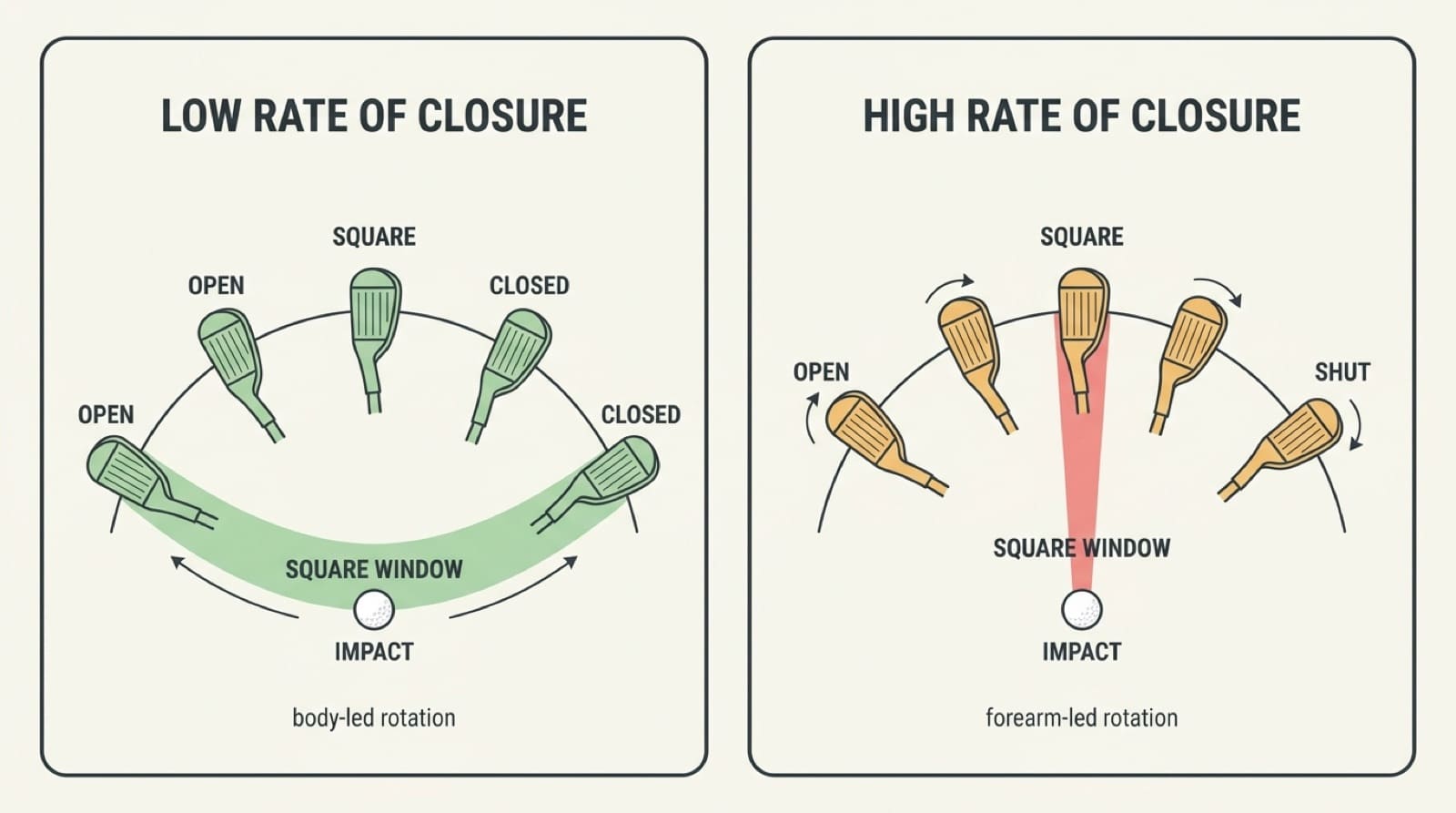
Here is the metric that reframes release training. Rate of closure is how fast the clubface rotates around the shaft axis through impact. MacKenzie reports typical values between 1,800 and 3,600 degrees per second, with the shaft-twist component alone running roughly 650 to 2,500 degrees per second on the PGA Tour. He also notes that swing plane contributes: at 90 mph of driver speed, a 30-degree incline-plane component adds about 800 degrees per second on its own.
Do the arithmetic on 2,500 degrees per second. The face moves about 2.5 degrees per thousandth of a second. A timing error of four milliseconds, which is far below conscious control, moves your face angle by 10 degrees. At driver length that is the difference between a fairway and a neighbouring hole.
Two consequences follow. First, no golfer times the release consciously, at any level, so instruction aimed at “when to snap the wrists” is aimed at a control loop that does not exist. Second, a lower closure rate widens the window in which your face is acceptably square, which is the theoretical case for a body-driven release. Worth stating plainly: MacKenzie notes there is currently no evidence that lower-closure players actually hit more fairways or closer approaches, so treat this as a fitting question rather than a proven upgrade. A high closure rate is not disqualifying, plenty of good players own one, but it leaves less room for a timing error.
The Release Match Test
Most release advice fails because it prescribes a pattern before diagnosing one. PracticeCaddie’s test takes three steps and costs nothing but a phone and 20 balls.
Step 1: log 20 shots. Hit 20 seven-irons and record two things per shot: where the ball started relative to your target line, and which way it curved. Start direction is mostly your face angle. Curve is the gap between face and path. TrackMan-era research quantified this as roughly 85 percent face contribution to start line with a driver and about 75 percent with irons, which makes start-and-curve the first diagnostic layer to run before you touch technique. It is inexact, since strike location adds gear-effect curve of its own, so judge the pattern across 20 shots rather than any single one. Ignore the divots. That same source calls divot direction virtually worthless for diagnosing what happened at impact, because divots form after the ball is already gone.
Step 2: read the pattern against the table.
| Dominant miss | Ball starts | Ball curves | Face vs path | Release verdict | First fix |
|---|---|---|---|---|---|
| Push-slice | Right | Right | Open to a right path | Under-releasing | More forearm rotation + lead-wrist flexion |
| Pull-slice | Left | Right | Open to a left path | Late release, body ahead | Slow the body, let the arms catch up |
| Pull-hook | Left | Left | Shut to a left path | Over-releasing | More body rotation, quieter forearms |
| Push-draw | Right | Left | Shut to a right path | Functional, timing-sensitive | Leave it alone, monitor dispersion |
| Two-way miss | Both | Both | Varies shot to shot | Mistimed, not mis-patterned | Reduce closure rate before anything else |
The two-way miss row is the one worth stopping on. A player who hits both a hook and a slice with the same swing has a closure rate their timing cannot service. Adding more hand action to that swing makes both misses worse.
Step 3: run the frame count. Film one swing at 240 frames per second from down the line. Find the frame where the shaft is parallel to the ground on the way down with the toe pointing roughly up, then find the matching toe-up frame in the follow-through. Count the frames between them. Fewer frames across the same rotation means a faster closure rate. This is a proxy, not a measured degrees-per-second figure, and it is only valid against your own baseline at the same frame rate. Its job is to tell you whether four weeks of work actually widened your window. Retest at Week 4 and compare the count.
That comparison is the whole point. Release work fails silently more often than any other swing project, because feel improves in week one and dispersion does not. A number you can retest is what separates a fix from a phase.
Should you use a forearm release or a body release?
Once the test sorts you, the pattern choice is simple.
If your face arrives open (push, push-slice, weak high shots), you need the face to rotate more before impact. That means more forearm rotation through the ball and more lead-wrist flexion. HackMotion’s wrist-action guidance suggests a workable target for a neutral grip is arriving at impact with the lead wrist 15 to 30 degrees less extended than it was at address, which both squares the face and produces forward shaft lean. Check the grip before adding hand action, because a weak lead hand makes the face harder to square no matter how well you rotate.
If your face arrives shut (pull, pull-hook), you need the body to lead longer and the forearms to do less. Keep the chest rotating through impact so the arms stay in front of it. Golfers in this group who add forearm roll get the classic snap-hook. The hook fix covers grip and path in more detail; the release piece is simply to stop asking the hands to do a job the torso should own.
If you deliver both, reduce closure rate first. Longer body rotation through impact, later arm extension, and gradual forearm supination that continues into the follow-through instead of firing in one burst. This gives you the widest timing window available, and it is the option most amateurs skip because it feels slower.
The one combination to avoid is aggressive forearm roll layered on top of aggressive body rotation. Both mechanisms close the face, and stacking them produces a face that is closed to a leftward path, which is the pull-hook.
What separates a good release from casting and flipping
Three faults live in this zone, and they are distinguishable by measurement rather than feel.
Casting is uncocking too early in the downswing. It matches the early-release style in the 84-golfer study: earlier peak in wrist uncocking velocity, spread across more of the downswing. It adds dynamic loft and moves the low point behind the ball, which produces high weak shots and fat-then-thin contact. Full protocol in the casting guide.
Flipping happens later, at impact itself, when the clubhead passes the hands and the lead wrist cups. It leaves the shaft leaning backward and the low point behind the ball. The compression guide covers the shaft-lean and low-point numbers that separate a flipped strike from a compressed one.
A functional release delivers the low point ahead of the ball with irons. GEARS defines low point as the distance from impact to where the clubhead sits when attack angle is zero, and TrackMan’s tour data puts a PGA Tour 6-iron at about −3.7 degrees of attack angle, meaning the club is still descending at impact and bottoms out afterward. That descending strike is what a well-timed release looks like on a launch monitor, and it happens without any conscious hand instruction.
What the research says about how to cue a release
The most useful finding in this entire topic concerns where you point your attention.
Gabriele Wulf and Janet Su’s study of a golf pitch shot compared instructions that directed attention externally, to the movement’s effect such as the club’s motion and the ball’s flight, against instructions directing attention internally to the body’s own movements, such as arm and wrist positions. The external-focus group showed better accuracy and better learning, including in novices performing a complex real-world skill. Internal-focus instructions performed no better than a control group given no attentional instruction at all.
Apply that to the release and it changes every cue you use:
- “Make the swoosh happen past the ball” beats “uncock your wrists later.”
- “Turn your chest to the target” beats “rotate your forearms through impact.”
- “Splash the handle forward” beats “keep your lead wrist flexed.”
Same mechanics, different attentional target, measurably better retention. This is also why the drills below all point at the club, the sound, or the ball, and never at a joint angle.
Four drills that train release timing
1. The swoosh drill. Turn a club upside down and grip it near the hosel. Swing at full speed and listen for where the loudest swoosh occurs. Casters hear it early, from the top. Target: 8 of 10 swings where the peak sound is clearly past where the ball would be. This is the purest external-focus drill in golf.
2. Split-hands swings. Separate your hands by two inches on the grip and hit half-speed shots. The gap makes the lead hand feel the handle leading and makes an early throw physically obvious. Target: 10 clean contacts before returning to a normal grip.
3. Feet-together shots. Hit 7-irons with your feet touching. Balance forces the body to sequence properly, because an arms-only throw tips you over. Target: 8 of 10 solid strikes inside a 20-yard window.
4. Step-through finishes. After impact, walk through toward the target with the trail foot. It keeps the body rotating past the ball, which is the direct antidote to a stalled body plus rolling forearms. Target: 10 in a row where you finish walking rather than falling back.
Run these in random rotation rather than in blocks of 20. The research on block versus random practice is consistent on this: block practice looks better inside the session and holds up worse afterward. The drill library has setup steps and success criteria for the wider set.
Release myths worth killing
- “Hold the lag as long as you can.” Worth about 1.6 percent of clubhead speed in simulation, at the cost of forearm tension and face control.
- “There’s one correct release.” Four distinct styles show up among 84 elite golfers with no speed difference between them.
- “Roll the forearms to square the face.” Correct for an open-face player, actively harmful for a shut-face player. Diagnose first.
- “Check your divot to see what your club did.” GolfWRX’s ball-flight breakdown calls divot direction virtually worthless as an impact diagnostic. The divot forms after the ball leaves.
- “Release the club to hit it farther.” The release owns about 85 percent of your start line. Speed comes from the sequence underneath it.
The four-week release program
Week 0 — diagnose. Run the Release Match Test: 20 shots logged for start and curve, one 240 fps video, frame count recorded. Change nothing.
Week 1 — fix delivery. Work upstream of the release. Grip and face-at-the-top for the open-face player, body rotation for the shut-face player. Waist-high shots at half speed, grip pressure around 4 out of 10, watching start direction only.
Week 2 — external cues. Swoosh drill and split-hands, 15 minutes each session, two to three sessions. Never a wrist thought.
Week 3 — speed plus randomization. Same drills at full speed, then an 18-shot list rotating club and target so no two consecutive shots match. Log start and curve on all 18.
Week 4 — pressure and retest. Three cold shots to a 30-yard window at the end of each session, pass or fail. Re-film, re-count frames, re-run the 20-shot log, and compare against Week 0.
If the Week 4 frame count and the Week 4 miss pattern both look like Week 0, the problem is upstream of the release. Two-way misses that survive four weeks of this usually trace to path or low point, and that is a lesson worth paying for rather than another month of drills.
Key takeaways
- The release owns your start line. Face angle drives roughly 85 percent of a driver’s start line and 75 percent with irons.
- Holding lag is worth about 1.6 percent. Sprigings and MacKenzie’s simulation put a delayed release at 44.7 m/s against 44.0 m/s for a conventional one.
- There is no single correct pattern. Four on-plane release styles appear among 84 elite golfers with no significant clubhead-speed difference.
- Your face rotates 1,800 to 3,600 degrees per second near impact, per MacKenzie’s rate-of-closure work, which puts conscious timing out of reach.
- Match the release to the face you already deliver. Open face wants forearm rotation, shut face wants body rotation, two-way miss wants a lower closure rate.
- Cue externally. Wulf and Su found external-focus instruction produced better accuracy and learning on a golf pitch shot than body-focused instruction, which performed level with no instruction at all.
- A good release shows up as a descending iron strike, near −3.7 degrees of attack angle on the PGA Tour, with the low point ahead of the ball.
- Retest at four weeks with the same frame count and the same 20-shot log. Feel improves before dispersion does, and only one of those lowers scores.
Frequently asked questions
What does it mean to release the golf club?
The release is the coordinated uncocking of the wrists, rotation of the forearms, and rotation of the body that accelerates the clubhead and squares the clubface through impact. It is the last link in the chain that transfers energy from the body to the club. The release is what sets your clubface angle at impact, which TrackMan-era ball-flight research shows accounts for roughly 85 percent of a driver’s starting direction, so it decides direction far more than it decides distance.
Should you release the golf club actively or passively?
Mostly passively, driven by body rotation, with only small active wrist input. Sprigings and MacKenzie’s forward-dynamics simulation found that actively resisting wrist uncocking to delay the release produced about 44.7 metres per second of clubhead speed against 44.0 for a conventional release, a gain of roughly 1.6 percent. That is a few yards, not a transformation. Trying to consciously time wrist torque at impact speeds usually costs more in face control than it earns in distance.
Does holding lag longer add distance?
Barely. Sprigings and MacKenzie’s simulation put the speed benefit of a delayed release near 1.6 percent, well below what earlier modelling suggested. A 2025 study of 84 elite male golfers found four distinct on-plane wrist release styles, including delayed, early, and recocking patterns, with no statistically significant difference in clubhead speed between them. Lag is a byproduct of good sequencing rather than a lever you pull. Chasing it directly tends to add forearm tension, which throws the club early instead.
What is rate of closure in the golf swing?
Rate of closure is how fast the clubface rotates around the shaft axis as it approaches impact, measured in degrees per second. Sasho MacKenzie reports typical values between roughly 1,800 and 3,600 degrees per second across golfers of all levels, with the shaft-twist component alone running between about 650 and 2,500 degrees per second on the PGA Tour. Those numbers explain why release timing errors of a few thousandths of a second produce large directional misses.
How do I know if I release the club too early?
Look at ball flight and shaft position rather than feel. An early release, or cast, adds dynamic loft and moves the low point behind the ball, so the pattern is high weak shots with fat-then-thin contact. On down-the-line video, scrub to the frame where your lead arm is parallel to the ground: if the shaft already lines up with that arm, you have released early. The full diagnosis and fix protocol lives in PracticeCaddie’s casting guide.
Should I use a forearm release or a body release?
Match it to the clubface you already deliver. A player whose face arrives open, producing pushes and slices, generally needs more forearm rotation and lead-wrist flexion through the ball. A player whose face arrives shut, producing pulls and hooks, generally needs more body rotation and quieter forearms. Mixing both, an aggressive forearm roll layered on top of hard body rotation, is the combination that produces the two-way miss.
What is the best drill to train release timing?
The swoosh drill gives the fastest feedback. Turn a club upside down, grip the hosel, and swing so the loudest swoosh happens past the ball rather than from the top. It uses an external focus, the sound and its location, which Wulf and Su’s golf pitch-shot research found produces better accuracy and better learning than instructions aimed at body positions. Pair it with split-hands swings so the lead hand feels the handle leading through the strike.
Related reading
- How to Grip a Golf Club — the pillar this cluster hangs from; the grip sets how much face rotation your release has to supply in the first place.
- Casting in the Golf Swing — the fault at the early end of the release spectrum, with a face-first 4-week protocol.
- How to Compress the Golf Ball — the impact-quality side: shaft lean, low point, and spin loft, with a launch-monitor scorecard.
- Golf Ball Flight Laws Explained — the diagnostic layer underneath the Release Match Test; read start direction and curve to reverse-engineer face and path.
- Golf Downswing Sequence — the pelvis-to-club ordering upstream of the release; a broken sequence is why the hands start rescuing.
- How to Fix a Hook in Golf and How to Fix a Slice in Golf — the two directional patterns the release most often produces.
- Block vs Random Practice in Golf — why the Week 3 randomized shot list matters more than another block of 50 swoosh swings.