
Early Extension in Golf: Causes, Drills, and a 4-Week Fix
Early extension is the pelvis thrusting toward the ball as you stand up out of posture. TPI finds it in 67% of amateurs. Why it happens, and how to stop it.
Quick answer
Early extension is your pelvis moving toward the ball in the downswing while your spine stands up out of its address posture. Titleist Performance Institute finds it in 67% of amateurs and almost no tour pros. The stand-up move shifts the bottom of your swing arc, which feeds shanks, thin shots, and blocks. Fix it in order: screen your mobility, set a constraint (the chair or wall drill), then retrain the sequence under random practice. Three to four weeks moves the needle for most players.
Early extension diagnostic — find your miss, then your fix
| Your miss pattern | What you see | Most likely driver | Highest-leverage first fix |
|---|---|---|---|
| The stand-up shank | Sudden hosel rockets, worst with wedges | Hands thrown out toward the ball as the body rises | Chair or wall drill (keep glutes back) |
| The two-way block-hook | Pushes right, then a snap-hook when you save it | Body stalls and stands up; hands flip to square | Chair drill + pump/sequence drill |
| The thin or top | Low rockets, clipped equator | Spine angle rises, low point lifts behind the ball | Wall posture drill; hold the hinge |
| The “no swing thought works” | Early extension returns every range trip | Limited hip turn, ankle, or hamstring mobility | Mobility track first (toe-touch, 90/90, ankle) |
| The over-the-top combo | Out-to-in path, then a stand-up to make room | Standing up to shallow the club from a stuck position | Path fix and chair drill together |
Why early extension wrecks ball-striking
Early extension is the single most common move that separates amateurs from good ball strikers. Titleist Performance Institute, the body that certifies thousands of golf-fitness and coaching professionals, defines it as “any forward movement of the pelvis toward the ball on the backswing or downswing.” Their screening database makes the case better than any swing theory: across more than 90,000 golfers tested, 67% early extend. Of the 100-plus PGA, European, and LPGA players they have measured, 99% do not.
The mechanism is geometric. The spine angle you set at address is the angle your body returns to at impact, so when the pelvis thrusts toward the ball and the chest rises, the whole swing arc rises with it. Coach Adam Young describes early extension as a loss of that setup posture, and the lost posture is what moves your low point. Good players run the opposite pattern: the pelvis rotates back and clears, the rear moves away from the ball, and the forward bend holds deep into the downswing. That preserved posture keeps the hands close and the low point stable, which is why a tour pro’s strike pattern stays tight while an early extender’s wanders from toe to heel.
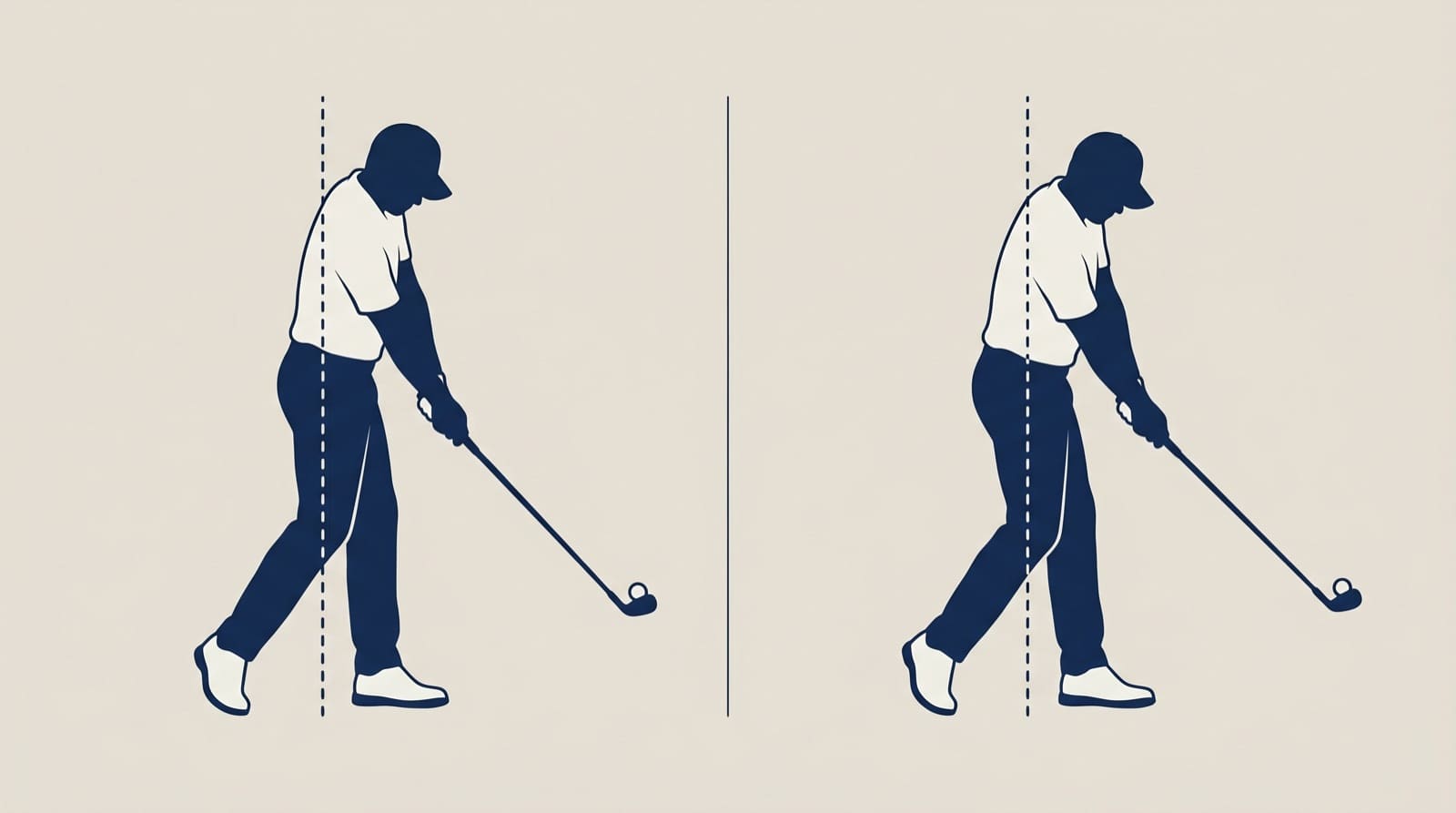
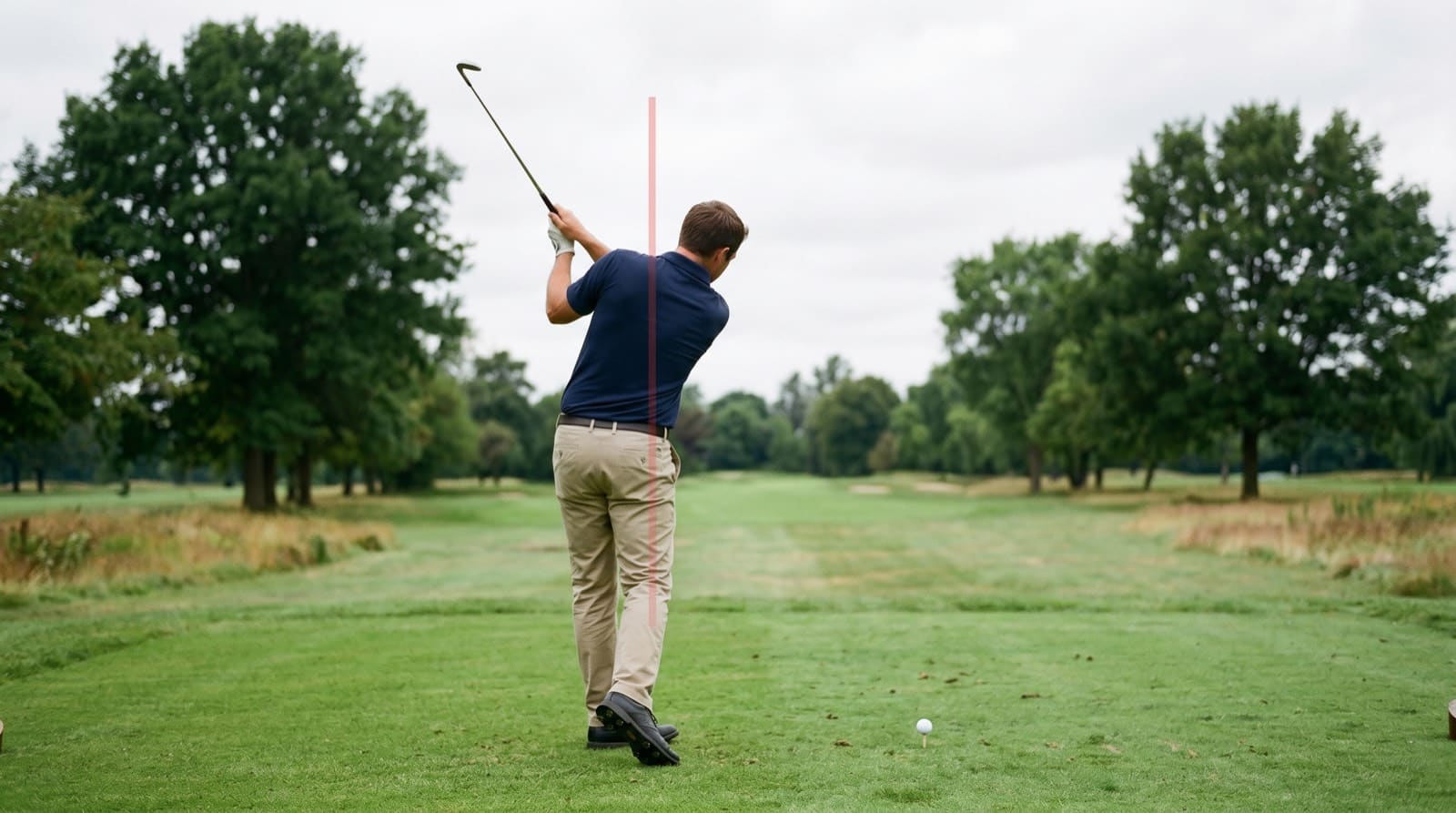
To check your own swing, film down the line, draw a vertical line touching your rear at address, and scrub to impact. Hips that cross that line toward the ball confirm early extension, no launch monitor required.
When you stand up, the hands and club get pushed out toward the ball to keep the clubhead reaching it. That outward shove slides the hosel into the ball and produces the shank, worst with the short irons and wedges. The same rise lifts the arc for thin and topped shots, and a stalling body forces a hand-flip that closes the face into a hook. One root fault, four or five misses.
The strike side shows up in the numbers. Iron contact depends on the club still descending at the ball, and TrackMan’s averages put PGA Tour pros at a downward attack angle of about 3.7 degrees with a 6-iron, which only happens when posture and low point stay forward. Stand up through impact and that descending strike turns glancing. On the scorecard, Mark Broadie’s strokes-gained framework ranks a shanked or topped iron among the costliest shots an amateur hits.
Is your early extension a mobility problem or a technique problem?
This is the question most “fix your early extension” videos skip, and it decides everything that follows. Early extension is frequently the body’s workaround for a physical limit: when your hips, ankles, or hamstrings cannot let you stay bent over while you rotate hard, standing up is the escape hatch your body finds. Drill the swing without clearing that limit and the fault comes straight back.
So screen yourself first. Three quick tests you can do at home in a few minutes sort the mobility track from the technique track. They mirror the mobility that TPI’s deep-squat screen checks for: hips, knees, ankles, and thoracic spine.
| Self-screen test | How to do it | You pass if | If you fail |
|---|---|---|---|
| Hip-hinge toe-touch | Feet together, push hips back, reach for your toes | Fingertips reach toes with a long back, not a curl | Hamstring or posterior-chain limit → mobility |
| Heels-down squat | Feet shoulder-width, squat with heels flat, arms overhead | Thighs near parallel, heels stay down, torso tall | Ankle or hip limit → mobility |
| Single-leg balance | Stand on your lead leg, eyes open, hold steady | 20-plus seconds with no big wobble | Stability and glute deficit → balance work |
The routing is simple. Fail any one screen and a physical limitation is feeding the fault, so daily mobility for that area is your Week 1 priority alongside the constraint drill. Pass all three and your body can already hold the posture, which means the cause is technical and the constraint and sequencing drills lead. This screen-first order is what TPI recommends, and it is why a golfer who has tried five swing thoughts is often one stiff ankle from the answer.
A second technical driver hides in your setup. Starting with your weight over the balls of your feet pulls you forward as you swing down and invites the stand-up move, so a stable stance with a mid-foot balance point is a prerequisite for the drills below. An over-the-top, steep downswing is the other culprit: the body stands up to make room for trapped arms, so the path fix and the posture fix run together.
Drills that actually fix early extension
The fastest fixes share one trait: a physical constraint that makes the fault impossible, so your body discovers the move instead of being told about it. Run them in order, re-test against video rather than feel, and treat the rep counts and pass marks below as practical targets to hold yourself to rather than published standards.
1. The chair drill (the core constraint)
Set a chair, an alignment stick on a box, or a padded bench so the seat rests lightly against your rear at address. Make slow downswing rehearsals and keep both glutes in contact with the surface through the impact zone. If your rear pulls off the chair, your pelvis is thrusting toward the ball. Start with no club, then half-swings with a 9-iron. Goal: 8 of 10 rehearsals holding contact. This is the constraint version of the TPI Beltloop Back feel, and it teaches the pelvis to rotate back and clear rather than push forward.
2. The wall drill (continuous feedback)
Stand with your rear lightly touching a wall in your normal posture, club in hand. Make slow swings and keep your glutes brushing the wall through the simulated impact position. The wall gives constant feedback the chair does not, so it suits players who lose contact early in transition. 30 reps a day, no ball, no range time required. The topping-fix protocol uses the same wall posture drill because standing up and topping share the same root.
3. The Beltloop Back glute feel
Before you swing, tuck your tailbone slightly to switch on your glutes, then feel the trail glute load behind you as you start down, like the start of a deadlift. Hold it with an external cue: think “press the trail heel into the ground” rather than “tuck your pelvis.” Motor-learning work by Wulf, Lauterbach and Toole (1999) found that an external focus, on the club or the target rather than the body, produced better golf-shot accuracy and retention. Build the feel with the constraint drills, then cue it externally to keep it.
4. The pump drill (sequence the pelvis correctly)
From the top, pump the trail knee down and inward toward the ball while keeping your spine angle, two or three times, then let the pelvis rotate back and clear before you fire through. The drill grooves the “drop and turn” sequence so the lower body rotates around a stable base instead of thrusting toward the ball. Pair it with a normal swing immediately after to lock the feel. This is where early-extension work overlaps with tempo and sequencing: the pelvis leads, the arms follow.
5. The mobility track (only if you failed a screen)
If a screen flagged a limit, two minutes a day moves it. Hamstrings: hip-hinge toe-touches sending the hips back. Ankles: drive the knee over the toes with the heel down. Hips: 90/90 rotations on the floor; upper back: open-book rotations on your side. TPI frames the hip hinge as the foundation that lets you rotate fully without standing up, so treat this as movement prep before practice.
The 4-week protocol that makes it stick
Drills work in week one and quit working by week four when they never meet a real, varied shot. The plan below mirrors the howTo on this page, the same screen-first sequence PracticeCaddie’s AI plans use when a golfer flags a stand-up miss in onboarding.
- Week 0 — measure and screen. Film a down-the-line swing and draw a line along your rear at address. Run the three self-screen tests. Note which you fail and where your hips finish relative to the line. Baseline only, no fix.
- Week 1 — open the gate or set the constraint. Failed a screen? Daily mobility for that area plus the chair drill with no club. Passed all three? Straight to the chair drill, 30 slow no-club reps a day.
- Week 2 — add the club. Keep any mobility work. Wall drill, then half-swing 9-irons holding glute contact through the strike, cued externally. Goal: 8 of 10 reps clean. Re-film at the end of the week.
- Week 3 — sequence and randomize. Add the pump drill, then an 18-shot list rotating club and target so no two shots match, applying the constraint feel on every swing. This random phase is what transfers the fix. See block vs random practice for why.
- Week 4 — pressure-test and play. Three cold shots to a 30-yard window, pass or fail, to end each session. Re-film against the belt line. Play nine holes and log every stand-up miss.
- Maintenance — re-film every two weeks. The habit returns under stress. Re-check your hips against the line every other week; two regressed sessions in a row triggers a single chair-drill reset session.
When to stop self-coaching and get screened
Self-coaching handles most early extension. Two patterns are worth a session with a TPI-certified coach or a sports physiotherapist instead of another month alone.
- A screen you cannot move. If a mobility limit barely improves after three to four weeks of daily work, you may have a structural restriction, an old injury, or a movement pattern that needs hands-on assessment. A TPI screen isolates which joint is the real bottleneck in one visit.
- A two-way miss that survives the protocol. Blocks one swing and snap-hooks the next, with the fault returning the moment your focus drifts, usually means the early extension is tangled with a path or release problem that is hard to see from your own phone. A coach with a launch monitor sorts the layers in 60 minutes, which is cheaper than four more weeks of guessing.
A single launch-monitor lesson runs roughly $75 to $150, worth it when the missing piece is the diagnosis rather than the drill.
Common mistakes
- Drilling the swing while a mobility limit is still locked. If you failed a screen, the body will keep standing up no matter how many chair reps you do. Open the gate first.
- Internal cues under speed. “Don’t stand up” and “tuck your pelvis” are body-part cues that fall apart at full swing. Switch to an external cue once the drill has built the feel.
- Skipping the down-the-line video. Face-on hides early extension because the move is toward the ball, not up. Without the down-the-line line, you cannot see it or measure it.
- Block practice for four weeks. Same club, same target, 50 reps. The fault looks fixed on the range and returns on the first tee. Week 3 must be random.
- Fixing posture without fixing setup. Starting on the balls of your feet pulls you forward into the very move you are trying to remove. Build a stable stance and balance point first, and measure change against your own Week 0 baseline rather than a tour-pro picture.
Key takeaways
- Early extension is the pelvis moving toward the ball while the spine stands up. TPI screens find it in 67% of amateurs and in only 1% of tested tour pros.
- It moves your low point, which is why one fault produces shanks, thin and topped shots, blocks, and hooks.
- Screen before you drill. A toe-touch, a heels-down squat, and a single-leg balance test sort the mobility track from the technique track. Fail one and mobility leads.
- The chair and wall drills are the highest-leverage fixes because the feedback is physical: keep your glutes back through impact, 8 of 10 reps clean.
- Cue it externally. Wulf et al. (1999) showed external focus beats internal focus for golf-shot accuracy and retention.
- Transfer beats reps. Random, mixed-club practice from Week 3 carries the fix to the course; expect three to four weeks for visible change and eight to twelve to make it stick, longer if a mobility limit has to open first.
Frequently asked questions
What is early extension in golf?
Early extension is any forward movement of your pelvis toward the ball during the backswing or downswing, paired with a loss of your address posture as your spine stands up. Titleist Performance Institute, which has screened more than 90,000 golfers, defines it that way and finds it in 67% of amateurs. Good ball strikers do the opposite: the pelvis rotates back and clears while the spine angle holds. The fault matters because standing up moves the bottom of your swing arc, which is why contact wanders.
What causes early extension?
Two roots, often together. The first is physical: limited hip internal rotation, ankle dorsiflexion, hamstring length, or weak glutes leave your body unable to hold its forward bend while it rotates, so it stands up. The second is technical: an over-the-top or steep downswing makes the body thrust toward the ball to create room for the arms, and ball-position or balls-of-the-feet setup errors pull you forward. Screen your mobility first, because no swing thought holds a posture your body cannot physically keep.
Does early extension cause shanks?
Often, yes. As the pelvis thrusts toward the ball and the body stands up, the hands and the club are pushed out and away from your body, which moves the hosel into the ball and produces a shank, especially on short irons and wedges. The same stand-up move also lifts the bottom of your swing arc, causing thin and topped shots, and it can stall the body so the hands flip and the face closes into a hook. One fault, several misses.
What is the best drill to fix early extension?
The chair or wall drill, because the feedback is physical and immediate. Set a chair seat or wall lightly against your rear at address, then rehearse the downswing and keep your glutes in contact with it through the impact zone. If your rear leaves the surface, you are thrusting toward the ball. Aim for 8 of 10 rehearsals holding contact, first with no club, then with half-swings. The constraint teaches the pelvis to rotate back and clear instead of pushing forward.
Is early extension a mobility problem or a swing problem?
It can be either, and a quick self-screen tells you which. Try three tests: a hip-hinge toe-touch, a heels-down deep squat, and a 20-second single-leg balance. Fail any one and a physical limitation is feeding the fault, so mobility work comes first. Pass all three and your body can hold the posture, so the issue is technique and constraint drills lead. Titleist Performance Institute’s guidance is the same: clear the physical limitation before drilling the swing, or the fault returns.
How long does it take to fix early extension?
Most golfers see meaningful change in three to four weeks of structured work, two to three sessions a week. Because early extension is a deep postural habit, lasting change usually takes eight to twelve weeks, longer if a mobility limitation has to be opened up first. Block practice on the range can hide the fault inside a session, so the random, mixed-club practice in week three onward is what decides whether the new pattern survives on the course.
Can I fix early extension at home without a launch monitor?
Yes. The two tools that matter are a phone camera and a wall. Film a down-the-line swing, draw a vertical line along your rear at address, and watch whether your hips cross it toward the ball in the downswing. Then rehearse the wall drill, keeping your glutes on the wall through impact, which retrains the pattern with no ball and no monitor. Mobility drills for hips, ankles, and hamstrings also need no equipment. Save the launch monitor for when self-coaching stalls.
Related reading
- Golf Stance and Posture: The Setup That Fixes Your Contact — the address posture early extension throws away; build a stable, mid-foot setup before you drill the fault.
- How to Stop Topping the Golf Ball — the low-point fault early extension feeds; the wall drill above is shared between the two protocols.
- How to Stop Shanking Irons — where the stand-up move sends the hosel into the ball; the same constraint drills apply.
- How to Fix a Slice in Golf — the over-the-top path that often forces the stand-up; run the path fix and the posture fix together.
- How to Grip a Golf Club — the setup cornerstone; a calm grip and square face reduce the hand-flip an early extender uses to save the shot.
- Golf Ball Position by Club — a ball played too far forward pulls you into a reach-and-stand-up move; setup feeds the fault.
- Block vs Random Practice in Golf — why the Week 3 random phase is what makes the new pattern survive on the course.
- Golf practice drills, organized by skill area — the companion drill library, with setup steps and success criteria.
- 30-minute golf practice plan — where the chair, wall, and pump drills fit into a tight session.