
How to Fix an Over-the-Top Golf Swing: Causes, Drills, and a 4-Week Plan
An over-the-top move throws the club outside the line for an out-to-in path — the engine behind most slices. What triggers it, the drills, and a 4-week fix.
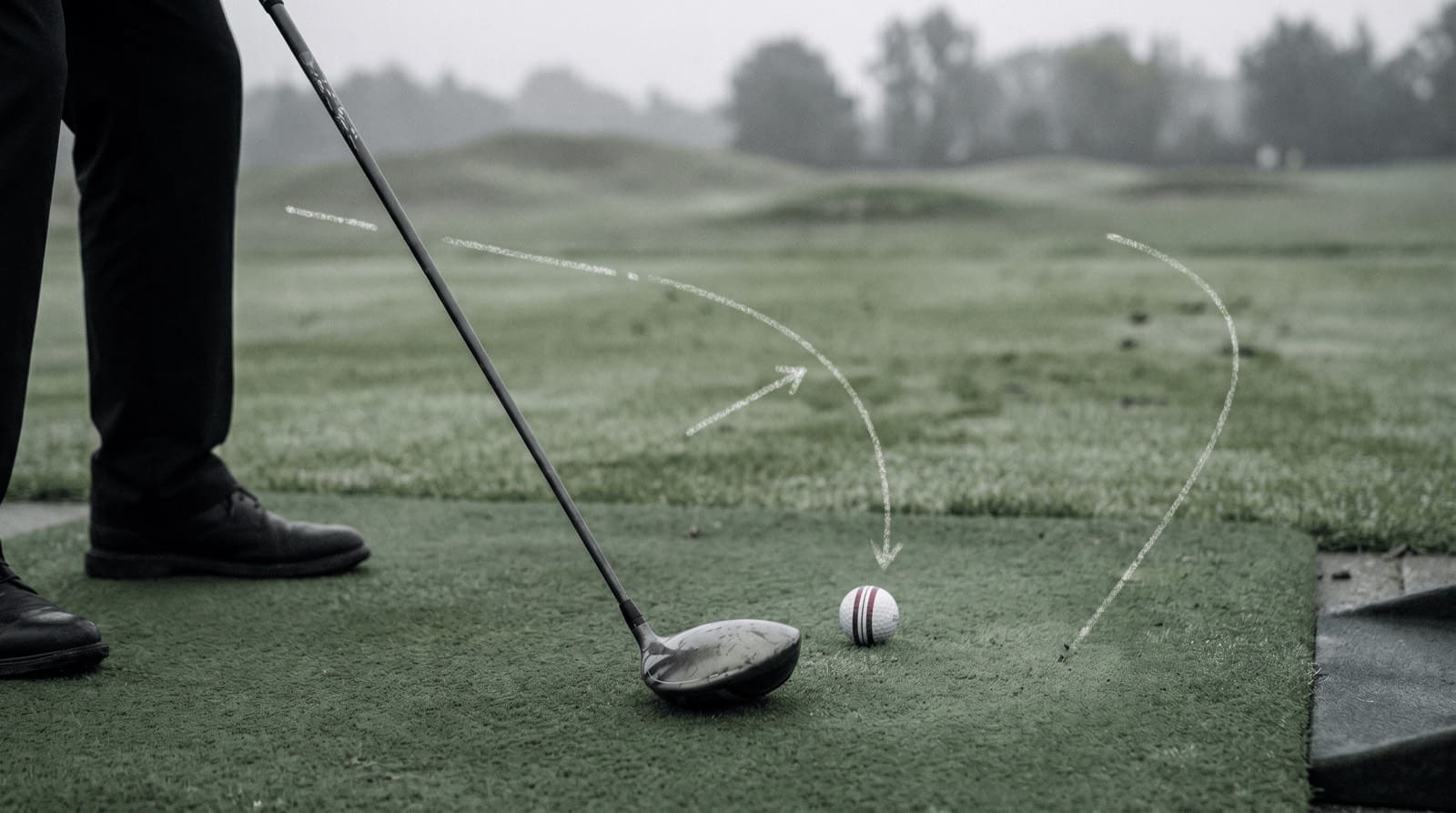
Quick answer
An over-the-top swing throws the club out and above the plane, so it cuts across the ball on an out-to-in path — the engine behind most slices. It is a path fault, and the face decides whether you slice, pull, or pull-hook. Fix the path before the face: square your setup, get the lower body leading so the club shallows, then lock it in with random practice. Three to four weeks brings meaningful change; eight to twelve makes it stick.
Over-the-top diagnostic — find your ball flight, then your fix
| Your ball flight | What it tells you | Face relative to path | Highest-leverage first fix |
|---|---|---|---|
| Pull-slice | Starts left, curves hard right | Open to an out-to-in path | Headcover gate + step-through (reroute the path) |
| Straight pull | Starts left, flies straight left | Square to a left path | Step-through drill; the path is left, not the face |
| Pull-hook | Starts left, curves further left | Closed to a left path | Fix the path first; stop closing the face |
| Steep pull-fade | Low, weak, drifts right; deep divots | Slightly open, steep AoA | Pump drill for shallowing; check ball position |
| Driver-only slice | Slices driver, irons are fine | Path error magnified by length | Square shoulders + gate drill with driver |
Why most amateurs come over the top
The slice is the most common miss in golf, and the over-the-top move is its usual engine. GOLFTEC’s swing data, reported by Golf Magazine, found that about 60% of all golfers slice. The rightward curve itself comes from a clubface open to the swing path at impact — but the out-to-in delivery that most amateurs pair it with is the over-the-top pattern, and it both widens the curve and steepens the strike.
The measurable difference between players who come over the top and players who do not shows up in the lower body. GOLFTEC’s SwingTru Motion Study, which analyzed more than 13,000 swings across six positions, measured how far a golfer’s hips move toward the target. Tour-level players average 3.9 inches of target-ward hip sway at the top of the backswing; a 30-handicap averages only 2.3 inches, and the study found those positions correlate directly with handicap. The reason that gap matters for path is the kinematic sequence: when the lower body leads toward the target the club shallows and drops to the inside, and when the hips stall and the shoulders take over, the club has nowhere to go but over the top.
This is why over the top is a sequence problem, not a hand problem. Higher-handicap players keep their weight back and spin the shoulders open from the top; better players shift into the lead side early and let the club fall. The arms-first move feels powerful and controllable, which is exactly why it is so common — and why telling someone to “swing more from the inside” almost never works on its own.
What “over the top” actually means
Strip the jargon and over the top describes one specific event in transition: as the club reaches the top, the hands and shaft move out toward the ball and up, instead of dropping down and behind you. From there the clubhead has to travel from outside the target line to inside it to reach the ball, which is the out-to-in path radar systems measure as a negative number. A confirmed slicer commonly delivers the driver several degrees out-to-in, where a tour player sits near zero or slightly positive.
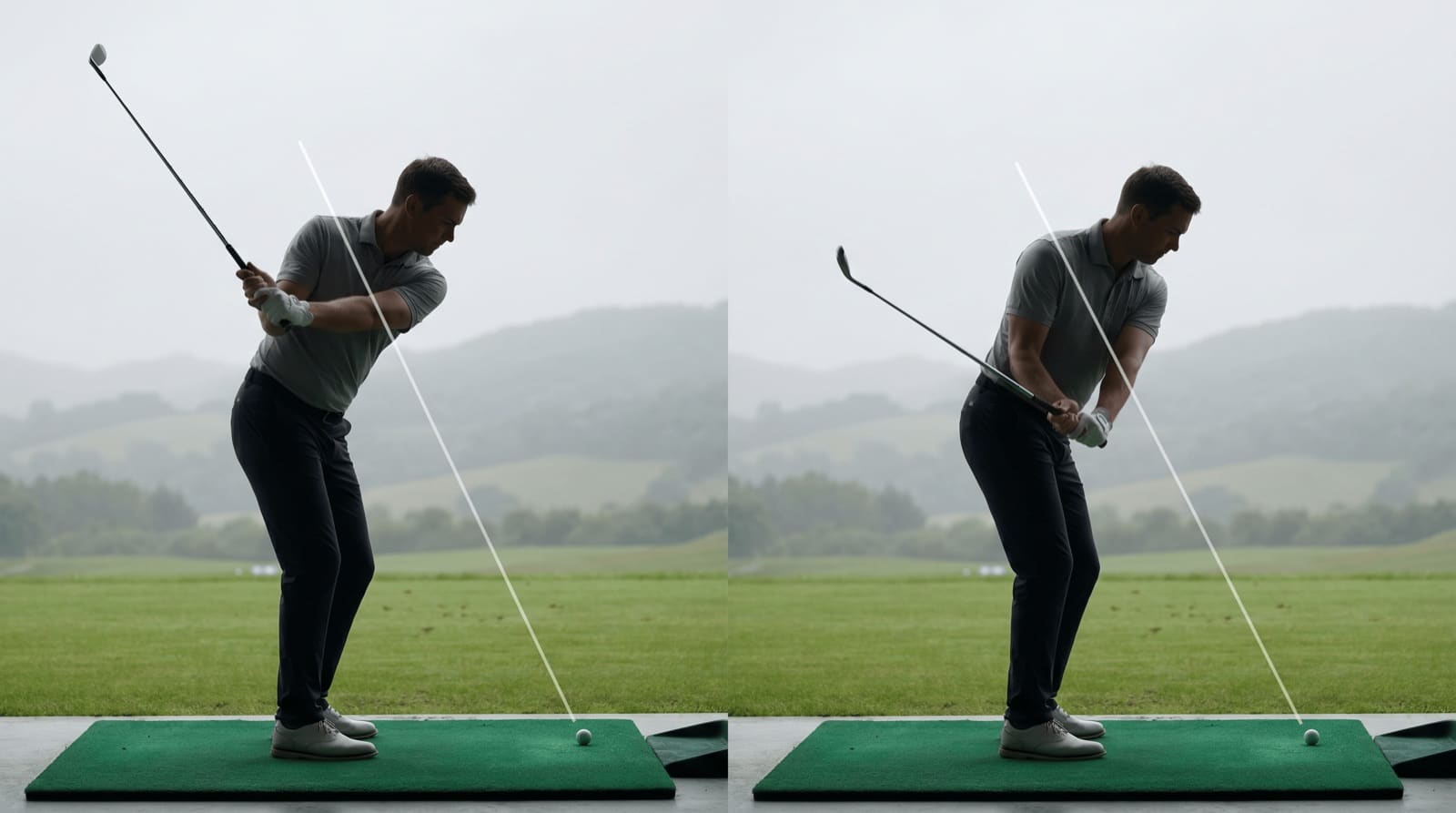
Here is the part most golfers get backward. Over the top sets the path; the face sets the curve. In the modern ball-flight model that TrackMan’s research established, the clubface is the primary driver of where the ball starts — on the order of 75–85% for a driver — while the gap between face and path controls how much it bends. Deliver an out-to-in path with a face that is open to it and the ball slices. Square the face to that same leftward path and you hit a dead pull. Close it and you hit a pull-hook. The over-the-top golfer who fights a two-way miss is living on exactly this knife-edge, squaring the face by feel on a path that keeps cutting left.
The steepness costs distance on top of accuracy. An over-the-top driver swing commonly arrives on a steeper angle of attack and a glancing, often heel-biased strike, which bleeds ball speed and adds spin — the weak, high slice that finishes short and right.
To confirm it in your own swing, film down the line and draw a line from the ball through your trail shoulder. Scrub to the moment your lead arm is parallel to the ground: if the shaft sits above that line and points outside the ball, you are over the top. No launch monitor required.
The fix order: reroute the path before you chase the face
For a pure slice, the fastest fix is the grip and the face first. For an over-the-top move, the order flips — fix the path first. The reason is mechanical. The out-to-in path is the root, and closing the face on top of an unchanged over-the-top path does not straighten anything; it converts a pull-slice into a pull or a pull-hook, which feels worse and convinces players the change failed.
The path itself is downstream of two things: where your lower body goes, and what your setup pre-loads. So the sequence that works is:
- Setup. Square your shoulders and check ball position. Open shoulders and a ball played too far forward build an out-to-in swing into your address position before you move. This is free and it removes the structural reason to come over the top.
- Sequence. Get the lower body leading the downswing so the club shallows instead of steepening. This is the actual fix, and it is what the kinematic sequence research describes: in efficient swings the pelvis peaks first, then the chest, then the arms, then the club, each handing energy up the chain. Over-the-top swings reverse it.
- Face and transfer. Once the path moves toward neutral, the face usually squares up with far less manipulation — then rehearse the whole thing under random practice so it survives the course.
Five drills that actually move the needle
Every over-the-top golfer has seen these drills. The ones who fix it permanently run them in the right order, with a numeric success criterion, and re-test against video.
1. The headcover gate (path)
Place a headcover, water bottle, or pool noodle just outside the ball on the target side, angled so an out-to-in swing crashes into it. Hit mid-irons trying to miss the object. To avoid it, you have to drop the club inside and swing out to the right. Golf.com’s instruction team calls a version of this a top first move for an over-the-top player, because an external target the club has to avoid reshapes a path faster than a verbal “swing from the inside” cue. Goal: 10 mid-irons in a row without clipping the object.
2. The pump drill (transition)
From the top of the backswing, pump the club halfway down — to where the shaft is parallel to the ground — feeling your back stay to the target and the club drop behind your hands. Return to the top, repeat once, then swing through and hit. The pump drill rehearses the shallowing move in slow motion without the panic of a full-speed swing. Goal: 8 of 10 reps where the club drops to the inside before the hands reach hip height.
3. The right-hand slot drill (shallowing)
Take your normal lead-hand grip, but set the trail hand under the shaft with the palm facing up, in a slightly open position. Rehearse the takeaway and then let the club fall into the slot as your weight moves to the lead side, feeling the trail palm support the club from underneath rather than throwing it over. Golf.com’s slot drill trains the exact feel of the club pitching shallow instead of steep. Goal: a club that feels like it drops straight down, not out toward the ball.
4. The step-through drill (lower-body lead)
Set up with your feet together. Make a backswing, then step toward the target with your lead foot as you start the downswing, the way a hitter strides into a pitch. The step forces the lower body to lead and makes it physically awkward to spin the shoulders over the top. It trains the pressure shift into the lead side that lets the club shallow — the same target-ward hip move the SwingTru data tie to lower handicaps. Goal: 20 slow step-through swings where you feel weight arrive in the lead foot before the club reaches the ball.
5. The closed-stance reroute (alignment)
Drop your trail foot back a few inches so your stance is slightly closed, aimed right of the target, with the clubface still aimed at the target. A swing that follows your body lines is now in-to-out relative to the target, so the over-the-top player can rehearse a neutral path that feels like a hook. Pair it with the headcover gate. Goal: a ball that starts right of target and draws back — proof the path has changed. Once the feel is reliable, square the stance back up.
The four-week protocol that makes it stick
Drills work in week one and quietly stop working by week four because the new path never gets exposed to variable conditions. This plan mirrors the howTo schema on this page, and it is the same sequence PracticeCaddie’s AI plans use when a golfer reports a slice or an out-to-in path in onboarding.
- Week 0 — measure. Phone video down the line, plane line drawn from the ball through the trail shoulder. Five drivers. Record start direction, curve, and club-path number if you have a monitor. No fix yet.
- Week 1 — setup and sequence. 30 minutes, three sessions. Square the shoulders, check ball position, then step-through drill with no ball. Block practice is correct here — you are acquiring a new motor pattern.
- Week 2 — reroute. 30 minutes, three sessions. Headcover gate with mid-irons, then the pump drill, then driver. Re-film at the end of the week; expect the start direction to move right and the curve to shrink from slice to fade.
- Week 3 — randomize. 45 minutes, three sessions. An 18-shot list rotating club and target, no two consecutive shots the same, applying the path feel on every swing. (See block vs random practice for the research underneath this step.)
- Week 4 — pressure. 45 minutes, three sessions. Each ends with three cold first-tee shots to a fairway-width target, pass or fail. Play nine holes and log your miss by hole.
- Maintenance. Re-film every two weeks for two months. The over-the-top move rebounds under pressure — measurement is the only reliable counter.
When to skip the protocol and book a lesson
Self-coaching works for the typical open-shoulder, arms-first over-the-top pattern. Three situations are worth a one-hour TrackMan or FlightScope lesson before you spend another month alone:
- A two-way miss with no consistent shape. If you pull-hook and slice in the same round, the path is unstable, and a coach with a launch monitor isolates the variable in one session.
- It worsens with speed. A swing that stays on plane at 80% and goes over the top at 100% is a sequencing problem under load — hard to diagnose from your own video.
- It rides on top of early extension. When the body stands up and shoves the hands out, the over-the-top path is a symptom of lost posture, and the two faults have to be screened and drilled together. TPI links the two directly.
A single launch-monitor session typically costs $75–$150 and can save four to eight weeks when the diagnosis matters more than the drill.
Common mistakes
- Chasing the face first. Closing the clubface on an unchanged over-the-top path turns a pull-slice into a pull-hook. Reroute the path, then let the face follow.
- Aiming further left to fit the slice. Aiming left opens the shoulders more, which steepens the over-the-top move and widens the slice. It is the single most common self-inflicted amplifier.
- Swinging “more from the inside” with no constraint. The cue is too vague to change a grooved path. Use an external object — the headcover gate — so the feedback is physical, not verbal.
- Block-practicing one drill for a month. Range numbers climb, course performance does not. The week-three random phase is non-negotiable.
- Skipping the week-0 video. Without a baseline you cannot tell at week four whether the path actually moved, and most “no progress” is just a bad memory of how steep it was.
Key takeaways
- Over the top is a path fault. It throws the club outside the line for an out-to-in path; the face then decides whether that path becomes a slice, a pull, or a pull-hook.
- It is the engine behind the slice that ~60% of golfers fight (GOLFTEC via Golf Magazine).
- The lower body is the tell. SwingTru data show tour players sway the hips 3.9 inches toward the target at the top versus 2.3 for a 30-handicap; leading with the lower body is what lets the club shallow instead of steepening.
- Fix the path before the face — the reverse of the pure-slice order — or you trade a slice for a pull-hook.
- The headcover gate plus the step-through drill is the highest-yield pair: one reroutes the path, the other installs the lower-body lead.
- Four weeks of structured work — setup → reroute → random → pressure — is what transfers the fix to the course. Random practice in week three is the difference between a range fix and a real one.
Frequently asked questions
What is an over-the-top golf swing?
An over-the-top swing is a downswing fault where the club and hands move out and above the ideal swing plane as you start down, instead of dropping into the slot behind you. The clubhead then approaches the ball from outside the target line and cuts across it, producing an out-to-in club path. It is the most common amateur swing flaw, and it is the dominant engine behind the slice. Better players do the opposite: the lower body leads and the club shallows before it reaches the ball.
What causes an over-the-top swing?
The root cause is sequence. Instead of the lower body leading the downswing, the upper body and arms fire first, throwing the club outward and steepening it. GOLFTEC’s SwingTru data tie this to less hip movement toward the target, and Titleist Performance Institute links it to early extension, where the body stands up and shoves the hands out to make room. Setup feeds it too — open shoulders, a ball played too far forward, and aiming left all pre-load an out-to-in path before the swing even starts.
Does coming over the top cause a slice?
Usually, yes, but not always. Over the top is a path fault: it delivers the club on an out-to-in path. What the ball does then depends on the clubface. If the face is open relative to that path, you get a slice. If the face is square to the leftward path, you get a straight pull. If the face is closed to it, you get a pull-hook. That is why simply closing the face without fixing the path often trades a pull-slice for a pull-hook instead of curing anything.
Should I fix the path or the face first?
Fix the path first for an over-the-top move, which reverses the order used for a pure slice. The over-the-top fault is fundamentally a sequencing problem, and closing the face on top of an unchanged out-to-in path just swaps a slice for a pull or a pull-hook. Get the lower body leading and the club shallowing so the path moves toward neutral, then fine-tune the face. Most players find the face squares up on its own once the club stops cutting across the ball.
What is the best drill to fix an over-the-top swing?
The headcover gate, because the feedback is instant and external. Place a headcover or water bottle just outside the ball on the target side so an out-to-in swing collides with it, then hit shots trying to miss it. To avoid the object, you have to drop the club to the inside and swing out to the right. An external target the club must avoid tends to reshape a path faster than an internal swing thought, which is why coaches reach for it first. Pair it with the pump drill to rehearse the shallowing move in transition.
How long does it take to fix an over-the-top swing?
Most golfers see meaningful change in three to four weeks of structured practice, two to three sessions a week. Because the pattern is deeply grooved, fully owning a neutral path usually takes eight to twelve weeks, and a season to make it automatic under pressure. The path will feel wildly exaggerated at first — what plays as neutral feels like swinging out to right field. Block practice hides progress inside a session, so the random, mixed-club work from week three onward is what makes the fix transfer to the course.
Related reading
- How to Fix a Slice in Golf — the symptom this fault produces; that protocol fixes the face, this one fixes the path that feeds it.
- How to Grip a Golf Club — the setup cornerstone; an open face from a weak grip pairs with an out-to-in path to widen the slice.
- Early Extension in Golf: Causes, Drills, and a 4-Week Fix — the posture-loss fault that often sits underneath an over-the-top move; screen and drill them together.
- Weight Shift in the Golf Swing — the trail-to-lead pressure move that lets the lower body lead and the club shallow.
- Block vs Random Practice in Golf — the motor-learning research behind the week-three transfer phase of this protocol.
- Golf practice drills, organized by skill area — the companion drill library with setup steps and success criteria.
- Driving range practice plan — how to structure the 30–45 minute sessions in this protocol.