
How to Put Backspin on a Golf Ball: Spin Loft and the Real Numbers
Backspin is spin loft, speed, friction, and clean contact. The real rpm numbers by club, what you actually control, and how much each factor is worth.

Quick answer
Backspin is a measurable outcome of four things: spin loft (the gap between the loft you deliver and how steeply the club moves), clubhead speed, friction at impact, and a centered, ball-first strike. To spin a wedge, keep loft on the face from a clean lie, use a urethane ball and fresh grooves, and accelerate through. TrackMan puts a healthy pitching-wedge window at 8,500 to 10,500 rpm. Delofting the wedge hard to “trap” the ball usually reduces spin.
The four levers of backspin
| Lever | What it does | Roughly worth | How you control it |
|---|---|---|---|
| Spin loft | The biggest driver of spin; wide gap between delivered loft and club direction | The difference between a mid-iron (~6,000 rpm) and a full wedge (~9,000+ rpm) | Keep loft on the face, moderate descending strike, use the bounce |
| Clubhead speed | More speed raises spin for a fixed loft and lie | Meaningful; accelerate vs decelerate | Commit and swing through the ball |
| Equipment | Urethane cover + fresh grooves grip the ball | Ball up to ~4,000 rpm; grooves ~1,000–2,000 rpm | Play a tour ball, replace wedges every 75–125 rounds |
| Clean contact / lie | Friction needs nothing between face and ball | Poor lie or moisture can cut spin by thousands of rpm | Ball-first strike, tight dry lie, clean grooves |
Every number in that table comes from launch-monitor and robot testing cited below. The pattern is consistent across all of it: backspin is stacked from friction, loft, and speed delivered cleanly, and the swing itself is only one of the four levers.
Why backspin is a scoring skill
Approach play is where scores separate, and spin is how good wedge players control where the ball finishes. Mark Broadie’s strokes-gained work in Every Shot Counts established that approach shots are one of the biggest drivers of the scoring gap between amateurs and better players. A wedge that spins predictably lands pin-high and stays there; one that skids releases past the flag or off the back. The aim is a repeatable one-hop-and-stop you can trust on a scoring club, which is exactly where approach-shot strokes gained is won or lost.
What actually creates backspin
Backspin is created in the fraction of a second the ball is on the face. The club applies two forces: one perpendicular to the face that makes ball speed, and one parallel to the face, driven by friction, that makes spin. TrackMan states that spin rate “is mainly produced by spin loft, speed, friction, and centeredness of impact,” and that all else equal, a higher spin loft produces a higher spin rate.
Spin loft is the load-bearing concept. TrackMan defines it as the angle between the direction the clubhead is moving and where the face is pointing, and notes it is generally very close to dynamic loft minus attack angle. Deliver a wedge with 45 degrees of loft while the club moves down at 5 degrees, and spin loft is about 50 degrees. That wide gap, combined with speed and friction, is what spins the ball.
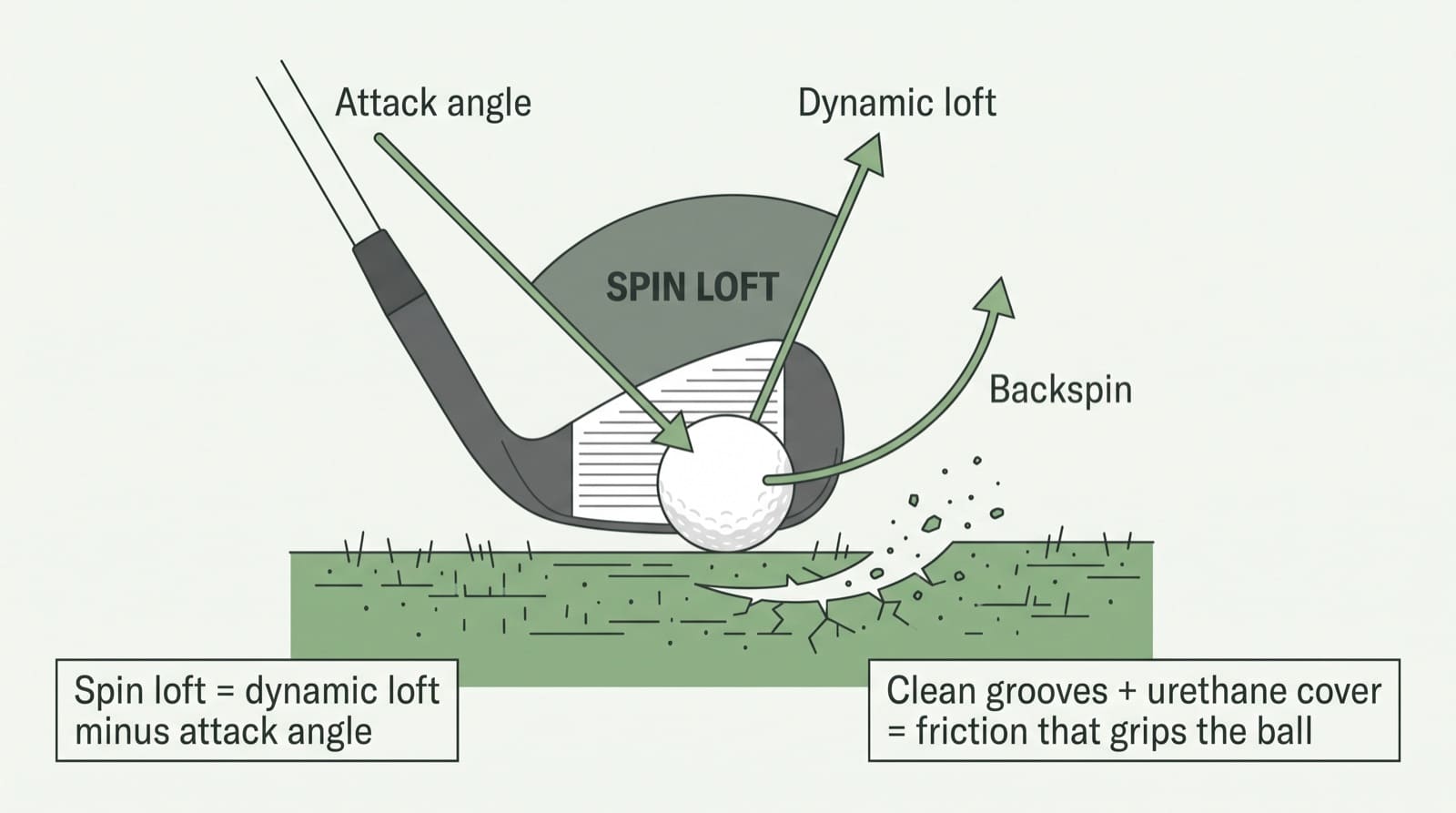
Friction decides how much of that parallel force becomes spin. It depends on clean grooves, a grippy cover, and nothing between the face and ball. Coach Andrew Rice’s wedge testing concluded that the quality of the lie is the single most important factor in controlling wedge spin, because rough or into-the-grain lies trap grass between face and ball and the club can never grip the cover.
Speed and centeredness round out the four. Faster clubhead speed raises spin for a given loft and lie. A centered strike keeps the collision efficient and avoids gear effect, the twisting that off-center hits impart, which TrackMan notes has an enormous influence on drivers in particular.
The real spin numbers by club
Spin rate climbs steeply as loft increases, which is why wedges hold greens and drivers run out. These are the measured benchmarks.
| Club | Tour spin rate | Tour spin loft | What it tells you |
|---|---|---|---|
| Driver | ~2,545 rpm | 14.7° | Low spin, low loft, built for carry and roll |
| 6-iron | ~6,200 rpm | 24.3° | Moderate spin plus a steep land angle holds greens |
| Pitching wedge | ~8,500–10,500 rpm | 40.6° | High spin loft is why scoring clubs stop fast |
The driver and 6-iron figures are TrackMan PGA Tour averages; the pitching-wedge window of 8,500 to 10,500 rpm is TrackMan’s published men’s target, and the 40.6-degree spin loft is TrackMan’s optimizer value for a pitching wedge at 72 mph. Sand and lob wedges carry more loft, which widens spin loft further, so their spin runs at or above the pitching wedge’s from a clean lie. Two facts jump out. Wedge spin loft (around 40 degrees) dwarfs the driver’s ~15 degrees, and that gap is the main reason wedge spin runs so much higher, even before speed and friction differences are counted.
Amateurs are not short on spin because they lack speed. TrackMan Combine data shows scratch amateurs average 2,896 rpm of driver spin, 10-handicaps 3,192 rpm, and mid-handicaps around 3,275 rpm, all higher than the tour’s 2,545. The amateur problem is inefficient spin loft and friction, not weak muscles, and the same pattern carries into the wedges.
The four things you actually control
1. Clean contact from a clean lie
This is the biggest lever most golfers overlook. Rice’s testing measured “friction launch” for a 50-yard shot and found the best result, 32%, came from an ideal fairway lie with a new, clean wedge and a premium ball, while the worst, 18%, came from a poor lie. Rough, first-cut, into-the-grain, and wet lies all launch higher and spin less, because grass and water get between the grooves and the cover.
The strike matters as much as the lie. A fat shot puts turf between face and ball; a thin shot barely engages the grooves. Both cut spin. You need the low point just ahead of the ball so the club is still descending at impact, the same clean, ball-first contact that fixes fat and thin shots. Rice also warns that practicing off mats builds an “illusion of competence,” because a mat never punishes a heavy strike the way real turf does.
2. Speed through the ball
For a fixed loft and lie, more clubhead speed means more spin. TrackMan is explicit: all else equal, more club speed raises spin rate. The practical version is to accelerate through impact rather than steer or quit on the shot. A decelerating, tentative wedge swing bleeds off exactly the speed that would have produced spin. Commit to the number and swing through it.
3. Equipment: the ball and the grooves
Two equipment choices are worth thousands of rpm combined, and both are easy to fix. The ball: a urethane cover grips the grooves far better than a hard ionomer distance ball. Independent MyGolfSpy testing has measured wedge-spin differences of nearly 4,000 rpm between ball models, with distance balls near the bottom. For a golfer whose short shots skid and release, that is the single largest spin gain on the table.
The grooves: they wear out faster than golfers think. Titleist’s Vokey R&D robot testing hit a 56-degree wedge at three wear levels: fresh grooves spun about 8,500 rpm and rolled out 10 feet, a 75-round wedge dropped to about 7,400 rpm, and a 125-round wedge fell to 6,500 rpm and rolled out 24 feet. That is up to roughly 2,000 rpm of lost spin, with control tailing off around 75 rounds. Most of the spin comes from the sharp groove edges and the rough texture between them, both of which smooth down with use. Clean the grooves before every shot, and treat a wedge as a consumable, not a lifetime club.
4. Delivering spin loft
The swing’s job is to arrive with a wide spin loft: a lofted, often slightly open face moving down and forward into the ball. Use the bounce so the face stays “pointing to the sky” through impact rather than shutting down. That keeps dynamic loft high while the descending strike keeps the contact clean, and the two together drive spin loft up. Modest shaft lean is fine for ball-first contact; heavy delofting is not, for reasons the next section makes concrete.
The spin-loft myth: delofting the wedge to “trap” it
The range-lesson maxim to “hit down and swing harder” to spin the ball is half right and half backwards. The half that is right: a descending strike and speed both help, and TrackMan confirms a steeper attack angle actually raises spin loft. The half that goes wrong is what many golfers do to “hit down”: they shove the hands forward and deloft the face, which lowers dynamic loft, and when that delofting outweighs the steeper strike, spin loft drops instead of rising.
Run the math TrackMan gives you. With a wedge delivering 45 degrees of dynamic loft and a 5-degree descending strike, spin loft is about 50 degrees. Deloft that same club to 35 degrees at the same attack angle, and spin loft falls to 40 degrees, taking spin down with it. The players who spin it best keep loft on the face and use the bounce, so a steeper strike adds spin loft rather than trading it away.
The other half of the myth is that effort beats conditions. It does not. From a wet or rough lie, Rice’s testing shows the ball launches higher and spins less regardless of how hard you swing, because the friction is already gone. MyGolfSpy’s wet-versus-dry ball test found that moisture on the cover made every ball launch higher and spin lower, even on perfect robot strikes. Clean contact, kept loft, and a urethane ball beat brute force.
The backspin scorecard: measure it, don’t guess
Feel is a poor judge of spin, so here is a PracticeCaddie framework that turns it into a pass-or-fail test. Any launch monitor that reports spin rate and land angle will run it: TrackMan, FlightScope, and Foresight all do, as do some consumer units like Rapsodo or Garmin depending on the model. The pitching-wedge spin target comes from TrackMan’s published men’s window of 8,500 to 10,500 rpm; the sand- and lob-wedge spin targets, the land-angle targets, and the pass conditions are PracticeCaddie practice targets extrapolated from it, since more loft widens spin loft and those wedges should match or beat the pitching wedge.
| Club | Target spin rate | Target land angle | Pass condition |
|---|---|---|---|
| Pitching wedge | 8,500–10,000 rpm | ≥ 45° | 6 of 10 balls inside both |
| Sand wedge | 8,500–10,500 rpm | ≥ 48° | 6 of 10 balls inside both |
| Lob wedge | 9,000–10,500 rpm | ≥ 50° | 6 of 10 balls inside both |
Hit 10-ball sets from a clean lie with a urethane ball and change one variable at a time: keep more loft on the face, or commit to more speed, or wipe the grooves between shots. If spin rate climbs and land angle steepens, the change is working. If spin falls when you add shaft lean, you are delofting the wedge past its spin-loft window. The scorecard converts a vague sensation into a number you can chase weekly.
How much backspin you actually need
Chasing maximum spin is the wrong goal. TrackMan frames pitching-wedge spin as a control number, 8,500 to 10,500 rpm for men, enough to make the ball climb, hold its line, and stop quickly. Push much past that window and extra spin tends to balloon the flight and cost distance control. A ball that lands pin-high, takes one or two hops, and stops leaves you closer than one that rips violently back off the front of the green.
Stopping power is spin, height, and land angle working together. A tour 6-iron holds greens at only ~6,200 rpm because it lands steeply, so the descent angle does much of the work. A full wedge stops fast because it lands steeply and spins. So the honest read on “backing it up” is that it depends as much on the green as on you: soft, receptive greens let a ball check and spin; firm greens release even tour-level spin. Match your landing spot to the firmness, and stop trying to zip every wedge back.
Common mistakes and spin myths worth killing
- Delofting the wedge to “trap” it. Heavy shaft lean drops dynamic loft and moves contact toward the leading edge, which can cut spin loft. Modest lean for clean contact, then keep the loft.
- Blaming your swing for a bad lie. From rough or wet grass the friction is gone before you start. Adjust expectations and plan for a lower-spinning flier.
- Playing a hard distance ball, then wondering why nothing checks. A urethane cover is worth thousands of rpm on short shots. It is the cheapest spin you can buy.
- Never replacing a wedge. Grooves are a consumable. Worn ones cost up to 2,000 rpm, and the loss is invisible until you compare against a fresh wedge.
- Practicing spin only off mats. Mats inflate friction and hide fat strikes. Train spin from real turf and varied lies.
- Chasing ever-higher spin. Well past the control window, extra spin tends to balloon the flight and cost distance control. A repeatable number inside TrackMan’s pitching-wedge window that lands pin-high scores better.
Key takeaways
- Backspin has four levers: spin loft, speed, friction, and centered contact. TrackMan treats spin loft, speed, friction, and centeredness as the drivers of spin rate; the swing is only one of them.
- Spin loft is the big one. It is roughly dynamic loft minus attack angle, and a wedge’s ~40-degree spin loft is the main reason it spins near 9,000 rpm while a driver at ~15 degrees spins ~2,500.
- Keep loft on the face. Delofting a wedge with heavy shaft lean can shrink spin loft and lower spin. Use the bounce and a moderate descending strike, which adds spin loft rather than trading it away.
- The ball and grooves are worth thousands of rpm. MyGolfSpy measured nearly 4,000 rpm between ball models; Titleist found worn grooves cost up to 2,000 rpm.
- The lie decides more than the swing. A clean, dry, tight lie lets the grooves grip; rough and moisture cause low-spin fliers no matter how hard you swing.
- You need less spin than you think. TrackMan’s 8,500 to 10,500 rpm pitching-wedge window with a steep land angle stops the ball fast; aim for a controlled one-hop-and-stop, not zip-back.
Frequently asked questions
What actually creates backspin on a golf ball?
Backspin comes from friction between the clubface and the ball during impact, driven mostly by spin loft, clubhead speed, friction quality, and a centered strike. Spin loft is the angle between the loft you deliver and the direction the clubhead is moving, and TrackMan reports it is roughly dynamic loft minus attack angle. A lofted face moving into the ball creates a wide spin loft, the grooves grip the cover, and the ball leaves spinning backward. More speed and more friction both raise the spin rate, as long as contact stays clean and centered.
How do I put backspin on a golf ball with a wedge?
Play from a clean, tight lie, strike the ball first with the low point just ahead of it, and keep loft on the face rather than delofting it. Use a premium urethane ball and reasonably fresh grooves, then accelerate through the shot. The combination of a wide spin loft, clean friction, and speed produces backspin. A still-lofted or slightly open face using the bounce spins more than a hands-way-forward, delofted strike, which is the opposite of what most amateurs try.
Do you need to swing hard or hit down steeply to spin the ball?
Speed and a descending strike both help, and a steeper attack angle can raise spin loft. The trap most golfers fall into is delofting the wedge by shoving the hands forward, which lowers dynamic loft and can cut spin loft even as the strike gets steeper. From rough or wet lies, swinging harder does not overcome the lost friction. The ball still launches higher, spins less, and rolls out. Clean contact, kept loft, and a urethane ball beat brute force almost every time.
Does the golf ball matter for backspin?
A lot. Urethane-covered tour balls like the Pro V1 grip wedge grooves far better than hard ionomer distance balls. Independent MyGolfSpy testing has measured wedge-spin differences of nearly 4,000 rpm between ball models, with distance balls near the bottom. TrackMan lists a healthy pitching-wedge window of 8,500 to 10,500 rpm for men, and reaching it depends heavily on cover. If short shots skid and release, switching from a distance ball to a urethane ball is often the single biggest spin gain available to you.
Why won’t my ball back up on the green?
Usually one of four reasons: a poor or wet lie that cuts friction, a hard distance ball, worn wedge grooves, or a delofted, decelerating strike. Backing a ball up also needs a soft, receptive green. On firm greens even tour-level spin releases. For most golfers dramatic zip-back is the wrong goal anyway. A shot that lands pin-high, takes one or two hops, and stops holds the green better than one that spins violently back off the front.
How much backspin do you need to stop the ball on the green?
Less than most golfers think. TrackMan puts a healthy pitching-wedge window at 8,500 to 10,500 rpm for men, and a mid-iron near 6,000 rpm with a steep land angle also holds greens per tour data. Stopping power comes from spin, height, and land angle together, so a steep land angle matters as much as the rpm. Good players control spin rather than maximize it, landing the ball pin-high with just enough spin to stop it near the pitch mark.
Do wedge grooves wear out and cost spin?
Yes. Titleist’s Vokey R&D robot testing found a fresh 56-degree wedge spun about 8,500 rpm with a 10-foot rollout, a 75-round wedge about 7,400 rpm, and a 125-round wedge about 6,500 rpm with 24 feet of rollout. That is up to roughly 2,000 rpm lost between fresh and worn grooves, and control starts falling off around 75 rounds. Most of the spin comes from the sharp groove edges and the rough texture between them, both of which smooth down with use. Clean the grooves before every shot and replace worn wedges.
Related reading
- How to Grip a Golf Club — the setup cornerstone that feeds face control and clean contact; every spin shot starts from a neutral, quiet grip that squares the face.
- How to Compress the Golf Ball — the sister concept for full shots; backspin wants a wide spin loft to grip and stop the ball, while compression wants a low spin loft to turn speed into distance, and both hinge on clean, ball-first contact.
- How to Stop Hitting Fat Shots (and Thin Shots) — the low-point fix underneath spin; fat and thin both put grass or air between the grooves and the ball and kill backspin.
- How to Hit a Pitch Shot — the scoring shot where spin control matters most; distance and trajectory built around a clean, lofted strike.
- Golf Chipping Drills — the short-game drill library that trains the clean contact spin depends on, with success criteria you can log.
- How to Hit a Flop Shot — the maximum-loft, maximum-spin-loft specialty shot; when to risk it and how the open face drives the height and check.
- Strokes Gained: Approach Explained — why wedge and approach spin control is one of the biggest scoring levers you own.
- Golf Ball Position by Club — the setup lever that sets where the low point sits, which decides whether you catch the ball cleanly enough to spin it.
- Golf practice drills that actually transfer — the companion drill library, organized by skill area with setup steps and success criteria.
- The 30-minute golf practice plan — how to fit short-game and spin work into a tighter window.