
Golf Practice Plan: The Weekly Schedule That Lowers Handicaps
Driver is 14 swings per round and the smallest SG-loss category. A weekly golf practice plan that allocates time where strokes actually leak instead.
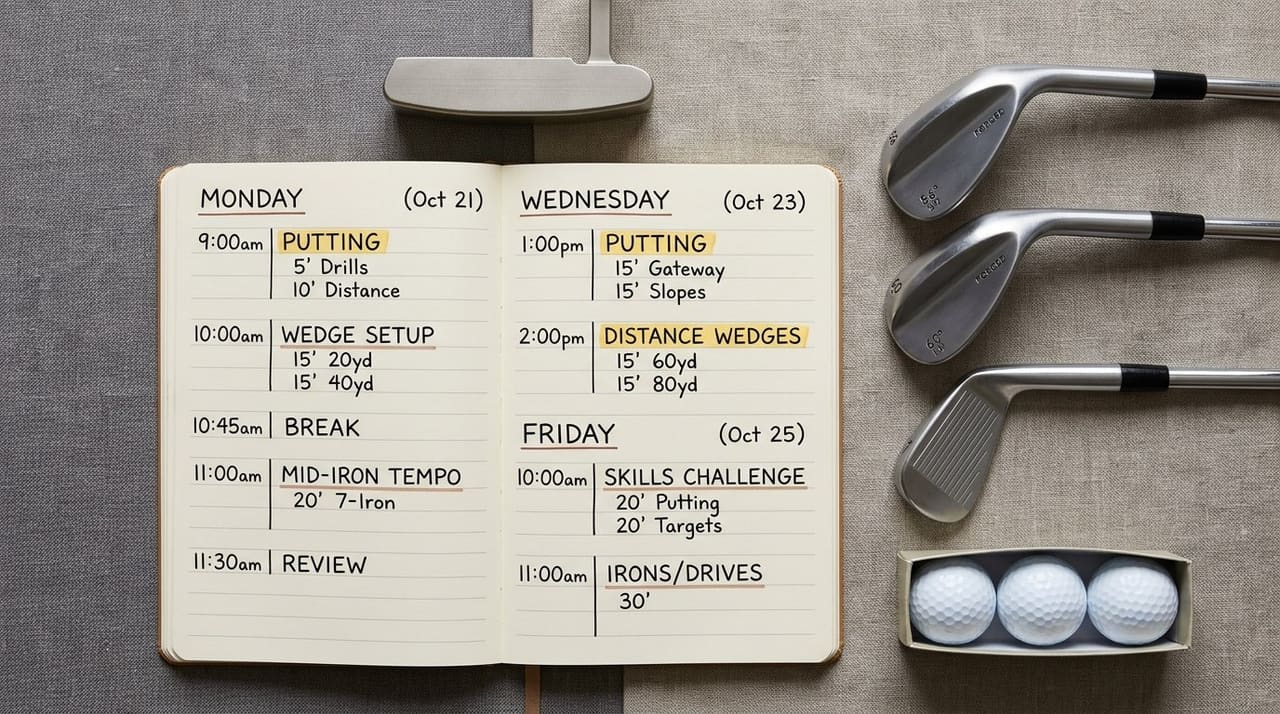
Quick answer
A golf practice plan is the structure of your week — which sessions you run, how often, how time inside each one is split, and how the weeks build into a cycle. The right plan locks 3 to 4 short sessions across the week, weights time by where strokes actually leak (60% short game and putting for beginners, 50% mid-handicaps, 40% single-digits), assigns 2 to 4 drills per session with numeric success criteria, and runs in 4-week cycles that progress from block to random practice before an on-course assessment. The math behind those weights comes from strokes-gained data, not feel.
Weekly practice plan at a glance
| Element | Beginner (25+ HCP) | Mid-handicap (10–20) | Single-digit (≤9) |
|---|---|---|---|
| Sessions per week | 2 | 3 | 3–4 |
| Minutes per session | 30 | 45 | 45–60 |
| Total weekly time | 60 minutes | 135 minutes | 150–240 minutes |
| Putting share | 30% | 25% | 20% |
| Chipping / wedge share | 30% | 25% | 20% |
| Iron / approach share | 30% | 35% | 45% |
| Driver share | 10% | 15% | 15% |
| Practice structure | ~80% block, 20% random | ~50% block, 50% random | ~30% block, 70% random + pressure |
| On-course assessment | 1 per 4 weeks | 1 per 3 weeks | 1 per 2 weeks |
| Primary metric to log | Clean-strike rate | GIR + 3-putt rate | Strokes-gained-by-category |
| Re-baseline cadence | Every 8 weeks | Every 6–8 weeks | Every 6 weeks |
Why a weekly plan beats more range time
Walk onto any driving range and watch what happens. The reach for driver first, then the long mid-iron, is a coaching cliché because it generalizes well across amateur ranges. Arccos — which has tracked over a billion shots from real players — publishes the math that exposes the problem: Lou Stagner, Arccos’s Data Insights Lead, summarizes the headline number as “the average 15-handicap loses more than four strokes per round inside 50 yards.”
Driving, by contrast, is the smallest single SG-loss category at every amateur tier. Practice time should follow that gap, not the satisfaction of hitting a long drive.
The cost of an unstructured plan is measurable. Mark Broadie’s strokes-gained framework in Every Shot Counts (2014) decomposes every amateur round into four buckets that always sum to your handicap deficit: Off the Tee, Approach, Around the Green, Putting. The decomposition produces a brutal pattern: across thousands of tracked amateur rounds, approach play accounts for the single largest stroke leakage at every handicap tier from 25 down to 5, while driving is the smallest.
A weekly plan built around that decomposition produces measurable scoring change in 6 to 8 weeks. A weekly plan built around “hit some drives, hit some irons, putt for 10 minutes” does not.
The second leak the data exposes is frequency. Cepeda et al.’s 2006 meta-analysis in Psychological Bulletin, covering 184 studies and 14,000+ participants, documented a large spacing effect (d ≈ 0.78) across learning tasks. Motor-skill replications extend the same pattern: three 45-minute sessions distributed across the week reliably out-learn one 135-minute Saturday session, even though the total time is identical. Going seven days a week for two weeks and then nothing for a month is the worst pattern for any tier.
Where strokes actually leak by handicap
The plan only works if you allocate by where your handicap actually loses strokes. Strokes-gained data from Broadie’s framework, Arccos, and Shot Scope’s 90M+ shot database converges on the same pattern. The composite ranges below are derived from Broadie’s tour-baseline math, Arccos community data, and Shot Scope’s aggregated handicap reports — exact per-row figures vary by dataset, but the relative ranking across categories is stable:
| Handicap tier | Off the Tee | Approach | Around the Green | Putting |
|---|---|---|---|---|
| 20+ (90s shooter) | 0.5–1.0 SG lost | 2.5–3.0 SG lost | 1.5–2.0 SG lost | 1.0–1.5 SG lost |
| 10–15 (mid-80s) | 0.5–0.8 SG lost | 2.0–2.5 SG lost | 1.0–1.5 SG lost | 0.8–1.2 SG lost |
| 5–10 (high 70s) | 0.3–0.6 SG lost | 1.2–1.8 SG lost | 0.6–1.0 SG lost | 0.5–0.8 SG lost |
| Scratch (par) | baseline | baseline | baseline | baseline |
Three patterns fall out of the table. First, approach play is the largest leak at every amateur tier and accounts for roughly 35–45% of total strokes lost to scratch. Second, the around-the-green category — chips, pitches, and bunker shots inside 30 yards — is the second largest leak at every tier. Third, driving is the smallest leak at every tier, despite being the area amateurs over-practice.
The plan below allocates accordingly.
The proximity-by-handicap data underneath the SG numbers is just as stark. Practical Golf’s summary of Broadie’s data places PGA Tour proximity from 150 yards in the fairway at roughly 23 feet, an 80-shooter at 42 feet, and a 90-shooter at 56 feet. That gap is why approach play dominates the leak table: the amateur is leaving themselves a 25-to-56-foot first putt on average, where three-putt rates climb sharply for every handicap tier. The fix is approach precision plus first-putt distance control, not more driver work.
GIR is the other side of the same coin. Arccos data shows scratch players hit 51% of greens, 10-handicaps 34%, 15-handicaps 28%, and 20-handicaps roughly 22%. The 22% GIR floor for 20-handicaps means about 14 greens missed per round, and those 14 misses produce a mix of greenside chips, longer pitches, and recovery shots — most inside 50 yards. The around-the-green block in the weekly plan is where the biggest single block of scoring gains typically hides for any 20-handicap.
The beginner plan (handicap 25+ or no handicap yet)
The beginner plan is two 30-minute sessions per week, total 60 minutes. Allocation: 30% putting, 30% chipping, 30% mid-iron contact, 10% driver. Most beginner strokes leak from contact, slices, and topped shots rather than from short-game proximity, so the iron-contact block earns its share even at this tier. The putting and chipping work is weighted high because both transfer immediately to score — a 25-handicap who learns to two-putt from 30 feet drops 3 to 4 strokes per round without changing a single full-swing element.
Block practice is correct here because the goal is acquisition. Schmidt and Lee’s Motor Control and Learning — the standard reference in the field — treats acquisition (block) and consolidation (random) as sequential phases, and trying to consolidate a movement you cannot yet repeat is wasted reps. A typical Tuesday session for this tier: 10 minutes of putting from 4 feet (gate drill, made/missed log), 10 minutes of chipping with one club and one landing zone (clean-contact log), 10 minutes of 7-iron at one target (6-of-10 clean-strike criterion). Saturday repeats the structure with different distances.
The primary metric for this tier is clean-strike rate, not GIR or proximity. Track the percentage of swings that produce a centered strike with the ball flight roughly straight; PracticeCaddie’s coaching heuristic is that a 25+ handicap holding clean-strike rate above 65% is ready to move into the mid-handicap allocation, with chipping that puts roughly 6 of 10 inside the green. The full chipping foundation lives in PracticeCaddie’s chipping drills post; for in-session structure use the 30-minute golf practice guide.
The mid-handicap plan (10–20)
The mid-handicap plan is three 45-minute sessions per week, total 135 minutes. Allocation: 25% putting, 25% wedges and short game, 35% iron approach and assessment, 15% driver. The shift from beginner to mid-handicap is the move from contact-focused work to precision-focused work, with approach play getting the largest single block because that’s where the strokes-gained data says the next handicap point is hiding.
The session structure shifts to roughly 50% block, 50% random. Shea & Morgan (1979) showed that varying the task between reps (a 7-iron, then a 9-iron, then a wedge) produced worse in-session performance but substantially better retention and transfer than blocking 20 reps of one task. Magill & Hall (1990) extended the finding by showing that the variability is most productive when the to-be-learned tasks are parameter modifications of the same generalized motor program — varying distance with the same club beats switching between fundamentally different shot types within one drill block.
A typical Tuesday session for this tier: 8 minutes of putting from 4 to 8 feet (20-in-a-row drill), 12 minutes of wedge ladder at 50/75/100 yards (within 5 yards = pass), 17 minutes of random iron mix with no two consecutive clubs the same (6 of 10 inside one club length), 8 minutes of driver with alignment sticks and a specific target. Thursday and Saturday rotate the H2 emphasis — Thursday weights short game, Saturday weights approach — so the week covers every block at least twice. The per-session templates that fit into these slots are in the driving range practice routine post and the driving range practice plan guide.
The primary metric for this tier is GIR plus 3-putt rate, logged across 5 rounds. GIR moving from 22% to 30% is roughly one stroke per round of expected scoring gain; 3-putt rate dropping from 19% to 10% (which Arccos data places at the gap between 16–20 handicaps and 0–5 handicaps) is roughly another 1.5 strokes per round. Together those two metrics cover most of the scoring gain the plan can produce, even though the exact strokes-gained conversion varies with course difficulty and recovery skill.
The single-digit plan (≤9)
The single-digit plan is three to four 45-to-60-minute sessions per week, total 150 to 240 minutes. Allocation: 20% putting, 20% wedges, 45% approach play and pressure work, 15% driver. The block shrinks on contact and grows on pressure: at this tier the movement pattern is repeatable and the next strokes come from executing under load.
Practice shifts to roughly 30% block, 70% random and pressure. The pressure-block sessions are the differentiator — pass/fail conditions on every drill, with re-test consequences when the block fails. Sample pressure block: 12 wedge shots at 80 yards, the session passes only if 8 of 12 land inside the 20-foot circle. Fail and the session repeats next week with the same threshold; pass and the threshold tightens to 9 of 12. The drill catalog this draws from is in the 10 golf practice drills post, and the underlying science is the block vs random practice piece. The next strokes at this tier come from holding skill under load — the gap between range performance and tournament performance is mostly a pressure gap.
The primary metric is strokes-gained-by-category from a tracking tool (Arccos, Shot Scope, or Pinpoint), logged across 8 to 10 rounds for stability. The signal at this tier is which category’s SG-loss is dropping fastest after each 4-week cycle, and the next cycle’s allocation re-weights toward whichever category is still leaking the most. On-course assessment cadence is one round every 2 weeks — single-digits need the course-only test more often than mid-handicaps because the gap between range performance and course performance widens at this tier (range is calm, the course is pressured, and the pressure differential is where the next strokes hide).
The science behind every plan
Three findings, repeated across decades of motor-learning research, are why the structure above works:
-
Distributed > massed. Cepeda et al. (2006) documented a large spacing effect (d ≈ 0.78) for distributed over massed practice across 184 studies. Motor-skill replications, including Walker and Stickgold’s sleep-dependent consolidation work, extend the pattern to physical-skill domains. Three 45-minute sessions on Tuesday, Thursday, and Saturday reliably out-learns one 135-minute Saturday session, even though total time is identical.
-
Random > block for retention. Shea & Morgan (1979), the seminal contextual-interference study, showed that varying the task between reps produced worse in-session performance but substantially better retention and transfer than blocking. The effect has been replicated across motor, music, and surgical-skill training in the decades since. Magill & Hall (1990) added the nuance that variability within the same generalized motor program (vary distance with the same club) outperforms variability across motor programs (jump between full-swing and putting in one block).
-
External focus > internal focus. Wulf, Lauterbach & Toole (1999) showed that golfers cued on external targets (“the flag”) outperformed golfers cued on internal mechanics (“the wrist”) on both acquisition and retention tests. The implication for the weekly plan: every drill block should specify a target and a numeric outcome, never a swing thought. Each block is target-driven all the way down.
The three findings converge on the same prescription: short, varied, target-focused sessions distributed across the week, with measurable success criteria and an honest log. A bucket of 200 balls on Saturday without those properties is range exercise that produces in-session feel and very little on-course transfer. — synthesized from Schmidt & Lee, Motor Control and Learning, and Cepeda et al., 2006, Psychological Bulletin
The fourth research finding, less famous but equally load-bearing, is the deliberate-practice framework from Anders Ericsson, Krampe & Tesch-Römer (1993) in Psychological Review. Practice produces gain only when it is goal-directed, generates immediate feedback, is effortful, and is focused. A weekly plan that satisfies those four conditions in every session is the structural form of deliberate practice; a plan that satisfies none is range exercise dressed up with a schedule.
A 4-week cycle that keeps the plan honest
Skill change shows up across cycles. Plan in 4-week blocks and judge progress at the cycle level.
- Week 1. Establish baseline if you don’t have one (5 recent rounds of GIR + 3-putt + scrambling). Run the allocated plan with roughly 70% block practice in every session.
- Week 2. Same allocation, same plan. The session-to-session feel should improve; the on-course feel will not yet, because skill change accumulates across the week and into the cycle.
- Week 3. Pivot toward random practice — within each session, no two consecutive shots use the same club, no two consecutive putts come from the same distance. The in-session experience will worsen. This is the trade.
- Week 4. Run one full on-course assessment round under normal scoring conditions. Compare to the Week 0 baseline. If a category’s SG-loss has dropped by 0.3 or more, the plan is working — repeat the cycle with the same allocation. If no category has moved, the allocation is wrong — re-weight toward whichever category is still leaking the most.
The cycle cadence solves two problems that destroy unstructured practice. The first is the in-session feedback trap: random practice feels worse in the moment than block practice, so amateurs quit it in week 2 and revert to repetitive same-club work. The 4-week cycle commits you across the trough. The second problem is the slow allocation drift: the leak you fixed in cycle 1 is rarely the leak costing the most strokes in cycle 3, so the allocation has to re-weight or the plan stops producing change. Re-baseline every 6 to 8 weeks, formally.
PracticeCaddie’s AI plan generator runs the re-allocation automatically when a fresh assessment is logged — it reads the strokes-gained-by-category gap, biases the next cycle’s allocation toward the largest remaining leak, and rotates drills inside each block on the block-to-random pivot the research above describes.
Common mistakes when building a practice plan
- Stacking the week into one Saturday session. Three 45-minute sessions out-learn one 135-minute session by a large margin (Cepeda 2006). Going seven days for two weeks and then nothing for a month is the worst possible pattern.
- Driver overweighting. Driver is roughly 14 swings per round and 15–17% of strokes for most amateurs. Shot Scope’s database shows scratch players hit only 4% more fairways than 20–25 handicaps. The math does not justify more than 15% of weekly time on driver at any handicap.
- No on-course assessment. A plan with no course test is a plan you cannot evaluate. The course is the only valid test of whether the random-practice transfer is producing scoring change. One assessment round every 2 to 4 weeks is the working cadence by tier.
- Same plan for 12 months. Re-baseline every 6 to 8 weeks. The right allocation 12 weeks ago is rarely the right allocation today.
- Mechanics-first sessions. Wulf et al. (1999) showed external-focus cueing outperforms internal-focus cueing on both acquisition and retention. Every block should specify a target and a numeric outcome, never a swing thought.
- Skipping the warm-up vs practice distinction. Pre-round warm-up exists to wake up rhythm and contact for 20 minutes before the first tee. Practice exists to change skill over 4 to 8 weeks. Treating one as the other is a common misallocation — see Adam Young’s “practice like play” essay for the canonical breakdown.
- No log. Without a numeric outcome per drill, the only signal is in-session feel, and feel rewards block practice (the wrong protocol). The log is what survives the random-practice discomfort window.
Key takeaways
- The plan is the unit of progress. A week with three 45-minute sessions out-learns one 135-minute Saturday session by a large margin (Cepeda et al. 2006, d ≈ 0.78 spacing effect).
- Allocate by the strokes-gained-by-handicap data. Beginners 60% short game and putting, mid-handicaps 50%, single-digits 40%. Approach play is the largest leak at every amateur tier.
- Driver is 15% of the plan at every handicap. It’s 14 swings per round and the smallest single SG-loss category for most amateurs. Shot Scope’s data shows scratch hits only 4% more fairways than 20–25 handicaps.
- Run 4-week cycles. Weeks 1–2 weight block practice. Weeks 3–4 weight random. End every cycle with one on-course assessment round.
- Re-baseline every 6 to 8 weeks. The right allocation 12 weeks ago is rarely the right allocation today. Use 5-round GIR + 3-putt + SG-by-category if you have it.
- The log is the lever. Without a numeric outcome per drill, the only feedback is in-session feel, and feel rewards the wrong protocol.
Frequently asked questions
What does a good golf practice plan look like?
A good golf practice plan locks three to four short sessions across the week, weights time by where strokes actually leak (60% short game and putting for beginners, 50% for mid-handicaps, 40% for single-digits), assigns 2 to 4 drills per session with numeric success criteria, and runs in 4-week cycles that progress from block practice to random practice before an on-course assessment. Evaluate progress at the cycle level, with each session as a checkpoint underneath. Without that structure, hitting 80 balls produces in-session feel and no transfer to the course.
How many hours per week should I practice golf?
Two to five hours per week is the working range for amateurs, with frequency mattering more than total hours. Three 45-minute sessions consistently out-learns one 135-minute session because Cepeda et al.’s 2006 meta-analysis in Psychological Bulletin documented a large spacing effect (d ≈ 0.78) for distributed practice across learning tasks. Beginners gain from 2 sessions per week, mid-handicaps from 3, single-digits from 3 to 4. Going seven days for two weeks and then nothing for a month is the worst pattern.
How should I split practice time between driver, irons, short game, and putting?
By handicap. Beginners and 25+ handicaps run roughly 30% putting, 30% chipping and pitching, 30% mid-iron contact, and 10% driver. Mid-handicaps (10–20) run 25% putting, 25% wedges and short game, 35% iron approach and assessment, and 15% driver. Single-digits run 20% putting, 20% wedges, 45% approach play and pressure work, and 15% driver. The allocation tracks the strokes-gained-by-category data: amateurs lose 2.5 to 3 strokes per round on approach, 1.5 to 2 around the green, 1 to 1.5 putting, and only 0.5 to 1 off the tee.
How long should each practice session be?
30 to 60 minutes is the working range. Quality drops sharply past 60 minutes for most amateurs because tired reps groove the wrong patterns. Within that window, 2 to 4 drills with 30 to 50 reps total beats one drill with 200 reps. Walker and Stickgold’s work on motor consolidation suggests sleep between sessions is more valuable than extra reps within a session, which is why a 45-minute Tuesday plus a 45-minute Thursday consistently out-learns a 90-minute Saturday.
Should beginners and low handicaps follow the same practice plan?
Beginners and low handicaps need different emphasis. Schmidt and Lee’s Motor Control and Learning treats acquisition (block practice) and consolidation (random practice) as sequential phases. Beginners need block-practice contact work to build the movement pattern. Single-digits need random and pressure-block work to consolidate it under tournament conditions. Running a beginner on a random iron mix or a single-digit on 30 mid-iron blocks is a mismatch in both directions, and both end with the same outcome: no measurable scoring change after 8 weeks.
How often should I update my golf practice plan?
Re-baseline every 6 to 8 weeks. Use a recent 5-round average of strokes-gained-by-category from Arccos or Shot Scope, or just GIR plus 3-putt rate from a paper scorecard. The right allocation 12 weeks ago is rarely the right allocation today, because the leak you fixed in cycle 1 is rarely the leak that’s costing the most strokes in cycle 3. PracticeCaddie’s AI plan generator runs that re-allocation automatically when a fresh assessment is logged.
Related reading
- Golf Practice Schedule: 2, 3, and 5-Day Weekly Templates (Free PDF) — the calendar side of this plan: which days, how far apart, and printable templates for 2, 3, and 5-day weeks.
- Driving Range Practice Routine: 3 Plans by Handicap — the single-session range routines that drop into the weekly slots described here.
- Block vs Random Practice in Golf: What the Research Actually Says — the motor-learning science behind the block-to-random pivot every plan above is built on.
- 10 Golf Practice Drills Tour Coaches Actually Use — the drill catalog the plans draw from, with success criteria and research basis.
- How to Actually Improve at Golf — the wider playbook the practice plan sits inside, including how to assess and re-baseline.
- Golf course management tips — the on-course companion: how to deploy the skill you build in practice without giving strokes back to bad decisions.
- Golf practice plan: the complete guide (2026) — the long-form pillar with 30, 60, and 90-minute single-session templates.
- Practice plan by handicap — deeper handicap-specific weighting across all skill areas.