
10 Golf Practice Drills Tour Coaches Actually Use (And the Research Behind Them)
A bucket of balls is not a drill. Ten golf practice drills used by tour coaches, each with a named origin, a success criterion, and the data behind it.
Quick answer
A bucket of balls is not a drill. A golf practice drill is a structured rep with a numeric success criterion, variability built in, calibrated difficulty, and a logged result. The ten drills below — Tiger Woods’s 9-Window, the Pelz wedge ladder, Vision54’s worst-ball, par-18 short game, 20-in-a-row 4-foot putts, the random iron mix, the gate drill, the alignment-stick approach test, the pressure wedge test, and the two-ball lag — are the ones tour coaches actually use, because each one satisfies all four properties and attacks a skill that on-course data shows costs you strokes.
The ten at a glance
| Drill | Skill it trains | Origin / coach | |
|---|---|---|---|
| 1 | 9-Window | Trajectory + curvature control | Tiger Woods / Hank Haney (How I Play Golf, 2001) |
| 2 | Wedge distance ladder | 40–100-yard proximity | Dave Pelz, Short Game Bible |
| 3 | Worst-ball | Commitment + pressure tolerance | Vision54 (Pia Nilsson & Lynn Marriott) |
| 4 | Par-18 short game | Up-and-down conversion | TPI / short-game academies |
| 5 | 20-in-a-row from 4 feet | Make-percentage under pressure | Common across tour coaches |
| 6 | Random iron mix | Approach precision under interference | Contextual-interference literature |
| 7 | Putting gate | Start-line precision | AimPoint / SeeMore-style instruction |
| 8 | Alignment-stick approach test | Routine + target specificity | Scottie Scheffler / Randy Smith range routine |
| 9 | Pressure wedge test (20-ft circle) | Wedge proximity under load | Mark Broadie strokes-gained framework |
| 10 | Two-ball lag | Three-putt avoidance | Generic — sourced from Arccos lag data |
What separates a drill from hitting balls
Most “practice” is not practice. Anders Ericsson’s 1993 paper in Psychological Review, the seminal definition of deliberate practice, lists four conditions: the activity must be goal-directed, generate immediate feedback, be effortful, and be focused. A bucket of 80 driver swings at no specific target satisfies zero of those conditions and produces zero of the gains.
The motor-learning research that followed Ericsson narrows the prescription further:
- Contextual interference. Shea & Morgan (1979) showed that varying the task between reps (a 7-iron, then a 9-iron, then a wedge) produced worse in-session performance but substantially better retention and transfer than blocking 20 reps of one task. The effect has been replicated across motor, music, and surgical-skill training in the decades since.
- Distributed practice. Cepeda et al.’s 2006 meta-analysis in Psychological Bulletin covering 184 studies and 14,000+ participants documented a large spacing effect across learning tasks. Motor-skill replications (e.g., Walker and Stickgold’s work on motor consolidation) extend the same pattern to physical-skill domains: shorter sessions distributed across the week tend to out-learn one long session.
- Constraints-led skill acquisition. Newell’s constraints framework, extended by Davids and colleagues, treats drills as scaffolds that channel emergent skill. Gates, success thresholds, and pressure conditions are the constraints.
- Acquisition before consolidation. Schmidt and Lee’s Motor Control and Learning — the standard reference in the field — treats block practice (acquiring a movement) and random practice (consolidating it) as a sequential progression for most learners. The order is the reason a 25-handicap and a 5-handicap usually should not be running the same drill set.
A drill that satisfies all four properties — clear criterion, built-in variability, calibrated difficulty, logged result — converts that science into a usable rep. A drill that satisfies none is exercise.
The on-course data that should drive drill selection
Drills are not free; you trade range time for them. Pick the ones that attack skills where you actually lose strokes.
Arccos — which has tracked over a billion shots from real players — publishes the strokes-lost map cleanly. Lou Stagner, Arccos’s Data Insights Lead, summarizes the headline number: “the average 15-handicap loses more than four strokes per round inside 50 yards.” That single statistic rewrites what a sensible mid-handicap drill list looks like.
The proximity-by-handicap pattern points the same direction:
- Scratch players hit greens with their iron approach 51% of the time; 5-handicaps 43%, 10-handicaps 34%, 15-handicaps 28%.
- Approach proximity averages 41.7 feet for scratch on greens hit, 68 feet for 15-handicaps.
- 15-handicaps miss greenside bunkers about 30% of the time; scratch players miss only 11% (Stagner, Arccos analyst Q&A, 2024).
Putting tells the same story from the other end. Mark Broadie’s strokes-gained framework and more recent PGA Tour data (summarized here) place tour-pro make rates at roughly 99% inside 3 feet, 88–92% from 4 feet, 77–81% from 5 feet, and 70% from 6 feet (the older 88%/77% figures are from Broadie’s original dataset; the higher recent figures reflect 2021–22 Tour averages). The gap between scratch players and double-digit handicaps is largest in the 4-to-10-foot range — which is exactly where the 20-in-a-row drill below targets.
The implication for drill choice: most amateurs over-allocate to driver work, where Shot Scope’s 90+ million-shot database shows scratch players hit only 4% more fairways than 20–25 handicaps. The skill gap is in approach precision, wedge proximity, and 4-to-10-foot putting. Drill time should follow the gap, not the fun.
The ten drills
1. Tiger’s 9-Window (full-swing trajectory + curvature)
Origin. Documented in Tiger Woods’s 2001 book How I Play Golf, taught to Tiger by Hank Haney and used as the warm-up before nearly every round. It is also widely reproduced by tour coaches on YouTube and in instruction books.
What it trains. Trajectory and curvature control — the ability to actually shape a shot the situation demands, not just hit your stock shot.
How to run it. Pick a 6- or 7-iron and a single target. Hit nine balls, one each of: low draw, mid draw, high draw, low straight, mid straight, high straight, low fade, mid fade, high fade. Score one point per shape that lands in the right window. First-time scores of 3 or 4 out of 9 are normal.
Success criterion. 6 of 9 windows hit on a working day; 8 of 9 is tour-level.
Why it works. Maximum contextual interference inside one club. The cognitive cost of re-planning each shot is the mechanism — Shea and Morgan’s work is the textbook citation.
2. Pelz wedge distance ladder (40–100-yard proximity)
Origin. Dave Pelz, in Dave Pelz’s Short Game Bible and the supporting research at the Pelz Golf Institute. Pelz’s data showed amateurs lose disproportionately inside 100 yards because they have no calibrated distances; the ladder is the fix.
What it trains. Wedge distance control at the yardages where the strokes-lost map is most expensive.
How to run it. Pick three target distances — typical sets are 40/60/80 or 50/75/100 yards. Hit three shots at each, rotating distances (not all 40s, then all 60s). Use one wedge if you can; rotate two if you must.
Success criterion. 6 of 9 within 5 yards of the target. Lower the criterion to “within the green” for beginners; raise to “within the 20-foot circle” for single-digits.
Why it works. Variability across distances inside the same drill (interleaving), which the contextual-interference research consistently shows beats blocking. Pelz’s published data and Broadie’s strokes-gained framework agree that this yardage band is where amateurs leak the most strokes.
3. Worst-ball (commitment + pressure tolerance)
Origin. Vision54 — the coaching system from Pia Nilsson and Lynn Marriott documented in Every Shot Must Have a Purpose — popularized worst-ball as a commitment drill. Tiger Woods has referenced playing his own course in worst-ball format to expose weaknesses.
What it trains. Commitment to the shot you’ve decided on, and the ability to hit the next shot from the spot the previous one earned you.
How to run it. Pick a target. Hit two balls. Find both, identify the worse one, drop the other ball next to it, and hit two more. Continue until the ball is on the green or in the hole. The version on a course is brutal — most rounds take 30–50% more shots than your normal score.
Success criterion. Beat your worst-ball baseline over 5 sessions. The improvement is the signal.
Why it works. Every shot has the cognitive load of the worst possible follow-up, which simulates pressure better than any range condition. The deliberate-practice and contextual-interference effects compound.
4. Par-18 short-game game (up-and-down conversion)
Origin. A staple at TPI-style short-game academies; popular in tour-level practice because it translates directly to the strokes-gained-around-the-green metric Broadie introduced.
What it trains. The complete short-game sequence — chip, then putt — under a single scoring system that mirrors how the round actually plays out.
How to run it. Pick nine spots around a practice green, varying lie (fringe, light rough, sand). At each spot, hit one chip, then putt out. Par is 2 (chip + 1 putt). Score: birdie −1, par 0, bogey +1, double +2. Total par is 18. Track your number across sessions.
Success criterion. Beat your previous best across 4 sessions; aim for under-par across 8 sessions if you’re a single-digit handicap.
Why it works. Specificity and feedback in one rep. You can’t separate the chip from the putt on the course; the drill doesn’t either.
5. 20-in-a-row from 4 feet (make-percentage under pressure)
Origin. Common across tour coaching since at least the 1990s. Brad Faxon, Phil Kenyon, and Stan Utley all use variants. Mark Broadie’s strokes-gained-putting framework supplied the why: 4-foot putts are the inflection point where tour-level make percentage drops below 95%.
What it trains. Make percentage at the distance where the score-leverage is largest, with cumulative pressure as the rep count grows.
How to run it. Place a ball 3 to 4 feet from the cup. Make twenty consecutive. A miss restarts the count at zero. Most amateurs need 30 to 60 attempts to complete it the first time.
Success criterion. 20 in a row. No partial credit.
Why it works. Recent PGA Tour data places 4-footer make rates around 88–92% — meaning even at the highest level, the math says you’ll miss roughly 1 of every 8 to 12 attempts unaffected by pressure. The drill bakes in the pressure because the count restarts on a miss, and the cumulative pressure as the count climbs is what makes it transfer.
6. Random iron mix (approach precision under interference)
Origin. A direct application of Shea & Morgan (1979) and the contextual-interference literature, taught at most modern tour academies. The “every ball at a different target with a different club” structure is what PGA.com observed in Scottie Scheffler’s pre-Masters range session in April 2025.
What it trains. Approach precision under maximum club-to-club variability — the closest range condition to actual on-course shotmaking.
How to run it. Hit ten shots. No two consecutive shots use the same club. No two consecutive shots target the same flag. Vary the club from 5-iron through pitching wedge.
Success criterion. 6 of 10 within one club length of the chosen target. Note: in-session performance feels worse than block practice. That is the point.
Why it works. This is the canonical contextual-interference protocol. Decades of motor-learning replications show the in-session penalty for variability is paid back in retention and transfer to novel conditions. The novel condition is the next round you play.
7. The putting gate (start-line precision)
Origin. Used by most modern putting coaches; Phil Kenyon, Stan Utley, and Mark Sweeney all teach gate variations. Backed by the constraints-led skill-acquisition framework (Newell; Davids).
What it trains. Start-line precision. If the ball doesn’t start on your line, no green-reading system in the world will save it.
How to run it. Place two tees in the green about 12 inches in front of your ball, just wider than your putter head. Use a hole 6 to 9 feet beyond. Putt 10 balls. The ball must roll between the gate and either be holed or finish within 18 inches.
Success criterion. 8 of 10 through the gate; 6 of 10 holed or inside the 18-inch circle.
Why it works. Two constraints simultaneously — start line (the gate) and outcome (the hole) — without overlapping. Constraints-led research shows compound constraints accelerate skill emergence faster than serial single-constraint drills.
8. Alignment-stick approach test (routine + target specificity)
Origin. PGA.com’s April 2025 report on Scottie Scheffler’s pre-Masters range session documented four routine elements: alignment sticks down for every shot, a grip check between clusters, a full pause between reps, and a specific target on every ball. Scheffler led the PGA Tour in Strokes Gained: Approach in 2024.
What it trains. The non-negotiable infrastructure underneath every other drill: alignment, target specificity, and routine consistency.
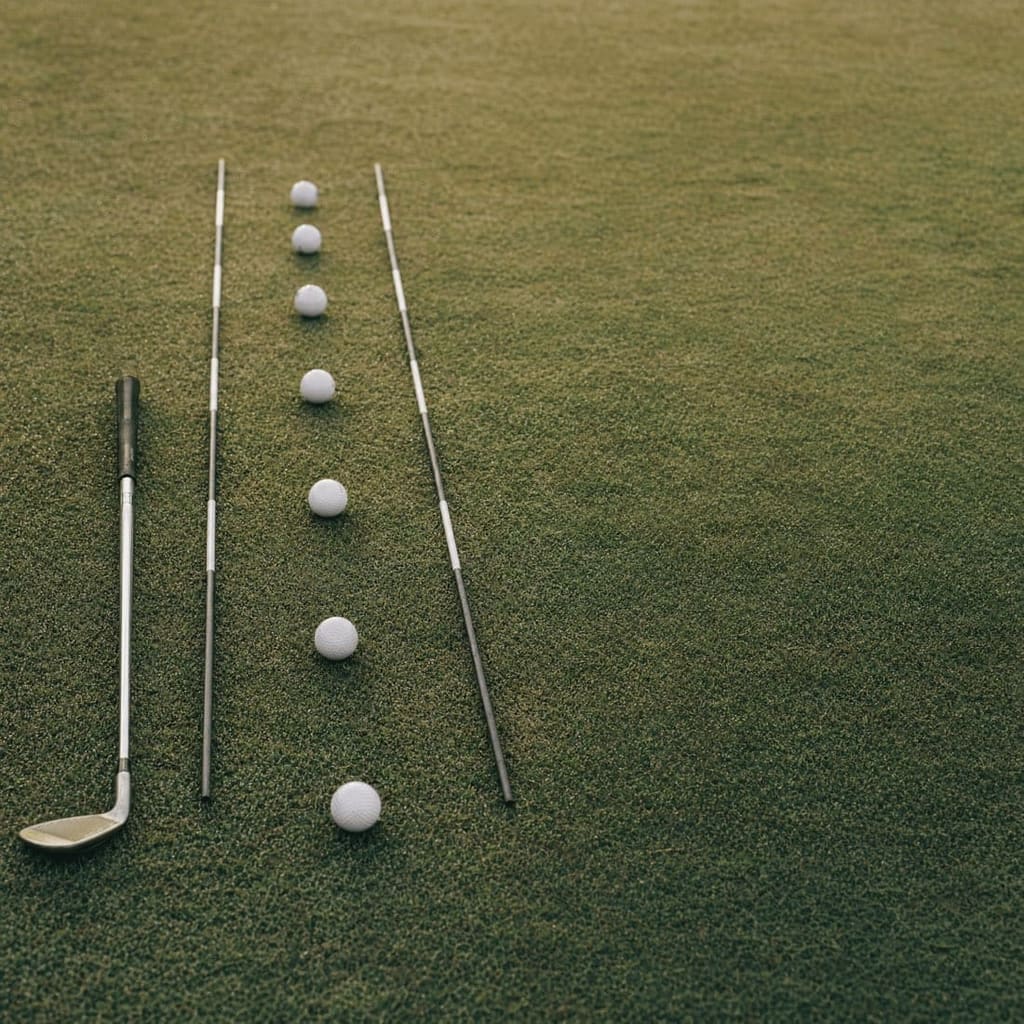
How to run it. Lay one alignment stick along your toe line and a second along your target line. Pick a single, specific flag — not “the middle of the green.” Hit eight shots, one club. Step away after every shot. Run the full pre-shot routine on every rep.
Success criterion. 6 of 8 starting on the intended line, with the correct shape. Misses to the wrong side of the target count as failures regardless of distance.
Why it works. The drill makes routine the variable, not the swing. Most amateurs run a sloppy range routine and a careful course routine; the gap between the two is one of the most under-discussed leaks in amateur scoring.
9. Pressure wedge test (20-foot circle)
Origin. The drill’s structure is generic; the success criterion comes directly from Mark Broadie’s strokes-gained framework in Every Shot Counts (2014). The 20-foot circle is the proximity at which a wedge approach turns from “two-putt likely” into “one-putt possible” for a tour-quality putter.
What it trains. Wedge proximity at the yardages where mid-handicaps lose the most strokes — under conditions that simulate the third hole of a tournament.
How to run it. Pick a target at 60, 80, or 100 yards. Lay alignment sticks 20 feet either side of the flag (or visualize a 20-foot circle). Hit twelve shots, full pre-shot routine on each. The session is a “pass the test” condition: pass requires 8 of 12 inside the 20-foot circle. Fail and the next session repeats it.
Success criterion. 8 of 12 inside 20 feet.
Why it works. Combines specificity (one yardage), pressure (a binary pass/fail), and a numeric outcome derived from strokes-gained — a triple constraint on the rep that approximates tournament conditions better than a normal range bucket can.
10. Two-ball lag (three-putt avoidance)
Origin. Generic putting drill; the version here is calibrated against Arccos data showing 15-handicaps average roughly 3.3 three-putts per round. Three-putts are the fastest stroke leak in amateur scoring, and three-putts overwhelmingly originate from outside 30 feet.
What it trains. Lag-putt distance control — getting the first putt inside three feet so the second is the 92% make Broadie’s data describes.
How to run it. Pick three distances: 30, 45, and 60 feet. Hit two balls per distance — not one — and putt them out. Score per pair: 0 if both first putts finish inside three feet, 1 if one does, 2 if neither does.
Success criterion. 0 across all three distances over a 6-ball session. A single 1 on a session is acceptable; a 2 anywhere triggers an extra five-ball lag set.
Why it works. The two-ball variant catches the second-putt distance leak that single-ball lag drills hide. It maps directly to the three-putt-avoidance lever Arccos data identifies as the largest single-stroke leak in mid-handicap rounds.
How to combine drills into a session
Two to four drills per session, never more. The standard split for a 45-to-60-minute session:
- One full-swing drill. 9-window or random iron mix, 10 to 15 reps.
- One wedge drill. Pelz ladder or pressure wedge test, 9 to 12 reps.
- One short-game drill. Par-18 or chipping zone, 9 spots.
- One putting drill. 20-in-a-row, gate, or two-ball lag, until the criterion is met.
The session principle, drawn from the block-vs-random-practice literature: block practice early in a session is fine for warm-up, but the bulk of reps should be random and goal-directed. Beginners should weight more block; single-digits more random; mid-handicaps sit in the pivot zone. The full handicap-by-handicap weekly cadence is in the driving range practice routine guide.
The contextual-interference effect, the spacing effect, and the deliberate-practice framework converge on the same prescription: short, varied, focused drills distributed across the week, with measurable success criteria and an honest log. A bucket of 200 balls without those properties is exercise, not practice. — synthesized from Schmidt & Lee, Motor Control and Learning, and Ericsson et al., Psychological Review, 1993
Common drill mistakes
- No success criterion. “I’m working on my 7-iron” is not a drill. “I’m hitting eight 7-irons inside one club length of the 150-yard flag” is.
- No log. Without a logged number per drill, the only signal is in-session feel — and feel rewards block practice precisely because block practice produces the strongest in-session performance. The log is what survives the random-practice discomfort window.
- Wrong drill for the handicap. A 22-handicap running the pressure wedge test is grading on a scale they cannot pass; a 7-handicap running 20-mid-iron blocks is starving the skills that move scoring. Match the drill to the tier.
- Driver overweighting. Scratch players hit only 4% more fairways than 20–25 handicaps. The math does not justify spending more than 15% of drill time on driver at any handicap.
- Same drill set for 12 months. Drills should rotate every 4 to 6 weeks once the criterion is consistently met. A drill that no longer challenges you is a drill that no longer teaches.
- Range-only drills with no on-course test. A drill is a hypothesis. The course is the only valid test. If your scoring isn’t moving over 8 weeks, the drill list — not your swing — is the variable to change.
Key takeaways
- A drill is not hitting balls. It needs a numeric success criterion, built-in variability, calibrated difficulty, and a logged result. Drills that satisfy all four are far more likely to transfer; drills that don’t tend to stay as range-only reps.
- On-course data drives drill choice. 15-handicaps lose 4+ strokes/round inside 50 yards. Tour pros make 92% of 4-foot putts. Approach proximity drives strokes-gained at every level. Drill time should follow that map.
- The ten drills above cover every part of the game. Each has a tour-level origin, a research justification, and a success criterion you can hit or fail. Pick four per session, rotate every 4 to 6 weeks.
- Block before random, then mostly random. The acquire-then-consolidate sequence is well established in the motor-learning literature. Beginners weight block; single-digits weight random; mid-handicaps run the pivot.
- The log is the lever. Without it, you’ll quit random practice in week two. With it, you’ll see the in-session penalty pay back as on-course transfer in weeks four through eight.
Frequently asked questions
What are the best golf practice drills?
The best golf practice drills share four traits drawn from motor-learning research: a numeric success criterion (e.g., “8 of 10 inside 20 feet”), variability within the drill (rotate clubs, distances, or targets), calibrated difficulty so you fail sometimes, and a logged result. The most-cited examples used by tour-level coaches are Tiger Woods’s 9-Window iron drill, Dave Pelz’s wedge distance ladder, Vision54’s worst-ball game, the par-18 short-game game, and the 20-in-a-row 4-foot putting drill. A drill without those four properties is just hitting balls.
What golf practice drills should a beginner do?
Beginners should run block-practice contact drills before any variability work. Twenty mid-iron swings at one target with a “clean strike, ball flight roughly straight” criterion (6 of 10) builds the movement pattern that everything else depends on. Schmidt and Lee’s Motor Control and Learning treats acquisition (block practice) and consolidation (random practice) as sequential phases — trying to consolidate a movement you cannot yet repeat is wasted reps. Save the 9-window and worst-ball drills for after contact is reliable.
What’s the most effective putting drill?
For most amateurs the highest-leverage putting drill is the 20-in-a-row from 4 feet — make twenty consecutive putts, miss restarts at zero. Mark Broadie’s strokes-gained data shows PGA Tour pros make about 92 percent of 4-foot putts and 81 percent of 5-foot putts, and the gap between scratch players and double-digit handicaps is largest in the 4-to-10-foot range. Pressure-tolerance under that exact distance is a direct lever on score. For three-putt avoidance, layer in the lag-putting two-ball drill from 30+ feet.
How long should a golf drill session last?
Thirty to sixty minutes is the working range. Quality drops sharply past 60 minutes for most amateurs because tired reps groove the wrong patterns. Within that window, two to four drills with 30 to 50 reps total beats one drill with 200 reps. Cepeda et al.’s 2006 meta-analysis in Psychological Bulletin documented a large spacing effect (d ≈ 0.78) for distributed over massed practice — three 45-minute drill sessions reliably out-learn one 135-minute session.
Do golf practice drills actually transfer to lower scores?
Drills that satisfy the four properties above are far more likely to transfer; drills that don’t typically stay as range-only reps. The strongest evidence is the contextual-interference effect documented in Shea & Morgan (1979) and replicated across decades: random or interleaved practice produces lower in-session performance but substantially better retention and transfer to a new context (the course). Drills that bake in variability — random clubs, varied distances, alternating targets — generally outperform repetitive same-club, same-target work for on-course outcomes, even though they feel worse while you’re doing them.
Can I do golf practice drills at home?
Yes — putting and chipping drills transfer well to a living-room carpet or a small backyard, and putting from 3 to 6 feet is high-leverage at-home work. Lay two tees a putter-head’s width apart for a gate drill, work to 20 in a row from 4 feet, and run a daily 10-minute lag drill on a long carpet. Full-swing drills are best run into a net or simulator; swinging into space without a ball gives no contact feedback.
Related reading
-
10 Golf Chipping Drills Tour Coaches Actually Use — short-game spoke; goes deep on the chipping drills this pillar only touches via Par-18.
-
10 Golf Putting Drills That Move Strokes-Gained-Putting — putting spoke; expands #5 (20-in-a-row), #7 (gate), and #10 (two-ball lag) above into a ten-drill catalog with a four-week protocol.
-
8 Lag Putting Drills That Cut Three-Putts — lag-specific spoke; goes deeper on #10 (two-ball lag) and adds calibrated leave-distance work against Lou Stagner’s Tour-data 30% rule.
-
Golf Tempo Drills: The 3:1 Ratio — tempo spoke; the rhythm catalog behind smoother, more repeatable contact on every drill above.
-
Ball-Striking Drills for Golf — contact spoke; low-point and compression drills that feed the full-swing reps in this catalog.
-
Block vs Random Practice in Golf: What the Research Actually Says — the motor-learning science behind the block-to-random pivot every drill above is built on.
-
Driving Range Practice Routine: 3 Plans by Handicap — how to drop these drills into a Tuesday/Thursday/Saturday cadence at the right weekly volume for your tier.
-
How to Fix a Slice in Golf — the four-week slice protocol layers cleanly on top of the contact-focused drills above.
-
Golf practice drills that actually transfer to the course — the companion drill library, organized by skill area with setup steps and success criteria.
-
The 30-minute golf practice plan — how to fit two to three of these drills into a tighter window.
-
Practice plan by handicap — deeper handicap-specific weighting across all skill areas.