
How to Hit a Driver: Setup, the Upward Strike, and Distance
The driver is the one club you hit on the way up. A setup that builds a positive angle of attack, the launch numbers worth chasing, and the data behind them.

Quick answer
A driver is the one club you hit on the way up. Tee the ball so half of it sits above the crown, play it off your lead heel, and tilt your spine slightly away from the target so the clubhead is rising at impact. A positive angle of attack launches the ball higher with less spin, which carries farther at the same speed. Most amateurs hit down on it, and that is the first thing to fix, before chasing any extra mph.
Tour vs amateur driver: the side-by-side
| Player | Driver attack angle | Typical launch | Typical spin | What it produces |
|---|---|---|---|---|
| PGA Tour (avg) | −0.9° | low teens° | mid-2,000s rpm | Penetrating; 113+ mph carries it anyway |
| LPGA Tour (avg) | +2.8° | mid-teens° | mid-2,000s rpm | Hits up; max carry at ~94 mph swing speed |
| Average male amateur | −1.8° | too low | often 3,000+ rpm | Hits down; spin balloons, carry leaks |
| Your target (90–95 mph) | 0° to +3° | 13–15° | 2,300–2,800 rpm | Most carry for your speed |
Attack-angle figures from TrackMan’s attack-angle data; optimal launch and spin windows from MyGolfSpy’s optimal launch and spin chart. The load-bearing line of the whole post is in the bottom two rows: the average amateur hits down on the driver, which is the opposite of what their swing speed needs.
Why the driver is the only club you hit on the way up
Every club in the bag has a low point, the spot where the clubhead is closest to the ground. With an iron, you want that low point past the ball, so the club is still descending at impact and the ball is struck before the turf. The driver is the exception. The ball sits on a tee, the club has the least loft in the bag, and the goal is carry, so you want the low point behind the ball and the clubhead rising as it arrives.
TrackMan’s attack-angle research puts the contrast in numbers. PGA Tour players average about −3.7° of attack angle with a 6-iron, a clear downward strike, but about −0.9° with the driver, much shallower. LPGA Tour players average +2.8° with the driver, hitting up on it, and they swing it around 94 mph, similar to a strong male amateur. That last fact is the one to sit with.
TrackMan states the rule for every other full-swing club plainly:
“Golf shots hit off the ground (not off tees) should have a negative Attack Angle to optimize trajectory.”
The driver is the lone exception in the bag, because it is the only full swing you play off a tee.
Here is the mechanism. Hitting up on the ball while keeping dynamic loft reasonable lowers the spin-loft, the angle between where the club is moving and how much loft it presents. Lower spin-loft means lower backspin and a higher launch, which is exactly the combination that carries a moderate-speed drive farther. Hit down on the driver and spin-loft climbs, spin balloons past 3,000 rpm, and the ball climbs and drops with no run.
This is why a swing that strikes irons cleanly can still waste the driver. A player grooved to hit down, who then plays the driver from a centered, iron-like setup, delivers a negative attack angle and high spin even when contact feels solid. The strike feels fine. The launch monitor says otherwise.
Angle of attack: the difference between 260 and 288 yards
The distance on the table from attack angle alone is large. GolfWRX’s analysis of TrackMan optimization data, from coach Tom Stickney, reports that a golfer at 105 mph clubhead speed carries the ball about 260 yards at a −5° attack angle but about 288 yards at +5°, with dynamic loft adjusted to match. That is 28 yards of carry from changing one number, no extra speed required.
A 90–95 mph amateur sees less than the full 28, because the swing speed is lower, though the direction holds. Moving from a −2° attack angle to +2° at that speed commonly adds 15 to 25 yards of carry once launch and spin shift into the optimal window. Stickney’s recommended target for most club golfers is an attack angle between −1° and +3°, slightly up without overdoing it.
The reason it matters so much for amateurs is physics. A drive launched at 90 mph of clubhead speed loses speed to drag faster than a tour drive at 115, so it needs more height and time in the air to carry. MyGolfSpy’s optimal launch chart puts the window for a roughly 95 mph swing at a 13–15° launch with 2,300–2,800 rpm of spin. You reach that window by hitting up through the ball, which raises launch while holding spin down.
The setup that creates a positive angle of attack
Most negative-attack-angle problems begin at address. Fix the geometry there and the upward strike usually follows, because the body simply rotates around the frame you build. Five setup elements do most of the work.
| Fundamental | What good looks like | What most amateurs do | First fix |
|---|---|---|---|
| Ball position | Off the inside of the lead heel | Center, copied from irons | Move it forward to the lead heel |
| Tee height | Half the ball above the crown | Too low, ball even with the crown | Tee it higher; aim to strike the upper face |
| Stance width | Slightly wider than the shoulders | Same as the 7-iron stance | Widen for a stable, tilt-friendly base |
| Spine tilt | Trail shoulder lower, head behind the ball | Level, or tilted toward target | Drop the trail shoulder; lean away from target |
| Shaft lean | Neutral to slightly back at address | Forward, like an iron | Hands even with, or just behind, the ball |
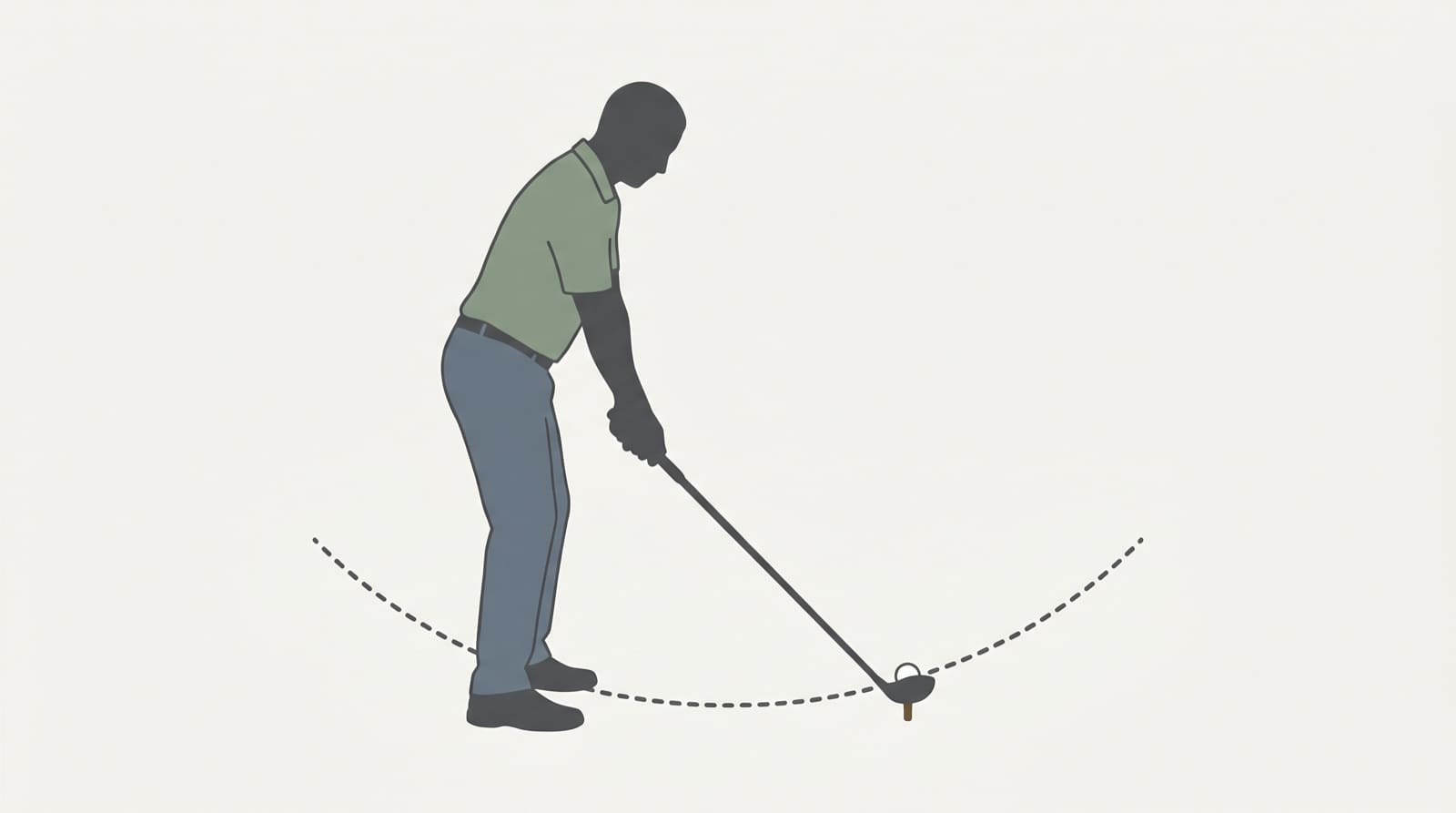
Ball position and tee height set the geometry. PGA professional Rick Shiels, in his Complete Driver Guide, teaches the ball inside the lead heel, far forward of any iron, and a tee height with “half the golf ball above the clubhead’s crown.” Played there, the clubhead has already passed its low point and is traveling up when it meets the ball, and the high tee lets it catch the upper face, where spin runs lower.
Spine tilt is the piece most amateurs skip. Dropping the trail shoulder so your head sits behind the ball tilts your rotational axis away from the target, which lets the club travel up through impact even as the body keeps turning hard. Set the shoulders level or tilted toward the target and the same rotation drives the club down into the ball, the negative attack angle you are trying to avoid.
What the launch-monitor data actually says
Distance starts with ball speed, and ball speed is set by clubhead speed multiplied by strike quality. TrackMan’s ball-speed data breaks driver ball speed down by handicap and gives a clear ladder to measure yourself against.
| Golfer | Driver ball speed | Approx. carry (good launch) |
|---|---|---|
| PGA Tour (avg) | ~171 mph | mid-270s yds |
| Scratch male amateur | ~161 mph | ~245 yds |
| 5-handicap | ~147 mph | ~225 yds |
| 10-handicap | ~138 mph | ~210 yds |
| Average male (~14.5 hcp) | ~133 mph | ~205 yds |
Ball speeds from TrackMan; carry figures are approximate, using TrackMan’s rule of thumb of up to 2 yards per mph of ball speed under good launch conditions.
Smash factor is the multiplier hiding in that table. It is ball speed divided by clubhead speed, a measure of how centered the strike is. Tour players run about 1.48 to 1.50; many amateurs sit closer to 1.40 to 1.45. TrackMan’s worked example is blunt: a player swinging 95 mph at a 1.40 smash produces about 133 mph of ball speed, but the same player at 1.48 produces about 141 mph, an 8 mph gain worth roughly 12 to 16 yards of carry, with no change in swing speed.
For most amateurs, the biggest driver gain is strike quality, ahead of raw speed. As Lou Stagner notes from Arccos data, the low-hanging fruit for many amateurs is hitting the center of the face more often with a better clubface delivery. Speed training pays off later, once the strike is repeatable.
How to check your angle of attack without a launch monitor
You do not need a launch monitor to know which way you are hitting the driver. Three field tests get you close, and they cost nothing.
Read the ball flight. A drive that climbs steeply and drops with almost no roll is spinning too much, the signature of hitting down on the driver. A drive that comes off low and dives has too little dynamic loft. The flight you want climbs steadily and runs on landing. The mechanism is the spin-loft relationship TrackMan describes, read backward from the result.
Run the headcover-ahead test. Lay a headcover on the target line about six inches in front of the ball, then tee up and swing. Clip the headcover and the clubhead is still level or descending at the ball. Miss it cleanly and the clubhead is rising past the ball, the ascending strike you want. Hit ten and count how many you clear.
Film it face-on. Shoot slow motion from face-on at ball height (a phone’s slow-motion mode works). At impact, an iron shows the hands ahead of the ball and the shaft leaning toward the target; a good driver shows the hands even with or just behind the ball and the shaft leaning slightly away. Free tools like Kinovea step through it frame by frame. In PracticeCaddie’s approach, this attack-angle check comes before any speed work, because adding mph to a downward strike just adds spin.
What more distance is actually worth
The case for training the driver is a scoring one. Mark Broadie’s strokes-gained research shows that distance off the tee is one of the largest separators between scoring levels, because a longer drive leaves a shorter approach, and a shorter approach finishes closer to the hole. In his book Every Shot Counts, Broadie’s data has a tour pro leaving a 150-yard fairway approach around 23 feet from the hole, against roughly 56 feet for a player who shoots in the 90s. Get the tee shot 20 yards closer and that approach gets easier in a way that compounds across 14 driving holes.
The amateur data backs it directly. Stagner’s analysis of Arccos shot-tracking found that golfers who added 10 or more yards of driving distance year over year improved their scores by nearly two strokes per round on average, and more than 40% improved by over three strokes. The common fear, that more speed means spraying it, did not show up: players who gained distance did not get significantly wilder, and many got slightly straighter.
That is why Stagner’s club-off-the-tee work lands on driver as the default. Modeled across realistic dispersion patterns, driver usually posts the lowest expected score even when it occasionally brings trouble in, because the shorter approach more than pays for the odd missed fairway. Hit driver unless a hole gives you a genuine reason not to. For the full framework, see Strokes Gained explained for amateurs.
The drills that build an upward strike
Pick two or three and run them until the pattern holds. Each gives external, checkable feedback, which is what makes a drill different from hitting balls.
1. The tee-it-high, hit-the-top drill
Tee the ball so half of it sits above the crown and try to strike the upper-center of the face. Foot-spray powder or face tape shows where you made contact. The success criterion is 7 of 10 strikes in the upper half of the face. High-face contact lowers spin through gear effect, and reaching the high tee forces the clubhead to arrive on the way up. Shiels teaches this tee height for exactly that reason in his driver guide.
2. The headcover-ahead drill
Place a headcover on the target line about six inches in front of the ball and swing up and over it. Catching it means the clubhead is still descending or bottoming out at the ball; clearing it means the club is rising. Success criterion: 8 of 10 swings that miss the headcover and still find the center of the face. This is the same upward-strike feel the forward ball position and spine tilt are built to produce, trained with instant feedback.
3. The 7-iron tempo transfer
Hit a five-shot block alternating a 7-iron and the driver on the same tempo count. Most amateurs lash at the driver and lose their sequence, which throws off both the strike and the attack angle. Tour Tempo’s research finds tour pros hold a roughly 3:1 backswing-to-downswing ratio regardless of club; recreational golfers break it by getting quick from the top. Matching the 7-iron’s rhythm keeps the longer club smooth. For the full set, see golf tempo drills.
If your driver miss is a slice rather than a low spinny pull, the fault lies in path and face. Run the dedicated path-and-face protocol in how to fix a slice in golf alongside these.
Common driver mistakes
- Ball played too far back. A habit carried over from irons. It puts impact before the low point, forcing a downward strike, low launch, and high spin. Move it forward to the lead heel.
- Setting up like it is a long iron. Level shoulders, hands forward, a low tee. That geometry drives the club down. Tee it up, play it forward, and tilt the trail shoulder lower.
- Slicing it. An out-to-in path with a face open to that path. This is a path-and-face fault, often paired with a steep, downward strike; the slice protocol is the dedicated fix.
- Casting from the top. Throwing the clubhead early burns lag and adds dynamic loft, which spikes spin. Better sequencing from the ground up holds it; see how to increase golf swing speed.
- Chasing speed before geometry. Adding mph to a negative attack angle just adds spin. Fix the strike first, then train speed, then the speed actually shows up as carry.
A four-week driver protocol
The drills work only when sequenced. Block practice in weeks 1 and 2 grooves the motor pattern; random and full-speed work in week 3 makes it survive the course. The structure mirrors the howTo on this page and the motor-learning case in block vs random practice in golf.
- Week 0, measure the baseline. Ten drivers on a launch monitor. Record clubhead speed, ball speed, smash, attack angle, launch, and spin. Negative attack angle plus 3,000-plus spin means hitting up is your first gain.
- Week 1, set up for the upward strike. Three 20-minute setup-only sessions. Tee it high, ball off the lead heel, wider stance, trail shoulder dropped. Slow rehearsal swings that brush up through impact.
- Week 2, groove the ascending strike. Three 25-minute sessions. Tee-height drill and headcover-ahead drill. Goal: 8 of 10 clearing the headcover and finding the high face.
- Week 3, add path, face, and speed. Three 30-minute sessions. Driver-and-7-iron tempo blocks, a few full-intent speed swings on a wide target, attack angle checked.
- Week 4, on-course transfer. Two range sessions plus one round. Cold three-ball tests on the range; log every tee shot on the course and compare fairway rates.
- Maintenance, every two to three months. Re-run the Week 0 test. Attack angle and speed drift; the pattern needs periodic re-grooving.
Key takeaways
- The driver is the one club you hit on the way up. PGA Tour players average −0.9° attack angle with it, LPGA players +2.8°, while the average male amateur is around −1.8°, hitting down (TrackMan).
- Attack angle is worth real yards. A 105 mph swing carries about 260 yards at −5° and 288 at +5°, a 28-yard swing from one number (GolfWRX). Target −1° to +3°.
- Set up for the upward strike. Ball off the lead heel, half the ball above the crown, wider stance, trail shoulder lower, hands neutral. The strike follows the geometry.
- Aim for the right window at your speed. Around 95 mph, that is a 13–15° launch with 2,300–2,800 rpm of spin (MyGolfSpy), reached by hitting up through the ball at your speed.
- Strike quality beats raw speed for most amateurs. Moving smash factor from 1.40 to 1.48 is worth 12 to 16 yards at the same speed (TrackMan).
- Distance lowers scores without wrecking accuracy. Amateurs who added 10-plus yards improved nearly two strokes per round and did not get wilder (Arccos via Lou Stagner).
- Hit driver by default. Across realistic dispersions it posts the lowest expected score on most holes (Stagner).
Frequently asked questions
Should you hit up or down on a driver?
Up. The driver is the one club you hit on the way up. Off a tee, an ascending strike (a positive angle of attack) launches the ball higher with less spin, which carries farther for the same swing speed. PGA Tour players average about minus 0.9 degrees, slightly down, but they swing 113-plus mph; LPGA players average plus 2.8 degrees and gain distance from it. For an amateur around 90 mph, hitting up matters even more, because slower ball speed needs the extra carry.
Where should the ball be in your stance for a driver?
Forward, off the inside of your lead heel, much further forward than any iron. Ball position sets where in the swing arc you make contact: forward of the swing’s low point, so the clubhead is already rising when it reaches the ball. An iron sits near the center of the stance because it needs a descending strike; the driver sits forward because it needs an ascending one. A ball played too far back is the most common cause of hitting down on the driver.
What is a good angle of attack for a driver?
For most amateurs, neutral to slightly positive, roughly 0 to plus 3 degrees up. Tour-coach guidance reported by GolfWRX from TrackMan optimization data recommends an angle of attack between minus 1 and plus 3 degrees for most club golfers. The gain is real: TrackMan’s optimization chart shows a player at 105 mph swing speed carrying about 260 yards at minus 5 degrees but about 288 yards at plus 5 degrees, a 28-yard difference from attack angle alone. Most mid-handicaps measure negative, so the move is upward.
How high should you tee a driver?
About half the ball should sit above the crown of the driver at address. That height lets the clubhead reach the ball as it rises and encourages contact high on the face, where spin is lower. A tee that is too low pulls the strike down toward the center of the face or below, steepening the angle of attack and adding spin. With a modern 460cc head, half the ball above the top edge is the working reference most coaches teach.
Why do I slice my driver but not my irons?
The driver exposes a path-and-face problem the irons hide. It has the least loft and the longest shaft, so the same open-face-to-path relationship that barely curves a 7-iron sends a driver sideways. The longer shaft also swings on a flatter plane and is harder to square, and the ball sits forward off a tee, giving an out-to-in path more time to leave the face open. Fix the path and face with the driver specifically, using the dedicated slice protocol.
Does hitting driver farther make you less accurate?
Usually not, according to shot-tracking data. Lou Stagner’s analysis of Arccos data found that amateurs who added 10 or more yards of driving distance improved their scores by nearly two strokes per round on average, and did not become significantly more erratic; many got slightly straighter. Mark Broadie’s strokes-gained work shows distance off the tee is worth far more than the occasional missed fairway, because a shorter approach finishes closer to the hole. Driver should be your default off the tee.
What is the average driving distance for an amateur?
About 225 yards total for the average male amateur, per Arccos data summarized by Practical Golf, with most golfers between 200 and 250 yards in Shot Scope’s database. Distance falls with age and with higher handicaps. The USGA and R&A’s 2024 Distance Report puts the major men’s professional tours near 295 to 300 yards, so the recreational-to-tour gap runs roughly 70 to 90 yards. For an amateur, most of that gap comes from swing speed and strike quality rather than equipment.
Related reading
- How to Grip a Golf Club — the cornerstone every full-swing club is built on, the driver included; a slice often starts in the grip.
- How to Hit a Fairway Wood — the next club down, with the same low-point logic flipped to a shallow downward strike.
- Golf Ball Position by Club — the setup fundamental underneath this post, mapped club by club from driver to wedge.
- How to Fix a Slice in Golf — the dedicated path-and-face protocol for the driver’s most common and most destructive miss.
- How to Increase Golf Swing Speed — once your strike is sound, the speed work that adds the next 10 yards of carry.
- Golf Swing Speed Chart by Age and Handicap — where your clubhead speed sits, and the carry it should produce.
- Golf Tempo Drills — the 3:1 ratio that keeps the driver from getting quick at the top.
- Driving range practice plan — the longer-form companion that drops this driver work into a full range session.