
How to Hit a Hybrid: Setup, Strike, and Which Iron It Replaces
A hybrid is played more like an iron than a wood: a slightly descending strike, ball just forward of center, small divot. Plus the data and how to gap yours.

Quick answer
A hybrid is struck more like an iron than a fairway wood: a slightly descending blow, brushing the turf at or just past the ball, with a small divot. Play the ball just forward of center and keep your weight on the lead side. Most topped hybrids come from playing the ball too far forward and trying to lift it. Match a hybrid to an iron by loft and carry rather than club number, and below about 85 mph driver speed the hybrid beats the long iron.
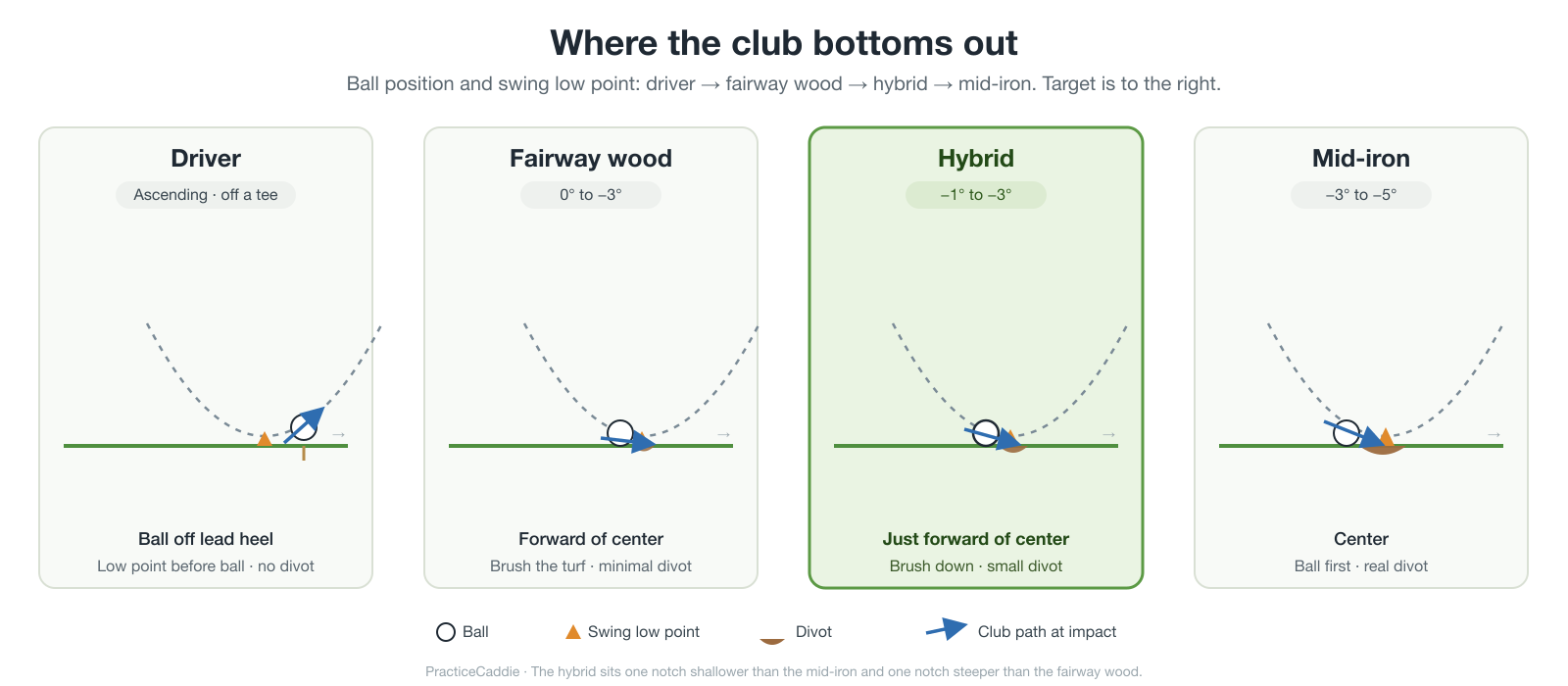
Driver, fairway wood, hybrid, iron — where the club bottoms out
| Club | Ball position | Typical attack angle | Low point | What to feel |
|---|---|---|---|---|
| Driver | Off the lead heel | Up, off a tee | Before the ball | Sweep up, no turf |
| Fairway wood | Forward of center, ~1 ball inside heel | About 0° to −3° | Just after the ball | Brush the turf, minimal divot |
| Hybrid | Just forward of center to inside lead heel | About −1° to −3° | Just after the ball | Brush down, take a small divot |
| Mid-iron | Center | About −3° to −5° | Clearly after ball | Ball first, then a real divot |
The progression is the load-bearing idea of the whole post: as you move down the table the strike gets more descending and the divot grows. The hybrid sits one notch shallower than the mid-iron and one notch more descending than the fairway wood, closer to the iron. Hybrid attack-angle figures from Golf Monthly’s ball-striking masterclass; the negative-attack-angle principle for any shot off the ground is from TrackMan’s attack-angle data.
Why a hybrid earns its slot in the bag
Hybrids cover the long-approach distances, roughly 170 to 210 yards, that decide whether you putt for birdie or scramble for bogey. A reliable one moves the scorecard as much as a mid-iron does, because advancing the ball to a shorter approach lowers your expected score. Mark Broadie’s strokes-gained research is direct about it: getting the ball further down the hole, as long as it avoids penalty trouble, lowers expected strokes, because a shorter approach finishes closer to the pin.
The stakes at this distance are high and most amateurs lose them. Golf Monthly’s read of 2026 Shot Scope data found that a 15-handicap comes up short of the green from 200 yards 73 percent of the time. A club that retains ball speed on a mis-hit, instead of falling out of the sky, is how you stop leaking those shots. (For the full framework, see Strokes Gained: Approach, Explained.)
Why a hybrid is closer to a long iron than a fairway wood
The single idea that fixes the most hybrids: it looks like a small wood, but it plays like a forgiving long iron. The mistake nearly every amateur makes is letting the wood-like head trigger a wood-like sweep.
Golf Monthly’s instruction is blunt about the setup: despite their mini-wood head style, treat them much more like an iron than a wood for both set-up and execution.
The reason is the club’s center of gravity. As Golf.com’s fitting breakdown explains, the CG of a fairway wood sits furthest from the ball, the CG of an iron sits closest, and the CG of a hybrid sits in between. That forward, low CG is built to launch the ball off a slightly descending strike, not a sweep. My Golf Instructor gives the practical version: position a hybrid like an iron, “play the ball in the middle or one ball forward of middle,” and “try taking a small divot to make sure that you are hitting with a descending blow.” A hybrid you sweep launches low and spinny and runs through the green. A hybrid you brush down on launches high and stops.
The setup that puts you in the impact window
Most hybrid misses are setup misses wearing a swing-fault costume. Fix the geometry at address and the strike usually follows. Four fundamentals close most of the predictable error.
| Fundamental | What good looks like | What most amateurs do | First fix |
|---|---|---|---|
| Ball position | Just forward of center, toward the lead heel for a 3H | Up by the lead heel, copied from a wood | Move the ball back toward center one ball-width |
| Weight | 55–60% on the lead foot, staying there through impact | 50/50 or hanging back on the trail side | Pre-set the weight forward and keep it there |
| Attack angle | Shallow, −1° to −3°, small divot just past the ball | Sweeping up, low point behind the ball | Brush the grass past the ball, take a small divot |
| Tempo | Same beat as the 7-iron, just a longer arc | Lashing at it harder than any other club | Count the 7-iron’s rhythm and match it |
Ball position: a forward band you calibrate
Ball position for a hybrid lives between a mid-iron and a fairway wood. Golf Monthly lands it at “more like a mid- to long-iron, so about one-and-a-half balls inside your left heel depending on loft.” A practical band: roughly one ball forward of center for a higher-lofted 5-hybrid, moving up toward one to one-and-a-half balls inside the lead heel for a 3-hybrid. The longer and lower-lofted the hybrid, the slightly more forward the ball, because the swing’s low point sits further forward with a wider arc.
The dominant error is playing it too far forward. GolferGeeks’ setup guide puts the safety rule plainly: “Never play it as far forward as a driver. That’s a recipe for topped shots or weak hooks,” and “if anything, it’s better that it’s too far back than too far forward.” Start from the band, then move the ball a half-ball at a time while watching only contact quality, until the club meets the ball at the bottom of its arc.
Weight forward, low point in front of the ball
Keeping 55 to 60 percent of your weight on the lead side, and leaving it there through impact, pre-loads the forward low point a hybrid needs. The cue most coaches use is the lead shoulder: the bottom of the arc sits roughly under it, so your chest has to cover the ball through impact rather than hang back. When the upper body drifts away from the target trying to help the ball up, the low point stays behind the ball and the club is already rising at contact. That is the topped hybrid in one sentence.
Grip down half an inch to an inch, too. The hybrid shaft runs about an inch longer than the matching iron, and Golf Monthly recommends choking down to “make you more comfortable and get it feeling more like an iron at set-up,” which also tightens control.
Angle of attack: shallow, slightly down, small divot
The fix for the most hybrids is permission to take a divot. A hybrid off the turf wants a shallow descending strike, and Golf Monthly’s ball-striking masterclass puts a number on it:
“Your angle of attack can be as little as 1° downwards or level at the point of impact… it should still be either 1° negative (downward), or at worst neutral.”
That is shallower than a mid-iron, which the PGA Tour delivers around −3.7° with a 6-iron, but the strike still descends. The broad sole is what lets you take that divot safely. As Golf Monthly notes, “you shouldn’t be afraid to hit the ground at impact and take a little divot, the head design with its broad sole helps to prevent the club from digging in.” TrackMan frames the universal principle: any shot played off the turf wants a negative attack angle for the right launch. A useful image is skimming a hand across water: the hand drops slightly to meet the surface, then glides along it. The hybrid sole should thud the turf at the ball and glide past it.
Off a tee, change one thing. Tee it low, only about a quarter of the ball above the top edge of the club, and level the strike out slightly. Tee it as high as a driver and you will scoop it, “as it will just roll up the clubface.”
Hybrid vs long iron: what the tracked data actually says
For most amateurs, the highest-leverage hybrid decision is made before the swing: carry the hybrid instead of the long iron. The shot-tracking data is one-sided. Shot Scope compared 3-, 4-, and 5-hybrids against their iron counterparts across green-hit rate, proximity, dispersion, and distance from the rough. Hybrids won in every metric, at every handicap.
| Handicap bracket | Hybrid greens-hit edge | Hybrid proximity edge | Hybrid dispersion edge | Hybrid distance from rough | Verdict |
|---|---|---|---|---|---|
| 20-handicap | +1% greens hit | 16 ft closer to pin | 19 ft tighter | +11 yards | Move to the hybrid; the long iron offers nothing |
| 10-handicap | +2% greens hit | 14 ft closer to pin | 15 ft tighter | +14 yards | Hybrid for almost every scenario |
| Scratch | +6% greens hit | 11 ft closer to pin | 10 ft tighter | +1 yard | Hybrid still wins on proximity; long iron for shaping |
Data: Shot Scope, “Hybrids or long irons?”, a tracked-shot comparison across its database.
The scoring case is even sharper at distance. Golf Monthly’s analysis of 2026 Shot Scope data found a 20-handicap’s chance of hitting a green from 175 yards nearly doubles, from 7 percent to 14 percent, with a hybrid instead of a long iron. The one exception in that 175-yard cut is the scratch player, who hit 2 percent more greens with the long iron, which is why many low-handicaps keep one for trajectory and shot-shaping. Even there, Shot Scope’s broader comparison (the +6 percent above) still leans hybrid. The mechanism is forgiveness: a hybrid retains more ball speed and launch on an off-center strike, so the wide sole strikes cleanly more often and the ball carries hazards short of the green instead of falling in them.
A separate Shot Scope study puts a finer point on the cutoff: from over 200 yards a hybrid is almost twice as effective as a long iron, so “most golfers should not be carrying irons which they can hit over 180 yards.” For the same decision run from the iron’s side of the bag, see how to hit long irons in golf.
Hybrid lofts and gapping: match by loft, not by number
Hybrid club numbers do not map cleanly onto iron numbers, which is why so many golfers end up with a gap or an overlap. The fix is to gap by loft and measured carry, not by the number stamped on the sole.
| Hybrid | Typical loft | Replaces (traditional iron) | Typical carry (mid-handicap) |
|---|---|---|---|
| 2H | 16°–18° | 2-iron | 185–210 yards |
| 3H | 19°–21° | 3-iron | 175–195 yards |
| 4H | 22°–25° | 4-iron | 162–182 yards |
| 5H | 25°–28° | 5-iron | 150–170 yards |
Loft ranges and replacement mapping from Mitchell Golf’s loft chart; cross-checked against PXG’s hybrid FAQ, which maps a 3-iron to a 19° hybrid, a 4-iron to a 22° hybrid, and a 5-iron to a 25° hybrid.
A hybrid carries roughly 8 to 12 yards further than the same-numbered iron, so swapping like-for-like by number leaves an overlap. To replace a long iron, pick a hybrid with about 2 degrees more loft than the iron you are removing, which cancels the distance bump. To replace a fairway wood, go the other way and pick a hybrid 1 to 2 degrees stronger. The principle holds across brands even as the labels drift.
A worked gapping example
Suppose your 7-iron carries 165 yards and your 5-wood carries 205. That is a 40-yard hole in the bag. Fill it with two hybrids at even gaps: a 4-hybrid (about 22–23°) around 185 and a 3-hybrid (about 19–20°) around 197, leaving roughly 10 to 12 yards between each club. Golf.com’s fitting data confirms the equivalence that makes this work: 5-woods, 3-hybrids, and 3-irons all tend to live within a degree of 18°, while 7-woods, 4-hybrids, and 4-irons cluster around 21 to 24°. Confirm the actual carries on a launch monitor before you buy; loft labels are a starting point, not a guarantee.
Hybrid vs fairway wood (and the 7-wood)
For the long-approach slot, the club you can launch and control beats the one that carries furthest on paper. The two clubs solve the gap differently.
| You want… | Reach for… | Why |
|---|---|---|
| Forgiveness, control, rough escape | Hybrid | Shorter shaft, deeper CG, higher MOI; easier to time and strike |
| Maximum distance, higher launch, tee | Fairway wood | Longer shaft and bigger head carry further from a clean lie |
| A bridge between the two | 7-wood | Hybrid-like turf interaction with more height and stopping power |
PXG’s club comparison sums up the trade: “A hybrid is played more like an iron, while a fairway wood has a longer shaft length… For maximized distance, we recommend fairway woods. For improved forgiveness, higher launch, and versatility, we recommend hybrids.” The shorter shaft is the quiet advantage. As Golf.com puts it, “the shorter shaft we can get in your hands, the simpler the game is.”
The honest read from fitters who test both side by side: if you sweep the ball, a high-lofted fairway wood will suit you; if your strike is steeper or you find the rough often, the hybrid is more versatile and easier to control. If your real trouble at this distance is a fairway wood off the deck, the companion read is how to hit a fairway wood, which runs the same launch-monitor decision for the 3- and 5-wood.
The drills that build clean contact
Pick three; do not rotate weekly. Each gives external, numeric feedback on the low point, which is the variable that decides every hybrid strike. They are the same ball-striking family used in ball striking drills for golf, tuned for the hybrid.
1. The feet-together ball-position finder
Stand with your feet together, ball centered, hybrid behind it. Take a medium step toward the target with your lead foot, then a slightly bigger step away with your trail foot. The ball ends up about one ball forward of center, off your shirt logo, which is the hybrid window. Run it before every session until the position is automatic. It removes the guesswork that produces a too-far-forward, topped setup.
2. The tee drill — establish clean contact first
Tee the ball low, a quarter of the ball above the crown, and hit ten shots. The success criterion is binary: did the club brush the grass in front of where the ball sat, or scrape it behind? Most amateurs cannot strike a teed hybrid without hitting the ground behind it, the same fault that tops it off the deck. The tee removes turf interaction so the underlying attack-angle pattern shows itself.
3. The towel-behind-the-ball drill — kill the early low point
Place a folded towel about a hand-width behind the ball and hit shots without touching it. Catch the towel and your low point is behind the ball, the fat-and-thin fault. Titleist’s towel drill teaches the same move into the lead side a hybrid needs. Run ten reps, then move the towel an inch closer and run ten more. The goal is a shallow divot at or just past the ball.
4. The 7-iron tempo transfer — stop lashing at it
Hit a five-shot block alternating 7-iron and hybrid, using the same tempo count on every swing. Most amateurs accelerate the hybrid and lose their sequence; the longer shaft does the distance work when the rhythm holds. Tour-tempo research finds nearly all tour pros swing at a 3:1 backswing-to-downswing ratio regardless of club. For the full set, see golf tempo drills.
Common mistakes
- Ball too far forward, copied from a wood. Up by the lead heel, the low point falls behind the ball and you top it. Move it back toward center one ball-width. This is the most common hybrid fault by a wide margin.
- Trying to lift the ball. The loft launches it. Adding a scoop hangs you back and moves the low point behind the ball. The towel drill fixes it.
- Sweeping it like a fairway wood. Off the turf a hybrid wants a slight descending strike and a small divot (Golf Monthly). Brush down through the ball.
- Teeing it as high as a driver. A high tee invites the scoop. Tee it low and keep the strike level off the tee, slightly down off the deck.
- Lashing harder than the 7-iron. Tempo identical to the 7-iron is the consistency multiplier; extra effort costs the strike that makes the speed.
Which hybrids to carry, by swing speed
The bag decision is a data decision, and swing speed sets the starting point. The common fitting rule is that below about 85 mph of driver clubhead speed, hybrids beat long irons across the board, starting with the 4-iron and longer. The slowest swingers benefit from going further still: one fitting guide suggests players well under 85 mph carry hybrids for everything below the 7-iron. Use the table as the starting hypothesis, then confirm with the Week 0 launch-monitor test below.
| Your driver speed | Likely setup | Notes |
|---|---|---|
| Under 85 mph | Hybrids for everything 4-iron and longer; add a 7-wood | The Shot Scope edge is largest here; long irons leave strokes on the table |
| 85–95 mph | 3- and 4-hybrid, irons starting at 5-iron | A/B test the 4-hybrid against your 4-iron for three sessions; keep the winner |
| Above 95 mph | One hybrid or driving iron, longer irons in play | Strong, descending strikers can hold a long iron for trajectory and shaping |
This is the same launch-monitor-driven logic, run for the hybrid, that how to hit long irons in golf runs for the 3- and 4-iron. The two posts are two sides of one bag decision.
A four-week hybrid protocol
The drills work only when sequenced. Block practice in weeks 1 and 2 grooves the motor pattern; random practice in week 3 makes it survive the course. The sequence mirrors the howTo on this page and the motor-learning research in block vs random practice in golf.
- Week 0 — measure the baseline. Ten hybrid shots and ten with the iron it would replace on a launch monitor. Record speed, attack angle, launch, carry, dispersion. If the iron launches low or scatters, or you are under ~85 mph, the bag changes here.
- Week 1 — the iron-like strike off a tee. Three 20-minute sessions, tee drill only. Low tee, ball one ball forward of center, 55 to 60 percent lead-foot weight, a brush in front of the ball.
- Week 2 — low-point control off the turf. Three 25-minute sessions. Towel drill and brush-the-ground drill. Goal: 8 of 10 shots taking a shallow divot at or just past the ball.
- Week 3 — random distance and the A/B test. Three 30-minute sessions. A 12-shot rotation alternating the hybrid, the long iron, and a mid-iron at three targets. Track proximity per club. The data picks the survivor.
- Week 4 — on-course transfer. Two range sessions plus one round. Log every hybrid shot. Compare your on-course strike rate against the range number.
- Maintenance — every six months. Re-run the Week 0 test. Strike and swing speed drift; the bag should move with them.
Key takeaways
- Play a hybrid more like an iron than a wood. Slightly descending strike, brush the turf at or just past the ball, take a small divot (Golf Monthly).
- Ball just forward of center, between a mid-iron and a fairway wood. Roughly one ball forward of center for a 5H, up to one to one-and-a-half balls inside the lead heel for a 3H. Err toward center.
- Angle of attack about −1° to −3°. As little as 1° down to level off the turf (Golf Monthly); the broad sole lets you take the divot safely.
- Loft launches it. Trying to help the ball up hangs you back and tops it; keep your weight on the lead side through impact.
- Match a hybrid to an iron by loft and carry, not number. A hybrid flies ~8–12 yards further than the same-number iron (Shot Scope), so replace the next iron up.
- Below ~85 mph driver speed, the hybrid beats the long iron on greens hit, proximity, dispersion, and rough distance for every handicap (Shot Scope). A 20-handicap finishes 16 feet closer.
- Hybrid for control and rough, fairway wood for distance. The shorter shaft is the quiet advantage (PXG).
Frequently asked questions
Do you swing a hybrid like an iron or a fairway wood?
Off the turf, swing a hybrid more like an iron than a fairway wood. The club’s low center of gravity is built for a slightly descending strike, so you brush the turf at or just past the ball and a small divot is fine. Golf Monthly’s instructors recommend treating a hybrid much more like an iron than a wood at setup and execution, and being unafraid to take a little divot. Off a tee, level the strike out slightly, but off the ground the iron-like descending blow produces the cleanest contact.
Where should the ball be in my stance for a hybrid?
Play a hybrid between a mid-iron and a fairway wood: roughly one ball forward of center for a 5-hybrid, moving up to about one to one-and-a-half balls inside the lead heel for a 3-hybrid. The longer and lower-lofted the hybrid, the slightly more forward the ball. Never play it as far forward as a driver, up by the lead heel, which is the single most common cause of topped hybrids. If you are unsure, err toward center: too far back costs a little distance, too far forward costs the strike.
What is the correct angle of attack for a hybrid?
Off the turf, a hybrid wants a shallow, slightly descending strike, roughly one to three degrees down, shallower than a mid-iron but still descending. Golf Monthly puts the hybrid angle of attack at as little as one degree down to level at impact. The club should brush the turf at or just past the ball and take a small divot. Hitting up on a hybrid like a driver is the most common cause of topped and thin shots, because the swing’s low point ends up behind the ball.
Why do I keep topping my hybrid?
A topped hybrid means the club reached the bottom of its swing arc behind the ball and was already rising at impact. The two usual causes are a ball position copied too far forward from a fairway wood or driver, and hanging back on the trail foot trying to lift the ball into the air. The fix is to move the ball back toward center and keep your weight moving onto the lead side through impact, so the low point shifts in front of the ball. Trust the loft to launch it.
What iron does a hybrid replace?
Match a hybrid to an iron by loft and carry distance, not by club number. A hybrid flies roughly 8 to 12 yards further than the same-numbered iron, per Shot Scope, so you replace the next iron up: pick a hybrid with about 2 degrees more loft than the iron you are removing. In practice a 19 to 21 degree 3-hybrid replaces a 3-iron, a 22 to 25 degree 4-hybrid replaces a 4-iron, and a 25 to 28 degree 5-hybrid replaces a 5-iron. Always confirm the gap on a launch monitor.
At what swing speed should I switch from long irons to hybrids?
The common fitting rule of thumb is about 85 mph of driver clubhead speed; below that, replace every iron 4-iron and longer with hybrids. The cleaner decision is the data: Shot Scope’s tracked-shot study shows hybrids beat long irons on greens hit, proximity, dispersion, and distance from the rough for every handicap bracket, and the advantage widens as handicap rises. A 20-handicap finishes 16 feet closer to the pin with a hybrid. Run a launch-monitor A/B test and let the proximity numbers decide.
Should I carry a hybrid or a fairway wood?
Carry a hybrid when you want forgiveness, a higher, softer-landing approach, control from the rough, and a shorter, easier-to-time shaft. Carry a fairway wood when you want maximum distance from a clean lie or the tee and a higher launch. A 7-wood bridges the two. The honest rule from fitters: if you sweep the ball, the wood suits you; if you strike down or play out of the rough often, the hybrid is more versatile. Many golfers carry one of each.
Related reading
- How to Hit Long Irons in Golf — the same bag decision from the iron’s side. Read it to see when a long iron is worth keeping over the hybrid that would replace it.
- How to Hit a Fairway Wood — the longer club above the hybrid, and the level-strike technique that contrasts with the hybrid’s small divot.
- How to Stop Topping the Golf Ball — the topped hybrid is a low-point fault; this is the dedicated fix across the bag.
- Golf Ball Position by Club — the setup fundamental underneath this whole post, mapped club by club.
- Strokes Gained: Approach, Explained — why advancing the ball to a shorter approach is worth training a hybrid for.
- Ball Striking Drills for Golf — the parent catalog; the tee, towel, and tempo drills here belong to the same family.
- Golf Tempo Drills — the 3:1 ratio that keeps your hybrid swing from getting quick at the top.
- Driving Range Practice Plan — the longer-form companion that drops this hybrid rotation into a full range session.
- How to Grip a Golf Club — the cornerstone every full-swing club is built on, hybrids included.