
How to Read Your Divots: What a Golf Divot Tells You (and What It Doesn't)
A divot's start point, direction and depth are real swing feedback, and each one proves less than golfers assume. What the evidence actually supports.

Quick answer
A divot records turf interaction, one slice of the impact picture. Its start point is the most reliable clue — a divot beginning on the target side of the ball means ball-first contact. Its direction approximates swing direction rather than club path. Its depth is confounded by turf firmness and sole bounce. Read all three across five shots off a reference line.
What each divot clue actually proves
| What you see | The defensible read | What it does not prove |
|---|---|---|
| Divot starts behind the ball | Ground-first contact — the low point sat behind where it needed to be | Which body movement caused it |
| Divot starts at the ball’s target-side edge | Ball-first contact on a descending strike | That face angle or path were correct |
| Little or no divot on a solid strike | Shallow turf interaction, firm ground, or a longer club | A fault by itself |
| Deep, abrupt divot | Too much of the swing arc entered the ground | A steep attack angle, once turf softness and sole bounce are accounted for |
| Divot points left (right-hander) | Swing direction through the turf was leftward | Club path at impact, or face angle |
| Divot points right (right-hander) | Swing direction through the turf was rightward | That the ball will draw |
| Toe side deeper | Delivered lie may be too flat | That the clubs need bending |
| Heel side deeper | Delivered lie may be too upright | That the clubs caused it |
| Start points scattered across five shots | Poor low-point control | Any single mechanical cure |
That table is the whole post in miniature. The left column is what the ground shows you. The right column is the reason most golfers who “read their divots” reach a confident wrong conclusion — they treat a turf mark as a launch-monitor readout.
What is a divot in golf?
A divot is the strip of turf the clubhead removes after it strikes the ball. It exists because an iron shot requires the club to still be traveling downward at impact, which means the arc’s lowest point sits past the ball. The ball goes first, the ground goes second, and the mark left behind traces where the arc crossed the surface.
That mark is the cheapest feedback in golf. A launch monitor costs money and a coach costs an appointment, but every full iron shot writes a small report on the ground. The problem is that golfers over-read it — assigning a divot’s angle to club path, or its depth to attack angle, when neither inference holds cleanly.
TrackMan gives the underlying number a name: Low Point, defined as the distance from the clubhead’s geometric center to the lowest point on the swing arc at maximum compression. Its readouts mark that distance “A” for after the ball and “B” for before. As TrackMan puts it, a “B” reading with a 7-iron means “you are hitting the ground before you reach the ball.” Your divot is the visible half of that measurement.
Where should your divot start?
The divot begins at or just past the ball’s target-side edge. It does not begin several inches in front of the ball — that pattern describes a club that has already passed its useful contact window, which is a thin strike.
Andrew Rice, a GOLF Top 100 teacher, states it directly: “The divot should start under the forward side of the ball,” and “the deepest point of the divot should be 3 inches forward of where the ball contacts the ground.” That distinction between where the divot starts and where it is deepest is the one most golfers collapse, and collapsing it is how you end up chasing a thin shot in the name of hitting down.
For scale, a GolfWRX explainer on low point puts the tour reference at “typically 3-5 inches with a 7 iron for a tour pro.” The ball is struck before all of that happens.
If your divots keep starting behind the line, the fault lives upstream of the divot — ball position, pressure that stays on the trail foot, or a release that throws the clubhead past the hands. The fat-shot fix protocol works through those causes in order.
The low-point data: spread is the skill signal
The measured data points at repeatability. Better players bottom out in the same place twice, and their average position sits close to everyone else’s.
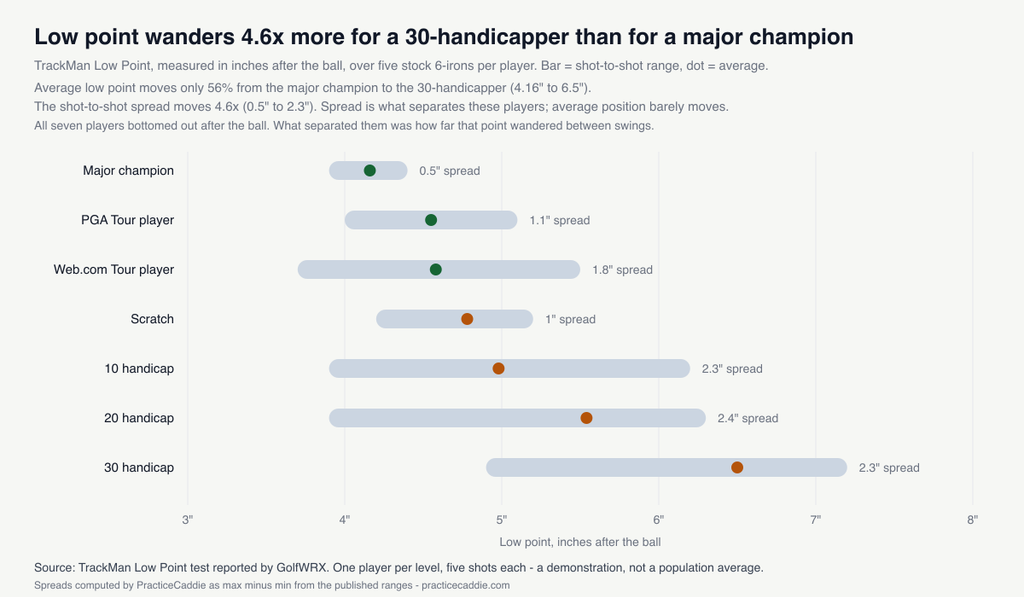
A TrackMan low-point test reported by GolfWRX put one player at each level through five stock 6-irons. The published ranges:
| Player | Low point range (after the ball) | Average | Spread |
|---|---|---|---|
| Major champion | 3.9″ – 4.4″ | 4.16″ | 0.5″ |
| PGA Tour player | 4.0″ – 5.1″ | 4.55″ | 1.1″ |
| Web.com Tour player | 3.7″ – 5.5″ | 4.58″ | 1.8″ |
| Scratch | 4.2″ – 5.2″ | 4.78″ | 1.0″ |
| 10 handicap | 3.9″ – 6.2″ | 4.98″ | 2.3″ |
| 20 handicap | 3.9″ – 6.3″ | 5.54″ | 2.4″ |
| 30 handicap | 4.9″ – 7.2″ | 6.50″ | 2.3″ |
Every player in the test bottomed out after the ball. Average low point climbs only 56% across the whole span, from 4.16″ to 6.50″. The shot-to-shot spread climbs 4.6×, from half an inch to nearly two and a half.
Two caveats before anyone treats this as gospel. It is one player per level hitting five shots — a demonstration, not a population study, and the author said as much. And the spread column above is computed as max minus min from the published ranges, because the source’s scratch row prints a two-inch spread its own 4.2″–5.2″ range does not support.
The practical consequence stands regardless of sample size. Judge your divots by how tightly their start points cluster. Position matters far less than repeatability. Five divots all starting a half-inch past the line is a better result than five averaging the perfect position while ranging from two inches behind to three inches ahead. That is also why the five-ball protocol below reads a set, never a single swing.
Reading divot direction (and why it isn’t club path)
For a right-hander, a divot angled left of target means the club was traveling leftward through the turf. Angled right means it was traveling rightward. That part is plain geometry.
The trap is equating that with club path. TrackMan defines club path as “the direction the club head is moving (right or left) at impact,” measured at impact — and treats swing direction as a separate parameter. Your divot forms around the bottom of the arc, which on a descending iron strike happens after impact. On a steep enough delivery, the club can be moving slightly right at impact and still carve a divot that points left.
The ball settles the argument. Face angle dominates start direction: Titleist reports that “TrackMan® data shows that with iron shots, face angle accounts for approximately 75% of the initial launch direction, while club path accounts for the remaining 25%,” and puts the driver ratio at 85/15. An official TrackMan University video gives about 75% for an iron and about 80% for a driver, so treat the exact split as loft-dependent rather than a constant.
The working order is therefore: read the ball’s start line as face evidence, its curve as face-to-path evidence, and the divot as supporting evidence about swing direction. The ball flight laws guide covers that hierarchy in full, and what your launch monitor numbers mean covers the parameters underneath it.
How deep should a golf divot be?
A healthy iron divot is shallow, even, and takes more grass than soil. Andrew Rice describes the target as an optimal depth that is “shallow,” with “very little digging into the dirt,” and adds that “the inside and outside edges should ideally be of similar depth.” GOLF’s summary of his guidance puts a useful length range on it: “Something between 4-6 inches is good barometer to follow.”
Depth guidelines are softer than golfers want them to be. A club professional’s rule of thumb puts the ideal at “no more than ½ an inch to an inch deep,” and calls anything past an inch a sign the club is arriving too steep. That is a teaching guideline, not a validated measurement, and no biomechanics or launch-monitor dataset converts a given attack angle into a given divot depth in inches.
Attack angle measures a different quantity than depth. TrackMan’s tour averages put the PGA Tour 6-iron at −3.7° and the driver at −0.9°; on the LPGA Tour the 6-iron averages −2.3° and the driver +2.8°. Its Combine data for male amateurs shows driver attack angle sliding from −0.9° at scratch to −1.8° for the average 14.5-handicap golfer and −2.1° for a bogey golfer. Those numbers describe how much the club is descending, not how far below the surface it travels.
Adam Young’s technical paper on attack angle and loft makes the decoupling explicit: “a deep divot is not a signifier of a steep angle of attack.” The paper lists what steepens delivery — ball farther back, weight more forward at impact, a later release with more shaft lean, and a more leftward swing direction. Two more variables sit outside the swing entirely. Turf firmness moves the result, as Rice notes that “the depth of a divot is highly dependent on turf conditions,” and a clubfitter’s breakdown of sole design adds that “the amount of sole bounce is a major factor.”
So a repeatedly deep, abrupt divot is evidence that too much of your arc entered the ground. It does not name the cause, and on soft turf it may overstate even that. Work down the list — ball position, shaft lean, body level through impact, then club bounce — instead of assuming one. The compression guide covers the shaft-lean half of that list in detail.
Toe-deep versus heel-deep: what the divot says about lie angle
A divot that consistently cuts deeper on one side is the clearest equipment signal a divot can send. Golf Digest states the pattern plainly: “Too flat, and the toe digs, producing toe-deep divots and pushes to the right,” while “a lie angle that’s too upright causes the heel to strike the ground first, creating heel-deep divots, closing the face and sending shots left of target.”
The mechanism is face direction. Titleist explains that “if the toe is higher than the heel at impact, the upright lie angle will naturally cause the shot to fly left. If the heel is higher than the toe (flat lie angle), the shot will fly right.” A tilted clubface aims its grooves sideways even when the face looks square from behind. Our loft and lie explainer works through the geometry.
Confirm before you bend anything. PING’s fitting process uses an impact board with sole tape — “when the club hits the board, it will leave a mark on the tape” — to read delivered lie rather than static lie. Titleist’s alternative uses a vertical ink line transferred from ball to face: perpendicular to the scorelines means the lie is correct, tilting toward the toe means too upright, tilting toward the heel means too flat.
One number gets quoted constantly here and deserves a caution. A PING retailer’s fitting guide offers the rule of thumb that “every degree your lie angle is off can send shots about four yards off your intended target line.” That guide names no club and no distance, and the actual error grows with loft, so treat it as directional rather than as a PING specification.
Delivery can also fake a lie problem. Posture, distance from the ball, and how you release the club all tilt the shaft at impact. A toe-deep pattern is a reason to book a dynamic fitting. Bending a set on divot evidence alone skips the measurement that sets the number.
What a divot cannot tell you
Some questions the ground never answers, and knowing which is what keeps this from becoming a superstition:
- Face angle. Nothing in the turf records where the face pointed. Only ball flight does.
- Exact club path. The divot forms around low point; path is measured at impact.
- Strike location on the face. A toe strike and a center strike cut identical divots. Foot spray on the face answers this in one shot.
- Whether a fat shot cost you a stroke. No published Arccos, Shot Scope, or Broadie dataset isolates fat contact and reports a standard yardage or strokes-gained penalty, because shot trackers record where a ball started and finished, not how it was struck. The cost of any single fat shot is whatever its finishing position was worth.
- How much your contact costs overall. That answer lives in outcome data. Shot Scope’s greens-hit study shows greens in regulation falling from 62% at scratch to 35% at a 10 handicap and 16% at a 20 — a scale of miss that strike quality contributes to without being separable from it. Our greens in regulation explainer breaks that down.
Anyone selling a one-to-one translation from divot to swing fault is over-claiming. The divot narrows the list of candidates; ball flight and a launch monitor pick from it.
The five-ball line test
This is the practice protocol that turns divots from decoration into data. It comes from GOLF Top 100 teacher Tim Cusick, whose white-line drill asks you to draw a line perpendicular to the target line and hit a series of balls from it: “Through the course of this exercise, divots appear, and a pattern begins to develop.” What he wants to see: “The ideal location of the divots should start on the white line and move forward toward the target. The divots should be relatively square with the same shallow depth from start to finish.”
- Draw a reference line. Chalk, removable spray paint, or an alignment stick pressed into the turf, perpendicular to your target line. On a mat, use a strike board or foot spray. Without the line, you are estimating start point from memory.
- Place five balls on the line and hit all five with the same club — a 7-iron or 8-iron. Change nothing between shots. You want your tendency, not your best swing.
- Read the start point first. On the target side of the line means ball-first. Behind the line means ground-first. This is the most reliable read a divot offers, so take it before any other.
- Then read direction, depth, and heel-to-toe balance, and photograph the set from directly behind the line. The pattern across five divots outranks any single divot.
- Change one variable and hit five more off a fresh line. Ball position, or lead-side pressure, or the intent to brush the turf a few inches past the line. One variable, or the next five divots cannot tell you which change worked.
- Confirm against ball flight before concluding anything. If the divots point left but the ball starts right and draws, believe the ball.
A second GOLF article runs the same idea as a five-ball “crime scene”: examine whether the marks start in front or behind and point left or right, adjust, then hit five more.
Why an external target beats a swing thought here
The reason this drill works is worth stating, because it is one of the better-supported findings in motor learning. Gabriele Wulf’s 1999 golf study had 22 novices hit 80 practice pitch shots — one group focused on their arm swing, the other on the club’s swing — then tested them again a day later over 30 trials. The external-focus group performed better during practice and on the retention test.
The finding has held up. A 2023 study on golf skill learning found that “skill learning was enhanced by instructions that promoted external foci, as measured by golf shot accuracy on delayed retention and transfer tests,” and Wulf’s own review of the literature reports the effect as consistent across tasks and skill levels.
“Brush the turf starting on the line” is an external cue. “Shift your weight forward and keep your left wrist flat” is an internal one. No published experiment has tested divot-focus specifically against a body cue, so treat it as an application of the principle rather than a measured result. The cue sits in the same category the research tested. It also pairs naturally with random practice, where the reference line stays fixed while the club and target rotate.
Divot patterns at the range and on the course
The pattern that helps the golf course
Where you place each next ball changes how much turf the practice tee loses. The USGA’s guidance is to work in a line, placing each ball just behind the previous divot so part of the next swing enters the existing scar: “This can usually be done for 15 to 20 shots before moving sideways to create a new line of divots.” Leave room between strips — “so long as a minimum of 4 inches of live turf is preserved between strips of divots, the turf will recover quickly.”
The arithmetic favors it. The USGA measured a normal iron divot at 3 inches wide by 6.5 inches long, or 19.5 square inches. With balls placed directly behind the preceding divot, subsequent marks averaged 3 inches by 3 inches — about 9 square inches, under half as much turf per swing.
A 2024 controlled study complicates the picture without overturning it. Researchers found scattered divots reached 50% recovery in 19 days against 27 days for linear ones, because scattered scars have living grass on every edge. By day 54 the scattered plots had fully recovered while linear plots sat at 95%. The researchers still concluded linear was the best overall option, since scattered practice damages far more usable teeing area to get there.
Recovery time is species-dependent, which is why no single number applies. The USGA notes perennial ryegrass “can sprout from seed in less than a week during ideal conditions,” creeping bentgrass “germinates in around two weeks,” and Kentucky bluegrass “can take up to a month.” One measured bentgrass practice tee took more than 30 days to reach 50% recovery.
Repairing divots on the fairway
The USGA’s rule is short. If the divot is intact with soil attached, “simply replace it in the correct orientation and firmly press the divot into the ground with your foot.” If it has shattered or carries no soil, it “cannot be replaced and expected to heal properly” — use the course’s divot mix, adding it “until it is slightly below the height of the adjacent turf, then smooth the mix and press down with your foot.”
Whether that mix contains seed depends on the grass. The USGA notes you “won’t see seed in the divot mix on a course with bermudagrass or zoysiagrass tees or fairways,” because warm-season grasses spread laterally to close the gap. Our etiquette and pace-of-play guide covers the rest of the course-care basics.
Turn one session of divots into a plan
Reading a divot is a five-minute skill. Building the practice that changes the pattern takes a structure, and that is what PracticeCaddie does: it converts what you find on the line into a session with a measurable outcome, then tracks whether the start points tighten over the following weeks. Start with the free plan — free forever, no credit card. AI-generated plans that bias toward your specific leaks are part of Pro, which includes a 3-day free trial.
If you would rather build the session yourself, the driving range practice plan has the block structure, and the ball-striking drill catalog has the contact drills to slot into it.
Related reading
- How to Grip a Golf Club — the setup pillar these fault-fix guides all branch from. Grip strength and hand position change delivered face angle before anything else does.
- How to Stop Hitting Fat Shots — the fix protocol for divots that keep starting behind the line.
- How to Stop Topping the Golf Ball — the opposite failure, when the low point arrives too early and there is no divot at all.
- How to Compress the Golf Ball — shaft lean and low point, the two mechanics that put the divot where it belongs.
- Golf Ball Flight Laws Explained — why the ball’s start line outranks your divot’s direction as evidence.
- Loft and Lie Explained — the geometry behind toe-deep and heel-deep divots.
- Golf Ball Position — the first variable to change when start points sit behind the line.
- Driving Range Practice Routine — where the five-ball line test fits into a full session.
Key takeaways
- Start point is the most reliable read. A divot beginning on the target side of the ball means ball-first contact; one beginning behind it means ground-first. Everything else a divot shows is softer evidence.
- The deepest point sits about 3 inches forward of where the ball met the ground, per Andrew Rice — which is not where the divot begins. Confusing the two turns “hit down on it” into a thin shot.
- Consistency beats position. In TrackMan’s low-point test, average low point varied only 56% between a major champion and a 30-handicapper, while shot-to-shot spread varied 4.6× — from 0.5″ to 2.3″.
- Divot direction is swing direction, not club path. Club path is measured at impact; the divot forms around low point, which comes later. Face angle drives roughly 75% of an iron’s start direction, so the ball settles the question.
- Depth is confounded. Attack angle, ball position, shaft lean, turf firmness, and sole bounce all move it, and no dataset converts degrees of attack angle into inches of depth. PGA Tour 6-irons average −3.7°.
- Toe-deep or heel-deep is a fitting signal, not a verdict. Confirm with an impact board or face tape before bending clubs, because posture and release fake the same pattern.
- Read five divots off a line, never one. A reference line plus five balls plus one changed variable is the whole protocol.
- Work in strips on the practice tee. Placing each ball behind the last divot cuts turf loss from about 19.5 square inches per swing to about 9, and the USGA asks for 4 inches of live turf between strips.
Frequently asked questions
What is a divot in golf?
A divot is the strip of turf a club removes when the clubhead continues downward and forward through the ground after striking the ball. It happens on iron and wedge shots because the ball sits on the ground and the club must reach its low point past the ball to strike it cleanly first. The mark it leaves is physical evidence of where your swing arc entered the ground, which direction it was traveling through the turf, and how far below the surface it reached. Reading it is free feedback available on every full shot.
Where should your divot start?
The divot should begin at or just past the target side of the ball, meaning the club strikes the ball first and the turf second. The deepest part of the cut sits farther forward still. Andrew Rice puts the deepest point roughly three inches ahead of where the ball met the ground. A divot that begins behind the ball’s position is ground-first contact, the definition of a fat shot. Do not chase a divot that starts several inches in front of the ball, because that pattern describes a thin strike, not a good one.
What does it mean if my divot points left?
For a right-handed golfer, a divot angled left of the target means the club was traveling leftward through the turf. That is evidence about swing direction rather than proof of club path at impact, because the club is still moving downward when it meets the ball and only turns leftward closer to the low point. TrackMan measures club path at impact and treats swing direction as a separate number. A steeply descending strike can leave a divot pointing well left while the actual path at impact was slightly right, so confirm with the ball’s start line and curve.
How deep should a golf divot be?
A healthy iron divot is shallow and even, taking mostly grass rather than soil, with the heel and toe sides cutting to a similar depth. Teaching guidelines commonly put it around half an inch to an inch deep and four to six inches long, though no biomechanics study validates a specific number. Depth also depends on turf firmness, moisture, and how much bounce your club’s sole carries, so the same delivery cuts differently on soft turf than on baked fairway. Judge depth by how repeatable it is across five shots rather than by a target measurement.
What does a toe-deep divot mean?
A divot consistently deeper on the toe side suggests the club is delivered too flat for you, with the toe reaching the turf first. Golf Digest links that pattern to shots pushed right for a right-hander, because a heel-high delivery points the effective face rightward. A heel-deep divot suggests the opposite, an upright delivery that closes the face and sends shots left. Both patterns can also come from posture, distance from the ball, or how the club is released, so confirm with a lie board or impact tape before bending any clubs.
Should you take a divot with every club?
No. Irons and wedges should produce a divot because the ball sits on the ground and the club must still be descending at impact. TrackMan’s tour averages show PGA Tour players hitting down 3.7 degrees with a 6-iron. A teed driver sits at the other end of that range, with PGA Tour players averaging only 0.9 degrees down and LPGA players 2.8 degrees up, so a driver divot signals a delivery far steeper than either and costs launch and carry. Fairway woods and hybrids fall between, brushing the turf rather than cutting a strip from it.
How do you read your divot pattern at the range?
Draw a chalk line perpendicular to your target line, place five balls on it, and hit all five with the same club without adjusting. Then read the set as a group: where each divot begins relative to the line, which way it points, how deep it runs, and whether the toe or heel side cuts deeper. GOLF Top 100 teacher Tim Cusick’s version wants divots starting on the line and moving toward the target at a consistent shallow depth. Photograph the pattern from behind, change one variable, and hit five more.