
Golf Etiquette and Pace of Play: What Ready Golf Actually Saves
The R&A's own manual calls player behaviour a minor cause of slow rounds. The 5 seconds a shot that still saves 26 minutes, and the etiquette behind it.
Quick answer
Etiquette is Rule 1.2: integrity, consideration for others, care of the course. On pace, The R&A’s own manual says player behaviour is relatively insignificant next to overcrowding and course set-up. Your controllable share is still real: 5 seconds saved per shot across a four-ball is 26 minutes 40 seconds a round. Ready golf is permitted by the Exception to Rule 6.4b, and Rule 5.6b recommends 40 seconds per stroke.
What each pace lever is worth, and who owns it
| Lever | Who controls it | What the source says it is worth | Reference |
|---|---|---|---|
| Starting interval | The club | 8 to 12 minutes depending on group size; too short and every group waits 1–2 minutes | R&A Pace of Play Manual §2.2 |
| Tee options for the field | The club | Kingsbarns cut play from its 6,800-yard tees from 50% to 15% by adding intermediate tees | R&A Manual §3 |
| Green speed and firmness | Superintendent | The R&A targets a maximum of 10½ feet on the stimpmeter at The Open | R&A Manual §3 |
| Rough height and ball loss | Superintendent | Named as a direct source of lost time; no minute figure published | R&A Manual §3 |
| Being ready when it’s your turn | You | 5 seconds a shot across a four-ball is 26 min 40 sec a round | R&A Manual §4 |
| Playing a provisional | You | Removes the walk back after a 3-minute search under Rule 18.3 | Rule 18.3 |
| Format of play | Your group | Match play is faster than four-ball stroke play | R&A Manual §4 |
Two of those seven sit with the player. The rest belong to whoever sets the tee sheet and mows the rough.
Slow play is golf’s most-cited complaint, and mostly not the player’s doing
When The R&A ran its global pace of play survey between September 2014 and March 2015, more than 56,000 golfers in 122 countries answered. The headline was a contradiction: 70% said they were largely happy with how long their rounds took, and 60% said they would enjoy the game more if it took less time. Time ranked third among the barriers to playing more, at 16%, behind work at 34% and family at 29%.
Recent U.S. numbers put the average round at four hours and change. The best-documented dataset is the Three45 GPS study hosted by the USGA, which covered 40,460 rounds at 175 courses and found an average of 4 hours 17 minutes, with morning rounds at 4:02 and afternoons at 4:21. Only 28.5% of those rounds finished inside four hours. A 2025 USGA article on pace-of-play pain points describes newer research showing 4:30 as a high-water mark, while also quoting 4:17, so the honest read is a band rather than a single figure.
The same USGA piece makes a point worth more than the averages: what golfers experience as slow play is the waiting between shots, not the number on the clock at the end. A group that goes round in 4:15 without stopping is happy. A group that takes the identical 4:15 while standing on every tee is not.
Etiquette lives in Rule 1.2, and it is short
Golf spent decades with etiquette in a separate section of the rulebook, treated as advice. The 2019 modernization folded it into Rule 1.2, Standards of Player Conduct, which now sits ahead of almost everything else. Rule 1.2a names three obligations.
Act with integrity. Follow the Rules, apply all penalties to yourself, and be honest about what happened. Golf is the only major sport where the competitor calls their own fouls, and the rulebook puts that first.
Show consideration for others. Play at a prompt pace, look out for everyone’s safety, and avoid distracting another player. The Rule specifically names shouting “fore” as the traditional safety warning.
Take care of the course. Replace divots, smooth bunkers, repair ball-marks, and avoid causing unnecessary damage.
There is normally no penalty for falling short of any of it. The teeth are elsewhere: a committee may disqualify a player for serious misconduct, and under Rule 1.2b a committee may adopt its own Code of Conduct as a Local Rule with one-stroke or general penalties attached. Most etiquette breaches are enforced by the people you are playing with, which is exactly how the Rule intends it.
Overcrowding beats bad manners as a cause
The R&A’s Pace of Play Manual ranks the causes, and puts player behaviour last. Its own words:
Individual players can, of course, have a negative effect on pace of play, but that effect may be relatively insignificant when compared to the impact that poor management practices and ill-considered course set up can have.
The management chapter names overcrowding as the most common cause of longer than necessary rounds, and gives a rule for avoiding it: a starting interval must never be shorter than the time it takes to play the quickest hole on the course. The recommended minimums are 8 minutes for two-balls, 10 for three-balls, and 11 or 12 for four-balls.
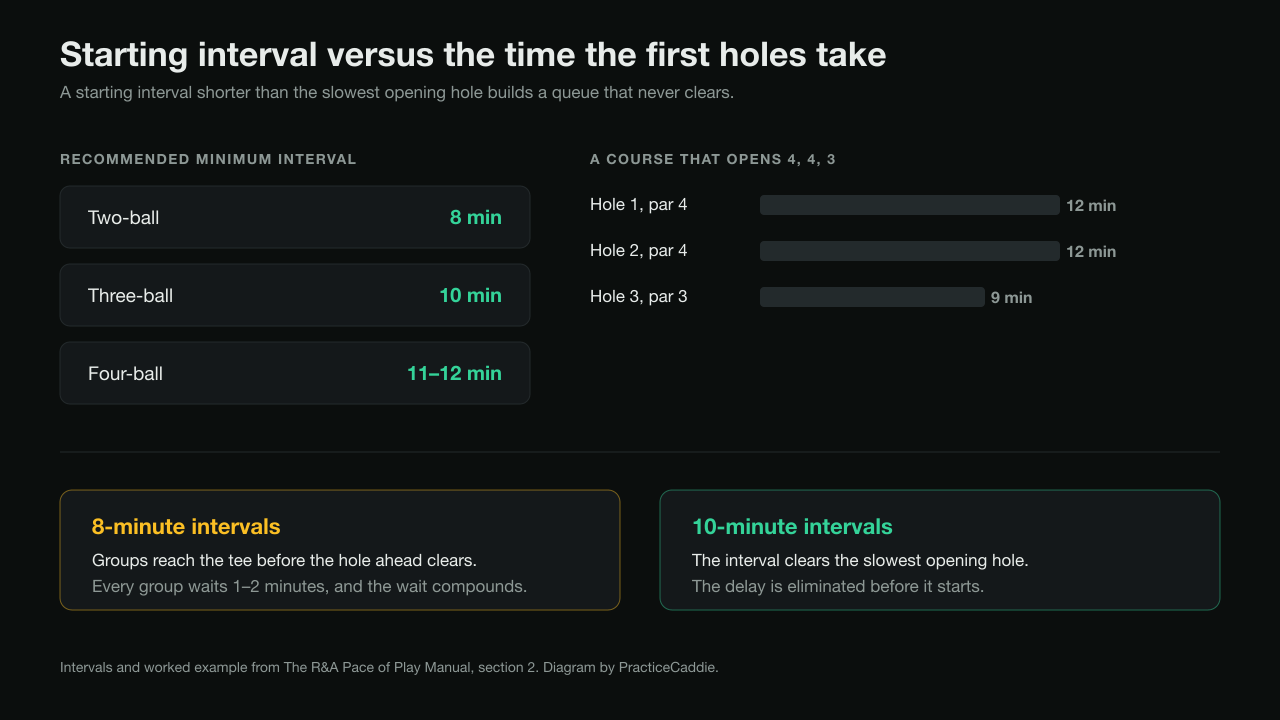
The worked example in the diagram is the manual’s own. On a course whose first two holes take 12 minutes each and whose third takes 9, eight-minute intervals hand every group a one to two minute wait that compounds through the morning. Ten-minute intervals remove it before it starts.
Course set-up carries the rest. The golf course chapter points at rough that turns stray shots into three-minute searches, and at green speeds beyond what a membership can handle — The R&A’s own maximum target at The Open is 10½ feet on the stimpmeter, which is slower than plenty of club members demand of their greens. It also notes that around half of all strokes in a round are played on or around the putting green, which is where the seconds live. Tee options matter as much: after Kingsbarns added intermediate tees, the share of groups playing the 6,800-yard set fell from 50% to 15%.
None of that is an excuse to dawdle. It does mean that a group being harangued about pace on a course running eight-minute intervals is being asked to fix someone else’s arithmetic.
Ready golf: what Rule 6.4b actually permits
Ready golf means playing when you are ready rather than strictly in order of distance from the hole. Since 2019 it has been written into the Rules: the Exception to Rule 6.4b permits players in stroke play to play out of turn in a safe and responsible way, and both governing bodies encourage it. No agreement is required and no penalty applies. In match play the order still stands, though Rule 6.4a lets an opponent invite you to play out of turn.
In practice it comes down to a handful of habits:
- Hit when you’re ready and safe, regardless of who is away, once you have checked that nobody is in front of you.
- Short hitters tee off first when the longer players are waiting on the group ahead to clear.
- Walk to your ball as a group breaks up, rather than following each other from shot to shot.
- Putt continuously when the ball is close and you are not standing in anybody’s line — hole the two-footer rather than marking it and waiting for your turn.
- Read your putt while others are putting, which is where most of the green-side time goes given that half of all strokes happen there.
- Park the bag or cart toward the next tee, so leaving the green is one movement rather than three.
- Mark your card on the next tee, not on the green you just left.
The one thing ready golf does not license is playing while a group is within range ahead of you. Safety outranks pace in Rule 1.2a and in common sense.
The 40-second recommendation, and the penalty that does exist
Rule 5.6b recommends making the stroke in no more than 40 seconds after you are, or should be, able to play without interference or distraction — and usually more quickly than that. Read the trigger carefully. The clock starts once you are able to play, which means all the yardage, club and wind work is expected to have happened before it starts running.
The 40 seconds carries no penalty on its own. Rule 5.6a does: unreasonably delaying play costs one penalty stroke for a first breach, the general penalty for a second, and disqualification for a third. Rule 5.6b(3) then encourages committees to adopt a pace of play policy as a Local Rule with its own time limits and penalties, which is what tournament golf runs on.
For most golfers the 40 seconds works better as a diagnostic than a deadline. A repeatable pre-shot routine makes 40 seconds feel generous; an undecided one makes it feel impossible. Our analysis of RSM Player Performance Study data on 22,579 European Tour shots found that consistency of time over the ball, rather than its duration, was what tracked with outcomes.
The five-second audit
One number in this subject belongs entirely to you, and the R&A’s own player behaviour chapter does the arithmetic. Four players. Roughly 80 shots each. Save five seconds per shot and the round is 26 minutes and 40 seconds shorter.
The unit is what makes it useful. One second per shot across a four-ball is 5 minutes 20 seconds. The formula is your saving in seconds, times 320, divided by 60. Nothing in that calculation requires anyone to hurry a swing; it requires four people to be a few seconds further along in their preparation when their turn arrives.
The manual asks players to time, and if possible film, their own routine from reaching the ball to impact. That measurement is the whole audit, and PracticeCaddie’s protocol for turning it into a round figure is four steps:
- Time ball-to-impact for one full round. Every full shot, 18 holes, written in the scorecard margin. Most golfers guess this number low by a factor of two.
- Find your median and your slowest quarter. The slowest quarter is the target, and it clusters in three places every time: an awkward yardage you have not committed to, the shot after a bad one, and the first putt on a green you did not read while walking up.
- Multiply your realistic saving by 320 and divide by 60. That is your group’s minutes, assuming three partners who do the same. The point is that habits scale and heroics do not.
- Take the seconds from the walk, never the stroke. Yardage, club, wind, read, glove, bag pointed at the next tee — all of it while somebody else is playing.
Two rounds of this tells you more about your own pace than a decade of being told to hurry up. It also tends to improve scoring, because the three situations where the audit finds time are the same three where indecision costs shots.
Care of the course: divots, bunkers, ball-marks
Rule 1.2a names three, and each has a technique worth getting right.
Divots. Replace the turf if it came out in one piece and press it down with your foot. If the course provides a sand and seed mix, fill the scar instead — many courses now prefer this on certain grasses, which is why the bottles are on the cart.
Bunkers. Enter from the low side at the point nearest your ball, never down a steep face. Rake your own marks and every footprint within reach on your way out, walking backward toward your entry point. Leave the rake where your club’s policy says. The greenside technique itself matters here too, since a clean splash displaces far less sand than three attempts.
Ball-marks. Push the turf from the edges toward the centre of the depression with a repair tool, then tap it flat with the putter sole. Lifting from underneath tears the roots and leaves a brown patch for weeks. Repair yours and one more, which is the convention that keeps a green ahead of the damage.
Safety, silence, and the putting green
Consideration for others is the vaguest of the three headings in Rule 1.2a, so it is worth making concrete.
- Shout “fore” immediately and loudly if your ball is heading anywhere near a person. Rule 1.2a names it. Waiting to see whether it lands near them defeats the purpose.
- Stand still and stay quiet while somebody plays, out of their peripheral vision and off the direct line behind them.
- Watch your shadow on the green. A shadow across the line of a putt is a distraction the player can see and you cannot.
- Never walk on another player’s line between their ball and the hole, including the extension past the hole.
- Leave the flagstick in when it helps. Since 2019 you may putt with it in the hole without penalty, and taking it out and replacing it on every green is pure lost time.
- Phones on silent, and take a call away from the group if you must take one.
- Repair, then leave. Clear the green before marking cards, which is the single most common bottleneck on a busy course.
When it isn’t your group’s fault
Pace pressure gets applied to the wrong people constantly, so a short decision list helps.
Wave the group behind through when you have lost a hole on the group in front and are searching for a ball, or when your group is genuinely two or more players slower than the field. It is a courtesy, and it costs you a few minutes at most.
Keep playing when you are in position — meaning the hole in front of you is clear when you arrive at your ball. Position on the course ahead of you is the only fair measure of whether your group is holding anybody up. A group that waits on every shot behind a full course is queued, and closing a gap that does not exist just moves the queue.
Say something to the pro shop, not the group in front, when the tee sheet is the problem. Eight-minute intervals on a course with 12-minute opening holes are a management decision, and the manual’s own worked example is the argument to make.
Play a provisional whenever the ball might be lost or out of bounds. Rule 18.3 costs nothing unless it comes into play, and it removes the three-minute search plus the walk back that follows. The full set of rulings that arrive every round, and what each one costs, sits in golf rules for beginners.
Build the habit somewhere other than the first tee
Every readiness habit above is a decision made in advance, which makes it a practice problem rather than a manners problem. Knowing your carry distances removes the club dithering. A committed pre-shot routine removes the second guess over the ball. A green-reading process done on the walk up removes the standing around. Sound course-management decisions keep you out of the rough where three-minute searches happen.
PracticeCaddie builds sessions around the leak your own scoring record shows, which is where the awkward yardages and the shots-after-bad-shots surface. Build a free practice plan in 30 seconds and the five-second audit becomes a line on the calendar rather than a good intention.
Related reading
- Strokes Gained Explained for Amateurs — the framework that tells you which part of your game is actually costing shots, so practice time goes where the strokes are.
- Golf Rules for Beginners — the 12 rulings that arrive every round, what each costs, and the four questions that resolve them. The rules companion to this post’s etiquette.
- The Golf Mental Game — the pressure and routine pillar; pace and composure share a mechanism.
- Golf Course Management Tips — the decision layer that keeps you out of the lies that eat time.
- Golf Pre-Shot Routine — the 40-second habit that satisfies Rule 5.6b and steadies the shot at the same time.
- How to Read Greens in Golf — the read done on the walk up, which is where half your round’s strokes are played.
- Golf Handicap Explained — what your scoring record is telling you, and how to read the spread.
- Golf Practice Plan — the weekly structure that has room for the habits above.
Key takeaways
- Etiquette is Rule 1.2a, three headings: integrity, consideration for others, care of the course. No penalty normally, but a committee may disqualify for serious misconduct.
- The R&A ranks player behaviour behind management and course set-up as a cause of slow play, calling its effect “relatively insignificant” by comparison.
- Overcrowding is the most common cause of long rounds; recommended starting intervals are 8 minutes for two-balls, 10 for three-balls, 11 to 12 for four-balls.
- 5 seconds saved per shot across a four-ball is 26 minutes 40 seconds a round, on the R&A’s own arithmetic of four players and 80 shots each.
- Ready golf is written into the Rules by the Exception to Rule 6.4b for stroke play, safety permitting, with no agreement needed.
- Rule 5.6b recommends 40 seconds per stroke and carries no penalty; Rule 5.6a does, at one stroke, then the general penalty, then disqualification.
- The average round runs 4:17 to 4:30, with only 28.5% of the 40,460 rounds in the Three45 study finishing inside four hours.
- Half of all strokes are played on or around the green, which is where readiness habits pay the most.
Frequently asked questions
What is ready golf and is it allowed in the rules?
Ready golf means playing when you are ready rather than strictly in order of who is farthest from the hole. It is expressly permitted in stroke play by the Exception to Rule 6.4b, provided it is done in a safe and responsible way, and the R&A and USGA both encourage it. In match play the order of play still stands, though under Rule 6.4a an opponent may invite you to play out of turn or agree to your request. Ready golf carries no penalty and needs no agreement in stroke play.
How long should 18 holes of golf take?
The best-documented U.S. dataset is the Three45 GPS study hosted by the USGA, covering 40,460 rounds at 175 courses, which found an average round of 4 hours 17 minutes. Morning rounds averaged 4:02 and afternoon rounds 4:21. Only 28.5% finished inside four hours and 10.4% took more than five. A 2025 USGA article describes newer research putting the average at 4:30, so treat four to four and a half hours as the realistic band for a walking four-ball.
What is the 40-second rule in golf?
Rule 5.6b recommends that a player make the stroke in no more than 40 seconds after they are, or should be, able to play without interference or distraction, and usually more quickly than that. The 40 seconds is a recommendation and carries no penalty by itself. A penalty arrives either through Rule 5.6a for unreasonable delay, which costs one stroke for a first breach and the general penalty for a second, or through a committee’s own pace of play policy adopted as a Local Rule.
What are the main rules of golf etiquette?
Rule 1.2a of the Rules of Golf compresses etiquette into three headings. Act with integrity, meaning follow the Rules and apply penalties to yourself honestly. Show consideration for others, meaning play promptly, look after everyone’s safety, and avoid distracting another player. And take care of the course, meaning replace divots, smooth bunkers, repair ball-marks, and avoid unnecessary damage. There is normally no penalty for falling short, but a committee may disqualify a player for serious misconduct.
What actually causes slow play on a golf course?
The R&A Pace of Play Manual is direct about this: individual players can have a negative effect, but that effect may be relatively insignificant compared with poor management practices and ill-considered course set-up. Overcrowding is named as the most common cause of longer than necessary rounds, driven by starting intervals shorter than the time it takes to play the opening holes. Course factors follow, including rough that swallows balls, green speeds beyond what members can handle, and tee options that put players on yardages they cannot reach.
Can you be penalised for slow play in golf?
Yes, though rarely in casual golf. Rule 5.6a prohibits unreasonably delaying play: one penalty stroke for a first breach, the general penalty for a second, and disqualification for a third. Separately, Rule 5.6b(3) encourages committees to adopt a pace of play policy as a Local Rule, setting time limits and penalties that can range from a warning to a stroke penalty. The 40-second recommendation in Rule 5.6b itself carries no penalty; it exists to define what prompt looks like.
Does playing faster make you score worse?
Nothing in the pace guidance asks you to rush the stroke. Rule 5.6b’s 40-second clock starts only once you are able to play without interference, so every second reclaimed is meant to come from the walk: yardage, club selection, wind read, and green read done while others are playing. The RSM Player Performance Study data behind our pre-shot routine work found that consistency of time over the ball, rather than its length, predicted outcomes. A rushed stroke and a prepared one are different things.