Golf Loft and Lie Explained: What One Degree Actually Costs
One degree of lie error swings a sand wedge's face three times as far as a 5-iron's, and the four-yards-per-degree rule quoted everywhere fails the geometry.
Quick answer
Loft is how far the face leans back; lie angle is how the shaft sits relative to the ground. Loft controls distance and height. Lie controls starting direction — a sole that arrives toe-up points the face left, toe-down points it right. The size of that error scales with loft, so one degree of lie error moves a sand wedge’s face three times as far as a 5-iron’s. Check the wedges first.
Loft and lie at a glance
| Loft | Lie angle | |
|---|---|---|
| What it is | Angle the face leans back from vertical | Angle between shaft and ground with the sole flat |
| Mainly controls | Carry distance, launch, spin, descent angle | Starting direction |
| Typical range | 26–35° (7-iron) | 61–63° (irons), 63–64° (wedges) |
| Miss it and | Your gaps go ragged | Your start line drifts, worst in the short clubs |
| Rough exchange rate | 1° ≈ 3 yards of carry | 1° ≈ 0.45° of face aim (5-iron) to 1.43° (sand wedge) |
| Adjustable? | Yes, on most forged and many cast heads | Yes, same |
Club-by-club lie ranges come from GOLF’s Fully Equipped breakdown; the 7-iron loft range from Today’s Golfer’s strong-loft survey. The face-aim figures are computed below, from geometry rather than from a source.
Lie angle: the spec that decides where the ball starts
Lie angle is the angle between the shaft and the ground when the club sits in its normal playing position — GOLF’s own definition, and one worth reading twice, because the address position is the part that misleads people. The number stamped on the club describes a static club sitting on a static floor. What decides your shot is the lie the sole presents at impact, after the shaft has bent, your posture has changed, and your hands have arrived wherever they arrive.
When that sole is not flat at impact, the loft on the face stops pointing straight up and starts pointing sideways. GOLFTEC states the direction plainly: too upright and the face points left of target for a right-handed golfer; too flat and it points right. GOLF’s fitting piece adds the contact half — upright lies produce heel contact and leftward divots, flat lies produce toe contact and pushes.
Brand standards are not close enough to ignore. GOLF puts the spread between manufacturers at two or three degrees, which is larger than the correction most players ever ask for.
Why one degree costs a wedge three times what it costs a 5-iron
Loft is the multiplier. A flat face with no loft, tilted a degree, still points where it pointed. Add loft and the tilt starts steering.
The geometry is exact, and it is one line. Tilt a lofted plane and the direction it faces moves by:
face aim shift = arctan( tan(loft) × sin(lie error) )
At the small lie errors anyone plays with, that collapses to a rule you can do in your head: face aim shift ≈ lie error × tan(loft). The table below uses the full expression; the shortcut tracks it to within about 0.01° out to 3° of error, so use whichever you prefer.
Run every club in the bag through it. The lofts below are typical modern specs; the carry column is a reference set that exists only to turn the angle into yards, so substitute your own measured carries when you run this (the sourced benchmark tables by handicap are in the golf club distance chart). The yardage columns assume the ball starts where the face points and ignore curve, so read them as the minimum the error costs.
| Club | Loft | Carry | Face aim shift per 1° of lie error | Start-line miss per 1° | Miss at 3° of error |
|---|---|---|---|---|---|
| 5-iron | 24° | 165 yd | 0.45° | 1.3 yd | 3.8 yd |
| 7-iron | 30° | 145 yd | 0.58° | 1.5 yd | 4.4 yd |
| 9-iron | 38° | 120 yd | 0.78° | 1.6 yd | 4.9 yd |
| Pitching wedge | 44° | 105 yd | 0.97° | 1.8 yd | 5.3 yd |
| Gap wedge | 50° | 90 yd | 1.19° | 1.9 yd | 5.6 yd |
| Sand wedge | 55° | 75 yd | 1.43° | 1.9 yd | 5.6 yd |
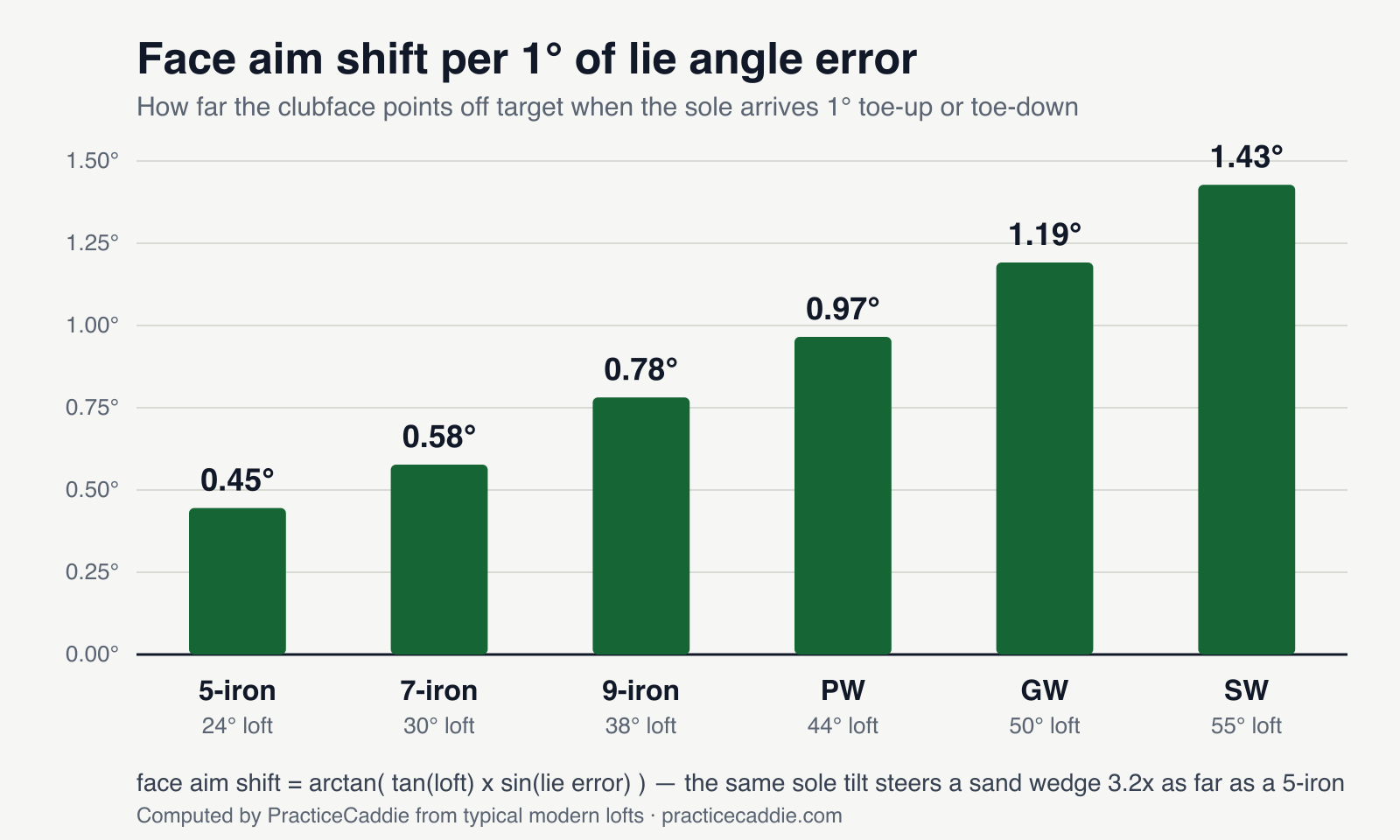
The table says two things, and the second matters more.
In yards, a degree of lie error is worth roughly the same everywhere: 1.3 yards in the 5-iron, 1.9 in the sand wedge. Wedges fly shorter, which cancels most of the angular penalty.
In shots, the wedge is far worse off, because of the size of the target. A 165-yard 5-iron is aimed at a green, and 3.8 yards of start-line drift still finds one. A 75-yard sand wedge is aimed at a flag, and 5.6 yards is 16.8 feet — outside any reasonable make radius, and outside the proximity band that decides whether you gain or lose strokes on approach. Same degree, very different bill.
The four-yards-per-degree rule does not survive the geometry
This figure appears on nearly every fitting page on the internet, usually with no source attached. Practical Golf’s version is representative: “for every degree that your lie angle is either too upright or flat, the ball will initially travel 4 yards off your intended target line.”
The word carrying the weight there is initially. Four yards of starting-direction miss takes about 1.5 degrees of face-aim shift at 150 yards, and 1.5 degrees per degree of lie error needs tan(loft) ≈ 1.5, which is roughly 56 degrees of loft. A club that lofted travels nowhere near 150 yards for the golfers this advice is written for. Shorten the shot to a wedge’s real range and the yardage shrinks with it, which is exactly what the table above shows: the geometric ceiling across the whole set is under 2 yards per degree.
So the figure describes total dispersion, and the word initially is the error. A tilted face is also open or closed relative to the swing path, which tilts the spin axis and curves the ball on top of the start-line miss — the model laid out in golf ball flight laws, and the reason face angle dominates start direction while the face-to-path gap does the curving (roughly 75% face on a mid-iron, per the TrackMan-derived figures the PGA Academy publishes). How much curve you get depends on your path and your speed, so no single yardage covers it. Treat the start line as the part lie angle owns outright, and the curve as a second charge on the same mistake whose size depends on your swing.
Loft: the number on the sole stopped meaning anything
Loft is the angle the clubface leans back from vertical, measured against the shaft. It sets how high and how far the ball goes, and it is the reason a 7-iron and a 9-iron fly different distances at the same swing speed. A 1990s 7-iron carried about 35 degrees of it.
Today’s Golfer’s survey puts the modern range at 26 to 35 degrees with an average of 29 to 30, and the extremes are both current models. A Titleist T400 7-iron is 26 degrees; a Titleist 620 MB 7-iron is 35. That 9-degree spread is more than two clubs, inside one brand, in the same season.
A golfer telling you he hits his 7-iron 155, then, has told you almost nothing.
What strong lofts buy
There is an engineering reason for the drift. Eric Hickman, a True Spec master club fitter, makes the case in GOLF: modern centres of gravity sit lower and further from the face than a 1990s blade’s, which launches the ball higher and spins it less at the same loft. Strong loft is the counterweight the design needed to keep flight under control.
Today’s Golfer’s testing shows how much room that leaves. A Ping G425 7-iron, at a comparatively weak 30 degrees, produced about 10 feet more peak height and a 4-degree steeper landing angle than the irons it was measured against — the trade the loft number is buying and selling in every set.
What strong lofts cost
Comparability, and gapping discipline. A 7-iron has become a marketing category, so measured carry is the only spec that travels between brands. MyGolfSpy’s gapping guidance gives the conversion that makes this actionable — roughly one degree of loft equals three yards of carry — which means most ragged gaps close with a bend instead of a purchase. The full method is in the golf club distance chart.
They also cost you spin, which is where a strong-lofted set stops working for slower swings. Less loft delivers less spin loft, and spin loft is the number that governs both spin rate and smash factor. Below a certain speed there is not enough spin left to hold the ball up, and the descent angle flattens until approach shots release through the back of the green. That is a fitting conversation, and it is the one place where the loft-jacking complaint has teeth.
How to check your own loft and lie
None of this needs a launch monitor to start.
The ball-line test
Draw a straight line down the back of a golf ball with a dry-erase marker and set the ball so that line stands vertical, facing the clubface. Hit the shot. The line transfers to the face, and its angle tells you what the sole did:
- Vertical mark — the sole arrived flat. The lie fits your delivery.
- Tilted toward the toe — the club is too upright for you. Expect pulls and heel contact.
- Tilted toward the heel — the club is too flat. Expect pushes and toe contact.
Two rules make it trustworthy. Hit off turf or a lie board, never a soft mat, because a mat lets the sole slide and erases the tilt. And read ten marks, not one — a single clean transfer describes one swing.
Run it with a wedge and a mid-iron. Per the table above, the wedge is where a real mismatch declares itself first.
Static fitting: the PING colour code
PING’s colour code chart is the oldest static system in the game and still the fastest starting point. Karsten Solheim built it around exactly two measurements — height and wrist-to-floor, taken in golf shoes — which plot to a colour code and a shaft length. Black is standard; the codes run progressively more upright in one direction and flatter in the other. Read the current chart from PING directly rather than a reprint, because the codes and their spacing have been revised over the chart’s fifty-year life.
Treat the code it gives you as a hypothesis. It knows your body and nothing about your delivery, which is why a tall player with flat shoulders and a tall player who stands up through impact get the same recommendation and need different clubs. PING publishes no accuracy figure for the chart, and neither the chart page nor the guides reprinting it quantify how often a static code matches a dynamically fitted one.
Dynamic fitting: what the launch monitor adds
A dynamic session measures the lie the club presents at impact, which is the only lie that hits the ball. Shaft droop, hand height, and how much you lose your posture through the strike all move it, which is why the fix for a tilted mark is sometimes a bend and sometimes a stance and posture change or a repair to early extension.
The honest sequencing: get the ball-line data yourself, then let a fitter tell you whether it is the club or the swing. Turning up with ten marked balls and a carry table changes that conversation completely.
What the fitting evidence actually says
The most-quoted number in club fitting is that 90% of US golfers may be playing clubs that do not fit them. It comes from a 2011 survey of nearly 6,000 avid golfers by the Sports & Leisure Research Group, commissioned by Golfsmith and the Sports Illustrated Golf Group.
Read that with the caveats attached. It is fifteen years old, it was commissioned by a retailer that sells fittings, it surveyed avid golfers rather than the general population, and the press release says may be rather than are. It never breaks the 90% down by spec, so it tells you nothing about how many of those mismatches were lie angle.
The adoption figures are better sourced and more interesting. GOLF reports that roughly a third of avid golfers have never been fitted, while 75% of Titleist’s direct iron sales now come through custom fitting. Both can be true, and together they describe the actual gap: fitting is standard at the buying end of the market and absent everywhere else.
The honest read for a mid-handicapper: a lie angle two or three degrees off is real and measurable, and it is still smaller than the shot-to-shot variation in where your club bottoms out. Fix the repeatable stuff first.
When bending is worth it, and when to skip it
Bending is among the cheapest interventions in golf — usually a few dollars per club, done in minutes, and reversible. PING alone will take irons as far as 5 degrees upright or 4 degrees flat.
Bend when:
- Ten ball-line marks tilt the same way with both a wedge and a mid-iron.
- Your miss pattern matches the tilt — consistent pulls with toe-side marks, consistent pushes with heel-side marks.
- You changed height, posture, or shaft length and the marks moved with it.
- Your carry gaps have a hole wider than 20 yards that a degree or two of loft would close.
Skip it when:
- Your strike location is still wandering between heel, centre and toe. Lie fitting a moving delivery fits a swing that will not exist next month.
- You are inside the first year of a swing change. Re-check after it settles.
- The marks disagree between clubs by more than a degree in opposite directions, which usually means the swing, not the set.
- Your heads are cast from a brittle alloy that a fitter declines to bend. Believe the fitter.
One more sequencing note. Bending lie also nudges loft slightly on most head designs, so ask for both numbers measured after the bend rather than assuming the sole stamp still applies. And if you play a set for years, re-check them — repeated ground contact and the occasional cart-path strike move real clubs off spec.
Key takeaways
- Lie angle owns your start line; loft owns your distance. Too upright points the face left for a right-handed golfer, too flat points it right.
- The penalty scales with loft, by the tangent of it. One degree of lie error shifts face aim 0.45° in a 24° 5-iron and 1.43° in a 55° sand wedge — more than three times as much.
- In yards the damage is flat, 1.3 to 1.9 per degree; target size is what converts it into shots. A 3° error puts a sand wedge 16.8 feet offline before the ball curves, on a shot aimed at a flag.
- The “4 yards per degree” rule is mislabelled. Geometry allows 1.3 to 1.9 yards of starting miss; the rest arrives as curve, sized by your own path and speed.
- A modern 7-iron runs 26° to 35° depending on model — a 9-degree, two-club spread against the 1990s standard of about 35°. Set your bag by measured carry.
- Stronger lofts are a counterweight to low modern centres of gravity, per True Spec’s Eric Hickman, and cost spin and descent angle at slower swing speeds.
- Test it yourself in five minutes. A dry-erase line down the back of the ball, ten shots off turf, a wedge and a mid-iron.
- The 90%-of-golfers-play-wrong-clubs stat is a 2011 retailer-commissioned survey that says “may be” and never breaks the figure down by spec. Directional at best.
Frequently asked questions
What is lie angle in golf?
Lie angle is the angle between the shaft and the ground when the sole of the club sits flat at address. Irons generally run 61 to 63 degrees and wedges 63 to 64, though standards vary by two or three degrees between brands. The lie that decides the shot is the one at impact: a sole that arrives toe-up points the face left of target for a right-handed golfer, and a sole that arrives toe-down points it right.
How many yards offline does one degree of lie angle cost?
Far less than the four yards quoted across fitting blogs, at least in starting direction. The face-aim shift equals the lie error multiplied by the tangent of the club’s loft, which works out to 0.45 degrees on a 24-degree 5-iron and 1.43 degrees on a 55-degree sand wedge. Carried out to normal distances that is 1.3 yards and 1.9 yards of start-line miss respectively. Larger figures include the curve that follows, since a tilted face is also open or closed to the swing path, and how much curve you get depends on your path and your speed.
Does lie angle matter more in wedges or long irons?
Wedges, by a factor of about three. Loft is what converts a tilted sole into a sideways-pointing face, so the same one-degree error moves a 55-degree sand wedge’s face 1.43 degrees and a 24-degree 5-iron’s only 0.45. The absolute yardage is similar because wedges fly shorter, but you aim a wedge at a flag and a 5-iron at a green. Measured against target size, the wedge is where a lie error costs you shots.
Are modern irons loft jacked?
Lofts are stronger, and the label is unfair. A 1990s 7-iron sat around 35 degrees and modern 7-irons run from 26 to 35 depending on category, with 29 to 30 as the average. True Spec master fitter Eric Hickman points out that modern centres of gravity sit lower and further from the face, which launches the ball higher, and stronger loft offsets that. The real cost is comparability: a 7-iron has become a marketing category, so measured carry is the only spec that travels between brands.
How do I know if my clubs are too upright or too flat?
Draw a vertical line down the back of a golf ball with a dry-erase marker, set the line facing the clubface, and hit the shot: the line transfers to the face. A vertical mark means the sole arrived flat. A mark tilting toward the toe means the club is too upright for your delivery, while one tilting toward the heel means it is too flat. Run ten balls and read the pattern rather than any single mark, using turf or a lie board rather than a soft mat.
Is it worth getting my lie angle bent?
Bending is one of the cheapest changes in golf, usually a few dollars a club, and forged heads take two to three degrees comfortably. It earns its keep when the ball-line test shows a consistent tilt across ten shots with a wedge and a mid-iron. It earns nothing when your delivery is still changing week to week, because you would be fitting the club to a swing that will not exist in a month. Fix a moving low point first, then bend.
Related reading
- How to Grip a Golf Club — the pillar for this cluster; the grip sets the face angle your lie angle then tilts, and it is the cheaper fix to try first.
- Average Golf Club Distances by Handicap — the carry-gap method that turns a loft question into a measurement.
- Launch Monitor Numbers Explained — spin loft, dynamic loft and attack angle, the numbers a dynamic fitting reads off the screen.
- Golf Ball Flight Laws Explained — the face-and-path model behind the curve half of a lie-angle miss.
- Golf Stance and Posture — the setup variable that moves your delivered lie more than any bending bar.
- How to Compress the Golf Ball — static loft versus the loft you actually deliver, with the shaft-lean numbers.
- Strokes Gained: Approach Explained — what proximity is worth, and why 16 feet of wedge dispersion is a real cost.
- How to Stop Shanking Irons — the heel-contact fault a too-upright lie feeds, and how to tell the two apart.
- Driving Range Practice Plan — the session structure to run the ball-line test inside.