
How to Measure Putter Length: The Rule and What Fitting Data Says
A putter is measured straight down its own shaft axis; woods and irons come off a 60-degree plane. The at-home method, and what the fitting data says.
Quick answer
A putter is the one club measured along its own shaft axis, from the top of the grip down to the sole. Woods and irons come off a 60-degree plane instead. If your putter has a bent neck, follow a straight-line extension of the shaft and ignore the bend. 34 inches is the only length every manufacturer stocks. Height charts get you into the right inch and no further, and fitting data says length is the least likely putter spec to be wrong.
The four numbers that decide a putter measurement
| What | The figure | Where it comes from |
|---|---|---|
| Minimum length, any club | 18 inches | Equipment Rules 2.1c |
| Maximum length | 48 inches, “except for putters” | Same rule — a putter has no ceiling |
| Measuring line, wood or iron | Sole set against a 60-degree plane | Same rule, Fig 3 |
| Measuring line, putter | Top of grip, along the shaft axis, to the sole | Same rule, Fig 4 |
How to measure putter length the way the rules define it
The Equipment Rules measure a putter from its sole, straight up the shaft axis to the top of the grip. Most golfers measure from the heel, which on a bent-neck putter is a different point on the club and a different number on the tape.
Rule 2.1c of Part 2 is short enough to quote whole: “The overall length of the club must be at least 18 inches (0.457 m) and, except for putters, must not exceed 48 inches (1.219 m). For woods and irons, the measurement of length is taken when the club is lying on a horizontal plane and the sole is set against a 60 degree plane… For putters, the measurement of length is taken from the top of the grip along the axis of the shaft or a straight line extension of it to the sole of the club.” That last sentence is the whole exception, and it is why a putter cannot be measured the way the rest of your bag is.
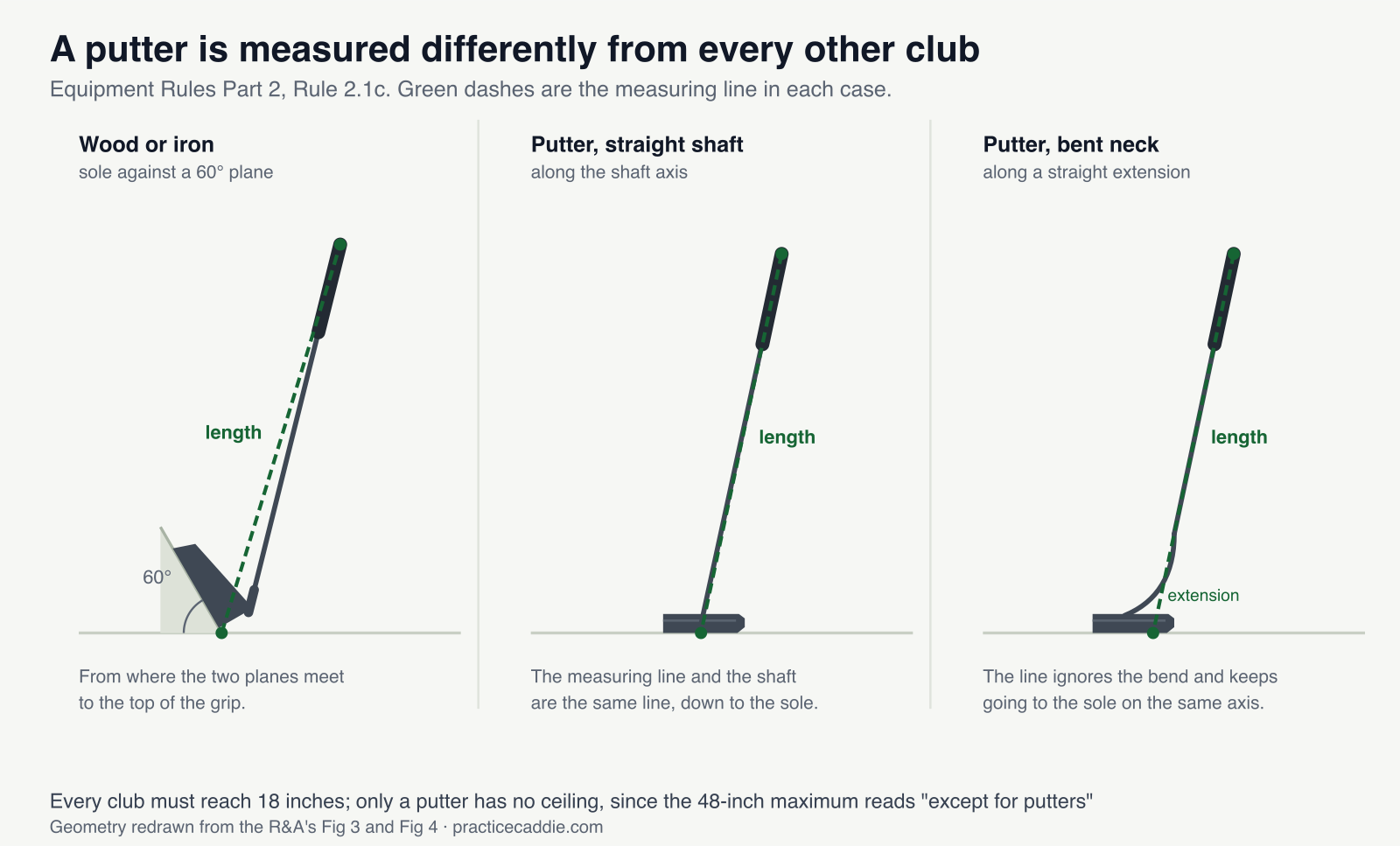
The bent-neck case is where the heel habit does real damage. On a plumber’s-neck or slant-neck putter the shaft reaches the head through a bend, and the R&A’s own Fig 4(b) says the measurement “does not follow the axis of the bend in the neck, but follows a straight line extension of the straight part of the shaft all the way to the sole.” Follow the neck down instead and you land on a different point on the sole and read a different number.
Hireko’s clubfitting reference adds the one detail the rule leaves implicit: the putter has to be sitting at its proper lie with the centre of the sole on the ground while you measure. Prop the toe up and the shaft tilts, the axis moves, and the ruler reads long.
Why the label on the putter is not the measurement
A putter sold as 34 inches has usually been regripped at least once, and possibly cut or extended. Grip caps differ in thickness. None of that shows up on the shelf tag. Measure the club in your hands rather than the club on the receipt — the same discipline that applies to grip diameter, where most golfers who assume they play standard have never put a gauge on it.
What “standard putter length” actually means
It means whatever the shelf happens to stock. No governing body defines a standard putter length.
An availability audit of 61 current models across eight brands — every model whose maker publishes a stock-length list — found that all 61 are offered at 34 inches, 60 at 35 inches, 43 at 33 inches, and exactly one at 32 inches. Thirty-four is the only length manufacturers unanimously agree on. That unanimity is a manufacturing convenience, not a fitting finding, and it is worth keeping the two apart.
| Stock length | Models offering it (of 61) | What it means for you |
|---|---|---|
| 32 in | 1 | Effectively a custom build |
| 33 in | 43 | Widely available, not universal |
| 34 in | 61 | The one length everyone stocks |
| 35 in | 60 | Nearly universal, common as a listed “standard” |
So the retail shelf hands most golfers three choices spaced a full inch apart, and the middle one is the safe default. A half-inch fit lives outside that entirely, which is a fair argument for a custom build and a poor argument for panic.
Putter length by height: what the chart is worth
Height charts are the most-linked thing in this subject and the least load-bearing. PGA Tour Superstore publishes one:
| Your height | Chart’s putter length |
|---|---|
| Under 5’0” | 31–32 in |
| 5’0”–5’2” | 32–33 in |
| 5’3”–5’6” | 33 in |
| 5’7”–5’9” | 33.5 in |
| 5’10”–6’0” | 34 in |
| 6’1”–6’4” | 34.5–35 in |
| Over 6’4” | 35+ in |
The store’s own note under the table is the honest part: it is “a helpful starting point, but not a substitute for a professional fitting,” and “factors like your posture, eye position, and personal comfort all play a major role.” It also assumes a traditional stance with the eyes over the ball, and says the ideal length may vary if yours is more upright or more bent.
Two golfers who both measure 5 feet 11 inches can differ by several inches in arm length, by 10 degrees of hip bend, and by an inch or more in where they like their eyes. Each of those moves the required length further than the last inch of height does. Treat the chart as the inch you start testing around, not the answer.
Eye position is what putter length sets
Length has one job at address: it decides how far you stand from the ball, which decides where your eyes sit relative to the target line.
Hireko’s fitting guide puts the failure modes in one sentence. A putter that is too long, or too flat, leaves the eyes too far inside the line; too short, or too upright, leaves them outside. And the consequence is an aiming error rather than a stroke error: “Inside the line, the target may appear to the right of where it is and cause a push. Conversely, outside the line, the target may appear to the left and result into a pulled putt.”
There is no single correct eye position to chase. Writing for Golf Canada, coach Tom Mullally is direct about it: “Most successful putters have their eyes slightly inside the ball to the target line but by how much varies based on your field of vision.”
The two-ruler test, free, on any practice green
Mullally’s exercise is the cheapest putter-fitting tool in golf:
- Put a three-foot ruler at the mouth of the hole and another three feet out from your ball, with a three-foot gap between them.
- Address the ball, hold your posture, and look toward the target. Try it with your eyes inside the ruler line, then outside, and watch the two rulers change orientation relative to each other.
- Somewhere between those two extremes they line up as one straight run to the target. That is your eye position.
- Drop a putting mirror or a CD under the ball and mark where your eyes actually sit at that position.
Now hold your own putter and stand there. If the length forces you closer or further away than the position you just found, you have your answer, and you found it without a fitting bay. Pair it with a start-line gate — the same one used in the putting drills catalog — and you can separate an aim problem from a face problem in one session.
What the fitting data actually says about length
MyGolfSpy ran a putter-fitting study with PING’s fitters: 20 golfers, screened for no industry affiliation, none fitted for a putter in the previous 12 months, all playing their own gamer. Every one of them got a full fitting. The spec-by-spec results are the most useful thing published on this topic.
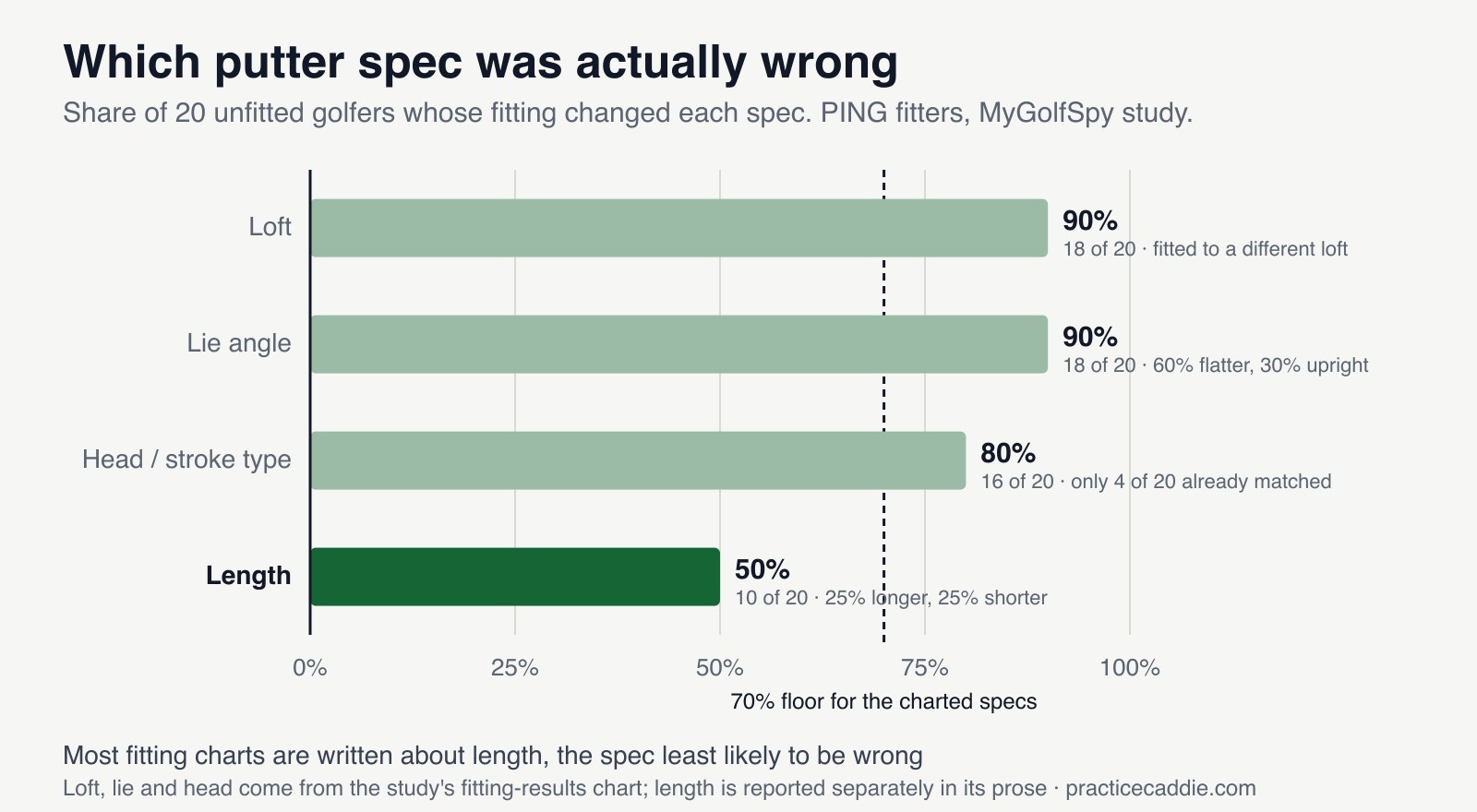
Ninety percent were fitted into a different loft. Ninety percent into a different lie. Only 4 of the 20 were already playing a head that matched their stroke type, so 80 percent needed a different head. Length was the outlier: 25 percent were fitted longer, 25 percent shorter, and the average change across the whole group was one sixteenth of an inch.
The honest read: length has more fitting charts written about it than any other putter spec, and is the least likely to be the one that is wrong. That average hides real individual moves — the study notes that changes of 1 to 1.5 inches “were common” inside it — so the check is still worth running. What it does not support is the premise underneath the entire height-chart genre, which is that your putter is probably the wrong length.
What a full fitting bought, and what it did not
Part II measured the outcome. Across the same 20 golfers, five-foot makes went from an average of 5.6 out of 10 to 6.1 out of 10, and 25-foot dispersion area shrank by slightly better than 25 percent. Both gains came out of a fitting that changed loft, lie, head, weight and length together, so neither attaches to length on its own.
The spread underneath those averages is the part most summaries drop. On the five-footers, 9 of 20 improved, 7 produced identical results, and 4 made fewer. From 25 feet, 11 improved, 5 were the same, and 4 got worse. So 9 of the 20 came out of a full professional fitting no better from 25 feet, and 4 of those were worse — which is the shape most honest equipment findings have.
The one number that isolates length
PING’s VP of Engineering, Dr. Paul Wood, gave PGATour.com the figure that comes closest to a clean length-only result, from testing PING ran for its length-adjustable Sigma 2 putters: “golfers experienced between 10 and 20% distance control improvements simply by adjusting to a length they were comfortable with.”
Distance control is where PING measured the gain, on speed rather than on start line. In the same interview Wood estimated the share of golfers on a wrong length “could be as high as 80% from our testing,” and added the detail that explains it: “no more than one single length of putter was best for more than 20% of people.” Read those two together and the 80 percent describes spread across golfers rather than a systematic bias toward long putters.
If distance control is the lever length moves, a lag test is what will show it, since that is the test that measures speed — which is what the lag putting drills are built around, and what shows up in strokes gained putting as the difference between a two-putt and a three-putt.
Lie angle: the interaction that gets overstated
Two claims travel with putter length. One is sound and the other is not.
Sound: changing length changes the lie you present at address. SAM PuttLab’s fitting protocol states it as a rule in its own report: “Shortening the putter will result in a steeper shaft angle which will bring the toe down.” The head’s manufactured lie has not moved. Your hands have, and the sole tells you so — which is the same relationship covered for the rest of the bag in loft and lie explained.
Not sound: that a lie error meaningfully bends the putt offline. Hireko modelled a putter delivered 6 degrees out of lie on a 10-foot putt with a square face:
| Putter loft | Dispersion angle | Error at 10 feet |
|---|---|---|
| 0° | 0° | 0” |
| 1° | 0.1° | 0.22” |
| 2° | 0.2° | 0.44” |
| 3° | 0.3° | 0.66” |
| 4° | 0.4° | 0.88” |
| 5° | 0.5° | 1.10” |
| 6° | 0.6° | 1.31” |
A normal putter carries about 3 degrees of loft, so a 6-degree lie error moves a 10-footer about two thirds of an inch. A 4.25-inch hole takes a ball whose centre finishes within about 1.285 inches of the middle, working from the 1.68-inch minimum ball diameter the Equipment Rules set, so that one drops with room to spare. Only the bottom row reaches the edge: 1.31 inches at 6 degrees of loft lips out by twenty-five thousandths of an inch, a margin thinner than the rounding in every number feeding it.
Set that against face angle. Hireko’s own framing on the same page: from 10 feet, “a 1° error one way or another is the difference of sinking a putt and completely missing the hole.” One degree of face at 120 inches puts the ball about 2.1 inches offline, which clears that threshold comfortably. So a single degree of face outweighs a full six degrees of lie by better than three to one, which is why the putter grip is a higher-leverage change than the shaft above it.
Lie still matters, through where it puts your eyes and how repeatably you can sole the club, both of which feed aim — and aim compounds with the green read, which is its own subject in how to read greens.
Toe hang vs face balanced, and where length comes in
Balance a putter shaft horizontally across a finger and let the head settle. If the face points roughly at the sky, it is face balanced. If the toe drops toward the floor, it has toe hang, and True Spec puts a plumber’s-neck Anser-style putter at about 45 degrees, which fitters call half toe hang. Conventional fitting pairs face-balanced heads with straighter strokes and more toe hang with more arc, on the reasoning that a head that wants to close suits a stroke that closes.
Length feeds straight into that pairing. The same SAM report carries the interaction as a rule: “A too long putter results in increased Arc and Rotation.” A longer putter stands you further from the ball on a flatter plane, the stroke arcs more, and the face rotates more through it — which is the exact variable toe hang is fitted against. Change length by more than half an inch and the head that matched your stroke may no longer match it.
No published dataset converts that into a formula, so treat length and head balance as two dials you turn together rather than one that predicts the other. Worth remembering that in the MyGolfSpy study 55 percent of golfers turned up with face-balanced putters and only 15 percent were fitted back into one, so the self-diagnosis “I putt straight back and straight through” is wrong far more often than it is right.
Putter length myths worth killing
- “There is a standard putter length.” There is a stocking convention. Thirty-four inches is what all 61 audited models offer; PING lists 35 as standard on several product pages. No governing body defines one.
- “The 46-inch rule banned long putters.” Model Local Rule G-10, “Prohibiting Use of Clubs Longer than 46 Inches,” lets a committee restrict “the maximum length for clubs, other than putters, to 46 inches,” with a 0.20-inch measurement tolerance. Broomsticks conform. What Rule 10.1b bans is anchoring the club or a gripping hand against your body during the stroke.
- “Most golfers need a shorter putter.” In the only published before-and-after with per-spec numbers, 25 percent were fitted longer and 25 percent shorter. The direction is a coin flip.
- “Measure from the heel.” The rule measures along the shaft axis to the sole. On a bent-neck putter those are different points and different numbers.
- “A wrong lie angle is why you miss.” Six degrees out of lie costs two thirds of an inch at 10 feet. One degree of face angle costs about 2.1 inches, and that one misses.
- “Your height picks your putter.” It picks the inch you start testing around. Posture, arm length and eye position decide the rest, and the chart’s own publisher says so.
When to skip all of this
Skip the length audit entirely if your last three rounds died on three-putts from outside 25 feet and your six-footers are fine. That is a speed problem, and speed is trained rather than bought.
Skip it too if you have changed putters within the last month. The MyGolfSpy report is blunt about the adjustment cost of a spec change, noting that a lie change in particular “will take the most adjustment from the player following a change.” Golfers compensate for an ill-fitting club, and removing the club without removing the compensation gets worse before it gets better. Give any change three or four rounds before you judge it.
And skip it if the money is better spent elsewhere. Mark Broadie’s decomposition in Every Shot Counts attributes only about one-sixth of the scoring difference between players to putting, against roughly two-thirds for the long game — a figure Practical Golf summarises as 15 percent importance. If your approach game leaks more, strokes gained approach returns more for the same hour.
Build the check into a practice block
Measuring the putter takes four minutes. Knowing whether the number is wrong for you takes a session with a ruler, a mirror and thirty balls — and then a second session two weeks later to see whether the change held.
That second session is the one golfers skip, and it is the one that decides the question. PracticeCaddie builds a measured putting block around a repeatable lag test and a start-line gate, so a spec change gets judged on dispersion across sessions instead of on the feel of one good afternoon. Build one free in 30 seconds — the free forever plan needs no credit card, and Pro adds AI-generated plans with a 3-day free trial (what’s in Pro).
Related reading
- How to Grip a Putter: Grip Styles, Pressure, and Face Control — the higher-leverage half of the putter; the face sets most of a putt’s start line, and one degree of it outweighs six degrees of lie error by better than three to one.
- 10 Golf Putting Drills That Move Strokes-Gained-Putting — the gate test and make-rate ladders that turn a spec change into a measured before-and-after.
- Lag Putting Drills — distance control is the one thing PING’s testing tied to length, and this is where you train it.
- Strokes Gained Putting — what your putting is actually costing you, so an equipment change gets compared against the alternatives.
- How to Read Greens in Golf — eye position sets your aim; the read sets where you should be aiming.
- Golf Loft and Lie Explained — the same two specs across the rest of the bag, where the consequences are much larger than they are in a putter.
- Golf Grip Size Chart and Golf Shaft Flex Chart — the other two equipment specs golfers blame their ball flight on, both audited against controlled testing.
- How to Grip a Golf Club — the setup pillar this cluster hangs off.
- Putting drills guide — the companion library, organized by skill area with setup steps and success criteria.
Key takeaways
- A putter is measured from the top of the grip along the shaft axis to the sole. Woods and irons come off a 60-degree plane instead. On a bent-neck putter, follow a straight-line extension of the shaft and ignore the neck.
- Every club must reach 18 inches; only a putter has no maximum. The 48-inch cap in Rule 2.1c reads “except for putters,” and Model Local Rule G-10 — available to committees since January 1, 2022 — excludes putters from its 46-inch limit too. Rule 10.1b regulates the anchored stroke, not the club.
- 34 inches is the only length every manufacturer stocks — all 61 models in an eight-brand audit, against 60 at 35 inches and 43 at 33 inches.
- Height charts get you into the right inch and stop there. PGA Tour Superstore’s own note calls its chart a starting point and names posture, eye position and comfort as the deciding factors.
- Length was the least-wrong spec in the only published per-spec fitting study. Loft and lie were changed for 90 percent of 20 golfers and the head for 80 percent, while half were already at a suitable length.
- The evidence that isolates length points at distance control: PING measured 10 to 20 percent distance-control gains from golfers moving to a comfortable length. Test with a lag drill, not a six-foot make test.
- A 6-degree lie error costs about two thirds of an inch at 10 feet. One degree of face error costs about 2.1 inches and misses the hole outright — better than three to one against six times the lie error. Fix the face first.
- Shortening a putter steepens the shaft and drops the toe, and a longer putter increases stroke arc and face rotation. Length and head balance are two dials you turn together.
Frequently asked questions
How do you measure putter length at home?
Stand the putter on a level floor in its playing position with the centre of the sole down, then measure along the shaft axis from the sole up to the top of the grip cap. If the putter has a bent neck, ignore the bend and follow a straight-line extension of the straight part of the shaft down to the sole, which is exactly how the Equipment Rules define it. Read the tape rather than trusting the number the putter was sold as, because a regrip or a previous cut moves the finished length.
What is the standard putter length?
There is no regulated standard, but 34 inches is the length every manufacturer agrees on. Stymie’s stock-length audit of 61 current models across eight brands found all 61 offered at 34 inches, 60 at 35 inches, 43 at 33 inches and one at 32 inches. So the retail shelf gives most golfers three choices, spaced an inch apart, and 34 sits in the middle of them. Custom builds go well outside that band, but no maker publishes those as a stock spec.
What putter length do I need for my height?
Height gets you into the right inch, and no further. PGA Tour Superstore’s chart maps 5 feet 10 inches to 6 feet to a 34-inch putter and 6 feet 1 inch to 6 feet 4 inches to 34.5 or 35, and the store’s own note calls it a helpful starting point rather than a substitute for a fitting. Two golfers of the same height can have different arm lengths, different hip bend and different preferred eye positions, and each of those moves the answer more than the last inch of height does.
Is there a maximum putter length in the rules?
No. Equipment Rules Part 2, Rule 2.1c sets a minimum of 18 inches for every club and a maximum of 48 inches for every club except a putter, so broomstick and mid-length putters conform. Model Local Rule G-10, which some professional tours use, caps clubs at 46 inches and also says except for a putter. What the rules do restrict is the stroke: Rule 10.1b bans anchoring the club or a gripping hand against your body, which is why long putters are legal but the old anchored stroke is not.
Does cutting down a putter change its lie angle?
Cutting a putter leaves the head’s built-in lie angle alone; only bending the hosel changes that. It does change the lie you present at address, because a shorter putter puts your hands lower and closer and steepens the shaft. SAM PuttLab’s fitting note states it directly: shortening a putter results in a steeper shaft angle, which brings the toe down. Watch the sole rather than a formula. Any published degrees-per-inch conversion for a putter is a rule of thumb, not a measured constant.
Does a wrong lie angle make you miss putts?
Far less than golfers assume. Hireko modelled a putter 6 degrees out of lie on a 10-foot putt: the error runs 0.66 inch at a normal 3 degrees of loft, rising to 1.31 inches at 6 degrees. A 4.25-inch hole captures a ball centred within about 1.285 inches, so the normal case drops comfortably and the extreme one only just lips out. One degree of face error at the same distance moves the ball about 2.1 inches and misses outright. Lie matters through where it puts your eyes and how repeatably you sole the club.
Should I get a shorter putter?
Only if a check says so. In the MyGolfSpy study run with PING’s fitters, 20 unfitted golfers were fitted for a different loft 90 percent of the time and a different lie 90 percent of the time, but half were already at a suitable length: 25 percent went longer, 25 percent shorter, and the mean change was one sixteenth of an inch. Individual changes of 1 to 1.5 inches were common inside that average, so the spec is worth checking. It is the least likely of the four to be your problem.