
Golf Grip Size Chart: How to Measure and What the Data Says
A standard men's grip measures 0.900 inch two inches below the cap. PING's own study found the ball flight thicker grips get blamed for was weight, not width.
Quick answer
Golf grip size is the installed outside diameter measured 2 inches below the grip cap. Men’s standard is 0.900 inch, midsize 0.960, jumbo about 1.025. Fit it by measuring your lead hand from wrist crease to middle-finger tip, then checking that your fingertips barely touch the heel pad. The popular claim that thick grips cause slices did not survive a controlled test — the effect was club weight, not grip width.
Golf grip size chart
| Size | Diameter 2” below cap | Difference from standard | Build-up wraps to get there |
|---|---|---|---|
| Women’s standard | 0.850” | −0.050” | Off the 1/64” ladder |
| Undersize | 0.885” | −1/64” | Thinner core or thinner shaft butt |
| Standard | 0.900” | baseline | none |
| 1/64” oversize | 0.915” | +1/64” | 1 |
| 1/32” oversize | 0.930” | +1/32” | 2 |
| 3/64” oversize | 0.945” | +3/64” | 3 |
| Midsize | 0.960” | +1/16” | 4 |
| 3/32” oversize | 0.990” | +3/32” | 6 |
| Jumbo / oversize | ~1.025” | +1/8” | 8 |
Gauge figures come from Mitchell Golf’s grip measuring and sizing guide and The GolfWorks grip gauge instructions. The wrap column comes from Golf Pride’s installation FAQ: “one wrap will increase grip size by 1/64, two wraps 1/32, four wraps 1/16.” The jumbo figure is the +1/8 retail convention rather than a gauge reading — Winn labels its oversize Dri-Tac 2.0 “+1/8”. The published gauge figures are tidied to the nearest 0.005 inch, so they sit slightly under the exact fractions: a true 1/16 over standard is 0.9625, printed as 0.960.
Why the labels lie and the gauge doesn’t
“Midsize” and “jumbo” are marketing words. No governing body defines them, no two brands are obliged to agree, and a grip labelled midsize by one company can measure what another calls 3/64 oversize. The only spec that travels between brands is the one clubmakers read off a gauge: outside diameter, 2 inches down from the edge of the cap, taken at the side of the grip so a molded rib doesn’t inflate the reading.
That measuring point is not arbitrary. Two inches down is roughly where the lead hand’s palm sits on a normal hold, and it sits below the flare of the cap, where every grip is thickest. Mitchell Golf’s guide is explicit about both details — measure at 2 inches, measure at the side, avoid the rib.
Once you’re on the gauge, the whole system is one number plus a stack of 1/64-inch steps. Standard is 0.900 inch. Every size above it is another sixty-fourth.
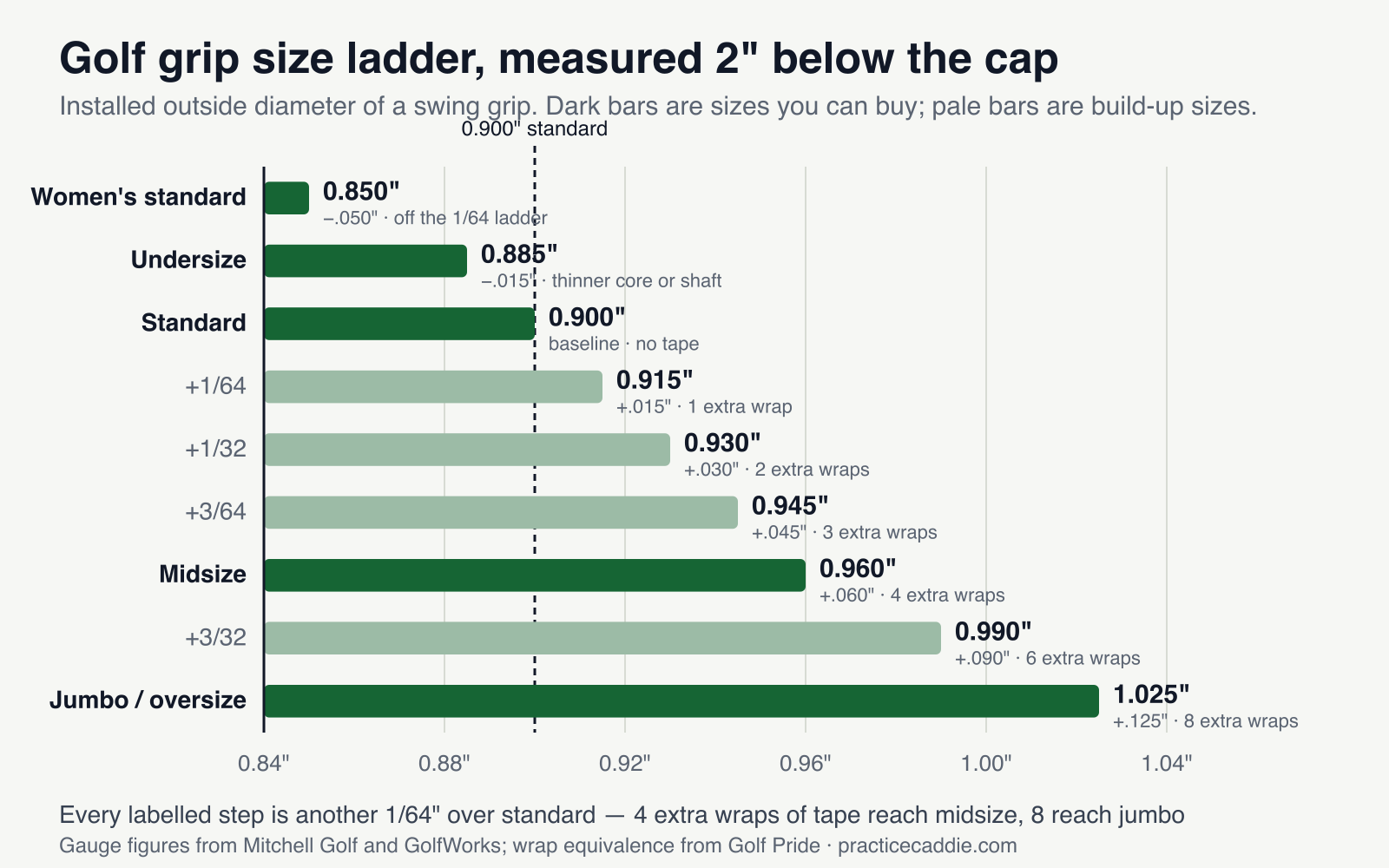
Look at how small the gaps are. Standard to midsize is 0.060 inch of diameter, which is 0.030 inch of rubber on each side — about the thickness of a credit card. Golfers describe the change as dramatic, and the measurement says it is the width of a business card wrapped around a stick. Both things are true, which is the first hint that grip size works on feel and hold before it works on physics.
How to measure your hand for grip size
Golf Pride’s size guide is the one manufacturer chart with published numbers on it. Measure the upper hand — the left hand for a right-handed golfer — from the main crease of the wrist to the tip of the middle finger.
| Hand length, wrist crease to middle-finger tip | Golf Pride’s recommendation |
|---|---|
| Under 5” | Junior |
| 5”–6.5” | Undersize |
| 6.6”–7.5” | Standard |
| 7.6”–9” | Midsize |
| Over 9” | Jumbo |
Golf Pride pairs the tape measure with a check you can run without one. Take your normal lead-hand hold and look at your fingertips:
- Fingers barely touch the heel pad — the size fits.
- Fingers wrap underneath and dig into the heel pad — the grip is too small.
- Fingers never reach the heel pad — the grip is too large.
When the two methods disagree, the heel-pad check wins. It reads the hold you actually make; the tape measure reads a hand lying flat on a table. Winn is blunter still and says there is no absolute rule, publishing its glove-size chart as a starting point only.
The honest read on all of these charts: they narrow the field to two candidates, and then you play both.
Core size, shaft butt, and the size change you didn’t order
The number stamped inside a grip’s mouth — M58, M60, 60R, .600 — is the core, the inside diameter the grip is molded to. It is not the size you’ll feel. What you feel is the core stretched over whatever shaft butt is underneath it.
Mitchell Golf lays out the arithmetic. A matched pair produces the standard 0.900 inch every time:
| Shaft butt | Grip core | Installed size |
|---|---|---|
| .580” | M58 | 0.900” |
| .600” | M60 | 0.900” |
| .620” | M62 | 0.900” |
Mismatch them on purpose and you have a free size change. A .580 core stretched over a .600 shaft butt installs at about 0.920 inch, close to 1/64 oversize. A .620 core over that same .600 butt installs at about 0.880, close to 1/64 undersize.
This is where a lot of “my new grips feel wrong” stories end. Graphite and steel shafts butt out at different diameters, a set can mix them, and a grip that reads standard on the package can install two sizes apart on two clubs in the same bag. If you have one club that never feels like the rest, measure it before you rebuild your hold around it. The same logic runs through how to grip a golf club: the hold you build is only as repeatable as the thing you’re holding.
Build-up tape: the sizes between the sizes
Retail sells four sizes. Clubmakers work in sixty-fourths, and the tool is masking tape wrapped under the grip before it goes on.
Golf Pride’s rule is one wrap per 1/64 inch, so two wraps reach 1/32, four reach 1/16. For a golfer stuck between standard and midsize, Golf Pride recommends 2 to 4 wraps under a standard grip.
The rule is an approximation, and worth treating as one. The GolfWorks measures a single-layer wrap of 3/4-inch masking tape at 0.010 inch of added diameter and an overlapped wrap at 0.020, against a nominal 1/64 of 0.015. Tape thickness, overlap and how hard the installer pulls all move the result a few thousandths. If you want a specific number, put a gauge on the finished club rather than counting wraps.
Tape also adds a little static weight at the butt end, which matters for the same reason the next section does.
Does grip size cause a slice or a hook?
The folk rule says thin grips let the hands turn over, so they hook, and thick grips restrain the release, so they slice. The GolfWorks repeats a version of it in its fitting guidance. It is the single most repeated claim in grip fitting, and the best controlled test of it came out the other way.
PING engineers Chris Broadie and Erik Henrikson ran a two-part experiment, published as The Influence of Grip Size on Driver Clubhead Delivery. Three drivers, identical except for a PING 5L grip at −1/16, standard and +1/16. Eighteen right-handed golfers hit eight shots with each, tracked on a Foresight GC2 with an eight-camera Vicon system at 720 fps.
Experiment one built the clubs the way a shop builds them. Swingweight was matched at D3 and total weight was allowed to climb with the grip: 307.7, 318.1 and 340.0 grams. The results looked exactly like the folk rule.
| Thickest grip vs thinnest, experiment one | Result |
|---|---|
| Face angle relative to path | More open, p < .001 |
| Closure rate | Slower, p = .003 |
| Impact location | Lower on the face, p = .005 |
| Shot bend | 7.1 yards further right, p < .001 |
| Offline carry | 8.8 yards further right, p < .001 |
| Total spin | 294.1 rpm more, p < .001 |
Experiment two changed one thing. Same three grips, same protocol, 18 golfers — but this time both swingweight (D4.8) and total club weight (346.8 grams) were held constant across all three builds. Every effect disappeared.
| Thickest grip vs thinnest, weight controlled | Result |
|---|---|
| Face angle relative to path | p = .42, not significant |
| Closure rate | p = .31, not significant |
| Vertical impact location | p = .34, not significant |
| Shot bend | 2.1 yards, p = .40 |
| Offline carry | 3.7 yards, p = .17 |
| Total spin | 74.4 rpm, p = .35 |
The authors’ own conclusion: “grip size alone is not responsible for significant changes in clubhead delivery,” and if a player asks for a thinner or thicker grip, “it is advisable to account for the change in mass properties when possible if a change in clubhead delivery is not desired.”
An 8.8-yard rightward shift is a real, visible miss. It was caused by 32 grams, not by an eighth of an inch.
What the research says about the hands
The other half of the folk rule assumes a fat grip quiets the forearms. Sorbie and colleagues tested that directly in Research in Sports Medicine, putting surface EMG on the extensor carpi radialis brevis and flexor digitorum superficialis of both forearms while 15 golfers hit 7-irons with undersize, standard and jumbo grips. Forearm activity showed no significant difference across the three sizes (p > 0.05). Clubhead speed did move — it rose with the undersize grip (p = 0.044) — on a sample of 15, which makes it a lead rather than a finding.
So the mechanism people quote isn’t showing up in the muscles either. If your face is arriving open, fix the slice at the face and the path, and read your start line and curve through the ball flight laws rather than through the rubber. A grip that’s the wrong size for your hand is worth changing on comfort and security. It is not a face-angle prescription, and the same goes in the other direction for fixing a hook.
The variable that does have evidence behind it: weight
Bigger grips are heavier grips, usually, and the size label on the package says nothing about it. Weight is the half of a grip change with measured effects behind it.
| Grip | Undersize | Standard | Midsize | Jumbo / oversize |
|---|---|---|---|---|
| Golf Pride MCC Plus4 | 47 g | 52 g | 66 g | 82 g |
| Winn Dri-Tac 2.0 | — | 51 g | 54 g | 56 g |
Two families, wildly different behaviour. Going midsize in an MCC Plus4 costs 14 grams; going midsize in a Dri-Tac 2.0 costs 3. And Winn’s Dri-Tac Lite in oversize weighs 33 grams, which is 19 grams lighter than a standard MCC Plus4 while being an eighth of an inch fatter. Size does not predict weight.
Weight at the butt end lowers swingweight. Golf Pride puts 4 grams at the grip end at one swingweight point; Hireko’s clubfitting reference uses 5 grams, and puts roughly 2 grams at the head at one point in the other direction. Run those two rates together and you get a rule of thumb worth carrying:
Add back at the head about half the grams you added at the grip, and the club balances where it did before.
Worked through the table above, using the 4-to-5-gram band at the butt and 2 grams at the head:
| Change | Grip weight change | Swingweight change | Head weight to restore it |
|---|---|---|---|
| MCC Plus4 standard → midsize | +14 g | −2.8 to −3.5 points | +6 to +7 g |
| MCC Plus4 standard → jumbo | +30 g | −6 to −7.5 points | +12 to +15 g |
| MCC Plus4 standard → undersize | −5 g | +1.0 to +1.25 points | −2 to −2.5 g |
| Dri-Tac 2.0 standard → oversize | +5 g | −1.0 to −1.25 points | +2 to +2.5 g |
Those are the numbers a fitter would put on it, computed here from the two published rates rather than transcribed from a source. They are approximations for exactly the reason Hireko gives — the grams-per-point figure drifts with club length, from about 1.6 grams on a 45-inch driver to 2.3 on a wedge — so weigh the finished club if you need it exact.
The practical upshot ties straight back to the PING study. If you change grip size and change nothing else, you have also changed the club’s mass properties, and the mass properties are the part with a measured effect on ball flight. A 6-gram tip weight or a strip of lead tape is a two-dollar fix. Skipping it is why a new set of midsize grips can feel like a swing fault.
Putter grips and the 1.75-inch rule
Putter grips break one rule and obey another, and golfers regularly get which is which backwards.
The Equipment Rules require a circular cross-section for every club except a putter. A putter grip may be non-circular provided the cross-section “has no concavity, is symmetrical and remains generally similar throughout the length of the grip.” That exception is why flat-fronted pistol grips and the big square SuperStroke shapes are legal on a putter and would be illegal on a 7-iron.
The size cap has no such exception. No grip on any club, putter included, may exceed 1.75 inches (44.45 mm) in cross-section measured in any direction. Grips may taper but may not have a bulge or a waist. And a putter may carry two grips as long as each is circular, each axis lines up with the shaft, and they are separated by at least 1.5 inches (38.1 mm).
Oversized putter grips are a different fitting question from oversized swing grips, and the hand-length chart above doesn’t govern them — that decision is about how much wrist you want in the stroke, which is covered in how to grip a putter.
How often to regrip your golf clubs
| Manufacturer | Published interval |
|---|---|
| Golf Pride | Every 40 rounds or once a year, whichever comes first |
| Lamkin | Once a year or every 40 rounds |
| SuperStroke | 30 to 40 rounds, or 12 to 18 months |
SuperStroke adds the detail that matters most for anyone reading a practice site: a normal practice session counts as roughly one round. Two range sessions a week is over a hundred “rounds” a year on top of whatever you play, which is why the grips of a golfer who practises hard go slick in a season while a casual player’s last three. If your range sessions are the bulk of your ball count, put them in the tally.
Inspect monthly rather than by the calendar. Shine, glazing, hardening and a slick feel in humidity all arrive before a year does.
When a grip change is the wrong fix
Skip the regrip and spend the money elsewhere when:
- Your miss is two-way. A two-way miss is a delivery problem, and no diameter fixes it. Start with a diagnosis instead.
- Your hold itself is off. A weak or overly strong lead hand changes face angle by degrees, which dwarfs anything a size change does. Fix the hold first.
- You’ve changed something else in the last month. Change one variable at a time or you learn nothing from either.
- You have no baseline. Without a before, a grip change is a feeling. With ten shots of before-and-after dispersion, it’s a measurement — the same logic behind reading launch monitor numbers instead of feel.
The exception that always earns its money: hand pain. The ergonomics literature is consistent that larger, softer handles reduce required finger force for people with hand arthritis, and comfort is a fitting outcome in its own right. If a jumbo grip lets you play 18 holes without your hands aching, that outweighs every launch-monitor argument on this page.
Related reading
- How to Grip a Golf Club — the pillar for this cluster; the hold you build on top of whatever diameter you’ve chosen, and the one that actually moves face angle.
- How to Grip a Putter — the separate fitting question behind oversized putter grips and how much wrist you want in the stroke.
- Golf Loft and Lie Explained — the other spec people blame their misses on, with the geometry of what one degree costs.
- Golf Ball Flight Laws Explained — read your start line and curve to find the real cause before you change equipment.
- How to Fix a Slice in Golf — the face-and-path protocol that a grip size change is not a substitute for.
- How to Fix a Hook in Golf — the same argument in the other direction, where a strong hold closes the face.
- Launch Monitor Numbers Explained — the numbers a dynamic fitting reads, and what a real before-and-after looks like.
- Average Golf Club Distances by Handicap — the measured-carry habit that turns equipment questions into data.
- Driving Range Practice Plan — the session structure to run a ten-shot before-and-after inside.
Key takeaways
- Grip size is one measurement: outside diameter 2 inches below the cap. Standard is 0.900 inch, midsize 0.960, jumbo about 1.025, undersize 0.885. Read it at the side of the grip, not over the rib.
- The retail labels are unregulated. Two grips both sold as midsize can gauge differently, so measure the club rather than trusting the package.
- Golf Pride’s hand chart is a two-candidate filter, not a verdict. Under 5 inches junior, 5–6.5 undersize, 6.6–7.5 standard, 7.6–9 midsize, over 9 jumbo — then confirm with the heel-pad check.
- Core size is not grip size. A .580 core on a .600 shaft butt installs about 0.920 inch, roughly 1/64 oversize, which is how one club in a set ends up feeling foreign.
- One wrap of build-up tape is about 1/64 inch. Four wraps reach midsize, eight reach jumbo, and Golf Pride recommends 2 to 4 wraps when you’re between sizes.
- Thick grips do not reliably cause slices. PING’s 18-golfer study produced 8.8 yards of rightward carry from the thickest grip, then lost every effect when total club weight was held constant (offline carry p = .17).
- Weight is the variable with the evidence behind it. Standard to midsize in an MCC Plus4 adds 14 grams and drops roughly 3 swingweight points; add back about half those grams at the head.
- Putters are exempt from the round-cross-section rule, not the size cap. No grip may exceed 1.75 inches in any direction.
- Regrip every 40 rounds or once a year, and count a practice session as a round.
Frequently asked questions
What size golf grips do I need?
Measure your upper hand from the wrist crease to the tip of your middle finger, then use Golf Pride’s chart: under 5 inches is junior, 5 to 6.5 inches undersize, 6.6 to 7.5 inches standard, 7.6 to 9 inches midsize, and over 9 inches jumbo. Confirm it with the heel-pad check, where your fingertips should barely touch the heel pad of your lead hand. Treat the chart as a starting point and the hold as the verdict, because the two disagree often enough to matter.
How do you measure golf grip size?
Grip size is the installed outside diameter measured exactly 2 inches down from the edge of the grip cap, read at the side of the grip so a molded rib does not inflate the number. A men’s standard grip measures 0.900 inch there, undersize 0.885, midsize 0.960 and jumbo about 1.025. Clubmakers use a slotted grip gauge, but calipers work. The number printed on a grip’s inner lip is its core size, not its outside diameter.
What is the difference between standard and midsize golf grips?
Midsize is nominally one sixteenth of an inch larger in diameter than standard, and gauges print it as 0.960 inch against 0.900 at the 2-inch measuring point. That is a smaller gap than the labels suggest, about the thickness of a credit card added all the way around. The bigger practical difference is weight: Golf Pride’s MCC Plus4 goes from 52 grams standard to 66 grams midsize, and 14 extra grams at the butt end reads as roughly 3 swingweight points lighter.
Do bigger golf grips cause a slice?
Not by themselves. PING engineers tested three grip sizes on 18 golfers and found the thickest grip left the face more open to the path and produced 8.8 yards more rightward carry, but the clubs also got 32 grams heavier as the grips got fatter. When they repeated the test with total club weight held constant, every one of those differences vanished, with face-to-path at p = .42 and offline carry at p = .17. The ball flight followed the weight, not the diameter.
How many wraps of tape equal a midsize grip?
Golf Pride puts one extra wrap of build-up tape at about 1/64 inch of added diameter, so four wraps reach the 1/16 inch that separates standard from midsize and eight reach jumbo. Golf Pride recommends 2 to 4 wraps when you land between sizes. Treat these as approximations: The GolfWorks measures a single-layer masking-tape wrap at 0.010 inch and an overlapped wrap at 0.020, so actual tape and technique move the result.
Are oversized putter grips legal?
Yes, within one limit. The Equipment Rules let a putter grip have a non-circular cross-section as long as it has no concavity, is symmetrical and stays generally similar along its length, which is why flat-fronted and pistol putter grips are legal while the same shape on an iron is not. Putters are not exempt from the size cap, though: no grip may exceed 1.75 inches in cross-section measured in any direction. A putter may carry two grips if each is circular and they sit at least 1.5 inches apart.
How often should you change golf grips?
Golf Pride recommends replacing grips every 40 rounds or once a year, whichever comes first, and Lamkin publishes the same interval. SuperStroke counts a normal practice session as roughly one round, which is the part range golfers miss: two sessions a week burns through the year’s allowance well before the rounds do. Heat, humidity, sunscreen and hand oils all speed it up, so inspect for shine, hardness or slickness monthly rather than waiting for a date.