
How to Read Greens in Golf: Break, Speed, and a Repeatable Routine
Amateurs make under 40% of putts from 6 to 9 feet, mostly from misreading break and speed. How to read greens: the physics, AimPoint, grain, and a routine.
Quick answer
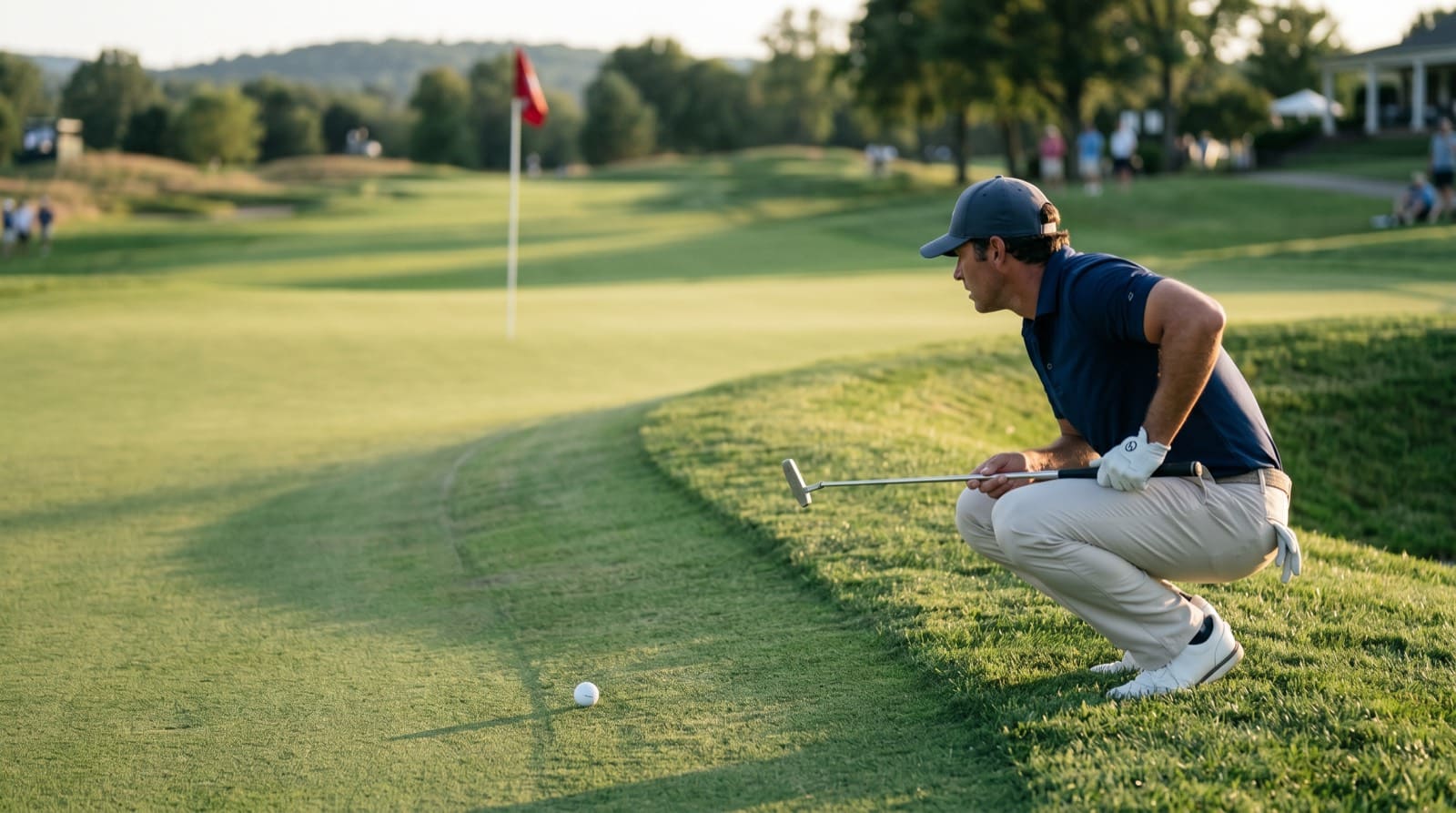
A green read is two decisions: how hard to hit the putt, and where to start it. A putt breaks because gravity pulls on it the whole time it rolls, so pace controls break and you set speed first. Read the whole green’s tilt on the walk up, get below the hole to see the slope, find the apex of the curve, and aim your start line there. Most amateurs miss low because they under-read break and putt too softly.
Make percentage by distance and handicap
| Putt length | Scratch | 5-HCP | 10-HCP | 15-HCP | 20-HCP | 25-HCP |
|---|---|---|---|---|---|---|
| 0–6 ft | 92.8% | 90.2% | 89.3% | 84.4% | 84.0% | 82.5% |
| 6–12 ft | 42.8% | 41.4% | 38.1% | 39.6% | 37.8% | 35.0% |
| 12–18 ft | 25.1% | 23.9% | 20.2% | 20.2% | 18.8% | 16.0% |
| 18–24 ft | 14.5% | 13.0% | 10.3% | 11.2% | 11.8% | 10.1% |
| 24–30 ft | 8.3% | 10.1% | 5.4% | 7.8% | 6.8% | 6.3% |
| 30 ft+ | 4.3% | 4.3% | 2.8% | 3.2% | 1.9% | 2.3% |
Source: Shot Scope make-percentage data by handicap, drawn from millions of recorded amateur putts.
Why green reading is where amateurs leak strokes
The make-percentage gradient between skill levels is small up close and small far away. The real gap sits in the middle, and so does the leak.
Arccos data, reported by Golf Monthly, shows golfers at every level from scratch to 20-handicap make under 40% from 6 to 9 feet. By the same Shot Scope comparison, the PGA Tour makes 96.7% from inside 5 feet, and only about half from 8 feet. From that range the difference between a make and a miss is mostly the read and the pace, because nearly everyone owns the stroke to roll a ball eight feet.
The cost shows up as three-putts, and the gap between Tour and amateur is stark. Arccos’s pros-vs-joes analysis measured the three-putt rate from 20 to 25 feet:
| Player | Three-putt rate, 20–25 ft |
|---|---|
| PGA Tour | 2.36% |
| 1-to-5 handicap | 9.43% |
| 6-to-10 handicap | 15.08% |
| 11-to-15 handicap | 16.20% |
A 15-plus handicap three-putts 3.2 times a round to a low handicap’s 1.6. A three-putt is almost always a first putt left too far from the hole, and distance control depends on reading the slope and grain that speed the ball up or slow it down. Better reading is a direct line to fewer three-putts.
What a green read actually answers
A read gives two answers that depend on each other: how hard to hit the putt, and where to start it. A putt curves because gravity pulls it down the slope for as long as it rolls, so a firm putt holds its line while a dying putt breaks the most. Speed is the lever on break, which is why a good read decides pace first and picks a start line to match. Grain becomes a third input on Bermuda.
The physics: speed sets the break
Pace is the master variable, and Dave Pelz’s testing pinned down the right amount. Summarized in his putting work, Pelz found the highest make rate comes from a putt rolling with enough speed to finish about 17 inches past the hole if it missed.
The reason is the lumpy donut, the ring of turf roughly one to six feet around every cup that gets walked on constantly but never stepped on directly over the hole. That foot traffic leaves it bumpy. A putt dying at the hole can use the full 4.25-inch width of the cup, but it arrives so slowly the bumps knock it offline. A putt racing four feet past holds its line but shrinks the effective hole to a sliver, so the aim must be perfect. Seventeen inches past balances the two, and it breaks less than a dying putt because it spends less time on the slope.
This is why pace comes first. Dave Stockton’s Unconscious Putting teaches the same order under a blunter slogan: speed determines line. Pick the pace and the green’s break is mostly fixed; then choose a start line that delivers the ball to the high side at that speed.
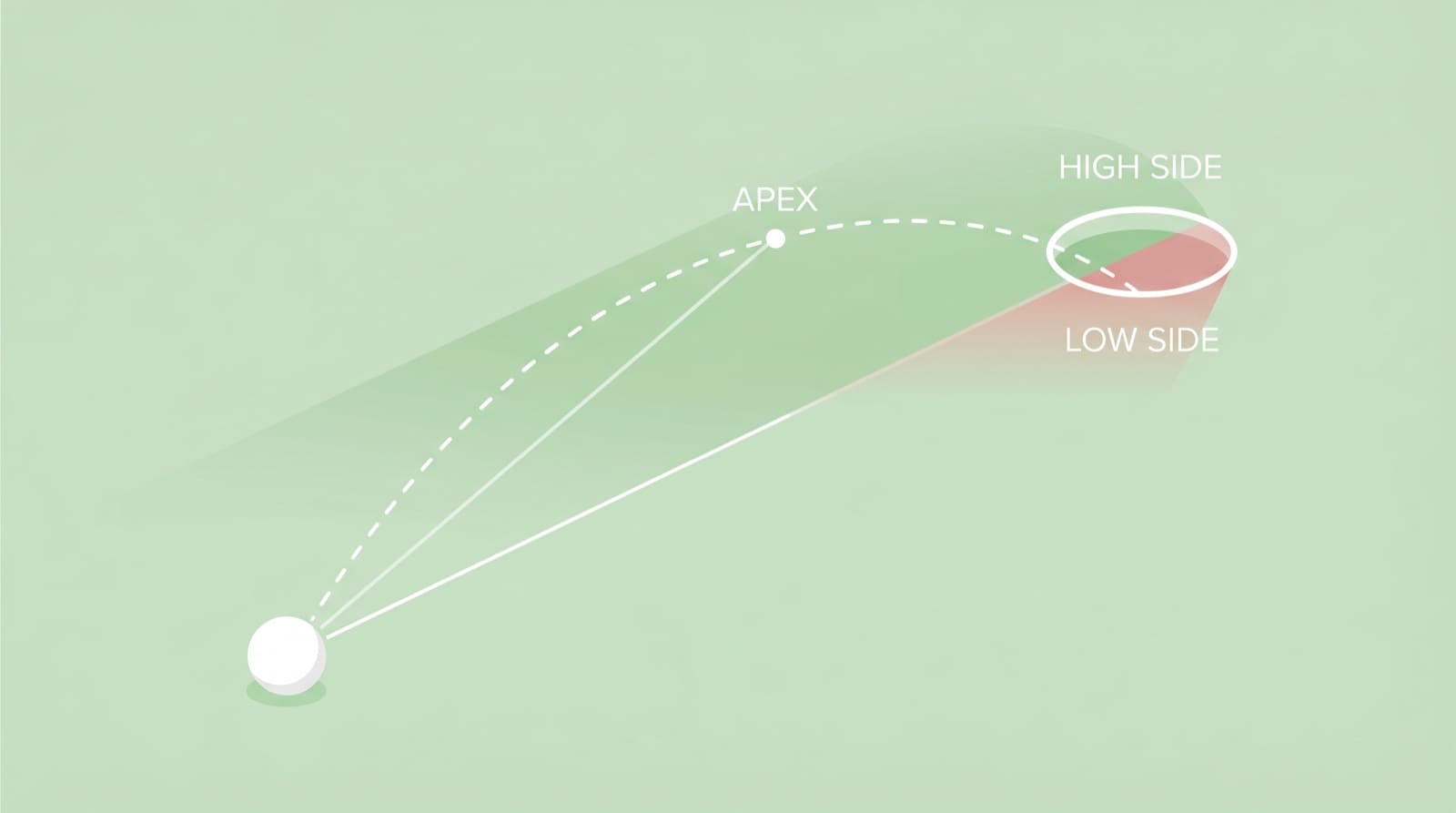
The apex is the high point of the curve, where the ball stops climbing the slope and starts falling toward the hole. Aim your start line at the apex, not the hole, because the ball must ride above the cup before gravity brings it back. Aiming at the hole sends the ball on a line that is already too low, the geometry behind the most common amateur miss.
Why most amateurs miss on the low side
Watch any green for an afternoon and the missed putts cluster below the hole, on what teachers call the amateur side. Two errors compound to put them there. The first is under-reading the break and starting the ball too close to the hole. The second is under-hitting, since a soft putt bends further low than a firm one.
AimPoint’s Mark Sweeney frames the penalty as asymmetric: an under-read costs more strokes than an equal over-read, because a putt started above the hole can still topple in on the high side while one started below it never had a chance. The honest read is that your instinct is probably too straight and too soft. On anything outside 6 feet, deliberately play more break than your eyes suggest and commit to the 17-inch pace.
Green-reading methods, ranked by what they’re good for
No single method does everything. The reliable approaches stack: a tilt read to get direction, a slope read to get amount, and a pace read to lock it in.
AimPoint Express — feeling slope with your feet
AimPoint Express, built by Mark Sweeney, reads slope through the body instead of the eyes. You straddle the line between ball and hole, feel how steeply the ground tilts, and grade it on a scale of roughly 1 to 5 percent. Then you stand behind the ball, hold up that many fingers at arm’s length beside the cup, and the outer edge of the last finger marks the start line. It works because the body senses tilt underfoot more reliably than the eyes read it, since the eyes get fooled by surrounding contours. Major winners including Adam Scott, Justin Rose, and Viktor Hovland use it, and a short clinic teaches the basics.
Reading from below the hole
Getting low on the low side is the oldest reliable read. From below the hole with your eyes near the ground, your sightline runs more parallel to the slope, so the tilt is easier to see than from a standing position behind the ball. Add a confirming look from beside the hole. A read taken only from full height behind the ball flattens the very slope you are trying to measure.
The “bucket of water” tilt read
For overall direction, picture pouring a bucket of water on the green and watch where it runs. This finds the dominant tilt of the whole surface, which biases every putt and often overrides the small contour next to your ball. It gives a direction, not an amount, which is why it is the first read in the routine rather than the last.
Plumb-bobbing — the one to drop
Plumb-bobbing, dangling the putter to find vertical, has the weakest evidence of any common method. A 2005 study by Sasho MacKenzie and Eric Sprigings in the Journal of Sports Sciences tested it and concluded it is an invalid system for determining break. It only works when the slope under your feet matches the slope along the whole putt, which is rarely true. The study also found over half of golfers stood more than 1.5 degrees off vertical, and on a 4.5-foot putt that error alone misreads the break by about three inches.
Reading grain (especially on Bermuda)
Grain is the direction the grass blades lie, and on Bermuda greens it changes both pace and break enough to matter. With the grain the putt runs out faster, like a downhill; into the grain it slows down, like an uphill; across the grain the blades nudge the ball the way they lean. Bentgrass and other cool-season greens barely grain at all, so on those you read slope and mostly ignore grain.
Two cues are dependable. The shine test: from behind the ball, a shiny, silvery surface means you are looking down-grain and the putt will be faster, while a dark, dull green means into the grain and slower. The cup edge: one side of the hole looks clean and the other looks ragged and browned, and the ragged side points down-grain, the way the grass grows and the ball runs.
The popular rules about grain growing toward the setting sun or the nearest water are not reliable. The USGA’s agronomists say grain direction on a given green is not reliably predictable, so the shine and the cup edge beat any compass rule. Into a strong grain, commit to a firmer stroke, because the grass grabs a timid putt and pulls it offline.
What your miss tells you
Every missed putt is feedback on the read. Track the pattern over a few rounds and it points at the specific error to fix. This diagnostic table maps the miss to its most likely cause and the correction.
| Your miss | Most likely cause | The fix |
|---|---|---|
| Finishes below the hole | Under-read break, or pace too soft | Play more break and a firmer 17-inch pace; raise the start line to the apex |
| Finishes above the hole | Over-read break, or pace too firm | Trust a touch less break, or commit to a straighter, firm line |
| Stops short, on line | Decelerating stroke | Commit to finishing 17 inches past; fix tempo, not aim |
| Races 4+ feet past or 3-putts | Pace too firm, downhill speed misjudged | Calibrate speed with a gate or distance drill before adjusting the read |
| Lips out on the low edge | Slightly under-read or under-paced | Small increase in both break and pace; a low lip-out is still an under-read |
The pattern matters more than any single putt. A low miss once is noise; a low miss six times in a round is a reading bias worth correcting on purpose.
How to practice green reading
Green reading improves like any skill: rehearse it, commit to an answer, then check the answer against reality. None of this needs proprietary gear.
The core drill is commit-then-check. On the practice green, read a 15-to-25-foot breaking putt fully, say your start line and pace out loud, hit it, and watch where it finishes relative to the hole. Log whether the miss was high or low, short or long. Twenty reads with feedback teach more than two hundred careless lag putts, because the feedback loop is what trains the eye. Vary the distance and break on every rep, which the contextual-interference research behind block-vs-random practice shows transfers better to the course even though it feels harder.
Pair it with a gate-and-pace drill. Set a tee 17 inches behind the hole and try to stop putts between the cup and the tee, which grooves the capture speed that makes break predictable. Most green-reading errors are really pace errors in disguise.
The reading routine then slots into a pre-shot routine you can repeat under pressure.
A green read is a calibration problem dressed up as a guessing game. Slope sets the break, speed sets how much of that break shows up, and grain tilts the whole thing on Bermuda. Commit to a pace and a start line, then let the miss tell you which input was off. — synthesized from Pelz’s capture-speed research and AimPoint’s slope-first framework.
Green-reading myths worth killing
- “Aim at the hole and trust your stroke.” On any breaking putt the start line has to point above the hole, at the apex. Aiming at the cup bakes in a low miss before the putter moves.
- “Plumb-bobbing tells you the break.” MacKenzie and Sprigings (2005) found it invalid for reading break. Keep it for entertainment, not for data.
- “Read the line first, then worry about speed.” Speed sets break, so pace is the first decision, not the last. Stockton and Pelz both teach speed-first.
- “Grain grows toward the setting sun.” The USGA’s agronomists say grain direction on a given green is not reliably predictable by sun or water. Use the shine and the cup edge instead.
- “Better putting is mostly a better stroke.” From 6 to 9 feet, every handicap level makes under 40%. The leak in that range is the read and the pace far more than the stroke.
A note on the rules: greens-reading books
Tournament golf tightened this up, and it is worth knowing why. Starting January 1, 2022, the USGA and R&A introduced Model Local Rule G-11, which lets a committee restrict players to an approved yardage book whose green diagrams show only major slopes and tiers, not the fine-grained contour maps that had become common. The PGA Tour and DP World Tour adopted it to put green reading back in the hands of the player and caddie. It is a model local rule, so it applies only where a competition adopts it; a recreational golfer under the standard Rules can still use a detailed book. The skill the rule protects is the one this guide trains.
Key takeaways
- Pace sets break, so decide speed first. A putt breaks the entire time it rolls, and a firmer putt breaks less. Pelz’s research puts the optimal pace at about 17 inches past the hole.
- Aim the start line at the apex, not the hole. The ball has to ride above the cup before gravity brings it down. Aiming at the hole is the geometry behind the low miss.
- Most amateurs miss low. Under-reading break and under-hitting stack, and from 6 to 9 feet every handicap makes under 40%.
- Read from below the hole. A low sightline reads slope better than a standing view from behind the ball.
- Plumb-bobbing is unreliable. A 2005 Journal of Sports Sciences study called it an invalid system for determining break.
- On Bermuda, read grain with the shine test and the cup edge. Down-grain runs fast, into-grain runs slow, and the sun-and-water rules are not dependable.
- Three-putts are the scoreboard. The Tour three-putts 2.36% from 20 to 25 feet to a mid-handicap’s 16.20%; better reading and pace close most of that gap.
Frequently asked questions
How do you read a green in golf?
Reading a green is a five-step routine, not a single glance. Walk up reading the whole green’s overall tilt, the way water would drain off it. Get behind the ball from the low side, below the hole. Decide speed first, because pace controls how much a putt breaks. Find the apex, the high point of the curve, and aim your start line there rather than at the hole. Commit to that line and roll it at a pace that finishes about a foot past. Speed and slope together produce the read.
Why do amateurs miss putts on the low side?
Because they under-read the break and hit the putt too softly, and the two errors stack. Arccos data shows golfers at every level from scratch to 20-handicap make under 40% from 6 to 9 feet, and most of those misses fall below the hole. AimPoint’s Mark Sweeney points out the penalty is asymmetric: under-reading break costs far more than over-reading it, so a defensive read almost always finishes low. A soft putt also spends more time on the slope, so gravity bends it further low than the player expected.
Should you read speed or line first?
Speed first. A putt’s break is set by how long the ball stays on the slope, so pace and line are linked rather than separate decisions. Dave Pelz’s research found the highest make rate comes from a putt with enough speed to finish about 17 inches past the hole if it missed. A firmer putt holds its line and breaks less; a dying putt breaks more and gets thrown off by foot-printed turf near the cup. Decide your pace, then pick a start line that matches it. Dave Stockton teaches the same order: speed determines line.
What is the AimPoint method?
AimPoint, developed by Mark Sweeney, reads break through your feet instead of your eyes. You straddle the line between ball and hole, feel the slope, and grade it on a scale of roughly 1 to 5 percent. Then you stand behind the ball, hold up that many fingers at arm’s length next to the hole, and the outer finger marks your aim point. Tour winners including Adam Scott, Justin Rose, and Viktor Hovland use it. The appeal is consistency, because feet sense slope more reliably than eyes, which are fooled by surrounding contours.
Does plumb-bobbing actually work?
Mostly no. A 2005 study by Sasho MacKenzie and Eric Sprigings in the Journal of Sports Sciences tested plumb-bobbing and called it an invalid system for determining the break of a putt. The method only works if the slope under your feet matches the slope along the whole putt, which it rarely does. The study also found over half of golfers stood more than 1.5 degrees off vertical, and on a 4.5-foot putt that error alone misreads the break by about three inches. Feeling slope with your feet is more reliable.
How do you read grain on Bermuda greens?
Use the two cues the agronomy supports. First, the shine test: look from behind the ball toward the hole. A shiny, silvery surface means you are putting down-grain and the putt is faster, while a dark, dull surface means into-grain and slower. Second, the cup edge: the ragged, browned side of the hole points down-grain, the way the grass leans. Down-grain putts run out; into-grain putts need a firmer stroke. Bermuda grain bends both speed and break noticeably, while bentgrass barely grains at all.
How far past the hole should a putt finish?
About 17 inches, per Dave Pelz’s putting research. That pace gives the ball enough speed to hold its line through the foot-printed, bumpy ring of turf around the cup that Pelz called the lumpy donut, without so much speed that it shrinks the effective size of the hole. A putt that dies at the hole can use the full 4.25-inch width but gets knocked off line by bumps, while a putt racing four feet past needs near-perfect aim. Seventeen inches past is the compromise that holes the most putts on real greens.
Related reading
- 8 Lag Putting Drills That Cut Three-Putts — the speed half of green reading, with calibrated leave-distance drills and the 30% Rule for distance control.
- Strokes Gained Putting, Explained for Amateurs — where putting actually costs you strokes by handicap, and why three-putt avoidance is the highest-leverage fix.
- 10 Golf Putting Drills That Move Strokes Gained — the parent putting-drills catalog; green reading is the read that those stroke drills deliver on.
- Golf Pre-Shot Routine: Build One That Holds Under Pressure — how the read routine becomes a repeatable pre-putt sequence on the course.
- Block vs Random Practice in Golf — the motor-learning case for varying distance and break on every green-reading rep.
- Putting drills to lower your scores — the companion guide with make-rate and proximity scoring criteria.
- The 30-minute golf practice plan — how to fit a green-reading block into a short session.