
Strokes Gained: Putting Explained (And Where Amateurs Actually Lose)
Putting is one-sixth of your scoring story. The make-rate data by distance, how the Strokes Gained: Putting metric works, and where amateurs lose strokes.
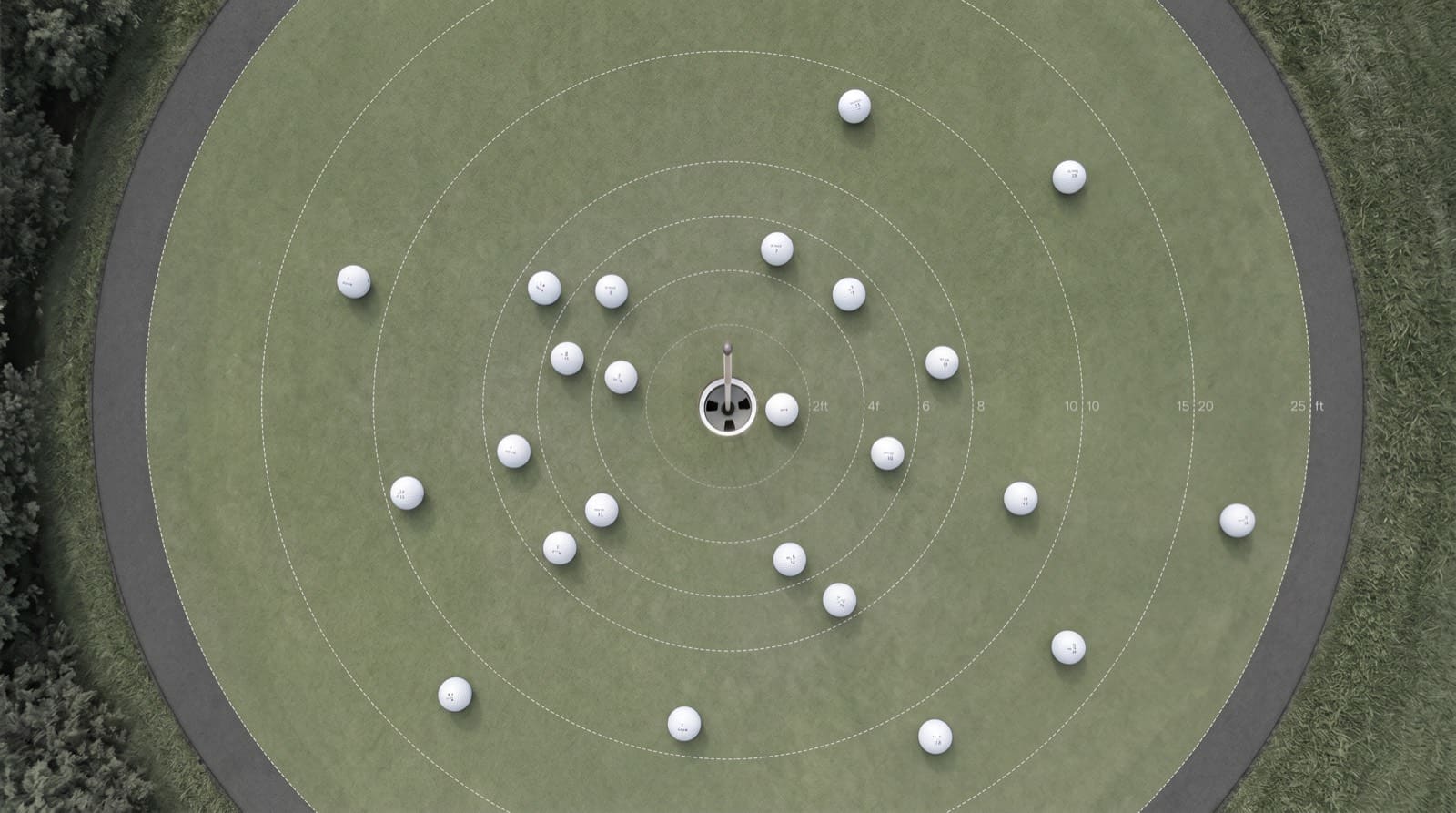
Quick answer
Strokes Gained: Putting scores every putt against the PGA Tour’s make-rate baseline from that exact distance, then sums the result. It is the smallest of golf’s four scoring levers — putting is roughly one-sixth of what separates players, while the long game explains about two-thirds. Amateurs leak putting strokes in two places: missing makeable putts from 5 to 15 feet, and three-putting from long range. Read the number, then practice the leak.
PGA Tour one-putt make rate by distance
| Distance | PGA Tour one-putt make rate |
|---|---|
| 3 feet | 99% |
| 4 feet | 92% |
| 5 feet | 81% |
| 6 feet | 70% |
| 8 feet | 53% |
| 10 feet | 40% |
| 15 feet | 23% |
| 20 feet | 15% |
| 25 feet | 10% |
PGA Tour one-putt make rates by distance, via Golf.com’s summary of ShotLink make-percentage data and Mark Broadie’s strokes-gained-putting research. Even the best players alive miss most putts from outside 8 feet.
Those make rates are the baseline every Strokes Gained: Putting number is scored against. They also explain the central finding of golf analytics: putting matters far less than the hours golfers pour into it. Mark Broadie’s data puts putting at roughly one-sixth of the scoring story.
What Strokes Gained: Putting actually measures
Strokes Gained: Putting scores every putt against what the PGA Tour field would expect from the same distance, then adds up the result.
Every spot on the green carries an expected number of putts to hole out, built from PGA Tour ShotLink data on millions of putts. From 3 feet the expectation is just over 1.0; from 10 feet it is about 1.6; from 25 feet it approaches 2.0 (Broadie’s strokes-gained-putting paper). Your gain or loss on a putt is the expected putts from where it starts, minus the expected putts from where it finishes, minus 1 for the stroke.
Hole a 10-footer, where the Tour expects 1.6 putts, and you gain 0.6 strokes. Two-putt from there and you have spent 2 putts against a 1.6 expectation, a loss of 0.4.
Sum that across all 30-odd putts in a round and you have your Strokes Gained: Putting for the day. Mark Broadie, the Columbia Business School professor who built the framework, introduced it in a 2008 paper, and the PGA Tour adopted Strokes Gained: Putting in 2011. The full four-category system, which our Strokes Gained primer walks through, arrived in 2016.
The point of all this machinery is context. A 28-putt round looks identical on the scorecard whether you faced 18 tap-ins or eighteen 20-footers, and Strokes Gained: Putting tells those two rounds apart.
Why putting is the smallest of the four scoring levers
Putting decides less of your score than almost any golfer believes. Broadie’s decomposition of Tour scoring variance attributes only about one-sixth of the difference between players to putting, and roughly two-thirds to the long game from 100 yards and out (Every Shot Counts).
Broadie said it plainly at the 2014 Sloan Sports Analytics Conference: “You don’t drive for show and putt for dough. It’s really the long game that matters. The long game explains about two-thirds of scoring.” The Golfer’s Journal ran his argument under a blunter headline — putting is overrated.
The Tiger Woods numbers make it concrete. Across 2003 to 2010, the stretch Broadie studied most closely, Woods beat the field by 3.2 strokes per round — about 2.1 of that came from his long game and only 0.7 from his putting (Broadie’s PGA Tour strokes-gained paper). One of the best putters of his generation built his edge mostly with ball-striking.
The same holds for amateurs. The putting gap between a scratch player and a 20-handicap runs roughly 1.4 to 1.7 strokes per round, against 4.5 to 6 strokes on approach — the full by-handicap breakdown is in our Strokes Gained primer. Approach play and driving are where the strokes hide at every handicap.
None of this makes putting optional. A cold putting week still costs real strokes, and three-putts compound fast. The accounting just says where the durable separation lives, and it lives in the long game.
Where amateurs actually lose putting strokes
Amateur putting strokes leak in two specific places, and they need different fixes.
The first leak is the makeable range, roughly 5 to 15 feet. Inside 3 feet, amateurs are close to Tour level. The gap explodes just past that, as Shot Scope’s comparison of a Tour putting leader, Maverick McNealy, against its amateur database shows:
| Distance | Tour leader | Scratch | Average amateur |
|---|---|---|---|
| 0–3 feet | 100% | 98% | 94% |
| 3–6 feet | 92% | 76% | 59% |
| 6–9 feet | 70% | 49% | 45% |
Putting make rates by player level, via Shot Scope’s tour-leader-versus-amateur comparison. Compare your own bands against Shot Scope’s full by-handicap chart.
The average amateur gives up 33 percentage points to a Tour-caliber putter from 3 to 6 feet, against only 6 points from inside 3 feet. That makeable band is where focused practice pays back fastest, because the make rates are high enough to move and the amateur deficit is largest there.
The second leak is three-putting, and it starts on the first putt. A scratch golfer three-putts about 3% of holes; a 25-handicap three-putts about 13% (Arccos). Per round, that is roughly 1.1 three-putts for a 5-handicap, 1.9 for a 15, and 2.4 for a 25 (Shot Scope). Every one traces back to a lag putt that finished too far away.
The two leaks split practice cleanly. The makeable-range fix is a make-rate drill from 6 to 10 feet; the three-putt fix is calibrated speed control from long range, which our lag putting drills post covers in eight drills. The putting drills catalog carries the make-rate gate work.
What a good Strokes Gained: Putting number looks like
A good Strokes Gained: Putting number is smaller than the highlight reel suggests, because the Tour make rates it benchmarks against are themselves humbling.
Tour players make 99% from 3 feet, 92% from 4, and 81% from 5 — then the floor drops. From 8 feet they make about 53%, from 10 feet 40%, and from 15 feet just 23% (Golf.com’s distance breakdown). The best players alive miss most putts from outside 8 feet, so an amateur staring down a 20-footer is facing a shot the Tour converts 15% of the time.
On the Strokes Gained scale, the Tour’s best putters over a season gain roughly three-quarters of a stroke per round on the field (PGA Tour Strokes Gained: Putting). That is the practical ceiling. Sustaining a full stroke per round with the putter would lead the Tour most years.
For amateurs the baseline is your own handicap tier, so a positive number means you out-putt your peers. The realistic target is the next tier down: lift your 6-to-10-foot make rate a few points and cut one three-putt, and a negative number creeps toward zero. Chasing Tour make rates from 15 feet is a trap, because even the Tour makes under a quarter of those.
How to read your own Strokes Gained: Putting
You need shot-level data to see Strokes Gained: Putting, and three tiers of tools produce it.
Automatic sensor systems do it with the least effort. Arccos (grip sensors plus phone GPS, annual subscription after the trial) and Shot Scope (a watch with tag sensors, one-time purchase, no subscription) record every putt’s distance and produce a full Strokes Gained: Putting breakdown after the round, benchmarked to your handicap tier.
Phone apps like 18Birdies and Garmin Golf log putts when you tap them in, cheaper but with more on-course effort. With no tool at all, you can track a useful proxy: make rate by distance band and three-putt count per round, in five rows of a notebook. DataGolf’s true-SG query is the free way to see what elite Strokes Gained: Putting profiles look like before you buy anything.
How to improve your Strokes Gained: Putting
Strokes Gained: Putting surfaces the leak. Closing it is a practice problem, and a very solvable one once you split it in two.
- Measure your two leaks separately. For three or four rounds, log your make rate from 5 to 10 feet and your three-putt count. A sensor automates it; a scorecard note works. These are different skills, so a single putts-per-round number hides which one is costing you.
- Fix makeable putts in the 6-to-10-foot range. Drill with a gate or a coin behind the hole and a numeric goal, such as 7 of 10 from 8 feet. The amateur-to-Tour gap is large across this makeable range, so a few points of make rate move the number fast.
- Fix three-putts with calibrated lag work. Train leave-distance from 30, 40, and 50 feet until the worst leave fits a tap-in circle. The second putt becomes automatic once the first finishes close. Our lag putting drills carry eight calibrated speed drills.
- Vary distance and break every rep. Rolling the same flat 10-footer trains one putt. The block-versus-random research shows varied reps transfer to the course far better than blocked repetition.
- Give putting a longer runway. It is the noisiest category, so wait for 15 to 20 tracked rounds before acting on the trend, and lean on approach and driving data sooner.
- Re-test every 4 to 6 weeks. Pull the same two numbers and read the trend across sessions. Putting gains show up as a higher make rate and fewer three-putts before they show up in the Strokes Gained number.
Splitting two putting leaks, dosing the right drill, and re-testing on a 4-to-6-week cadence is exactly the kind of multi-week plan that is tedious to track on paper. PracticeCaddie’s Pro plan builder saves it as a recurring template and logs make rate and three-putt count over time. For the practice-allocation math by skill level, the practice-plan-by-handicap guide lays it out, and the putting drills guide is the short-form companion.
When putting data lies
Three caveats matter more for putting than for any other Strokes Gained category, because putting is the noisiest of the four.
One hot or cold putting day swings the number violently. Putting has among the highest round-to-round variance of the four categories, so a single round of +2 or -2 Strokes Gained: Putting is mostly noise. Plan on 15 to 20 tracked rounds before you trust the trend.
Putting also predicts your future scoring worse than the long game does. Approach and off-the-tee performance are far more durable from season to season, which is why Broadie and modern analysts treat them as the real skill signals and putting as the streakiest (Golfer’s Journal). If you have only a handful of rounds logged, weight practice decisions toward the categories that stabilize first.
Green speed distorts the read. A week on slow municipal greens and a week on fast private ones produce different make rates and leave-distances from the same stroke, so your Strokes Gained: Putting reads as a venue trend as much as a skill trend. Compare your own number across similar surfaces over a season.
Common mistakes amateurs make with Strokes Gained: Putting
- Scoring yourself on putts per round. Total putts rewards missing greens and chipping close, so a 28-putt round can mean a cold approach day that left short chips and tap-ins, a flaw Broadie flags in Every Shot Counts. Track Strokes Gained: Putting or a make-rate-by-distance proxy instead.
- Grinding tap-ins. Practice from 2 feet feels productive and changes nothing — amateurs already make those at near-Tour rates. The makeable range from 6 to 10 feet is where the gap lives.
- Reacting to one round. Putting is the streakiest category, so a single great or terrible day is noise. Track the rolling average over 15-plus rounds before you change anything.
- Chasing makes from long range. Trying to hole 30-footers is a low-percentage habit even for the Tour, which makes about 7% from there. From long range the trainable skill is leave-distance, covered in the lag putting drills.
- Treating the number as a verdict. Strokes Gained: Putting surfaces the leak; the drill closes it. A negative SG: Putting is a calibrated assignment — pick the makeable-range or three-putt fix, run it for a month, then re-test.
Key takeaways
- Putting is roughly one-sixth of your scoring, while the long game from 100 yards out explains about two-thirds (Broadie). Weight practice accordingly.
- Strokes Gained: Putting scores every putt against the Tour’s make rate from that distance, then sums it — context the scorecard’s putts-per-round number cannot see.
- Tour make rates are humbling: 92% from 4 feet, 53% from 8, 40% from 10, 23% from 15. Your expectations from 15-plus feet should be modest.
- Amateurs leak putting strokes in two places: makeable putts from 5 to 15 feet, and three-putts from long range. They are different skills with different drills.
- Inside 3 feet, amateurs already putt near Tour level (94 to 98% versus 100%), so tap-in practice is wasted.
- Putting is the noisiest Strokes Gained category — give it 15 to 20 rounds before trusting the trend, and lean on approach and driving data sooner.
- PracticeCaddie’s AI plans weight practice toward your measured leaks, a Pro feature with a 3-day trial.
Frequently asked questions
What is Strokes Gained: Putting in golf?
Strokes Gained: Putting measures how many strokes you gain or lose on the greens against a baseline drawn from the PGA Tour’s make rate at every distance. The math is simple: take the expected putts to hole out from where your ball sits, subtract the expected putts from where it finishes, then subtract 1 for the stroke you took. Hole a 10-footer, where the Tour expects 1.6 putts, and you gain 0.6 strokes. Mark Broadie built the framework, and the PGA Tour adopted Strokes Gained: Putting in 2011.
How is Strokes Gained: Putting calculated?
Every distance on the green has an expected number of putts to hole out, derived from PGA Tour ShotLink make rates. From 3 feet the expectation is just over 1.0; from 25 feet it approaches 2.0. Your Strokes Gained on a single putt is the starting expectation, minus the finishing expectation, minus 1 for the putt. Sum that across every putt in the round to get your Strokes Gained: Putting, with the baseline set to a Tour field or to your own handicap tier.
Is putting really less important than the long game?
Yes, by a wide margin. Mark Broadie’s decomposition of Tour scoring attributes only about one-sixth of the difference between players to putting, while the long game from 100 yards and out explains roughly two-thirds. The putting gap between a scratch player and a 20-handicap is only about 1.4 to 1.7 strokes per round, against 4.5 to 6 strokes on approach. Putting still matters, and a cold week with the putter costs real strokes, but the durable scoring separation lives in approach play and driving.
Where do amateurs actually lose putting strokes?
Amateurs leak putting strokes in two specific places, starting with the makeable range from roughly 5 to 15 feet, where Tour players convert far more often. Shot Scope’s data shows a scratch golfer makes about 76% from 3 to 6 feet while an average amateur makes 59%, and the gap widens through 9 feet. The second is three-putting from long range, which comes from poor speed control on the first putt. Amateurs are surprisingly close to Tour level inside 3 feet, so tap-in practice is wasted time.
What is a good Strokes Gained: Putting number?
For a Tour player, anything above zero beats the field, and the season’s best putters gain roughly three-quarters of a stroke per round. For amateurs, the baseline is your own handicap tier rather than the Tour. A 15-handicap who putts like a scratch golfer would gain over a stroke per round against peers. The honest target for most amateurs is the next tier down: convert a few more putts from 6 to 10 feet and cut one three-putt, and the number climbs.
How many rounds before my Strokes Gained: Putting number is reliable?
More than you would expect, because putting is the noisiest of the four categories round to round. A single hot or cold putting day swings the number wildly, and green speeds you rarely see distort it further. Plan on 15 to 20 tracked rounds before treating your Strokes Gained: Putting as a stable signal rather than noise. Approach and off-the-tee numbers stabilize faster and predict future scoring better, so trust those sooner and give putting a longer runway before you act on it.
How do I improve my Strokes Gained: Putting?
Start by splitting your leak in two. Track your make rate from 5 to 10 feet and your three-putt count over three or four rounds, with a sensor or a notebook. If makeable putts are the problem, drill the 6-to-10-foot range with a numeric make goal; if three-putts are the problem, train leave-distance from 30 to 50 feet until the second putt is a tap-in. Re-test the same two numbers every 4 to 6 weeks and read the trend across sessions rather than reacting to one round.
Related reading
- Strokes Gained Explained: What Amateurs Actually Need to Know — the four-category framework this putting deep-dive sits inside, with the full strokes-lost-by-handicap table.
- Strokes Gained: Approach Explained (And How to Fix Yours) — the biggest scoring lever of the four, and where most amateur strokes actually go.
- 8 Lag Putting Drills That Cut Three-Putts — the speed-control drills that fix the three-putt half of your putting leak.
- 10 Golf Putting Drills That Move Strokes-Gained-Putting — the make-rate gate work for the 6-to-10-foot makeable range.
- Golf Course Management Tips — why aiming at the fat of the green leaves more makeable putts and fewer three-putts.
- Golf Practice Plan by Handicap — how to allocate practice across skill areas at your level.