
How to Grip a Putter: Grip Styles, Pressure, and Face Control
Your putting grip has one job: return the face square, since face angle sets 83 to 92 percent of a putt's start line. The grip styles, pressure, and sizing.
Quick answer
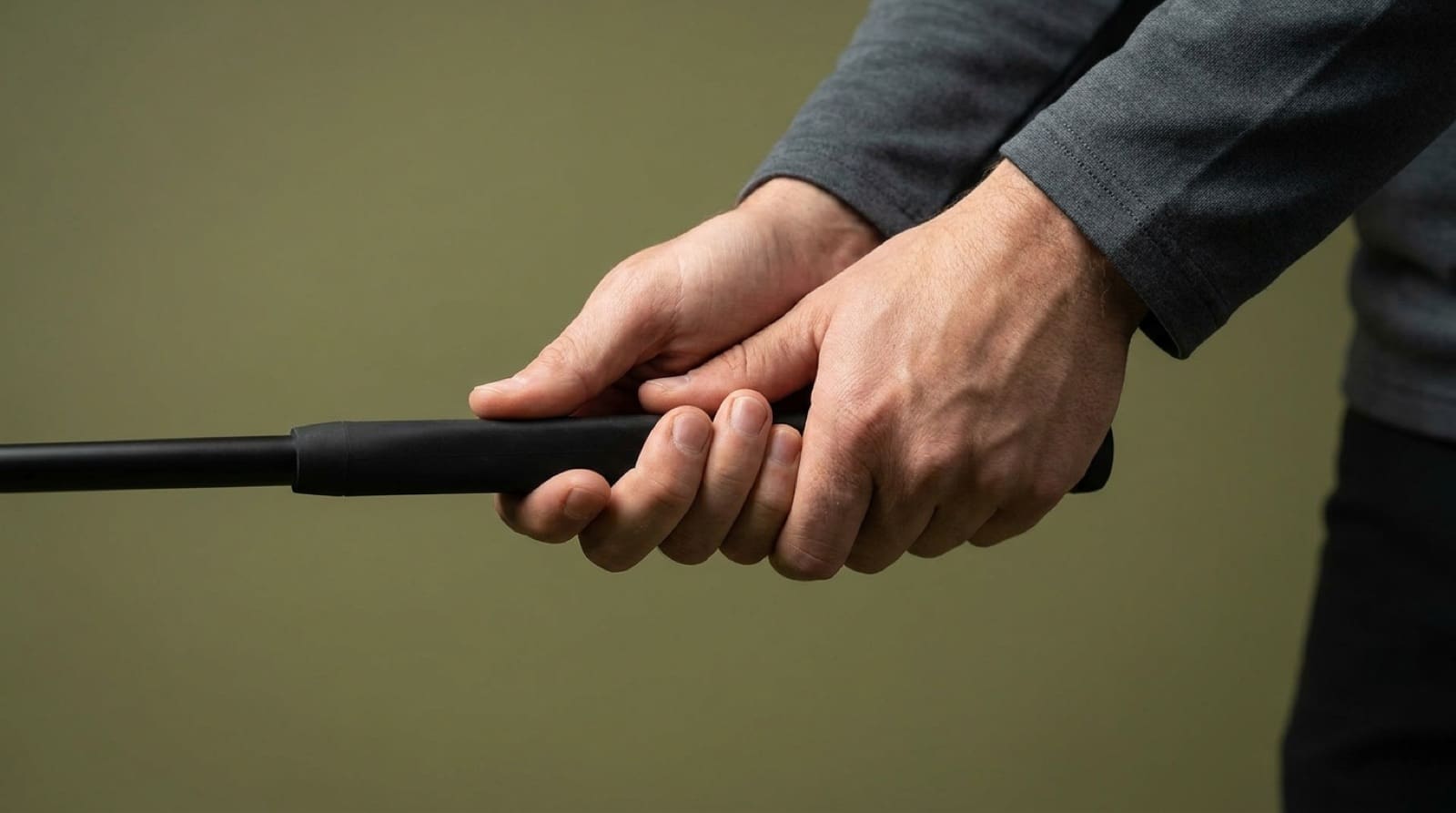
Your putting grip has one job: return the face square, because the putter face sets 83 to 92 percent of where a putt starts. That means holding the club in the palms, not the fingers, with light, even pressure (3 to 5 of 10) so the wrists stay quiet and the stroke runs off the shoulders. Start with the conventional reverse overlap. Move to a claw, cross-hand, or arm-lock grip only to fix a specific fault, and change one variable at a time.
The five putting grips at a glance
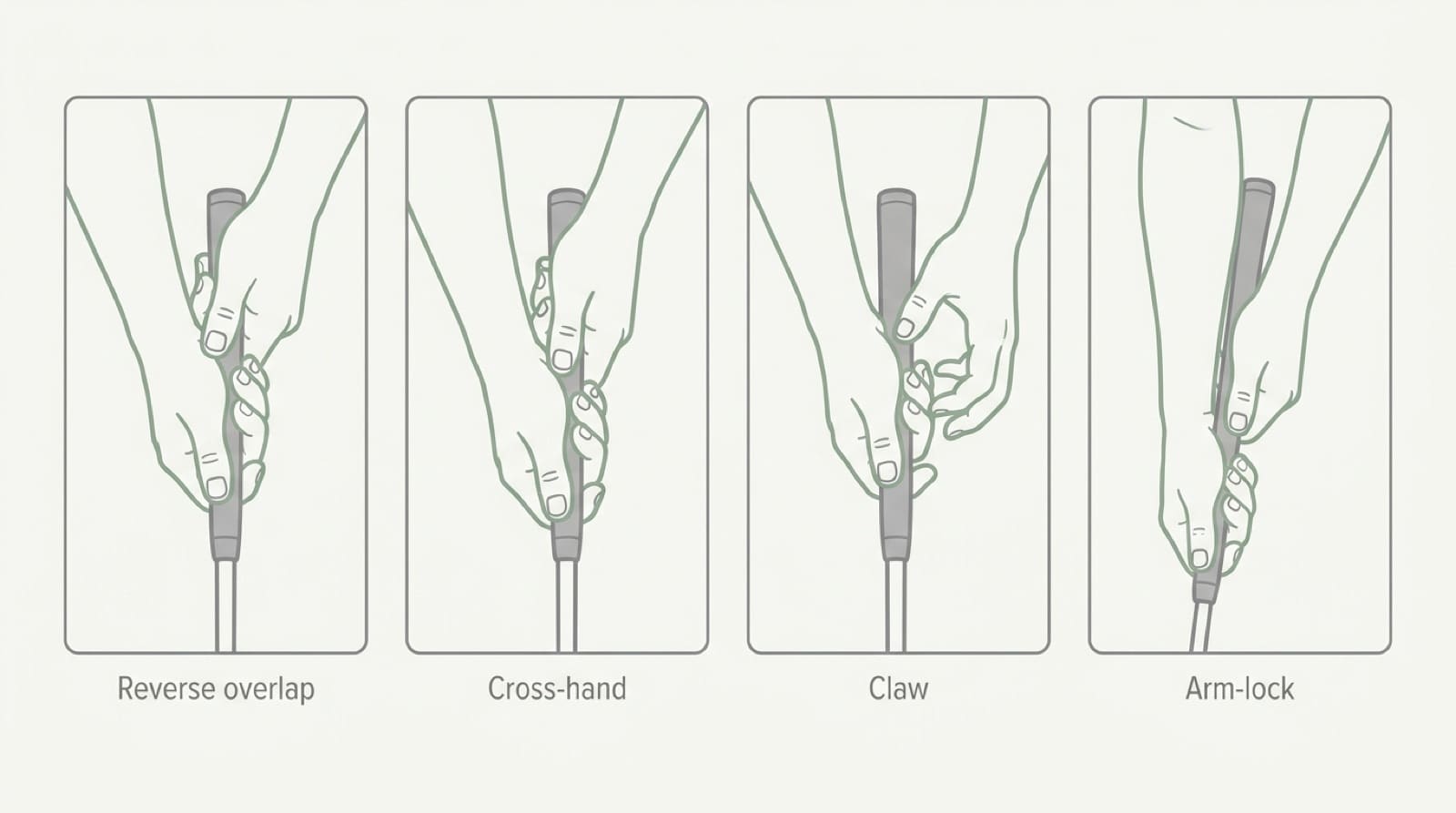
| Grip | Hand arrangement (right-handed) | What it fixes | Used on tour by |
|---|---|---|---|
| Reverse overlap (conventional) | Lead hand on top, trail below, lead index over trail fingers | The default; binds the hands, quiets hand roll | The widest tour standard |
| Cross-hand / left-hand-low | Lead hand below the trail hand | Firms a breaking-down lead wrist; levels shoulders | Jordan Spieth |
| Claw / pencil | Trail hand pinches side or top of grip | Neutralizes an overactive trail hand | Justin Rose, Scottie Scheffler, Tommy Fleetwood |
| Prayer / palm-to-palm | Both hands level, on opposite sides | Levels the shoulders, equalizes pressure | Mostly a training drill |
| Arm-lock | Long grip rests against the lead forearm | Removes wrist break and hand flinch | Bryson DeChambeau, Keegan Bradley |
Why the putting grip is nothing like your full-swing grip
The face is almost the whole game on the greens. Modern putting labs have measured how much of a putt’s start line comes from the face versus the stroke path, and the answer is lopsided: SAM PuttLab puts it at 83 percent face, TrackMan at 87 percent, and Quintic Ball Roll at 90 to 92 percent on a center strike. Putting coach Phil Kenyon rounds it to about 90 percent. The exact figure moves with the model, but every system agrees the face dominates.
That flips the purpose of the grip. In the full swing your grip controls the face too, but it does so while letting the wrists hinge and the hands release to add speed and square a fast-moving clubhead. Putting is a slow, small motion where speed is irrelevant and any hinge or release is noise. So the putting grip has the opposite assignment: hold the face dead square and take the hands out of it.
Run the numbers and the tolerance is measured in single degrees. Quintic found a face just 2 degrees open at impact misses the hole from 5 feet, and at 8 feet the face has to be under 1 degree off. Your hands are the only thing touching the club. A grip that lets them twist even slightly is the difference between a make and a lip-out.
What a good putting grip actually does
A good putting grip turns the club into an extension of your forearms instead of a lever hinged at your wrists. The cue instructors use is that at address the grip should visually disappear into your lead forearm, with a straight line running from the shaft up the arm. When that line is intact, the small wrist joints cannot easily add motion, and the stroke is driven by the bigger, steadier shoulder and arm segments.
Two build details make that happen. The club sits in the palms, not the fingers. A putter buried in the palms with the heel pad on top locks the wrists; a putter down in the fingers frees them to hinge, which is what you want for a wedge and never for a putt. And the palms oppose each other with both thumbs straight down the flat front of the grip, so neither hand can rotate the face on its own.
The reverse overlap is the conventional way to bind the hands together. Instead of the trail pinky sitting over the lead index the way a full-swing overlap does, the lead index finger lays across the trail-hand fingers. Golf.com notes it “helps prevent the potential rolling of the hands, and keeps the grip more in each palm for increased control.” That anti-rotation, palm-biased hold is the foundation under every style below.
The five putting grip styles
Conventional reverse overlap
This is the default, and for most golfers it should stay the default. Lead hand on top with the thumb down the front, trail hand below with its thumb down the front, and the lead index finger overlapping the trail-hand fingers. It keeps the club in the palms, ties the hands into one unit, and delivers a square face without any hand manipulation. It is also the most widely used grip on tour. If your start line is reasonable and your face is not visibly twisting, there is no reason to leave it.
Cross-hand (left-hand-low)
Flip the hands so the lead hand goes below the trail hand. Moving the lead hand closer to the putter head firms the lead wrist and makes it far harder to break down through impact, and dropping the trail hand higher up quiets its influence. It also tends to level the shoulders, which squares the stroke’s path. Jordan Spieth built a major-winning putting career on left-hand-low, and it is the standard first move for a player whose lead wrist flips at the ball. Keep the hands touching so they work together as one unit.
Claw (and the pencil variation)
The claw exists to neutralize a trail hand that takes over. The lead hand stays conventional on top, but the trail hand pinches the side or top of the grip with the thumb and first two fingers rather than wrapping around it. That repositioning strips the trail hand of its power to rotate the face. Golf.com’s breakdown of the claw shows how it hid Justin Rose’s wrist movement: with his trail hand rotated onto the grip, a wrist twist that used to open the face now just adds a touch of loft and leaves the face square. Scottie Scheffler, Tommy Fleetwood, and Collin Morikawa have all putted with claw-style grips. The pencil variation places the trail hand a bit more on the side for slightly more feel. The one weakness is long putts, where the quieted trail hand can make speed harder to judge, so a heavy lag putter may want a different grip.
Prayer (palm-to-palm)
Both hands sit level, on opposite sides of the grip, palms pressed toward each other like hands in prayer, thumbs down the top. Because the hands are even, the shoulders tend to level out and each hand applies equal pressure, so neither can dominate and torque the face. In practice it lives more as a training drill than a full-time grip: set your hands palm-to-palm, hit a few putts, and feel how still the face stays when the pressure comes evenly from both sides. Carry that feel back into your normal grip.
Arm-lock
Arm-lock uses a longer grip and shaft so the top of the grip rests against your lead forearm, locking the wrist angle from address through impact. With the forearm and shaft moving as one piece, the hands cannot flinch the putter offline, which is why it appeals to players fighting wrist break or the yips. Bryson DeChambeau, Webb Simpson, Keegan Bradley, and Will Zalatoris all use it. Xander Schauffele described the appeal plainly: you can flinch your hands, but you cannot flinch your entire lead arm. It is fully legal, with one nuance covered in the next section, and it is the most stable option for a badly broken stroke. The cost is a learning curve on speed, since the whole delivery feels different.
Grip pressure: hold it lighter than you think
Set your pressure at about a 3 to 5 on a scale where 10 is a white-knuckle squeeze, lighter than your full-swing grip. Brad Faxon, one of the finest putters of his generation, says most elite players he has asked sit in that 3-to-5 range, and he feels himself around a 4. He watches arm pressure as closely as hand pressure: rigid elbows and shoulders are a sign the whole system is clamped too tight.
Too tight is the common amateur mistake, and it is costly on the greens for a different reason than in the full swing. A clamped grip drowns the fine touch you need to feel the weight of the putter head, and that feel is your entire distance-control system on lag putts. Excess grip tension paired with anxiety is also one of the contributors to the yips, the involuntary hand spasms that wreck a stroke, according to the Mayo Clinic. Whatever number you pick, hold it constant from the first waggle through the finish. A pressure change mid-stroke is a face change.
Does putter grip size matter?
A bigger grip quiets the hands. Fill the palms with more material, midsize or oversize, and the wrists have less room to flex, so hand action drops and the face stays squarer. Phil Kenyon, drawing on SAM PuttLab measurement, points out that as grip size goes up, wrist flexion and extension tend to go down. Oversize grips like SuperStroke’s are engineered around that exact effect, and their no-taper designs also promote steadier, more even hand pressure.
Here is the honest read. The mechanism is well supported: larger grips demonstrably reduce wrist motion, and quieter wrists mean a squarer face. What is not published anywhere in hard numbers is how much your make rate or start-line dispersion actually improves from the grip size alone. Manufacturers and coaches report it works; nobody has put a public standard-deviation on it. So treat grip size as a real lever worth testing, not a guaranteed fix. Gate-test your face with your current grip, switch to a larger one, gate-test again, and let your own start line decide.
Is arm-lock legal? The anchoring rule, explained
The 2016 anchoring ban, now Rule 10.1b, bans a method of stroke, not a type of putter. Belly and long putters are still legal clubs. What you cannot do is anchor the club while you make the stroke, in either of two ways: holding the club or your gripping hand directly against your body, or pressing a forearm against your body to create a stable “anchor point” for the other hand to swing around.
Arm-lock does neither, which is why it survives the rule. The long grip rests against your lead forearm, and the USGA’s guidance is explicit that you may hold the club or a gripping hand against a hand or forearm. The forearm here is not braced against your torso, so there is no anchor point. Keep the hands touching or close together so they work as one unit and you stay clearly inside the rule. Cross-hand, claw, and prayer grips raise no anchoring question at all, since nothing touches the body.
Match your grip to your miss
The fastest way to pick a grip is to work backward from the fault you actually have. Neutral is the reverse overlap; everything else is a targeted fix. This decision table is the shortcut.
| Your miss on the greens | Likely cause | Grip to try |
|---|---|---|
| Start line wanders both ways, no pattern | Hands rolling the face open and closed | Reverse overlap done well, then an oversize grip |
| Pulls, a “hit” impulse at the ball | Dominant, overactive trail hand | Claw or pencil |
| Flippy short putts, lead wrist breaks down | Soft, collapsing lead wrist | Cross-hand (left-hand-low) |
| Twitches and spasms, full yips | Anxiety-driven hand spasm | Arm-lock, or a reverse claw |
| Stroke feels off-plane, shoulders tilted | Uneven hand height at address | Prayer / level hands |
The rule underneath the table: do not change grips to chase a good round, change grips to fix a repeatable, diagnosable fault. If you cannot name your miss, you are not ready to leave the reverse overlap.
How to measure your grip at home
You do not need a putting lab to know whether your grip is delivering a square face. Since the face sets roughly 90 percent of start line, a simple gate reads your start line, and mostly your face, the same principle behind Phil Kenyon’s mirrored gate.
- Build the gate. On a flat 6-foot putt, push two tees into the green about a foot ahead of the ball, just wider than your putter head, straddling your start line.
- Hit 10 putts. Roll the ball through the gate without clipping a tee, aiming for the center of the hole.
- Read the misses. Clipping the left tee means the face was closed at impact. Clipping the right tee means it was open. A ball that splits the tees but misses the hole is a read or speed error, not a face error.
- Log the number. Count how many of 10 cleared the gate and how many dropped.
- Retest after a grip change. Change one variable, give it two to three weeks, and run the same 10. If your gate rate climbs, the change is working. If it does not, revert.
That is the whole feedback loop: a grip is only better if it delivers a squarer face, and the gate is the cheapest way to see it. PracticeCaddie’s plans build this kind of measured, one-variable-at-a-time putting block into a structured session so you are not guessing whether a change stuck.
Common putting grip mistakes
- Gripping it like a full-swing club. A putter in the fingers frees the wrists to hinge, the exact motion putting is trying to remove. Move it into the palms.
- Too much pressure. Above a 5, you lose the head feel that controls distance. Firm enough to stay square, soft enough to feel the weight.
- Changing pressure mid-stroke. A squeeze on the takeaway or through impact twists the face. Hold one constant number start to finish.
- Switching grips every bad round. Grips fix diagnosed faults, not cold streaks. Give a change a few weeks of gate tests before judging it.
- Stacking changes. New grip plus new pressure plus a new oversize grip at once tells you nothing. Change one lever, measure, then move the next.
- Copying a tour pro’s grip without their problem. The claw solves an overactive trail hand. If that is not your fault, the claw is just a harder grip with no upside for you.
Key takeaways
- The face sets 83 to 92 percent of a putt’s start line (SAM PuttLab, Quintic), so the grip’s whole job is to return it square.
- Hold the putter in the palms, not the fingers. Palms quiet the wrists; fingers free them to hinge, which putting does not want.
- Start with the conventional reverse overlap. It is the tour standard and the right default until a specific fault sends you elsewhere.
- Pressure 3 to 5 of 10, lighter than your full swing. Brad Faxon and most elite putters live in that range; too tight kills distance feel and feeds the yips.
- Match the grip to the miss: claw for an overactive trail hand, cross-hand for a breaking lead wrist, arm-lock for the yips.
- Arm-lock is legal. The grip rests on the forearm, not the torso, so Rule 10.1b’s anchoring ban does not touch it.
- A bigger grip quiets the wrists, but the dispersion payoff is unproven in public data, so gate-test before and after and let your own start line decide.
- Change one variable and measure it. Give any grip change two to three weeks of gate tests before you keep or scrap it.
Frequently asked questions
What is the best putting grip for a beginner?
Start with the conventional reverse-overlap grip, the tour standard. Place the lead hand on top with the thumb down the flat front of the grip, the trail hand below with its thumb down the front too, and lay your lead index finger across the trail-hand fingers. Hold it in the palms, not the fingers, so the wrists stay quiet, and squeeze at about 3 to 5 out of 10. It is the most widely taught grip, it keeps the face square without manipulation, and every other style is a fix you move to only if a specific problem shows up.
What does the claw putting grip do?
The claw neutralizes an overactive trail hand. The lead hand stays on top as normal, but the trail hand pinches the side or top of the grip with the thumb and first two fingers instead of wrapping around it. That repositioning removes the trail hand’s ability to rotate the face, so a wristy player stops twisting the putter open or closed. It is popular on tour with players like Justin Rose, Scottie Scheffler, and Tommy Fleetwood. The trade-off is feel on long putts, where the quieted trail hand can make speed harder to judge.
Is arm-lock putting legal after the anchoring ban?
Yes. The 2016 anchoring rule, now Rule 10.1b, bans holding the club or a gripping hand against your body, or pressing a forearm against your body to create a pivot point. Arm-lock does neither. The long grip rests against your lead forearm, and the rules explicitly permit holding the club against your hand or forearm. Because the forearm is not braced against your torso, the stroke stays legal. Bryson DeChambeau, Webb Simpson, Keegan Bradley, and Will Zalatoris all use arm-lock putters within the rule.
How tight should I hold a putter?
Light. Aim for about a 3 to 5 on a scale where 1 is barely holding on and 10 is a white-knuckle squeeze, and keep it lighter than your full-swing grip. Brad Faxon, one of the best putters of his era, says most elite players sit in that 3-to-5 range and feels himself around a 4. Soft arms and shoulders matter as much as soft hands. Grip too tight and you lose the sense of where the putter head is in space, which wrecks distance control and, under pressure, feeds the yips.
Does putter grip size matter?
It can. A larger grip, midsize or oversize, fills the hands and reduces how much the wrists can flex, which quiets hand action and helps the face stay square. Putting coach Phil Kenyon, drawing on SAM PuttLab data, notes that increasing grip size tends to reduce wrist flexion and extension. Oversize grips like SuperStroke’s are built around exactly that idea. The honest read: the mechanism is well supported, but no public data set puts hard dispersion numbers on the improvement. Try one, gate-test your face before and after, and keep it if your start line tightens.
How long does it take to get used to a new putting grip?
For most golfers a new grip stops feeling foreign within two to three weeks of consistent reps, though it can revert under pressure for longer. Change one variable at a time. If you are switching to the claw and also lightening your pressure and adding an oversize grip all at once, you will not know which change helped or hurt. Move one lever, gate-test your face over a few sessions, and read the trend across sessions rather than reacting to one bad round on the greens.
Related reading
- How to Grip a Golf Club: Grip Styles, Strength, and Pressure — the full-swing companion; the grip that sets your clubface for every shot off the tee and into greens, and why its job is the opposite of the putting grip’s.
- Strokes Gained: Putting Explained — where amateurs actually lose putting strokes, and why a squarer face matters most in the makeable 6-to-10-foot range.
- 10 Golf Putting Drills That Move Strokes-Gained-Putting — the make-rate gate work that pairs with the face-gate test in this post.
- 8 Lag Putting Drills That Cut Three-Putts — the speed-control side of putting, where a light, constant grip pressure does the work.
- How to Read Greens in Golf: Break, Speed, and a Repeatable Routine — once your grip delivers a square face, aiming it at the right start line is the other half of a made putt.
- Putting drills, organized by distance and skill — the companion putting drill library, with setup steps and success criteria.