
Golf Shaft Flex Chart: What Swing Speed Actually Tells You
Nine shafts, every one recommended for the same golfer, measured 23 CPM apart. The swing-speed chart is where a shaft fitting starts, not where it lands.
Quick answer
A golf shaft flex chart maps driver clubhead speed to a starting letter — roughly L below 72 mph, A at 72–83, R at 84–96, S at 97–104 and X above 105. No governing body defines those letters, so they are a shortlist, not a spec. Nine shafts that five makers’ own brochures recommended for the same golfer measured 254 to 277 CPM apart. Verify with ball flight.
Golf shaft flex chart by driver swing speed
| Flex | Driver clubhead speed | Approximate driver carry | What it means |
|---|---|---|---|
| L (Ladies) | Below 72 mph | Under 150 yd | A weight class as much as a stiffness; lightweight A and R2 shafts often fit here too |
| A (Senior, sometimes M) | 72–83 mph | 150–180 yd | The most inconsistently labelled band in the industry |
| R (Regular) | 84–96 mph | 180–220 yd | Where the average male amateur lands |
| S (Stiff) | 97–104 mph | 220–255 yd | Test R alongside it if your transition is smooth |
| X (Extra stiff) | 105 mph and up | 255+ yd | Very aggressive transitions run on to TX |
The speed bands come from True Spec Golf’s chart as published by GOLF.com, which prints them as below 72, 72–83, 84–96, 97–104 and above 105 mph. The carry column is a separate consumer comparator from Launch Point Golf, included because it’s one of the few sources that states plainly whether it means carry or total. Neither is a manufacturer standard, and the two seams in the speed column — no band covers 104.5 mph — are in the original.
Read the table as a shortlist: the two or three shafts worth putting on a launch monitor. It is a filter that narrows a wall of forty shafts down to a testable handful, and that’s the whole of its job.
Why there is no golf shaft flex standard
No governing body specifies how stiff a Regular or a Stiff has to be. Each manufacturer picks its own labels, and the test procedures behind them — clamp length, trim, grip, head weight — vary between shops as well. The GolfWorks publishes frequency-flex range charts covering more than 1,100 shafts from 27 manufacturers and says outright that the charts exist to show “the ranges for each flex and the overlap that can occur.”
The cleanest evidence of how wide that overlap gets came out of the Dynacraft/Apollo Shaft Testing Project, which measured hundreds of shafts on one set of equipment. Its authors took a single hypothetical golfer — a 240-yard driver, fast tempo, above-average ability — and pulled every shaft that five manufacturers’ own fitting brochures recommended for him. Nine shafts survived the filter. Assembled to 43 inches at D-1 swingweight, they measured from 254 to 277 CPM, with torque ranging from 2.45 to 3.60 degrees.
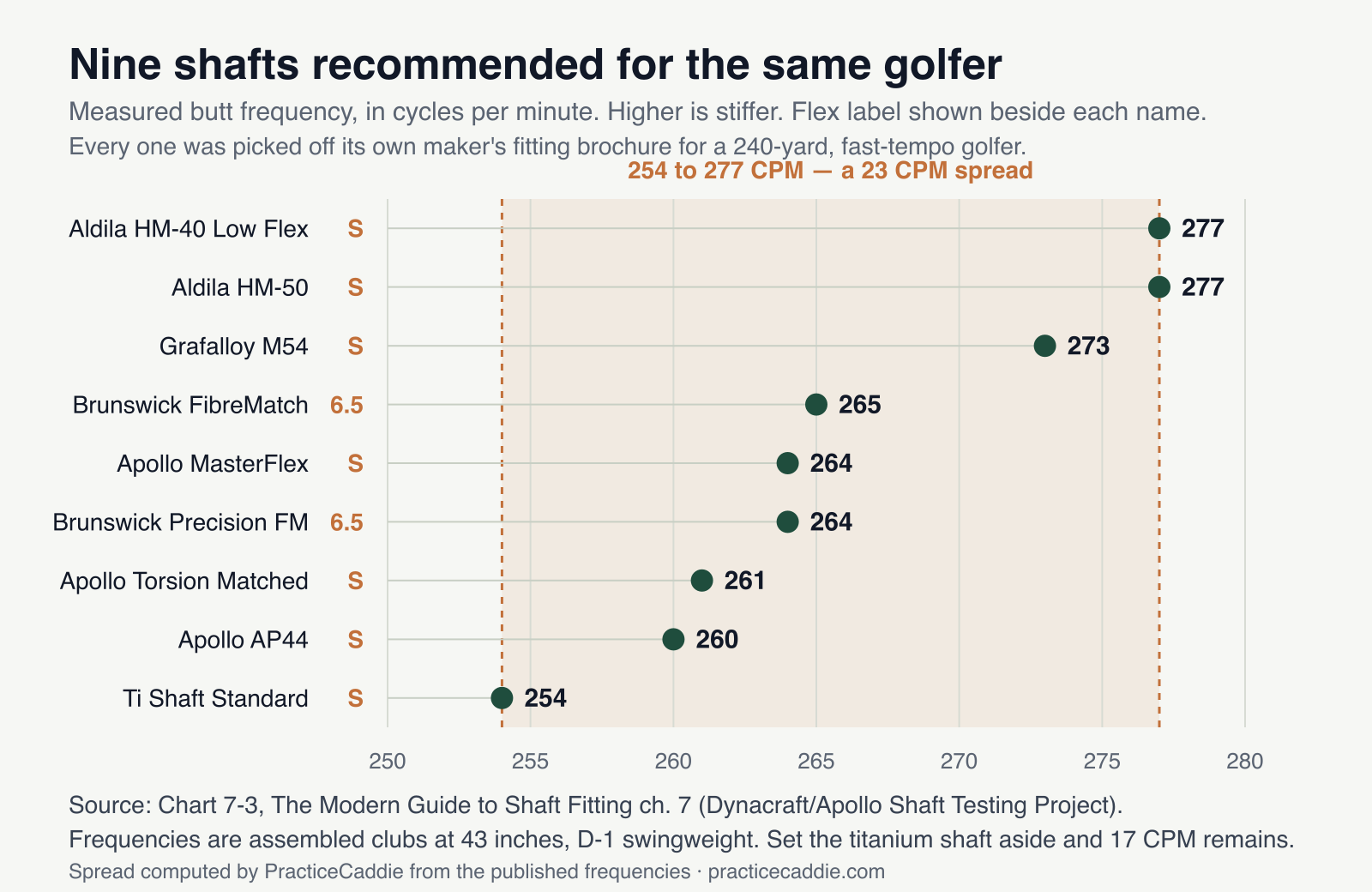
Twenty-three CPM is the gap between the softest and stiffest shaft on that list. Clubmakers working in the frequency-matching convention treat about 10 CPM as one full flex. Set aside the titanium shaft, whose low reading the source attributes to the material rather than the label, and 17 CPM remains — which the authors describe as “at least 1.5 standard flex levels.” Every one of those shafts was the maker’s own answer to the same golfer.
The overlap shows up in current catalogues too. KBS fits its MAX HL driver shaft by speed: 40 grams for 65 mph and below, 42 grams for 65–72, and 45 grams for 73–80 mph. The 45-gram model in that last band is labelled S. On True Spec’s chart, 73–80 mph is Senior flex. Wishon’s S2S White wood shafts start R at 75 mph and S at 90. Three sources, three different speeds at which a golfer becomes a stiff-flex player.
Even inside one manufacturer, one speed can produce three answers. Mitsubishi’s Diamana WB fit guide lists R for under 80 mph, R, SR or S for 81–90, S or X for 91–105 and X or TX above 106, and carries its own disclaimer: “For reference only. Mitsubishi Golf recommends being fit by a professional fitter.”
What CPM measures
Frequency testing clamps the butt of a club, pulls the tip down, releases it and counts the oscillations per minute. Higher is stiffer. Golf shafts commonly read somewhere between 200 and 300-plus CPM, and the number is a property of the assembly rather than the shaft on its own.
That last point causes most of the confusion in online arguments about flex. A shorter club oscillates faster, so a driver reading and an iron reading are different scales. Hireko’s database averages at a 39.5-inch measuring length come out at 292 CPM for a Regular steel iron and 307 for a Stiff, against 273 and 285 for the graphite equivalents. Those sit far above driver numbers. The FCM frequency-matching system was built around a 43-inch driver — its flex code 6.0 is shorthand for 260 CPM, 5.5 for 255 — and Hireko publishes its achievable ranges as R 4.0–5.5, S 5.0–6.5 and X 6.0–7.5, or 240–255, 250–265 and 260–275 CPM. Regular and Stiff overlap across a 5-CPM window by the system’s own definition. Length is what separates the iron numbers from the driver numbers: frequency climbs about 4.3 CPM per half inch of shortening, 8.6 per inch.
Reproducibility inside a single shaft is imperfect as well. True Fit Clubs reports seeing up to 8 CPM of variation from rotating one shaft in the clamp, and treats roughly plus or minus 2 CPM as a sensible tolerance within a flex. Anybody quoting you a bare number without a length, a head weight and a clamp condition is quoting an opinion.
Does shaft flex change your ball flight?
Three controlled studies have asked that question with motion capture, and their answers only look contradictory until you separate the population from the person.
Betzler and colleagues (2012) had 20 golfers hit two clubs built to differ only in bending stiffness. The softer club produced a 0.45 percent clubhead-speed increase (p < 0.001) and a 0.7 percent ball-speed increase (p = 0.008) — statistically real, and the authors’ own conclusion was that “the changes in shaft stiffness in isolation did not have a meaningful effect on the measured parameters.” The same study did measure significant face and loft differences — 0.65 degrees more open with the Ladies shaft, 0.44 degrees more loft with the X-stiff — and folded both into that verdict. Read the abstract.
Worobets and Stefanyshyn (2012) ran the bigger version: 40 golfers, 10 balls each with five drivers spanning Ladies to Extra Stiff, double-blind. Shaft stiffness significantly affected clubhead speed for 27 of the 40, loft angle for 11 of the 40, and lie angle for all 40. It showed no effect on face angle, in-to-out path, or attack angle. Among the 27 responders, the gap between each golfer’s fastest and slowest flex averaged 2.6 percent of clubhead speed.
MacKenzie and Boucher (2016) tested 33 golfers over 14 swings per shaft with an R-flex and an X-flex shaft matched for mass and moment of inertia and disguised with identical tape. The flexible shaft contributed more speed through deflection (p < 0.001) but came with slower grip rotation (p = 0.001), and the two cancelled: no significant difference in clubhead speed overall (p = 0.14). At the individual level, half the participants showed a significant difference anyway. The paper is public.
Put together, the honest read is this. Averaged across golfers, flex moves clubhead speed by a fraction of a percent and leaves club path and attack angle alone entirely. Averaged across your swings, it might be worth a couple of percent, or nothing, and there’s no published way to tell which you are without hitting both. The claims that a soft shaft hooks and a stiff one launches low come out weaker than the marketing — delivered lie changed in every golfer Worobets and Stefanyshyn tested, delivered loft in about a quarter, and face angle survived two of the three studies untouched.
Why the marketing overstates it
Consumer shaft testing produces much bigger numbers than the labs do, and the reason is sample size rather than a conspiracy. MyGolfSpy’s blinded flex test used three golfers hitting 10 shots each with R, S and X shafts matched for weight, torque and bend profile, and saw up to 22 yards of distance swing between flexes for one individual. Its most useful finding cuts against the chart at the top of this page: fitting the 110-mph-plus tester into X on speed alone would have cost him 9 mph of ball speed.
Three golfers is an anecdote with a launch monitor attached. Read those results as proof that individuals respond, not as an effect size you should expect.
Shaft weight vs flex: which one moves first?
Ask a fitter what to change before flex and most will say shaft weight, because weight sets total club weight, and total club weight changes timing and strike quality for every golfer at every speed.
GOLF ran a controlled version with 10 golfers between 2 and 18 handicap, five swings each, on 6-irons built to 85, 95 and 105 grams in both Regular and Stiff. The average gap between each golfer’s best and worst shaft was 9.2 yards of total distance and 20.2 feet of offline standard deviation. Three testers were best on 85 grams, three on 95, and four on 105. No weight won.
A peer-reviewed iron-shaft weight study found lighter shafts increased clubhead speed (p = 0.022) and ball speed (p = 0.004) on average, with the effect strongest among lower handicaps. Both things are true at once: lighter is faster on average, and the average is not your bag.
Weight also interacts with the flex you end up in. Tom Wishon’s fitting guidance is that at equal clubhead speed, an aggressive-transition golfer often fits a shaft 10 to 20 grams heavier and 2 to 3 swingweight points higher than a smooth one. This is the same lesson the PING grip study taught about grip diameter, covered in the grip size chart: the spec that gets blamed and the spec that moves the ball are frequently different specs.
Transition and tempo: why two 95-mph golfers fit different flexes
Clubhead speed is measured at impact. The shaft is loaded at the top. Two golfers can arrive at 95 mph having bent the shaft by wildly different amounts on the way, and that difference is what the letter is meant to capture.
Transition is the change of direction from backswing to downswing, and the force applied there supplies the shaft’s initial bending load. Fitters have traditionally classified it by eye as smooth, average or aggressive. The instrumented versions measure it directly: Mizuno’s Shaft Optimizer reports tempo, toe-down bending, kick angle and release each on a 1-to-9 scale, where 1 is the slowest tempo and 9 the fastest, and Mizuno describes 1 to 3 as a late release and 7 to 9 as early. True Temper’s Shaft Lab captured deflection through the downswing with strain gauges rather than inferring it from impact speed.
The practical version, if you have no access to either:
- Aggressive or hurried transition, late release — start one step stiffer than the chart says, or one step heavier.
- Smooth, gradual transition, early release — start at the chart, and test a step softer before you rule it out.
- You change gears between the range and the first tee — fit for the swing you make under pressure, which is usually the faster one.
Tempo is worth measuring on its own terms; our tempo drills post covers how to get a repeatable number out of a phone camera.
Torque, EI profile and tip stiffness
The letter on the label describes overall bending stiffness. Four other specs describe where and how it bends.
| Spec | What it measures | Typical range | The catch |
|---|---|---|---|
| Torque | Twist under a known load, in degrees. Lower resists twisting more. | About 2–6 degrees for composite shafts; Mitsubishi’s Diamana WB line spans 2.7–5.5 across weights | Clamp length and applied force differ between brands, so two torque numbers are not directly comparable |
| EI profile | Bending stiffness measured at points along the shaft | Butt stiffness is often 3–4× tip stiffness | One butt-frequency number cannot show the distribution; Wishon’s system takes seven readings at 5-inch intervals |
| Tip stiffness | Stiffness at the head end | Model-specific, published by some makers | Firm tips often lower spin for a given golfer, but “stiff tip launches low” is a tendency, not a law |
| Bend profile | Plain-language summary — firm butt, soft mid, firm tip | No standard scale | “Kick point” is a one-word compression of a curve, and it hides real differences |
Torque matters more than most golfers realise for how a shaft feels. The Dynacraft data included an R-flex Aldila Low Torque that read close to a True Temper Dynamic X-flex in frequency, and it played fine for regular-flex golfers — because its 5.85-degree torque softened the overall feel against the Dynamic’s 2.48. Frequency and torque work as a pair. Torque definitions and measuring conditions vary enough that cross-brand comparison needs care.
Why your driver flex and iron flex do not have to match
A driver swing and a 7-iron swing are separate athletic events on separate assemblies. Driver shafts run longer and lighter with smaller head weights; iron shafts run shorter and heavier. Their frequency baselines are different scales, as the 39.5-inch iron numbers above show.
True Fit Clubs’ working rule is that longer clubs often play one to one and a half flexes stiffer than shorter ones, and it names S driver with R irons as the standard case. That’s fitter experience rather than an industry rule, but it explains the common pattern: many golfers swing the driver for distance and the 7-iron for control, and the two swings load a shaft differently. Wishon’s procedure measures driver and 5-, 6- or 7-iron speed separately for that reason.
Material is a separate axis from flex. Mitchell Golf puts typical steel iron shafts at 95–130 grams with 1.5–2.5 degrees of torque and typical graphite iron shafts at 65–90 grams with 2.0–5.0 degrees. Graphite isn’t automatically soft, and steel isn’t automatically heavy — True Temper’s SteelFiber graphite iron shafts publish weights that overlap steel, while Dynamic Gold’s single “stiff” designation contains weight-sorted S200, S300 and S400 versions.
The blind flex test you can run yourself
Every study above that produced a clean result did the same thing: it hid the shaft from the golfer. Betzler’s clubs were built to differ only in stiffness. Worobets and Stefanyshyn ran double-blind. MacKenzie and Boucher matched their two shafts for mass and MOI with 6 grams of lead tape, wrapped both in identical black tape, told participants the study was about centre of pressure, and confirmed afterwards that not one of the 33 golfers had noticed the swap.
Blinding is there because a golfer who knows a shaft is stiffer swings differently at it. The same protocol, shrunk to something a range session can hold:
- Get two clubs that differ only in the shaft. Same head, same loft, same length, one flex apart, with total weight and balance matched as closely as the shop can manage.
- Hide which is which. Have someone else hand them to you and keep the record. If you’re alone, mark them A and B on tape you can’t read at address, and shuffle.
- Hit 28 drives in blocks of seven, about 30 seconds between shots and 2 minutes between blocks, at one target with your normal shape. The volume and rest intervals are MacKenzie and Boucher’s, and 28 shots is close to the minimum that survives normal scatter. Their golfers hit 14 drives before the covert swap; alternate your blocks instead, so warm-up drift lands on both shafts equally.
- Compare spread before averages. Look at the standard deviation of carry and the width of the landing pattern first. The individual clubhead-speed effect averaged 2.6 percent among the golfers who had one — about 2.5 mph on a 95-mph swing — which is smaller than the shot-to-shot noise of most amateurs across five swings.
If the two blocks come out inside each other’s spread, the flex letter isn’t your problem, and the money is better spent elsewhere. Two overlapping distributions is a finding, and it’s the finding no fitter earns a commission on. Running the same before-and-after discipline on the rest of your practice is the whole idea behind our driving range practice plan.
What a fitting costs, and when to skip it
Club Champion’s published US pricing puts a driver fitting at $175 for about 90 minutes, iron and wedge at $175, and a full bag at $400 over three hours, with promotional rates as low as $50 to $100 alongside a custom club purchase. True Spec lists $175 for a driver, $125 for a shaft-only session and $375 for a full bag without a putter. GOLFTEC’s US fittings start at $95, and it tells you to request a quote because the price varies by location.
The published gains are large, and every one of them is credited to the wrong variable. A PING fitting database summarised by MyGolfSpy reported about 11 yards of total distance, 9.5 yards of carry and a 25 percent smaller dispersion area against the golfer’s existing driver. Golf Digest’s nine-golfer study with Club Champion averaged 21 yards on the driver. Plugged In Golf’s 25-golfer analysis averaged over 16 yards. Every one of those sessions changed head, loft, length, weight, shaft and settings together, so none of the yardage belongs to the flex letter on its own.
| Your situation | The call |
|---|---|
| Buying a driver or an iron set | Book it. A $95–$175 session is small against the club, and you get to test head, loft, length, weight and shaft before you pay |
| High spin, scattered strike pattern, two-way misses | Highest expected value. Big reported gains come from correcting several mismatches at once |
| Launch, spin, strike and dispersion already look good | Lower expected return. Expect validation or a consistency gain rather than yardage |
| Not replacing the full bag | Buy the focused driver, iron or shaft-only session, not the $375–$475 full bag |
| Hoping the shaft alone delivers the advertised 20 yards | Reset the expectation before you book |
Off-the-rack is a defensible choice when your speed sits mid-band and your ball flight is already where you want it. Reading your own ball flight is the cheapest diagnostic in golf, and it will tell you whether equipment is the live question at all.
Related reading
- How to Grip a Golf Club — the pillar for this cluster; the hold that moves face angle, which no shaft change substitutes for.
- Golf Grip Size Chart — the other equipment spec golfers blame their ball flight on, and PING’s controlled test showing the effect was club weight rather than diameter.
- Golf Swing Speed Chart by Age and Handicap — where your number falls before you take it to a flex chart, with the age and handicap benchmarks behind it.
- How to Increase Golf Swing Speed — the training side, for when the answer is more speed rather than a different shaft.
- Launch Monitor Numbers Explained — smash factor, spin loft and attack angle, so the fitting bay’s screen means something to you.
- Golf Loft and Lie Explained — the spec that shaft stiffness demonstrably changed in all 40 golfers tested, and what a degree of it costs.
- How to Hit a Driver — the setup and attack angle that decide most of your driver distance before the shaft gets a vote.
- Average Golf Club Distances by Handicap — the measured-carry habit that turns equipment arguments into data.
- Senior Golf Swing Tips — where lighter, softer shafts earn their place, with the speed evidence behind the change.
- Driving Range Practice Plan — the session structure to run a blind before-and-after inside.
Key takeaways
- The chart is a shortlist. L below 72 mph, A at 72–83, R at 84–96, S at 97–104 and X above 105, per True Spec’s published bands — enough to pick two or three shafts to test.
- No governing body defines a flex letter. The GolfWorks charts 1,100-plus shafts from 27 makers specifically to show the overlap.
- Nine shafts, one golfer, 23 CPM apart. All were picked off their own makers’ fitting brochures for the same player and measured 254 to 277 CPM at 43 inches, with 2.45 to 3.60 degrees of torque.
- Charts disagree by 20-plus mph on where Stiff begins. KBS labels a 45-gram driver shaft S for 73–80 mph; Wishon starts S at 90; True Spec starts it at 97.
- CPM belongs to the assembled club, not the shaft. Steel irons averaged 292 R and 307 S at 39.5 inches, against 273 and 285 in graphite — numbers that do not translate to a driver.
- Flex is a personal-response variable. Betzler measured 0.45 percent of clubhead speed across 20 golfers and called it meaningless; Worobets and Stefanyshyn found a significant effect in 27 of 40 individuals, averaging 2.6 percent.
- Lie angle is the delivery spec stiffness reliably moves. Worobets and Stefanyshyn measured a lie effect in all 40 golfers, loft in 11, and nothing in face angle, path or attack angle. Betzler did find face angle moving 0.65 degrees and called the effect sizes meaningless.
- Weight moves before flex does. Ten golfers on 85/95/105-gram iron shafts averaged 9.2 yards and 20.2 feet between their best and worst; three, three and four testers won on each weight.
- Blind-test it or you are testing your expectations. Every clean study hid the shaft from the golfer, and MacKenzie and Boucher’s 33 participants never noticed the swap.
- A fitting is worth $95–$175 when you are buying clubs anyway. Published gains of 11 to 21 yards came from changing head, loft, length, weight and shaft together.
Frequently asked questions
What shaft flex do I need for my swing speed?
As a starting point, True Spec Golf’s published bands put Ladies flex below 72 mph of driver clubhead speed, Senior at 72 to 83, Regular at 84 to 96, Stiff at 97 to 104 and Extra Stiff above 105. Treat that as the two or three shafts worth testing rather than an answer. Manufacturers set their own labels with no governing standard behind them, so the same speed lands on different letters depending on whose chart you read.
Is regular or stiff better for a 95 mph swing speed?
Ninety-five mph sits at the top of Regular on True Spec’s chart and inside Mitsubishi’s 91 to 105 mph band, where its own guide lists S or X for the Diamana WB 63. Both letters are defensible at that speed, which is why the honest answer is to hit both. A hard, early transition and a late release push you toward the stiffer option; a smooth, gradual change of direction pushes you back toward Regular.
What CPM is a stiff shaft?
There is no universal number, because frequency is a property of the assembled club rather than the shaft alone. Length, head weight, grip and clamp all move the reading, so a driver figure and an iron figure are not comparable. In the FCM frequency-matching system, built around a 43-inch driver, Regular covers 240 to 255 CPM and Stiff covers 250 to 265 — overlapping by 5. Hireko’s separate database of finished irons averaged 307 CPM for stiff steel and 285 for stiff graphite at 39.5 inches.
Does shaft flex really matter?
It matters for some golfers and barely registers for others. Betzler and colleagues tested 20 golfers on two clubs differing only in bending stiffness and measured a 0.45 percent clubhead-speed gain for the softer shaft, concluding that stiffness alone had no meaningful effect. Worobets and Stefanyshyn tested 40 golfers across five flexes and found a significant clubhead-speed effect for 27 of them. Flex is a personal-response variable, which is exactly why a population chart cannot settle it.
What happens if your golf shaft is too stiff?
Less than the marketing suggests, and not in a fixed direction. Across the controlled studies, stiffness reliably changed delivered lie angle and often changed delivered loft, while club path and attack angle showed no effect at all. Face angle is mixed: Worobets and Stefanyshyn found none across five flexes, and Betzler measured 0.65 degrees more open with the softest shaft. In that 40-golfer test the stiffest shaft sat about 1.4 degrees more upright at impact than the most flexible.
Can I play stiff in my driver and regular in my irons?
Yes, and plenty of fitted golfers do. A driver and a 7-iron are different swings on different assemblies, so the letters were never meant to transfer. True Fit Clubs uses a working rule that longer clubs often play one to one and a half flexes stiffer than shorter ones, giving S driver with R irons as the standard example. Wishon’s fitting procedure measures driver and mid-iron clubhead speed separately for the same reason.
Is a golf shaft fitting worth the money?
For anyone about to buy a driver or an iron set, usually yes. Club Champion lists a driver fitting at $175 for about 90 minutes and a full bag at $400, and True Spec lists $175 for a driver and $125 for a shaft-only session. Published gains run from about 11 yards in a PING fitting database to 21 yards in a nine-golfer Golf Digest study, but those sessions changed head, loft, length, weight and shaft together, so none of it is attributable to the flex letter.