
10 Golf Putting Drills That Move Strokes-Gained-Putting (And the Tour Data Behind Them)
Putting is where amateurs leak the most strokes inside 30 feet. These ten golf putting drills — Faxon, Kenyon, Utley, Stockton, AimPoint — fix the leak.
Quick answer
A bucket of putts is not a drill. A golf putting drill is a structured rep with a numeric success criterion, varied distance or break, calibrated difficulty, and a logged result. The ten below — 20-in-a-row from 4 feet, the two-ball lag, the two-tee gate, the coin pace drill, around-the-world, eyes-closed putting, the gate-into-cup combo, the distance ladder, the tee-fan break read, and a par-18 nine-hole pressure game — are the ones tour-level putting coaches actually use. Each one attacks strokes-gained-putting, where amateurs leak the most strokes per round inside 30 feet.
The ten at a glance
| Drill | Skill it trains | Origin / coach | |
|---|---|---|---|
| 1 | 20-in-a-row from 4 feet | Make rate under cumulative pressure | Brad Faxon / Phil Kenyon (modern canonical) |
| 2 | Two-ball lag (30+ feet) | Three-putt avoidance, speed control | Generic; framed against Arccos / Shot Scope amateur lag data |
| 3 | Two-tee gate | Start-line precision and face-at-impact control | Phil Kenyon, Stan Utley, Mark Sweeney variants |
| 4 | Coin / back-of-cup pace drill | Pace control on holed putts | Dave Pelz wedge-and-putter laboratories |
| 5 | Around-the-world (six-ball circle) | Break read and face calibration across angles | Brad Faxon practice routine |
| 6 | Eyes-closed putting | Feel for stroke length and external focus | Dave Stockton / VISION54 |
| 7 | Gate-into-cup combo | Start-line plus speed under one constraint set | Phil Kenyon coaching variant |
| 8 | Distance ladder (3-6-9-12-15 ft) | Make rate across the scoring zone | Mark Broadie strokes-gained framework |
| 9 | Tee-fan / manila-folder break read | Visualizing and committing to break | AimPoint (Mark Sweeney) green-reading methodology |
| 10 | Par-18 nine-hole pressure putting | Score-pressure transfer under cumulative scoring | Adapted from VISION54 (Pia Nilsson and Lynn Marriott) |
Why putting is the largest score lever inside 30 feet
Most amateur range time is misallocated. Drivers eat the first twenty minutes of every range session for most weekend players. Then irons. Putting often gets a five-minute warmup before the first tee, if it gets anything at all. The strokes-gained map says that allocation is exactly backwards.
Mark Broadie’s strokes-gained framework, introduced in Every Shot Counts (2014) and now standard across PGA Tour and amateur analytics, accounts for putting separately from the rest of the bag. Putts make up roughly 40 percent of the strokes in a typical round. Broadie’s Columbia paper on putting strokes-gained sets the baseline make-rates that every modern putting drill is calibrated against.
PGA Tour ShotLink data summarized at Golf.com puts current Tour make-rates at:
| Distance | PGA Tour make % |
|---|---|
| 3 ft | 99.4% |
| 4 ft | 91.4% |
| 5 ft | 80.7% |
| 6 ft | 70.2% |
| 8 ft | 54% |
| 10 ft | 41.3% |
| 15–20 ft | 18.3% |
| 25+ ft | 5.5% |
Source for 8-foot figure: PGA Tour 2021–22 data summarized at MyAvidGolfer.
Shot Scope’s amateur make-rate database — drawing from a 90-million-shot amateur dataset — shows the pattern from the other end. Where PGA Tour pros convert at roughly 91 percent from 4 feet and 81 percent from 5 feet, mid-handicaps drop into the 60s and 50s by the same yardage. The gap widens fastest in the 4-to-10-foot zone — exactly the band where every drill below is calibrated.
Lou Stagner’s Arccos analysis — drawn from one of the largest aggregated amateur shot datasets in golf — shows three-putt frequency rises sharply as handicap climbs. Three-putts overwhelmingly originate from outside 30 feet and from missed first putts that leave a long second. Drill time should follow the leak, not the fun of crushing drivers.
What separates a putting drill from putting
The pillar version of this argument lives in 10 Golf Practice Drills Tour Coaches Actually Use. Applied specifically to putting, the same four properties separate a drill from “I rolled some putts before the round”:
- Numeric success criterion. “20 in a row from 4 feet, miss restarts at zero” is a drill. “Working on my putting” is not. The body needs a goal-state to pattern-match against, and the mind needs a number to chase.
- Varied distance and break, not just one straight repeat. Most amateurs run their drills off a flat 6-footer and then face downhill left-to-righters on the course. Move the ball around the cup; rotate breaks. Contextual-interference research (Shea & Morgan, 1979) shows that variability built into the drill produces better retention and transfer than blocking one putt shape.
- Calibrated difficulty. A drill where you make 9 of 10 is too easy; the body has nothing to learn. A drill where you make 1 of 10 is too hard; you train misses. Tune the success criterion until you sit somewhere between 4 and 7 out of 10 on performance drills, or use a count-based pressure drill where the difficulty is the streak itself.
- Logged result. Without a number per session, the only signal is in-session feel — and feel rewards block practice precisely because block produces the strongest in-session performance. The log is what survives the variability discomfort window in weeks two and three.
A putting drill that satisfies all four properties converts the science into a usable rep. A drill that satisfies none is a warmup.
The ten putting drills
1. 20-in-a-row from 4 feet — make rate under cumulative pressure
Origin. A canonical short-putt drill in modern tour-level putting coaching. Brad Faxon — one of the great putters of the 1990s and 2000s and a longtime mentor to Rory McIlroy on the greens — uses count-streak drills as a pressure mechanism. Phil Kenyon, whose tour client list runs through McIlroy, Justin Rose, Tommy Fleetwood, Matt Fitzpatrick, Brooks Koepka, Henrik Stenson, Francesco Molinari, Gary Woodland, and Scottie Scheffler, teaches the same family. The drill is generic enough that it shows up in nearly every modern putting academy; Mark Broadie’s strokes-gained data supplies the why.
What it trains. Make percentage at the distance where score impact is largest, with cumulative pressure as the rep count grows.
How to run it. Find a flat 4-footer on the practice green. Make twenty consecutive putts. A miss restarts the count at zero — no “well, I had nineteen, that counts” mercy rule. The pressure builds organically as the count climbs. Most mid-handicaps fail somewhere between the eighth and fifteenth putt the first time they run the drill.
Success criterion. 20 in a row before leaving the green. Beginners: 10 in a row. Single-digits: 30 in a row, then layer in a 5-foot version.
Why it works. PGA Tour data places 4-footer make rates around 91 percent — meaning even at the highest level, the math says one of every eleven attempts will miss unaffected by pressure. The drill bakes pressure in because the count restarts on a miss; the cumulative pressure as the streak climbs is what makes it transfer. The 4-to-10-foot band is also where Shot Scope’s amateur dataset shows the make-rate gap between scratch and double-digit handicaps is largest, so the drill targets the exact zone where score actually moves.
2. Two-ball lag from 30+ feet — three-putt avoidance
Origin. A long-standing lag-putting drill taught across nearly every major putting academy. The version below is calibrated against Arccos data showing higher-handicap players average several three-putts per round. Three-putts are the fastest stroke leak in amateur scoring, and three-putts overwhelmingly originate from outside 30 feet.
What it trains. Speed control on long putts, and the first-putt-to-second-putt distance that determines whether the second putt is a tap-in or a knee-knocker.
How to run it. Find a 30-to-50-foot putt on the practice green. Place a tee 3 feet short of the cup and another 3 feet long, defining a 6-foot landing zone. Roll five putts; the goal is for each ball to come to rest inside the 6-foot zone. Run a second set with a different target on a different break. Track the worst miss as well as the average — the worst is the one that becomes a three-putt on the course.
Success criterion. 4 of 5 inside the 6-foot zone. Single-digits should tighten to a 4-foot zone. The honest read for mid-handicaps is that this drill is harder than it looks the first time.
Why it works. Lag putting is a calibration problem more than a stroke problem. The body is trying to map green speed and slope to backswing length. The 6-foot landing zone is the proximity at which the resulting second putt — even with break — sits inside Tour-level make rates. The drill treats lag putting as a measurable skill instead of a feel exercise.
3. Two-tee gate — start-line and face-at-impact control
Origin. Used by most modern putting coaches. Phil Kenyon, Stan Utley, and Mark Sweeney all teach gate variants. The principle is older than any of them; it traces back to constraints-led skill acquisition (Newell; Davids and colleagues), which says a physical constraint that allows only the desired motion patterns the stroke faster than verbal cueing.
What it trains. Start-line precision. If the ball does not start on the intended line, no green-reading system in the world will save the putt. Face angle at impact is the dominant determinant of where the ball starts; high-end putting analyzers like SAM PuttLab consistently show face angle accounting for the large majority of start-line direction.
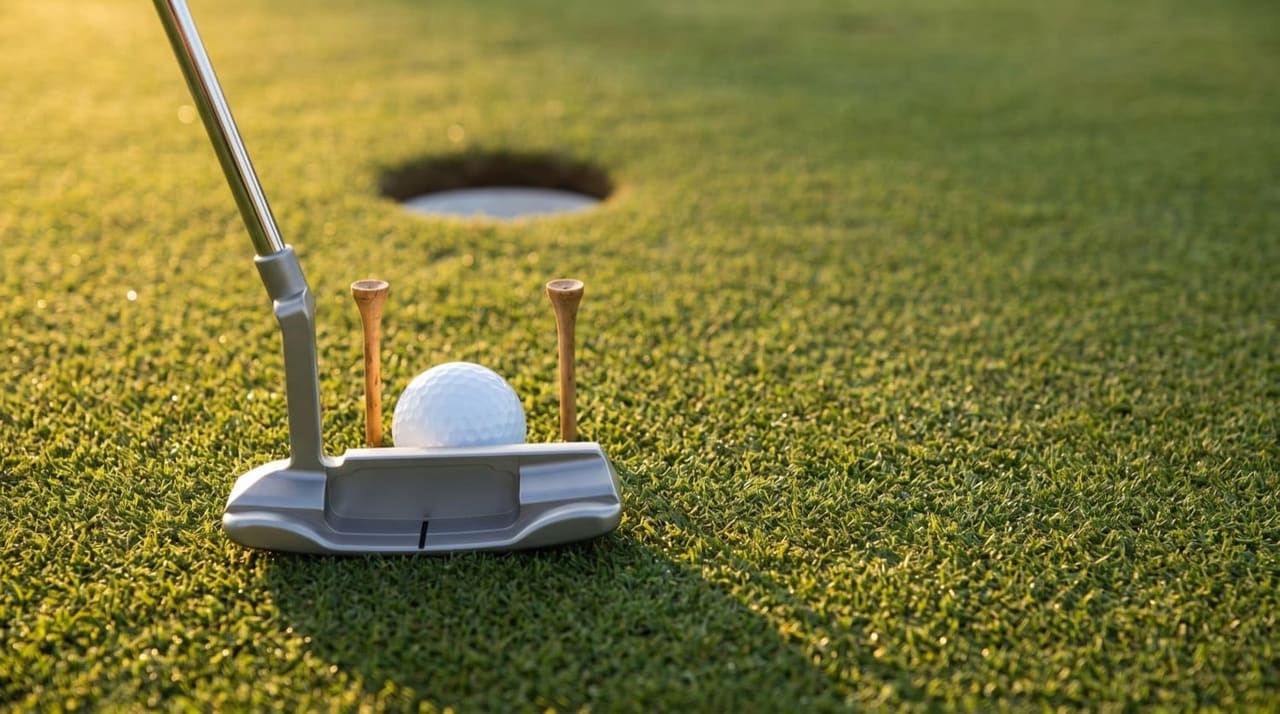
How to run it. Place two tees in the ground about 12 inches in front of your ball, just wider than the ball — a common spacing is the width of two ball-widths plus a hair. The intended line runs through the gate. Pick a target 6 to 10 feet beyond the gate. Hit ten putts. The ball must roll cleanly through the tees, not graze either one.
Success criterion. 8 of 10 through the gate cleanly. Tighten the gate to ball-width-plus-a-quarter-inch for single-digits. A ball that consistently misses the gate to the same side is a face-angle problem at impact, not a path problem.
Why it works. Two simultaneous constraints — start line (the gate) and outcome (rolling at the target) — without overlapping. The drill also exposes face issues quickly: a player who pulls the ball through the gate left has an open-to-path face-angle problem; a player who pushes it right is shut. The gate is faster diagnostic than video.
4. Coin / back-of-cup pace drill — pace control on holed putts
Origin. Generic across short-game academies. The principle traces to Dave Pelz’s mid-1980s and 1990s research, popularized in Putt Like the Pros — that the optimal pace on a made putt is one that would carry the ball roughly 17 inches past the cup if the cup were not there, the speed at which the ball still has enough roll energy to hold the line in the last foot but not so much that it lips out. Pace control on holed putts is its own discrete skill, separate from start-line and read.
What it trains. Pace such that the ball drops in the front of the cup or just past center, not pace that crashes the back of the cup or dies short.
How to run it. Place a coin or a tee on the green about 17 inches beyond the cup, on the same line as the putt. Hit ten 6-to-10-foot putts. The made putt is “good” only if the imagined continuation of its line would have stopped roughly at the coin — a putt that holed but would have rolled 4 feet past does not count, and neither does one that died at the front lip.
Success criterion. 6 of 10 in the “good pace” zone — pace that drops the ball in or would have stopped it within 12 inches past. The criterion is more about pace than make rate; treat made-but-too-fast as a failure for this drill.
Why it works. The most consistent dropping pace also gives the largest effective hole — the ball can catch the side of the cup at moderate speed and still drop, while the same break at faster speed lips out. Calibrating pace as a separate skill, with its own numeric criterion, is what produces the make-rate ceiling tour pros sit on.
5. Around-the-world (six-ball circle) — break read and face calibration
Origin. A practice routine widely associated with Brad Faxon, who used variants throughout his playing career and now teaches them. Six balls equally spaced around a cup at 4 to 6 feet — straight, hard left-to-right, soft left-to-right, straight from the other side, hard right-to-left, soft right-to-left. Every break shape is in a single drill.
What it trains. Break read and face calibration across all six putting angles. The same 6-foot putt is six different problems depending on the break, and most amateur drills only run the straight one.
How to run it. Pick a cup with mild break. Place six balls equally around the cup at 4 to 6 feet — twelve, two, four, six, eight, ten o’clock if you visualize the cup as a clock face. Putt all six in order. A miss anywhere restarts the lap. Run two laps cleanly and you are done.
Success criterion. Two clean laps in a row (12 of 12). Beginners: one lap. Single-digits: three laps in a row at 6 feet, or two laps at 8.
Why it works. Built-in variability across every break angle inside one drill — the textbook contextual-interference setup. The pressure compounds because a miss on the sixth putt of the second lap costs everything; players quickly learn that the “easy” straight putt is actually the hardest one to commit to under pressure because the read provides no cover for a sloppy stroke.
6. Eyes-closed putting — feel for stroke length and external focus
Origin. Dave Stockton, Unconscious Putting (2011), is the modern reference for the philosophy that excessive conscious thought during the putting stroke impairs performance. VISION54 (Pia Nilsson and Lynn Marriott) teaches a related family of feel drills. The eyes-closed putt itself is much older — every era of coaching has some version.
What it trains. Feel for stroke length and external focus on the target. With eyes closed, the body cannot reach for visual feedback during the stroke; it has to commit to the read and let the stroke run.
How to run it. Set up to a 6-foot putt. Read it normally — pace, line, break. Take your address, look at the hole, look back at the ball, and close your eyes before the takeaway. Putt. Do not open your eyes until you hear the ball or guess where it stopped. Hit ten. Then hit ten with eyes open and notice how the open-eye reps now feel quieter and more committed than your starting putts.
Success criterion. 6 of 10 on a 6-footer with eyes closed. The eyes-open transfer phase is the point — the goal is for the next 5 to 10 normal-eye putts to feel as committed as the closed-eye reps.
Why it works. Wulf, Lauterbach & Toole (1999) and the broader external-focus literature show that focusing on the outcome (the cup, the line) produces better motor performance than focusing on body mechanics (the wrists, the shoulders). Eyes-closed putting strips out the mid-stroke visual check that lets internal focus creep back in. The post-drill transfer reps are where the new pattern shows up.
7. Gate-into-cup combo — start-line plus speed under one constraint set
Origin. A Phil Kenyon coaching variant — start-line and pace folded into the same drill so the player cannot fix one at the expense of the other. Common in elite putting academies.
What it trains. Start-line through the gate AND pace that carries the ball into the cup. Either failure is failure.
How to run it. Place the two-tee gate from drill #3 about 12 inches in front of the ball. Place a target — a coin, an alignment-stick laid on the green, or just visualize the cup at 8 feet. The putt must roll cleanly through the gate AND end inside or within 18 inches of the cup. Hit ten.
Success criterion. 7 of 10 satisfying both constraints. A ball through the gate that died short does not count; neither does a ball with the right pace that grazed a tee.
Why it works. Combining start-line and pace into one constraint set prevents the subconscious trade-off where a player favors one. On the course, the only metric is “did it go in,” and the drill matches that — clean line plus correct pace, judged together. The drill also exposes the most common short-putt leak: pulling the ball under-line on a putt where the player decelerated trying not to run it past.
8. Distance ladder (3-6-9-12-15 ft) — make rate across the scoring zone
Origin. Calibrated against Mark Broadie’s strokes-gained-putting framework. The five distances span the make-zone where amateur and tour-pro performance diverges most sharply on a per-attempt basis.
What it trains. Honest make-rate measurement across the full scoring zone. Most amateurs over-practice the 6-footer and under-practice the 12-footer; the ladder forces honesty.
How to run it. Place a ball at 3, 6, 9, 12, and 15 feet from the cup along the same line. Putt the 3-footer, then walk to 6 and putt, then 9, then 12, then 15 — one rep per distance per round. Run five full rounds. Track make rate per distance over the 25 putts.
Success criterion. Compare your make rate per distance against the PGA Tour benchmark: 99% / 91% / ~50% / ~30% / ~25%. The closer your numbers track, the closer your putting is to a tour-level putter — at least on the practice green. Most mid-handicaps land 5 of 5 / 3 of 5 / 1 of 5 / 0 of 5 / 0 of 5 the first time and improve unevenly.
Why it works. Honest measurement of the metric the strokes-gained framework cares about. The progression also rehearses the cognitive shift between “make putts” (3 to 6 ft) and “two-putt putts” (12 to 15 ft) — a shift that determines whether the player tries to pour the ball into the cup or rolls it inside the leave-zone.
9. Tee-fan / manila-folder break read — visualizing and committing to break
Origin. Variants are taught across modern green-reading systems including AimPoint, the geometric-aided green-reading methodology popularized by Mark Sweeney since the late 2000s. The manila-folder version uses a folder laid flat on the green at the apex of the break to make the visual line concrete; the tee-fan version uses tees arranged along the curve.
What it trains. Reading the apex of the break and committing to a starting line that is not the cup. Most amateur missed-make putts under-read break by 30 to 50 percent — they aim too close to the cup and watch the ball trickle off the low side.
How to run it. Pick a 10-to-15-foot putt with at least 6 inches of break. Read the line normally. Place a tee at the apex — the highest point along the curve the ball must travel through. Place a second tee 6 inches above and a third 6 inches below the apex; this is the “fan” of acceptable starting lines. Putt five balls; the line must pass through one of the three tees and the ball must finish inside a 3-foot circle around the cup.
Success criterion. 4 of 5 putts pass through the tee fan AND end inside the 3-foot circle. Single-digits should narrow the fan to two tees; AimPoint-trained players often skip the fan entirely and use a single apex marker.
Why it works. Concrete visual targets at the apex force the player to commit to a line that is not the cup, which is the single biggest mental block on breaking putts for most amateurs. The fan acknowledges that read precision has a tolerance; the 3-foot finish circle keeps pace honest.
10. Par-18 nine-hole pressure putting — score-pressure transfer
Origin. Adapted from VISION54’s worst-ball game (Pia Nilsson and Lynn Marriott) and from short-game academies that use scored nine-hole drills. Cousin of the par-18 short-game game in the pillar post — this version is putting-only.
What it trains. The complete putting sequence — first putt, then second putt — under nine-hole scoring pressure. The drill makes “did it go in or did it two-putt” a number you can chase across sessions.
How to run it. Pick nine starting positions around a practice green at distances ranging from 8 to 30 feet. Vary the breaks. Drop a ball at each; putt out. Score per hole: par is 2 (one putt + tap-in or two putts). Birdie is 1, par is 0, bogey is +1, double is +2. Total par is 18.
Success criterion. Beat your previous best across four sessions. Mid-handicaps typically score +6 to +12 the first time and move to +0 to +4 across six weeks. Single-digits should aim for under-par across eight sessions.
Why it works. Specificity, scoring pressure, and feedback in one rep. The first-putt-then-second-putt sequence is the unit of putting on the course; the drill makes it the unit on the practice green. The scoreable number is what makes the skill change stick across sessions instead of staying as range-only feel.
How to combine drills into a putting session
Two drills per session, never more. The standard split for a 20-to-40-minute putting session:
- One technique drill. Two-tee gate, coin pace drill, or eyes-closed feel — 15 to 25 putts. The drill that attacks your specific failure pattern.
- One performance drill. 20-in-a-row, around-the-world, distance ladder, or par-18 — until the criterion is met or the time runs out.
The session principle, drawn from the block-vs-random practice literature: block work early in the session for a new pattern, random work for the bulk of reps once the pattern is reliable. Beginners weight more block; single-digits more random; mid-handicaps sit in the pivot zone. The handicap-by-handicap weekly cadence and how the putting block fits inside it lives in the driving range practice routine guide.
The contextual-interference effect, the spacing effect, and the deliberate-practice framework converge on the same prescription: short, varied, focused putting drills distributed across the week, with measurable success criteria and an honest log. A bucket of 200 putts without those properties is exercise, not practice. — synthesized from Schmidt & Lee, Motor Control and Learning, and Ericsson et al., Psychological Review, 1993
What the research says about putting practice
Three findings drive every drill above:
- External focus beats internal focus. Wulf, Lauterbach & Toole (1999) had two groups of golfers practice an unfamiliar shot. The group focused on the club (external) outperformed the group focused on the arm swing (internal) on a 24-hour retention test. A 2024 review by Wulf summarizes 25 years of replication. Cue the cup, the apex, the gate — not the wrists or the shoulders.
- Random practice retains better than block practice. The contextual-interference effect — studied across dozens of motor tasks (Shea & Morgan, 1979; Goode & Magill, 1986) — predicts that mixing distances, breaks, and drill types in a session produces worse in-session feel but better retention than blocking 20 reps of one distance. Putting-specific replications remain limited, but the pattern is one of the most consistently replicated findings in motor-skill research.
- Distributed practice retains better than massed. Cepeda et al.’s 2006 meta-analysis in Psychological Bulletin found a spacing-effect size of d ≈ 0.78 across 184 studies and 14,000+ participants. Most of those studies were verbal-recall tasks, not motor skills, so direct transfer to putting is an inference — but the recommendation it points to (split the session, don’t mass it) is consistent with how tour pros actually practice their putting.
A clean putting program threads all three: external cueing through gate constraints, apex tees, and pace targets; varied distance and break inside each drill; and short sessions distributed across the week.
Common amateur putting-drill mistakes
- No success criterion. “I’m working on my putting” is not a drill. “I’m running 20-in-a-row from 4 feet, miss restarts at zero” is.
- Same straight putt every rep. A drill from a flat 6-footer trains a flat 6-footer. The course gives you downhill left-to-right with a back pin and grain. Rotate the cup, rotate the break, rotate the distance.
- Too many drills per session. Six drills in one session is a tour of the practice green, not practice. Two is the limit.
- Decelerating into the ball. Fear of running the putt past produces a tentative stroke, weak roll, and a putt that comes up short anyway. Pace target is the fix; gate work plus the coin drill catches it.
- Treating make rate as the only metric. A made putt with the wrong pace is a near-miss next time. Pace and start-line are separate measurable skills; track them separately on technique drills.
- Skipping the routine on practice putts. A practice putt without the full pre-shot routine trains the routine to fail under pressure. Tour pros run the same routine on a 4-foot drill putt that they run on the back nine of a major.
- Steeply sloped indoor mats only. Indoor putting mats with built-in uphill bias hide pace problems. The drill teaches a stroke that pushes into the slope; the green does not. Real green time, even ten minutes a week, beats hours on a sloped mat.
Key takeaways
- Putting is the largest score lever inside 30 feet. Putts are roughly 40 percent of strokes per round; the make-rate gap between scratch and double-digit handicaps is largest in the 4-to-10-foot zone.
- A drill needs four properties to transfer: numeric success criterion, varied distance or break, calibrated difficulty, and a logged result. Drills that satisfy all four transfer; drills that satisfy none stay as range-only reps.
- The ten drills above cover make rate (20-in-a-row, around-the-world, distance ladder), technique (two-tee gate, gate-into-cup combo, coin pace), feel (eyes-closed), reading (tee-fan break read), lag (two-ball lag), and pressure (par-18). Pick two per session.
- External cueing beats internal cueing in motor-learning research. Cue the cup, the apex, the gate — not the wrists or the shoulders.
- Random beats block for retention once the basic stroke is reliable. In-session feel will get worse for two to three weeks before retention starts to outpace block. Trust the log.
- Twenty to forty minutes is the working window. Past 40 minutes, pace control drifts and tentative strokes start to groove the wrong pattern.
- Short and frequent beats long and rare. Three 20-minute sessions a week move the metric faster than one 90-minute session.
Frequently asked questions
What are the best golf putting drills?
The best golf putting drills share four properties drawn from motor-learning research: a numeric success criterion (e.g., 20 in a row from 4 feet), built-in variability across distance and break, calibrated difficulty so failure happens, and a logged result. The most-cited examples used by tour-level putting coaches are the 20-in-a-row 4-foot drill, the two-ball lag, the two-tee gate, the coin or back-of-cup pace drill, the around-the-world ladder, eyes-closed putting, the distance ladder, the tee-fan break read, and a par-18 nine-hole pressure game.
Why are putting drills so important for amateurs?
Putting accounts for about 40 percent of the strokes played in a typical round, and the skill gap between scratch and double-digit handicaps is largest in the 4-to-10-foot make zone. PGA Tour pros make roughly 91 percent of putts from 4 feet and 81 percent from 5 feet, while mid-handicaps drop into the 60s and 50s by the same yardage. Three-putts compound the leak. Drill time spent on putting has a higher per-minute strokes-gained payoff than nearly any other range allocation for amateur players.
How long should a putting practice session be?
Twenty to forty minutes. Quality drops sharply past 40 minutes for most amateurs because tired putting reps groove poor speed and tentative strokes. Within that window, two drills with 30 to 60 putts total beats one drill with 200 putts. Cepeda et al.’s 2006 meta-analysis in Psychological Bulletin found a large spacing effect (d ≈ 0.78) for distributed over massed practice — three short putting sessions reliably out-learn one long one. Short and frequent beats long and rare.
Can I practice golf putting drills at home?
Yes — putting transfers well to a flat carpet, hardwood floor, or backyard putting mat. Inside-6-foot work needs nothing more than a putter, a ball, and two tees for a gate drill or a coin for a back-of-cup target. Lag work needs a long carpet runway or a hallway and a small target. Avoid steeply sloped indoor putting greens for daily reps — they bias the stroke toward an uphill bias that does not transfer to flat green-side practice.
What is the best putting drill for inside 6 feet?
The 20-in-a-row drill from 4 feet is the highest-payoff short-putt drill for most amateurs. Make twenty consecutive putts; a miss restarts the count at zero. Mark Broadie’s strokes-gained data shows PGA Tour pros make about 91 percent of 4-foot putts and 81 percent from 5 feet, and the gap between scratch players and double-digit handicaps is largest in the 4-to-10-foot range. The cumulative pressure as the count climbs is what makes the drill transfer to tournament conditions.
Should beginners do putting drills?
Yes, but block practice first. Beginners should run twenty repeats of one drill — typically a 6-foot straight putt from a flat lie, success criterion “6 of 10 made” — before introducing variability. Schmidt and Lee’s Motor Control and Learning treats acquisition (block practice) and consolidation (random practice) as sequential phases. Trying to consolidate a putting stroke that cannot yet repeat reliably is wasted reps. Once the basic stroke is reliable, layer in distance variation, break, and pressure drills.
Related reading
- 8 Lag Putting Drills That Cut Three-Putts — the speed-control sister catalog; expands drill #2 (two-ball lag) and drill #8 (distance ladder) above into an eight-drill catalog focused on the 25-to-55-foot band where three-putts originate.
- 10 Golf Practice Drills Tour Coaches Actually Use — the drill-catalog pillar; the full-bag version of the same four-property frame applied here to putting.
- 10 Golf Chipping Drills Tour Coaches Actually Use — the short-game sister post; chipping and putting are the strokes-gained pair around the green.
- Block vs Random Practice in Golf: What the Research Actually Says — the contextual-interference literature behind the random-distance, random-break structure of every drill above.
- Driving Range Practice Routine: 3 Plans by Handicap — where the putting block fits inside a Tuesday/Thursday/Saturday cadence at the right weekly volume.
- Golf Tempo Drills: The 3:1 Ratio and 8 Drills That Actually Move It — tempo is the universal lever; the 3:1 backswing-to-downswing ratio compresses to 2:1 on putting strokes.
- How to Grip a Putter: Grip Styles, Pressure, and Face Control — the grip underneath every make-rate drill above; the styles, pressure, and sizing that return the face square, since the face sets most of a putt’s start line.
- Putting drills to lower your scores — the companion guide; the four-drill short-form version with proximity and make-rate scoring criteria.
- The 30-minute golf practice plan — how to fit a putting drill block into a tighter window.