
8 Lag Putting Drills That Cut Three-Putts (And the Tour Data Behind Them)
Lag putting drills that cut three-putts: Faxon's look-at-the-hole stroke, Stockton's intermediate spot, Kenyon's metronome, Utley's underhand toss, and more.
Quick answer
Three-putts come from lag putts that finish too far from the cup. A lag putting drill is a structured rep with a target landing zone, varied distance and break, and a logged leave-distance. The eight drills below — the 30-percent landing zone, the 10-to-50-foot ladder, Faxon’s look-at-the-hole stroke, Stockton’s intermediate spot, Kenyon’s metronome rhythm, Utley’s underhand toss, the eyes-closed lag, and the two-ball worst-leave drill — cut three-putts at the source by training speed on every rep.
The eight at a glance
| Drill | Skill it trains | Origin / coach | |
|---|---|---|---|
| 1 | 30-percent landing zone | Calibrated leave-distance from 30+ ft | Lou Stagner / Mark Broadie Tour data |
| 2 | 10-to-50-foot ladder | Speed across the full lag-distance band | Phil Kenyon (5-Day Lag Putting Challenge) |
| 3 | Look-at-the-hole long stroke | External focus and free-flowing rhythm | Brad Faxon (Golf Digest, Titleist) |
| 4 | Intermediate spot drill | Start-line plus reactive pace | Dave Stockton (Unconscious Putting) |
| 5 | Metronome rhythm lag (54 BPM) | Constant tempo, length-controlled distance | Phil Kenyon coaching variant |
| 6 | Underhand toss to putt | Kinesthetic distance transfer to the stroke | Stan Utley (The Art of Putting) |
| 7 | Eyes-closed lag | Pure external focus and committed stroke | VISION54 + Wulf external-focus research |
| 8 | Two-ball worst-leave | Three-putt risk visibility | Adapted from Arccos amateur lag data |
Why lag putting is where three-putts actually come from
Most amateurs blame their three-putts on the second putt. The data says otherwise.
Shot Scope’s 90-million-shot amateur dataset shows the average 15-handicap leaves about 8 feet for the second putt when they three-putt. From 8 feet, PGA Tour ShotLink data places make rates near 53% — and most amateurs are well below that. The three-putt is baked in before the second stroke begins.
The same dataset puts three-putt frequency by handicap at:
| Handicap tier | Three-putts per round |
|---|---|
| 5 HCP | 1.1 |
| 15 HCP | 1.9 |
| 25 HCP | 2.4 |
Lou Stagner’s Tour-data analysis — summarized as the 30% Rule — shows that 90% of PGA Tour lag putts finish within ±30% of the starting distance. The same rule produces this elite benchmark for typical leave-distance:
| Starting distance | Tour avg leave past hole |
|---|---|
| 15 ft | 16.5 inches |
| 25 ft | 11.2 inches |
| 35 ft | 5.9 inches |
| 45 ft | 2.7 inches |
Overall, the PGA Tour’s average first-putt leave across all distances is 2 feet 4 inches. Mid-handicap amateurs are several times farther, which is exactly where the three-putt math compounds.
There is an honest wrinkle here worth surfacing. On a strict per-putt basis, Mark Broadie’s strokes-gained-putting data shows the biggest amateur-vs-Tour gap sits in the 6-to-15-foot zone. From 25+ feet, both pros and amateurs make almost nothing. The lag-zone leak is a three-putt problem — each three-putt prevented is a full stroke recovered, and over a season of rounds, the cumulative score impact is large. (PGA.info’s summary of the same Tour data reaches the same conclusion: amateurs improve their lag scoring by reducing three-putts, not by holing more long putts.)
What separates a lag putting drill from rolling long putts
The four-property frame from the pillar drill-catalog post applies here with a lag-specific twist — the criterion is a leave-distance measured against Tour benchmark dispersion.
- Numeric leave-distance criterion. “Worst leave from 35 feet under 5 feet” is a drill the body can learn against. The mind chases the number; the body chases the rhythm that hits it.
- Varied distance and break, not one straight 30-footer. Most amateurs roll the same lag putt ten times. On the course, every long putt is a new starting distance and a new break shape. Drop balls from 25, 35, 45, and 55 feet; rotate uphill, downhill, and crossbreak. The contextual-interference effect (Shea & Morgan, 1979) predicts the variability will feel worse in the session and retain better.
- Calibrated difficulty against Tour data. A 6-foot landing zone from 30 feet is achievable for a mid-handicap with a few sessions; a 3-foot landing zone from 50 feet is single-digit territory. Set the circle so you fail 30 to 50 percent of reps. Easy drills train nothing; impossible drills train misses.
- Logged result per rep — average AND worst leave. Average is the headline; worst is the three-putt risk. A drill where your average leave is 4 feet but your worst is 11 feet still gives you a three-putt on the course. Track both numbers.
A lag drill that satisfies all four properties converts Tour-data speed control into a reproducible session. A drill that satisfies none is rolling balls.
The eight lag putting drills
1. The 30-percent landing zone — calibrated leave-distance
Origin. Calibrated against Lou Stagner’s Tour data, often called the 30% Rule for lag putting: 90% of PGA Tour lag putts finish within ±30% of the starting distance. The drill turns that benchmark into a target circle on the practice green.
What it trains. Leave-distance — the single output the lag stroke is for. Make rate is a side effect on long putts; leave-distance is the lever on score.
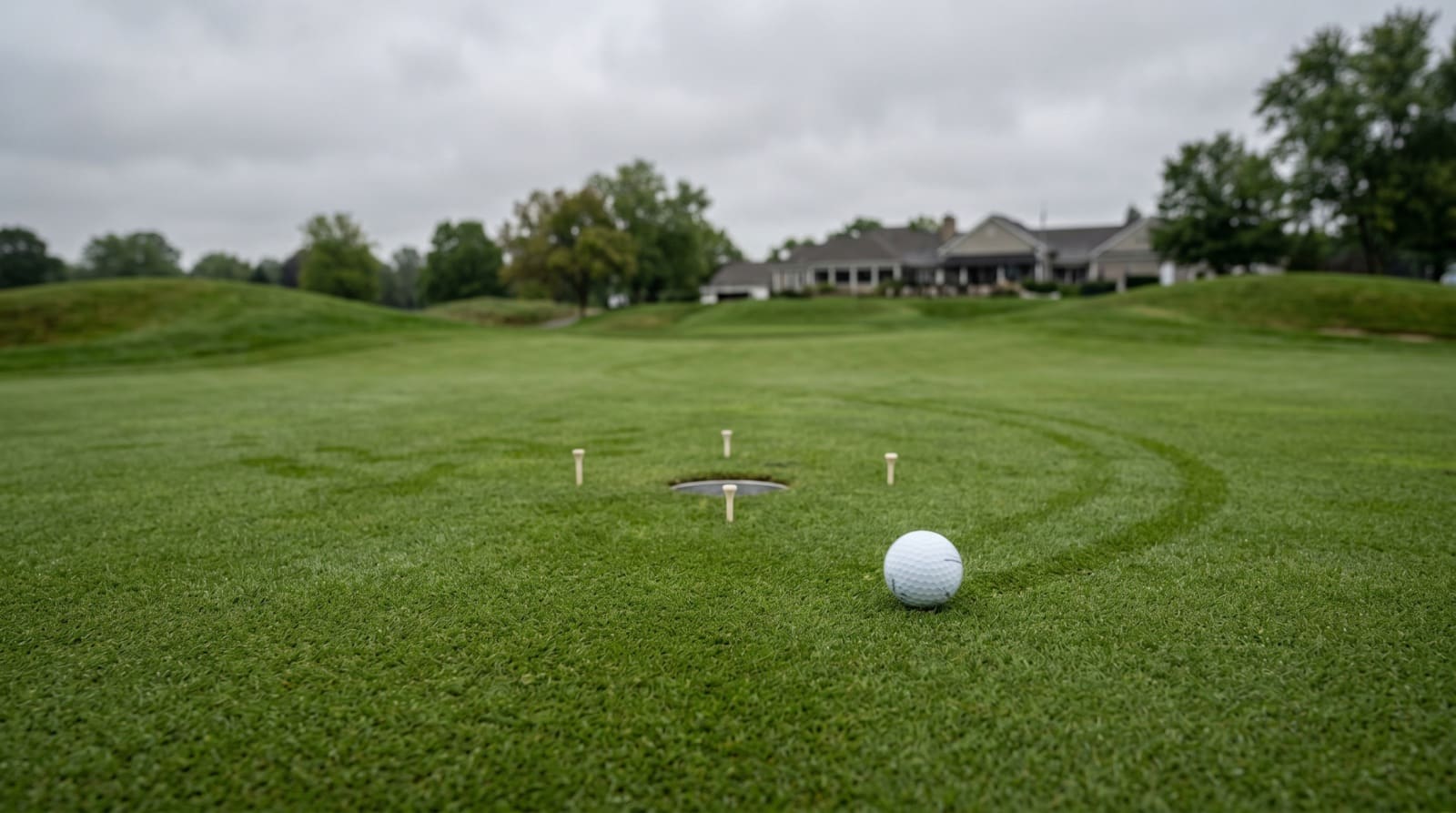
How to run it. From 30 feet, lay tees or a chalk circle 3 feet around the cup (10% of the starting distance, the elite benchmark). From 45 feet, expand to a 4.5-foot circle. From 60 feet, a 6-foot circle. Roll five balls at each distance. Score each ball by whether it finishes inside the circle.
Success criterion. 8 of 10 inside a 6-foot circle from 30 feet for mid-handicaps. 6 of 10 inside a 4.5-foot circle for single-digits. 4 of 5 inside a 3-foot circle from 30 feet for advanced players chasing Tour-level dispersion.
Why it works. The drill replaces the vague “lag it close” intention with a measurable, Tour-calibrated number. The 30% Rule supplies the elite anchor; the circle gives you the immediate per-rep feedback that motor-learning research treats as a precondition for skill change.
2. The 10-to-50-foot ladder — speed across the full lag band
Origin. Phil Kenyon — putting coach for Rory McIlroy, Justin Rose, Tommy Fleetwood, Matt Fitzpatrick, Brooks Koepka, Henrik Stenson, Francesco Molinari, Gary Woodland, and Scottie Scheffler — uses ladder drills in his structured lag-putting work, including his published 5-Day Lag Putting Challenge which ranges from 30 to 70 feet. Earlier ladder variants trace through Dave Pelz’s distance-control research.
What it trains. Speed mapping across every distance in the lag band, in a single drill. Most amateurs over-practice 30-footers and under-practice 45-and-50-footers; the ladder forces honesty.
How to run it. Place a tee or coin in the ground at 10, 20, 30, 40, and 50 feet along a single line on the practice green. Putt one ball from each distance toward the cup, walking up the ladder. Run five complete passes. Track leave-distance for each of the 25 putts.
Success criterion. Average leave-distance under 4 feet across the five 30-foot putts; under 5 feet across the five 45-footers; under 6 feet across the 50-footers. Worst leave-distance not more than 1.5x the average at each distance.
Why it works. Variability across distances inside the same drill is the textbook interleaving structure. The five distances span the strokes-gained-putting band where amateur three-putts cluster, and the per-distance log surfaces which leave-distance is your actual weakness — which is rarely the distance you assumed.
3. Look-at-the-hole long stroke — external focus and free-flowing rhythm
Origin. Brad Faxon, one of the great putters of the 1990s and 2000s and a longtime mentor to Rory McIlroy on the greens, teaches this drill on the Titleist YouTube channel and in his book A Mind for Golf (1998). In a separate Titleist segment on long putts, Faxon explicitly rejects the term “lag putting”: “Lag implies you’re just trying to get it close, almost like you’re afraid of it.”
What it trains. External focus on the target, plus a free-flowing stroke long enough to actually reach the hole — two things tentative lag strokes consistently fail at.
How to run it. Stand beside a 30-to-50-foot putt. Look at the hole, not the ball. Make several long, flowing practice strokes while still looking at the hole — exaggerate the length, let the putter swing past your normal lag length. Step in, set the putter behind the ball, look at the hole once, look back at the ball, and roll it without thinking. Hit ten.
Success criterion. 6 of 10 inside a 6-foot circle from 35 feet. The deeper criterion is feel — the next ten lag putts you hit with normal pre-putt vision should feel as committed as the look-at-the-hole reps.
Why it works. Wulf, Lauterbach, & Toole (1999) and the 25 years of external-focus replications that followed show that focusing on the target produces better motor performance than focusing on body mechanics. Looking at the hole during the stroke is the strongest possible external-focus cue, and the long practice strokes train past the amateur tendency to decelerate on long putts.
4. Intermediate spot drill — start-line plus reactive pace
Origin. Dave Stockton’s Unconscious Putting (2011) teaches a 1-to-2-inch spot in front of the ball as the only line-of-aim reference, combined with the principle that speed determines line — the harder you hit it, the less it breaks. Brad Faxon teaches a closely related variant on long putts, picking an intermediate spot 2 to 4 feet in front and rolling the ball over it.
What it trains. Start-line precision and reactive pace at the same time. On a lag, an over-broken read with the wrong pace produces a worse leave than a slightly mis-read line with the right pace.
How to run it. Pick a 35-foot putt. Read the break, then place a tee or a piece of grass 2 to 3 feet in front of the ball on your intended start line. Forget the hole. Roll the ball over the spot with the pace you decided on. Hit five. Then move to a 45-foot putt and repeat.
Success criterion. 4 of 5 balls passing within 6 inches of the intermediate spot AND finishing inside a 6-foot circle around the cup. Both conditions or it does not count.
Why it works. The intermediate spot turns a 35-foot abstraction into a 3-foot concrete target the eyes can lock onto, which simplifies the start-line task. Decoupling line-aim from speed-feel means each gets its own attention budget. Stockton’s published claim that speed determines line is the reason the spot-and-roll order matters — speed first, line through the spot, the rest is reaction.
5. Metronome rhythm lag (54 BPM) — constant tempo, length-controlled distance
Origin. Phil Kenyon teaches a metronome-based lag drill at roughly 54 BPM — tick on top of the backswing, tock at impact. The principle generalizes from broader tempo research showing tour-pro putting backswing-to-impact times are nearly constant across distances (Dr. Ralph Mann and Fred Griffin’s data places the typical pro stroke around 840 ms regardless of putt length). The body adjusts distance through backswing length at constant tempo.
What it trains. Constant tempo across every distance in the lag band, with backswing length as the only distance variable. Decelerating strokes — the most common lag failure — die immediately once the metronome anchors the tempo.
How to run it. Set a metronome to 54 BPM (most phones have one; the Tour Tempo app works too). Take address over a 30-foot putt. On one beat, start the backswing; on the next beat, the putter should be striking the ball. Hit five 30-footers, then five 40-footers, then five 50-footers, holding the same tempo and only changing the backswing length.
Success criterion. Average leave under 5 feet across the fifteen lag putts. Worst leave under 8 feet. The internal criterion is that you can feel the difference between three backswing lengths at the same tempo.
Why it works. Distance control on long putts is a backswing-length-to-distance mapping problem. Holding tempo constant by external rhythm removes the most common interference — a player who decelerates trying not to run it past, then over-corrects on the next ball by accelerating. The metronome forces honesty across reps and is also the canonical external-focus cue for stroke timing.
6. Underhand toss to putt — kinesthetic distance transfer
Origin. Stan Utley, in The Art of Putting (2006) and his SwingU clinic content, uses an underhand-toss drill to transfer distance feel from a motion the body already knows (tossing a ball) to one it does not (a putting stroke at the same distance). Utley’s broader framework is dead strength — letting the putter weight and gravity create the stroke speed rather than muscle effort.
What it trains. Distance feel transferred from a familiar throwing motion. The arm-and-shoulder rhythm that produces the right toss is similar to the rhythm that produces the right lag stroke; the drill leverages one to calibrate the other.
How to run it. Stand to the side of a 30-foot putt. Hold a golf ball in your dominant hand. Toss the ball underhand toward the cup, trying to stop it inside a 3-foot circle. Repeat until you can stop the ball within the circle three times in a row. Immediately pick up the putter and roll a putt, recreating the arm rhythm of the toss. Hit five. Move to 45 feet and repeat.
Success criterion. 3 of 5 inside the 3-foot circle from 30 feet after the toss-calibration sequence. 2 of 5 from 45 feet.
Why it works. The toss bypasses conscious mechanical thought. The throwing motion is one of the most over-learned movements in the human motor repertoire; tapping into it primes the stroke at the same distance. Utley’s dead-strength frame says muscular effort distorts the rhythm; the toss anchors the natural rhythm and the putt copies it.
7. Eyes-closed lag — external focus and committed stroke
Origin. A drill widely used across modern putting academies. VISION54 (Pia Nilsson and Lynn Marriott) teaches a closely related family of feel drills in Play Your Best Golf Now. The sport-psychology grounding is the same external-focus research that supports the look-at-the-hole drill — strip out the mid-stroke visual check and the body has to commit.
What it trains. Trust in the stroke. Most amateur lag misses come from a flinch at the start of the downswing — eyes-closed reps make the flinch impossible.
How to run it. Set up to a 35-foot putt. Read it normally — pace, line, break. Take address, look at the hole, look back at the ball, and close your eyes before the takeaway. Putt. Do not open your eyes until you hear the ball stop or guess where it stopped. Hit ten. Then hit ten with eyes open and notice how the open-eye reps now feel more committed than your starting putts.
Success criterion. 6 of 10 inside a 9-foot circle from 35 feet with eyes closed. The eyes-open transfer phase matters more than the eyes-closed number — the goal is for the next 5 to 10 normal-eye putts to feel as quiet as the closed-eye reps.
Why it works. Closing the eyes blocks the mid-stroke visual feedback loop that lets internal focus creep back in. Wulf et al. (1999) and subsequent replications show that focusing on the target rather than the body produces better motor performance and retention. Eyes-closed reps strip the focus down to the target image, and the transfer phase is where the new pattern shows up.
8. Two-ball worst-leave drill — three-putt risk visibility
Origin. Adapted from Arccos’s amateur lag-putting data and the published Shot Scope three-putt analysis finding that the average 15-handicap leaves 8 feet for the second putt on a three-putt. The drill tracks the worst of two balls rather than the average, because the worst leave is the one that becomes a three-putt on the course.
What it trains. Three-putt risk specifically. Average leave-distance is the headline metric; worst leave is the three-putt predictor.
How to run it. Find a 35-foot putt. Roll two balls. Measure both leave-distances. Score per pair: 0 if both finish inside 5 feet, 1 if one does, 2 if neither does. Repeat from 45 feet and from 55 feet — six balls total, three pair scores. Run two full rounds (six pairs, twelve balls).
Success criterion. 0 total across all six pairs over a single session. A 1 anywhere is acceptable for mid-handicaps. A 2 anywhere triggers an extra five-ball single-distance set at whatever distance produced the 2.
Why it works. Two balls per distance catches dispersion that a single-ball drill hides. A player who lands one ball inside 3 feet and another 11 feet from the hole has the same average as a player whose worst leave is 7 feet — but only the first player has three-putted on the course. The drill makes that dispersion visible per rep.
How to combine lag drills into a session
Two lag drills per session, never more. A 20-to-30-minute lag block fits inside any putting session:
- One technique drill — Faxon’s look-at-the-hole stroke, Stockton’s intermediate spot, Kenyon’s metronome, or Utley’s underhand toss. 15 to 20 putts. The drill that attacks your specific failure pattern.
- One performance drill — the 30-percent landing zone, the ladder, or the two-ball worst-leave. Until the criterion is met or 25 putts roll, whichever comes first.
The session principle, drawn from the block-vs-random practice literature: block work early in the session for a new rhythm cue, random work for the bulk of reps once the cue is reliable. The lag block fits inside the broader putting cadence outlined in the 10-putting-drills sister post; the weekly cadence and how lag work fits into a Tuesday/Thursday/Saturday rotation lives in the driving range practice routine guide.
Lag putting is a calibration problem dressed as a stroke problem. The body is trying to map green speed and slope to a backswing length it has never used on this surface before. Drills that calibrate against measured leave-distance — and log both average and worst — convert the science into a usable rep. — synthesized from Stagner’s 30% Rule and Broadie’s strokes-gained-putting framework.
What the research says about lag putting practice
Three findings drive every drill above:
- External focus beats internal focus. Wulf, Lauterbach & Toole (1999) had two groups of golfers practice an unfamiliar shot. The group focused on the club (external) outperformed the group focused on the arm swing (internal) on a 24-hour retention test. A 2024 review by Wulf and colleagues summarizes 25 years of replication. Cue the cup, the apex, the intermediate spot — never the wrists or the shoulders.
- Random practice retains better than block. The contextual-interference effect — replicated across motor, music, and surgical skills since Shea & Morgan (1979) — predicts that varying distance and break inside a session produces worse in-session feel but better retention. The ladder drill and the worst-leave drill bake this in; the player who only practices 30-footers gets better at one distance and stays bad at every other distance on the course.
- Distributed practice retains better than massed. Cepeda et al.’s 2006 meta-analysis in Psychological Bulletin found a spacing-effect size of d ≈ 0.78 across 184 studies and 14,000+ participants. The studies were mostly verbal-recall tasks, so direct transfer to putting is an inference — but the prescription it points to (split the session, don’t mass it) matches how tour pros practice their putting.
A clean lag program threads all three: external cueing through landing zones and intermediate spots; varied distance inside each drill; and short sessions distributed across the week.
Common lag-putting drill mistakes
- Tracking only average leave, never the worst. Average is the headline; worst is the three-putt risk. A drill with a 4-foot average and an 11-foot worst is still gifting three-putts on the course.
- Same straight 30-footer every rep. A drill from a flat 30-footer trains a flat 30-footer. The course gives you downhill left-to-right with grain from 47 feet. Rotate distance and break inside the drill.
- Too many drills per session. Five drills in 30 minutes is a tour of the practice green, not practice. Two is the limit for a lag block.
- Decelerating on long putts. Fear of running the putt past produces a tentative stroke, weak roll, and a putt that finishes short anyway. The metronome and the look-at-the-hole drill both attack this; the underhand toss bypasses it entirely.
- Treating make rate as the metric. A made 40-footer is luck. Leave-distance is the trainable skill. Track leave first, makes second.
- Skipping the read on practice lags. Rolling lag putts without a full pre-putt read trains the routine to skip the read under pressure. Read every lag — speed and line — even on a drill rep.
- Indoor-mat-only lag practice. Indoor mats roll faster or slower than every actual green you will play. Use indoor mats for tempo and rhythm only; the leave-distance work has to happen on a real practice green.
Key takeaways
- Three-putts start with the first putt finishing too far from the cup. Shot Scope data shows the average 15-handicap three-putt leaves about 8 feet for the second putt — the lag is already a three-putt before the second stroke begins.
- Lou Stagner’s 30% Rule is the elite benchmark. 90% of Tour lag putts finish within ±30% of the starting distance. A 30-foot putt should leave inside 3 feet, a 45-footer inside 4.5 feet.
- The eight drills above cover calibration (30-percent landing zone, ladder, two-ball worst-leave), rhythm and tempo (metronome, look-at-the-hole, underhand toss), and start-line plus pace (intermediate spot, eyes-closed). Pick two per session.
- Leave-distance is the trainable metric. Track average leave AND worst leave per session. Log both.
- External cueing beats internal cueing in the motor-learning research. Cue the hole, the apex, the intermediate spot, the metronome — never the body.
- Random beats block for lag retention once a rhythm cue is reliable. Variability across distance and break is uncomfortable in-session and pays back in transfer across two to four weeks.
- Twenty to thirty minutes is the working window for a lag session. Past 30 minutes the tempo drifts and tentative strokes start to groove.
Frequently asked questions
What are the best lag putting drills?
The best lag putting drills share four properties drawn from motor-learning research: a numeric success criterion expressed as a leave-distance or landing circle, built-in distance and break variability, calibrated difficulty so failure happens, and a logged result per rep. The most-cited examples used by tour putting coaches are the 30-percent landing zone (calibrated against Lou Stagner’s Tour-data 30% rule), the 10-to-50-foot ladder taught by Phil Kenyon, Brad Faxon’s look-at-the-hole long stroke, Dave Stockton’s intermediate-spot drill, the metronome rhythm drill at 54 BPM, Stan Utley’s underhand-toss drill, the eyes-closed lag, and the two-ball worst-leave drill.
What is a good lag-putting distance from 30 feet?
Lou Stagner’s published Tour data — summarized as the 30% Rule for lag putting — shows the elite benchmark is a 3-foot leave from a 30-foot putt, roughly 10% of the starting distance. A 45-foot putt should finish inside about 4.5 feet on average. PGA Tour pros average a 2-foot 4-inch first-putt leave overall across all distances. Mid-handicaps typically leave 5 to 7 feet from 30 feet on their first try with this drill, and that delta is where three-putt frequency comes from.
How do I stop three-putting?
Three-putts overwhelmingly originate from a first putt that finishes too far from the hole. Shot Scope’s 90-million-shot amateur database shows the average 15-handicap leaves about 8 feet for the second putt on a three-putt — and from 8 feet, PGA Tour data places make rates near 53%. The fix is to train the leave-distance until the second putt is a tap-in. Calibrated lag drills with a 3-to-6-foot landing zone are the highest-payoff three-putt cure for most amateurs.
How long should a lag-putting practice session be?
Twenty to thirty minutes. Quality drops sharply past 30 minutes for most amateurs because tired lag strokes groove a tentative tempo that does not transfer. Within that window, two drills with 30 to 50 putts total beats one drill with 200 putts. Cepeda et al.’s 2006 meta-analysis in Psychological Bulletin found a large spacing effect (d ≈ 0.78) for distributed over massed practice — three short sessions reliably out-learn one long one. Lag transfer is the test — measure it across sessions, never within one.
Can I practice lag putting at home?
Partly. The tempo and rhythm drills — Kenyon’s metronome, Faxon’s look-at-the-hole long stroke, Utley’s underhand toss — transfer well to a long carpet or a hallway because they train the stroke, not the read. Distance-and-leave drills need a real practice green because indoor surfaces roll faster or slower than every actual green you will play and bias your speed map. A useful split is mid-week home work on rhythm and weekend practice-green work on leave-distance.
Why is lag putting harder than short putting for amateurs?
Short putts are mostly a face-angle and start-line problem inside a small distance range. Lag putts add a second axis — speed — that the body has to map to backswing length on a surface it has never seen before. Lou Stagner’s Tour data shows 90% of pro lag putts finish within ±30% of the starting distance; amateur dispersion is wider, which is why three-putts cluster outside 30 feet. Lag putting needs a calibrated speed system that matches Tour dispersion benchmarks.
Do lag putting drills actually transfer to lower scores?
Yes, when the drill has a numeric leave-distance criterion and the rep is varied across distances and breaks. Three-putts are one of the fastest correctable leaks in amateur scoring — Shot Scope data shows the average 25-handicap three-putts about 2.4 times per round, the 5-handicap about 1.1. Each three-putt erased is a stroke recovered. Drills that just roll lag putts without a logged leave-distance produce in-session feel but no transfer. The log is the lever.
Related reading
- 10 Golf Putting Drills That Move Strokes-Gained-Putting — the parent putting-drills post; this lag catalog expands drill #2 (two-ball lag) and drill #8 (distance ladder) into a full eight-drill speed-control catalog.
- 10 Golf Practice Drills Tour Coaches Actually Use — the drill-catalog pillar; the full-bag version of the four-property frame applied here to lag putting.
- Block vs Random Practice in Golf: What the Research Actually Says — the contextual-interference literature behind the random-distance, random-break structure of every drill above.
- Driving Range Practice Routine: 3 Plans by Handicap — where the lag block fits inside a Tuesday/Thursday/Saturday cadence at the right weekly volume.
- Golf Tempo Drills: The 3:1 Ratio and 8 Drills That Actually Move It — full-swing tempo deep-dive; putting tempo compresses to roughly 2:1 backswing-to-downswing, but the rhythm anchor is the same.
- Putting drills to lower your scores — the companion guide; the four-drill short-form version with proximity and make-rate scoring criteria.
- The 30-minute golf practice plan — how to fit a lag block into a tighter window.