
Golf for Beginners: What to Learn First, and in What Order
Tracked 25-handicappers take 4.67 penalty strokes a round and hit 10% of greens. The order to learn golf in, and the 12-week ladder that gets you there.
Quick answer
Learn golf in contact order: chipping, then one mid-iron, then three clubs, then a short course, then 18 holes. Buy about seven clubs — Rule 4.1b caps you at 14 and expressly allows fewer. Spend the first month on blocked repetition before mixing clubs and targets. Track one number — penalty strokes. Shot Scope’s tracked 25-handicap takes 4.67 per round; get under four and you are already better than that benchmark.
The first-season ladder at a glance
| Rung | Where you are | What you work on | Gate to clear before moving up | Typical time |
|---|---|---|---|---|
| 1 | Chipping and putting green | Contact from 30 yards in, one club | 8 of 10 chips finish on the putting surface | 2 weeks |
| 2 | Range, one 7-iron | Grip, setup, brushing turf after the ball | 7 of 10 strikes are ball-then-turf | 3 weeks |
| 3 | Range, three clubs | Same swing, rotating clubs and targets | 6 of 10 inside a 30-yard-wide corridor | 3 weeks |
| 4 | Par-3 or nine holes | Pace, ready golf, where to stand | Nine holes without losing sight of the group ahead | 2 weeks |
| 5 | 18 holes, forward tees | Keeping the ball in play | Under 4 penalty strokes per round, twice in a row | 2 weeks |
That ladder is PracticeCaddie’s own framework. The sequence follows the motor-learning evidence below, but the specific gate numbers are house calibration built to sit just inside reach of a tracked 25-handicap. Use them as thresholds to move on, not as grades.
What “beginner” actually means in the numbers
Golf has no published average score for absolute first-year players, and anyone quoting one to three significant figures is guessing. The honest benchmarks come from three separate populations, and they disagree because they measure different people.
The USGA reported 3.68 million US golfers carrying a Handicap Index in 2025, averaging 14.0 for men and 28.8 for women. Those are indexed golfers, who skew committed. The 2024 USGA Golf Scorecard gives a closer proxy for new players: golfers establishing an index for the first time averaged 16.5 for men and 32.1 for women. And the National Golf Foundation, surveying more than 36,000 golfers including people with no handicap at all, puts the overall US average 18-hole score near 94.
For a working target, Shot Scope’s tracked benchmarks are the most useful: a 25-handicap averages 28.97 strokes over par, or about 101 on a par-72 course. Breaking 100 puts you past that group. If you want the mechanics of how rounds become an Index, that lives in Golf Handicap Explained.
You have plenty of company. The NGF counted 3.3 million on-course beginners in 2025, out of 48.1 million total participants, and at least 3 million new on-course players every year since 2020.
Where beginner strokes actually go
The single most expensive belief in beginner golf is that putting is the problem. Mark Broadie’s strokes-gained work says otherwise. Of the 10-stroke difference between a 90-shooter and an 80-shooter, about 6.5 strokes come from outside 100 yards, roughly 4 from approach shots alone, and about 1.5 from putting. The long game accounts for roughly 65% of that gap; putting accounts for about 15%.
The Shot Scope benchmarks show the same thing from a different angle, and the comparison is worth sitting with:
| Metric | Scratch | 20 handicap | 25 handicap |
|---|---|---|---|
| Fairways hit | 50% | — | 46% |
| Greens in regulation | 61% | — | 10% |
| Penalty strokes per round | 0.56 | 3.03 | 4.67 |
| Putts per round | 29.4 | — | 33.8 |
Fairway accuracy is nearly identical. Greens in regulation is not remotely close. That gap is why “fairways hit” is a poor stat for a beginner to chase: it hides tee-shot distance, the severity of the misses, and the quality of the approach that follows.
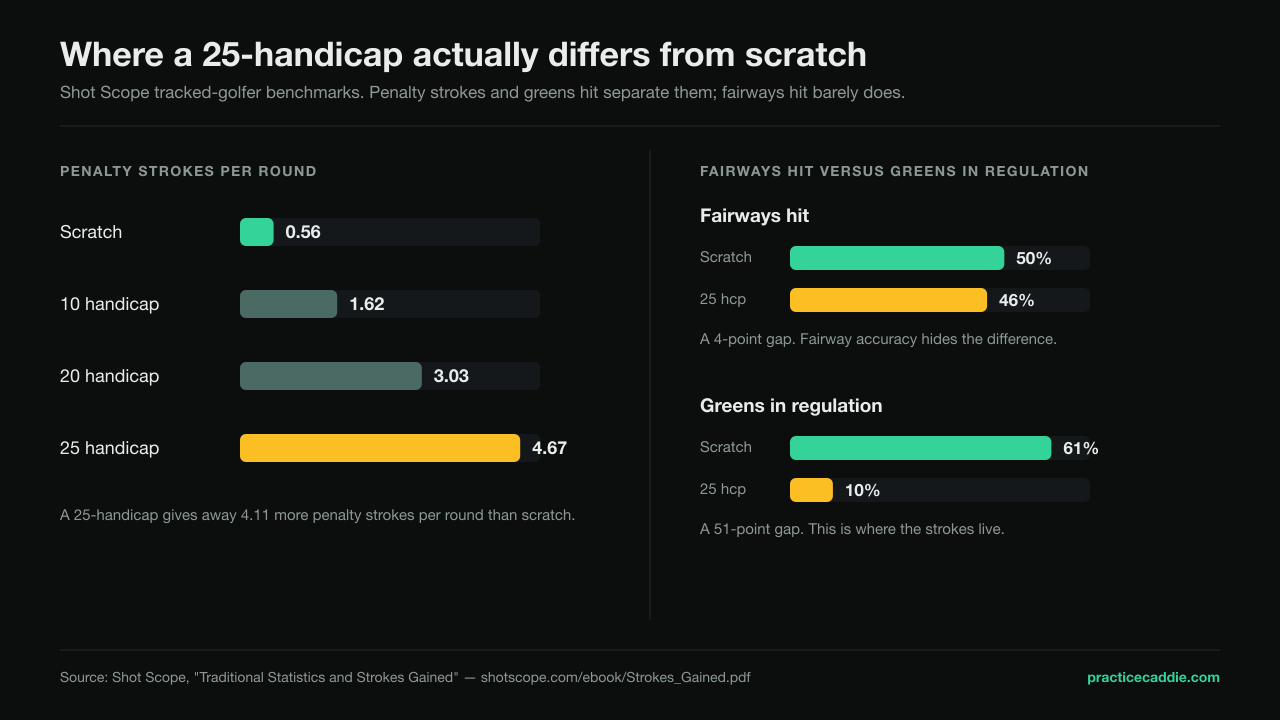
Penalty strokes are the clearest beginner leak of all. A 25-handicap gives away 4.67 per round against a scratch player’s 0.56 — a bigger raw gap than the entire 4.4-putt difference between them. Both are arithmetic comparisons. Putt totals depend on how many greens you hit and from what distance, so read the direction and ignore the precision. Three-putting adds to it: Shot Scope’s data on three-putt frequency puts a 25-handicap at roughly 13% of holes, about 2.4 three-putts per 18, against about 3% for scratch.
Two practical conclusions. Keep the ball in play, and learn to advance approach shots reliably. The full framework behind these numbers is in Strokes Gained Explained for Amateurs.
What a beginner should learn first, in order
Order matters more than content here, because each item is the precondition for the next one working.
- Grip. Everything downstream of a bad grip is compensation for the grip. Start at How to Grip a Golf Club and settle on overlap, interlock or ten-finger in your first week, then stop revisiting it.
- Setup and posture. Distance from the ball, spine angle and weight distribution decide whether the club can reach the bottom of the arc in the same place twice. Golf Stance and Posture covers the checkpoints.
- Ball position. One variable, enormous consequences for contact. Golf Ball Position gives the by-club positions; a beginner needs only the mid-iron one at first.
- A repeatable full swing. How to Swing a Golf Club is the motion; the goal for months one to three is ball-then-turf contact, nothing else.
- Speed control on and around the green. Distance beats line for beginners on every putt over 15 feet. The drills are in Golf Putting Drills and Golf Chipping Drills.
Notice what is missing: draw and fade shaping, wedge distance charts, driver distance. Those are real skills, and they are useless until contact is repeatable.
Why your first month should be blocked practice
This is where most beginner advice, including plenty of it on this blog, needs a caveat.
The contextual-interference literature is clear that mixing skills randomly beats repeating one skill in blocks — for retention. Shea & Morgan (1979) found blocked practice produced better performance during the session and random practice produced better retention and transfer afterwards. That finding underpins block vs random practice and most of PracticeCaddie’s session design.
It does not apply cleanly on day one. Magill & Hall’s 1990 review argued the effect’s generalisation depends on task characteristics. Guadagnoli & Lee’s challenge-point framework (2004) makes the prediction explicit: learning depends on the interaction between the learner’s skill level and the functional difficulty practice creates, and lower contextual interference suits beginning skill levels, with higher interference becoming useful as skill rises. A randomised study of 52 novice physical-therapy students learning force modulation found blocked practice beat random practice on both post-test and retention accuracy, F(1,50) = 5.57, p < .05.
The practical translation is the ladder above: short blocks while grip, setup and contact stabilise, then serial and variable work with different clubs and targets, then random on-course-like practice. Weeks of mindless repetition is the failure mode on one side; maximal randomness from the first ball is the failure mode on the other.
Where you point your attention
The same nuance applies to swing thoughts. A 2021 meta-analysis in Psychological Bulletin found an external focus of attention — on the club, the ball, the target — beat an internal focus on body parts, with Hedges’ g of 0.264 for immediate performance, 0.583 for retention and 0.584 for transfer. A 2024 systematic review of motor learning in golf reports superior delayed retention under external-focus instruction in novices.
The caveat is real though: Perkins-Ceccato et al. (2003) found low-skill golfers performed better with internal instructions while skilled golfers favoured external ones. The workable compromise is to use brief internal information to build a safe grip and setup, then move attention outward once the ball is in front of you. “Brush the grass just after the ball” and “start it through that gate” are the cues that survive contact with a first tee.
The seven clubs you actually need
Rule 4.1b caps you at 14 clubs and expressly permits fewer. Golf Digest’s beginner guidance puts a workable starting bag at about seven: a high-lofted driver, a fairway wood, a 5-iron, a 7-iron, a 9-iron, a sand wedge and a putter. Six is enough to play.
Fewer clubs is a learning advantage. Every club you carry is a decision you have to make and a set of distances you have to calibrate, and a beginner has neither the contact consistency nor the yardage data to do that. When you do have the data, the club distance chart is where gapping starts.
What it costs to start playing golf
New package sets run roughly $200 to $500 for the mainstream options, with the full market spanning $200 to $1,000. A complete used set generally lands in the $200 to $600 range, and older Callaway Strata-type sets turn up around $180 to $220.
On fitting, the evidence is thinner than the sales pitch. A Golf.com test of seven golfers found fitted sets cut scoring by 2.83 strokes on average, and a Golf Digest study of nine golfers found 1.7 strokes across roughly half a season. Both are tiny samples, both bundled a fitting with brand-new equipment, and neither isolated beginners. Forgiving head design has better evidence behind it: a Golf Datatech test summarised by Golf Digest found higher-handicap golfers hit super-game-improvement irons 18 yards farther than players’ irons, with dispersion 36% to 227% tighter.
Buy roughly correct length, weight, flex and grip size, plus forgiving heads. Book the full fitting when your swing has stopped changing every month — or sooner if you are well outside standard height or strength ranges, where an off-the-rack set will fight you.
Lessons: what the evidence supports, and what it doesn’t
Lessons are almost certainly worth it, and the published proof is thinner than the advertising implies.
GOLFTEC reports that 96% of its students improve, averaging around seven shots, with the campaign figure specifying students who took at least 10 lessons. That is company-reported observational data with no untreated comparison group, no published attrition analysis and no independent audit. Read it as a directional signal. On the peer-reviewed side, a differential-learning pitching intervention improved technical variables and some scoring measures including among higher handicaps, but it tested pitching rather than full-round scoring. No independent randomised study establishes how many lessons produce a given handicap drop.
Costs, from current market pricing guides: individual lessons commonly run $50 to $150 per hour, with five-lesson packages around $200 to $500, and group clinics around $20 to $50 per person per session. The PGA’s Get Golf Ready curriculum runs five group lessons that progress through putting, short game, irons, driving and finally playing a hole — the cheapest structured on-ramp in the game.
For cadence, GOLFTEC recommends one 30-minute lesson every one or two weeks paired with two practice sessions. That matches the challenge-point logic well: the lesson raises the task difficulty, and the practice sessions are where the new difficulty gets absorbed. GOLFTEC’s cadence is a company programme recommendation that has never been tested against alternatives, though it is a defensible place to start.
Your first round: where to play, and from which tees
Do not make your debut on a 6,600-yard championship layout on a Saturday morning.
PGA of America guidance recommends a quiet time of day with an experienced golfer, starting close to the green and moving progressively farther back. Par-3, executive and nine-hole courses are legitimate venues: since the 2024 handicap revision, courses as short as 750 yards for nine holes or 1,500 for 18 can receive Course and Slope Ratings, which the USGA says made more than 600 additional facilities eligible. Scores there count.
Pick tees by driving distance. The PGA’s rule of thumb puts a golfer who drives it 175 yards at about 4,500 yards and a 225-yard driver at around 6,000. The USGA’s Course Playability Calculator uses average 7-iron distance instead of guesswork.
The range and the simulator count as real preparation. The NGF counted 19 million Americans playing exclusively off-course in 2025, and reports that roughly two-thirds of new on-course golfers arrive with prior off-course experience. Topgolf and simulator bays are a legitimate on-ramp, and the structured version of that time is in the driving range practice routine.
The rules and pace habits that keep you welcome
Four situations cause nearly every beginner penalty: a lost or out-of-bounds ball, a ball in a penalty area, free relief from cart paths and casual water, and an unplayable ball. Those are covered in detail in Golf Rules for Beginners, and the ball-search limit is three minutes.
On pace, Rule 5.6b recommends playing within 40 seconds once it is your turn and expressly encourages safe ready golf in stroke play. A USGA study measured an average round at 4 hours 17 minutes. The habits that keep you inside it as a beginner are mechanical: choose your club while others play, carry three or four clubs to your ball when walking, play a provisional the moment a ball might be lost, and pick up in casual play once a hole stops teaching you anything. Golf Etiquette and Pace of Play covers the rest, and a repeatable pre-shot routine is what makes 40 seconds feel roomy.
Nobody minds a beginner who shoots 115. They mind a beginner who takes five and a half hours doing it.
How fast beginners actually improve
No golf-specific study establishes a universal hours-to-competence figure, and the 10,000-hour rule has never been demonstrated in golf. The USGA publishes annual averages but no cohort curve showing how a first-year golfer’s Index moves.
The best longitudinal numbers available come from Arccos: among new 2021 members, golfers starting at 21-plus handicap improved 8.85 strokes after at least 10 tracked rounds and 10.15 after at least 20. Golfers starting at 16 to 20 improved 5.90 and 6.75 respectively. Lower handicaps improved least, which is what you would expect.
Read those with the selection bias attached. Arccos users bought a shot-tracking system and logged enough rounds to be analysed, so the figures describe an engaged, self-selecting group. Still, “measures their rounds” is a choice available to any beginner, and it is the single cheapest thing on this page. Shot Scope’s whole population moved only from 15.31 over par in 2019 to 14.97 in 2024 — improvement in golf is slow in aggregate and fast for people who are deliberate about it.
Common beginner mistakes
- Buying 14 clubs before you can hit three. More clubs means more decisions and fewer repetitions each. Seven is plenty for a year.
- Practising putting because it feels productive. Broadie’s numbers put roughly 65% of the 90-to-80 gap outside 100 yards and 15% in putting. Speed control still earns range time; it just should not dominate the week.
- Chasing fairways-hit as the tee-shot metric. Scratch and 25-handicap golfers hit fairways at 50% and 46%. Penalty strokes, at 0.56 versus 4.67, is the stat that separates them.
- Playing from tees matched to your ego. Every extra 500 yards adds approach shots from distances you cannot yet reach, which is the exact category the data says costs you most.
- Randomising practice from day one. The contextual-interference research is about retention in learners who already have a stable movement. Guadagnoli and Lee’s framework predicts lower interference suits beginners.
- Taking a lesson and then not practising between lessons. The lesson raises task difficulty; the practice absorbs it. One without the other wastes both.
- Quitting on the first round because of the score. The first round is a logistics exam — where to stand, when to play, how to keep up. Score it later.
Related reading
- How to Swing a Golf Club — the full-swing cornerstone every item on the ladder is building toward.
- Block vs Random Practice in Golf — the motor-learning research behind the blocked-to-random progression, and why beginners start on the blocked end.
- How to Grip a Golf Club — the first thing to settle and the last thing to keep changing.
- Strokes Gained Explained for Amateurs — the framework that tells you which part of your game is actually costing shots.
- Golf Rules for Beginners — the 12 situations that produce nearly every beginner penalty, with the rule numbers.
- Golf Handicap Explained — how your scores turn into an Index once you start posting them.
- Golf Practice Plan — how to structure the week the ladder assumes you have.
- Practice Plan by Handicap — where practice time should go once you have a number to work from.
Key takeaways
- There is no published beginner scoring average. Tracked 25-handicappers average about 101 on par 72; the overall US average is near 94; first-time index holders averaged 16.5 (men) and 32.1 (women) in 2024.
- The long game holds most of the gap. About 65% of the 90-to-80 difference sits outside 100 yards, roughly 40% in approach shots alone, and about 15% in putting.
- Penalty strokes are the beginner leak worth measuring. 4.67 per round at 25 handicap against 0.56 at scratch — a bigger raw gap than the 4.4-putt difference.
- Greens in regulation is the stat that separates. 61% versus 10%, while fairway accuracy is 50% versus 46%.
- Blocked practice first, then variable, then random. Guadagnoli and Lee’s challenge-point framework predicts lower contextual interference suits beginning skill levels; a randomised novice study found blocked beat random on retention.
- Seven clubs is enough. Rule 4.1b caps you at 14 and permits fewer. New sets run $200 to $500; used sets $200 to $600.
- Fitting evidence is small-sample. 2.83 strokes across seven golfers, 1.7 across nine. Forgiving heads have better support than a premium fitting does for a beginner.
- The improvement data is selection-biased. Arccos members starting above 21 improved 8.85 strokes over 10 rounds — among golfers who chose to measure every one of them.
Frequently asked questions
What score should a beginner golfer expect to shoot?
There is no published average for absolute first-year golfers, so treat any exact figure with suspicion. The closest defensible benchmarks: Shot Scope’s tracked 25-handicap averages about 29 strokes over par, roughly 101 on a par-72 course, and the National Golf Foundation puts the overall US average 18-hole score near 94. USGA data shows golfers establishing a Handicap Index for the first time in 2024 averaged 16.5 for men and 32.1 for women.
How many golf clubs does a beginner need?
Rule 4.1b caps you at 14 clubs and expressly allows fewer, so an incomplete set is legal. Golf Digest recommends starting with about seven: a high-lofted driver, a fairway wood, a 5-iron, a 7-iron, a 9-iron, a sand wedge and a putter. Fewer clubs means fewer decisions and more repetitions with each one, which matters far more early on than filling every slot in the bag.
Should a beginner practice putting or the full swing first?
Short swings first. Chips and pitches give you the most strike repetitions per hour with the least room to build a damaging pattern, which makes them the safest place to learn contact. Once you can finish 8 of 10 chips on the green, move to a single mid-iron on the range. Broadie’s data shows the long game drives most scoring difference, so the full swing is where your strokes eventually come from; the short game is just where the learning starts.
Do beginners need custom-fitted golf clubs?
Not before you can make consistent contact. The available fitting studies are small and combine fitting with new equipment, and none isolates beginners: a Golf.com test of seven golfers found an average 2.83-stroke improvement, and a Golf Digest study of nine golfers found 1.7 strokes. Forgiving head design has better evidence behind it. Get clubs of roughly correct length, weight and grip size, and save the full-bag fitting until your swing has stopped changing every month.
How long does it take to get decent at golf?
No golf-specific study establishes a universal hours-to-competence figure, and the 10,000-hour rule has no golf evidence behind it. The best available longitudinal numbers come from Arccos: new members starting at 21-plus handicap improved 8.85 strokes after at least 10 tracked rounds and 10.15 strokes after 20. Those users bought a shot-tracking system, so they are more engaged than a typical beginner, and the figures describe an engaged, self-selected group.
Where should a beginner play their first round of golf?
A par-3, executive or nine-hole course at a quiet time of day. Since 2024 the USGA rates courses as short as 750 yards for nine holes, which made more than 600 mostly par-3 facilities eligible for a Course Rating, so short courses count for a handicap. PGA of America guidance suggests going out with an experienced golfer, starting near the green and working backwards. Choose tees by driving distance: the PGA’s example puts a 175-yard driver at about 4,500 yards.
Are golf lessons worth it for a beginner?
Probably, though the evidence is weaker than the marketing suggests. No independent randomised study establishes how many lessons produce a given score drop. GOLFTEC reports that 96% of its students improve, averaging about seven shots, but that is company-reported data with no untreated comparison group. Group programmes such as the PGA’s Get Golf Ready run five lessons for far less than individual instruction, which typically costs $50 to $150 an hour.