
Golf Rules for Beginners: The 12 That Actually Cost You Strokes
The 2023 Rules run through 2027, and four questions resolve nearly every ruling a beginner meets. Rule numbers, stroke costs, and the drops done right.
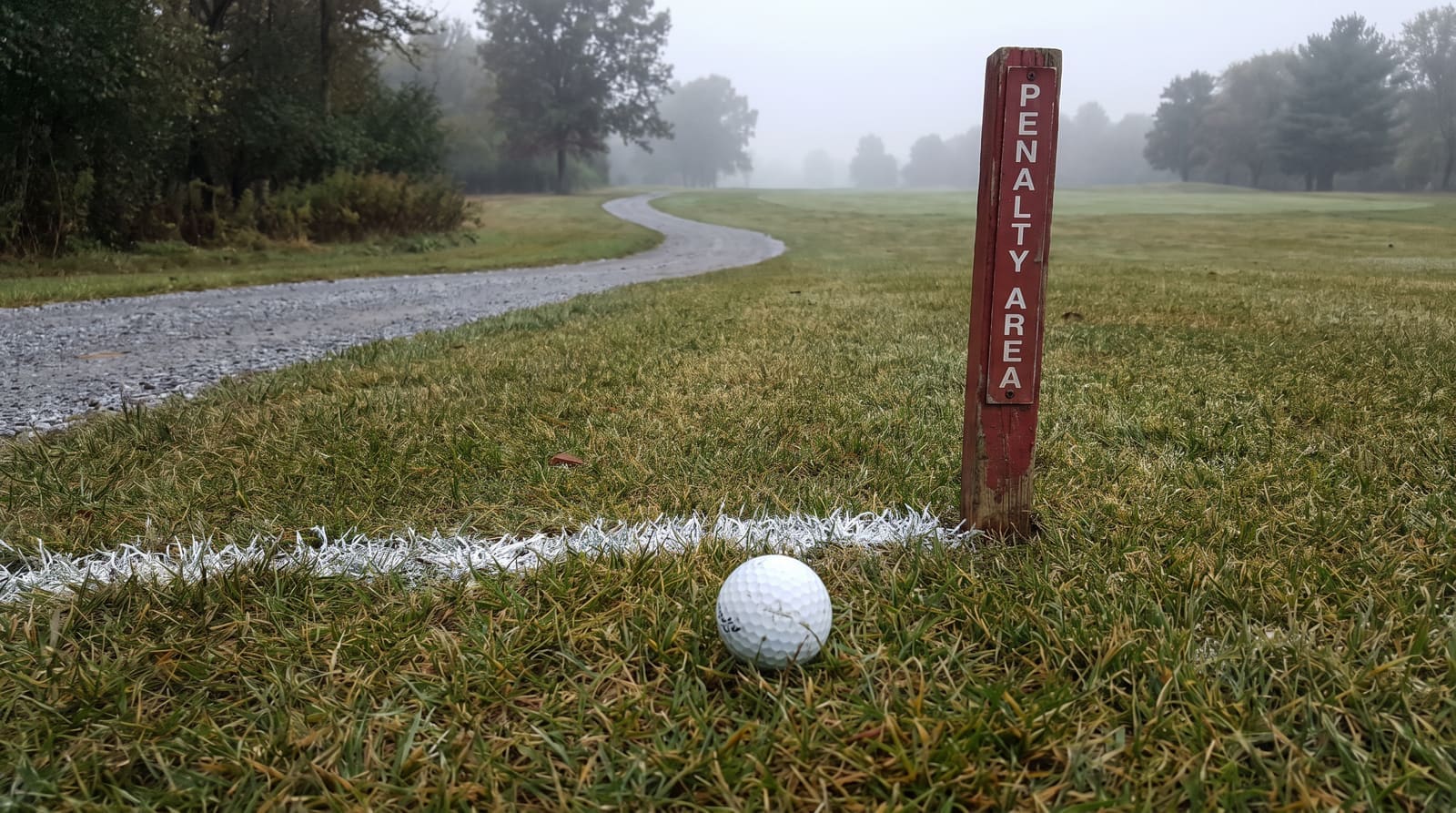
Quick answer
Learn the 12 situations that produce nearly every beginner penalty and the rest of the Rules can wait. Lost or out of bounds costs one stroke plus the distance back to your last spot (Rule 18.2). A penalty area costs one (Rule 17.1). Cart paths, sprinklers, ground under repair, temporary water and embedded balls are free relief (Rules 16.1 and 16.3). Every drop comes from knee height (Rule 14.3b).
The 12 rulings a beginner actually meets
| # | Situation | Rule | What you may do | Cost |
|---|---|---|---|---|
| 1 | Ball not found within 3 minutes | 18.2 | Stroke and distance: replay from your previous spot | 1 stroke + distance |
| 2 | Ball out of bounds (all of it past the line) | 18.2 | Stroke and distance | 1 stroke + distance |
| 3 | Ball might be lost or out of bounds | 18.3 | Announce and play a provisional before you walk forward | 0 unless it counts |
| 4 | Ball in a red penalty area | 17.1d | Play it, stroke and distance, back on the line, or 2 club-lengths lateral | 0 played, else 1 stroke |
| 5 | Ball in a yellow penalty area | 17.1d | Play it, stroke and distance, or back on the line | 0 played, else 1 stroke |
| 6 | Ball unplayable in the general area | 19.2 | Stroke and distance, back on the line, or 2 club-lengths lateral | 1 stroke |
| 7 | Ball unplayable in a bunker | 19.3 | Three options inside the bunker, or back on the line outside it | 1 stroke, or 2 outside |
| 8 | Cart path, sprinkler, ground under repair, casual water | 16.1 | Nearest point of complete relief, then 1 club-length, no nearer the hole | 0 |
| 9 | Ball embedded in its own pitch-mark | 16.3 | Drop within 1 club-length of the spot right behind it | 0 |
| 10 | Leaves, stones, rakes, bottles in the way | 15.1, 15.2 | Remove them anywhere on the course, bunkers included | 0 |
| 11 | You move your ball at rest by accident | 9.4 | Replace it on its original spot | 1 stroke |
| 12 | You play the wrong ball | 6.3c | Correct it before you tee off on the next hole | 2 strokes |
Every penalty in this post is the stroke-play figure, which is what you are playing in a casual round or a medal competition. Match play scores the same breaches differently: what the Rules call the general penalty is two strokes in stroke play and loss of hole in match play.
The Rules in force today are the Rules of Golf effective January 2023, published jointly by the USGA and The R&A. Revisions land on a four-year cycle, and the governing bodies have announced that the next edition arrives on January 1, 2028 rather than 2027. Every rule number in this post comes from that 2023 text or from the Rules of Handicapping, and the small print in between gets updated through quarterly clarifications rather than a new book.
These situations arrive every single round
Rulings are not rare events reserved for tournament players. The R&A’s 2025 Rules of Golf survey collected more than 20,000 golfer responses and just under 900 club responses, and asked players about their previous five competitive rounds. Across those rounds, a search lasting over one minute happened in an average of 72%, a provisional ball was played in 59%, free relief was taken in 66%, and penalty-area relief in 59%, according to the R&A’s published survey themes. That survey covered R&A jurisdictions and excluded the United States and Mexico, and it measured how often these situations arose rather than how often players handled them correctly.
Read those four numbers as a workload. Two or three of these decisions per nine holes is normal, which makes the Rules a scoring skill sitting right next to wedge distance control. The National Golf Foundation counts roughly 3.3 million people taking up on-course golf in the United States each year, and the USGA reported 3.68 million U.S. golfers carrying a Handicap Index in 2025, up more than 8.2% year over year. Most of them are learning the Rules from the person in the next cart.
The five areas of a golf course
Every relief option in the Rules keys off where the ball sits. The course is divided into exactly five areas, and the boundary between them decides what you may do.
| Area | What it covers | What changes there |
|---|---|---|
| Teeing area | The rectangle you start each hole from | Re-tee freely before your first stroke; playing from outside it costs 2 |
| General area | Fairway, rough, trees, waste ground — everything not listed below | Free relief for abnormal conditions and embedded balls lives here |
| Bunkers | Prepared areas of sand | No touching sand near the ball; a fourth unplayable option exists |
| Penalty areas | Water and anything staked red or yellow | No free relief; play it, or pay one stroke |
| Putting green | The green of the hole you are playing | Mark and lift freely; no penalty for accidentally moving your ball |
Out of bounds is not one of the five. A ball out of bounds is off the course entirely, which is why the only relief is going back to where you played from.
The four questions that resolve nearly every ruling
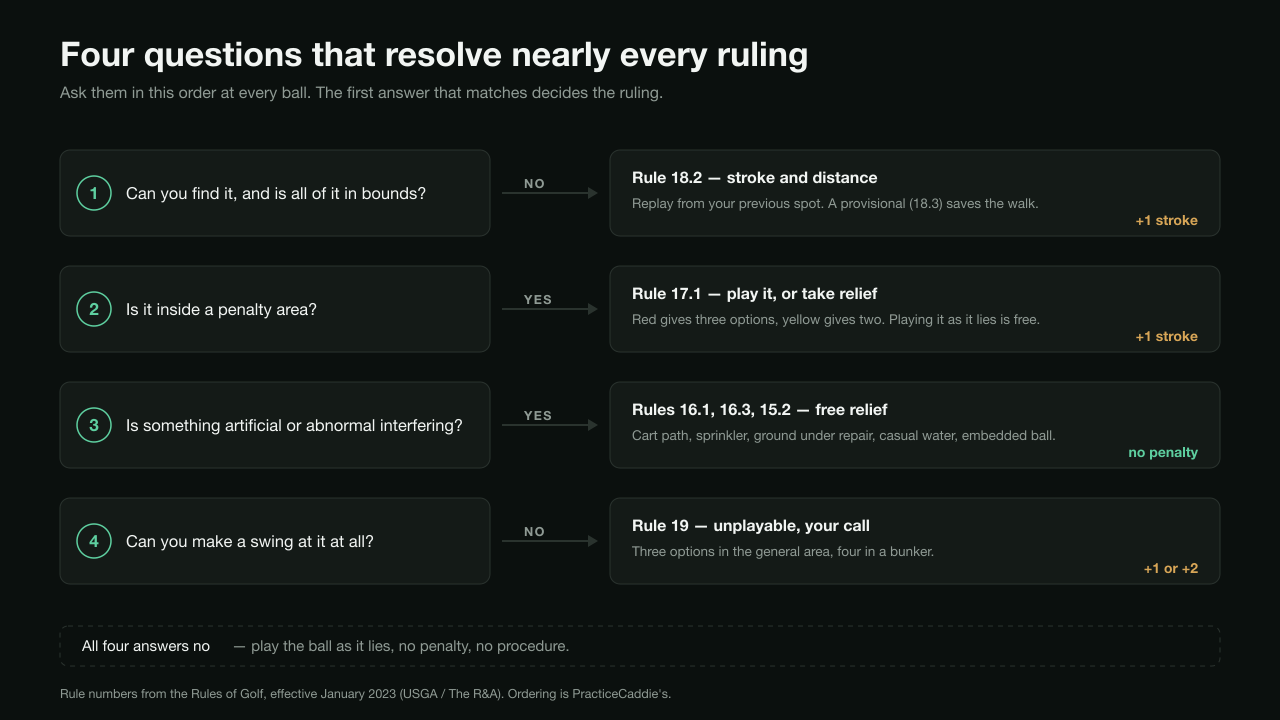
There are 24 numbered Rules, plus a separate official guide carrying the interpretations, committee procedures and Model Local Rules. You do not need any of that on the course. Walk up to your ball and ask four questions in this order. The first answer that matches decides the ruling.
- Can you find it, and is all of it in bounds? If no, the answer is stroke and distance under Rule 18.2: one penalty stroke, replay from the spot of your previous stroke. Nothing else is available unless the committee has posted Model Local Rule E-5.
- Is it inside a penalty area? If yes, you may play it as it lies for nothing under Rule 17.1b, or take one stroke and use the relief options for that colour.
- Is something artificial or abnormal interfering with your lie, stance or swing? If yes, the relief is free. Cart paths, sprinkler heads, ground under repair and temporary water go through Rule 16.1; rakes, bottles and towels through Rule 15.2; a ball plugged in its own pitch-mark through Rule 16.3.
- Can you make a swing at it at all? If no, declare it unplayable under Rule 19 and take one stroke, or two for the option that gets you out of a bunker backwards.
If all four answers are no, play the ball as it lies. That is the whole framework, and the order matters: checking the boundary before you start measuring club-lengths saves you from carefully executing a free drop for a ball that was never in play.
Lost ball and out of bounds: the most expensive rule in golf
Stroke and distance is the ruling beginners fight hardest, because it costs a stroke and the yardage. Under Rule 18.2, a ball is lost if you have not found it within three minutes of starting to search, and it is out of bounds only when all of it lies past the boundary edge. A ball sitting on the line, with any part touching the inside, is in play.
The relief in both cases is the same: add one penalty stroke and play from where you played your previous stroke. A drive out of bounds means your next swing is your third, from the tee.
The provisional ball is the fix, and it is free. Rule 18.3 lets you play a second ball before walking forward, whenever the original might be lost outside a penalty area or out of bounds. Say the word “provisional” out loud before you hit it, because a second ball played without that announcement becomes your ball in play under stroke and distance immediately. Find the original in bounds within three minutes and you abandon the provisional at no cost.
Model Local Rule E-5 exists, but only if the course adopted it
The two-stroke drop near where your ball was lost is a Local Rule, not a Rule of Golf. Model Local Rule E-5 allows a committee to offer an alternative to walking back: estimate where the ball came to rest or crossed the boundary, find the nearest fairway point no nearer the hole, and drop in the area between those two lines, extended up to two club-lengths outside the ball-side line and two club-lengths into the fairway. It costs two penalty strokes, so a lost tee shot means you are hitting four.
Three details that catch people out:
- It applies only where the committee has adopted it. Check the scorecard, the notice board or the pro shop before you use it.
- You cannot use it for the original ball if you already put a provisional in play under Rule 18.3.
- It does not cover an unplayable ball or a ball that is known or virtually certain to be in a penalty area.
Penalty areas: red gives you three options, yellow gives you two
Penalty areas are marked with stakes or lines: yellow for water you would normally play across, red for water and rough ground along your line. Since 2019 you may ground your club, touch the water and remove loose impediments inside one, so playing the ball as it lies under Rule 17.1b costs nothing.
| Option | Yellow | Red | Cost |
|---|---|---|---|
| Play the ball as it lies | Yes | Yes | 0 |
| Stroke and distance from your previous spot | Yes | Yes | 1 stroke |
| Back on the line through the point where it last crossed | Yes | Yes | 1 stroke |
| Two club-lengths lateral from that crossing point | No | Yes | 1 stroke |
The back-on-the-line option has no distance limit — you may go as far back as you like, keeping the crossing point between you and the hole. The USGA’s penalty-area guidance is explicit that the opposite-side option no longer exists for red areas, which is the single most common holdover from the pre-2019 Rules. You may not cross to the far bank and drop there.
Free relief: the reliefs that cost you nothing
Three separate Rules give relief for zero strokes, and beginners routinely skip all of them.
Abnormal course conditions (Rule 16.1) covers an animal hole, ground under repair, an immovable obstruction such as a cart path or sprinkler head, and temporary water. In the general area, find the nearest point of complete relief — one specific spot, found by taking the stance you would use — then drop within one club-length of it, no nearer the hole, staying in the general area. Relief requires interference with your lie, your intended stance or your intended swing. Standing on a cart path with the ball in the fairway counts. Wanting a better angle does not, and there is no free relief inside a penalty area.
Embedded ball (Rule 16.3). A ball plugged in its own pitch-mark anywhere in the general area gets free relief: drop within one club-length of the spot immediately behind it. This applies fairway and rough alike, per the USGA’s embedded-ball explanation, with the notable exception of a ball plugged in sand in an area not cut to fairway height.
Loose impediments and movable obstructions (Rules 15.1 and 15.2). Natural loose objects — stones, leaves, twigs, unattached pine cones — may be moved anywhere on the course, bunkers and penalty areas included, since the 2019 change. Artificial movable objects such as rakes, bottles and towels may be moved too, and if the ball moves while you move an artificial object there is no penalty. If the ball moves while you are clearing a natural object, that normally costs one stroke and the ball goes back.
Unplayable: your own call, three options outside a bunker
Only you can declare your ball unplayable, and you may do it anywhere except inside a penalty area. Rule 19.2 gives three options in the general area, each for one penalty stroke: stroke and distance, back on the line through the ball’s position, or two club-lengths lateral, no nearer the hole.
Inside a bunker, Rule 19.3 adds a fourth. The first three work the same way but keep you in the sand. The fourth lets you drop outside the bunker on the line back from the hole, for a total of two penalty strokes. Paying that second stroke to escape a buried lie under a steep face is often the cheapest way to finish the hole, and it is the option that most bunker-phobic beginners have never heard of. If the lie is playable, the greenside bunker technique is a learnable skill, and fairway bunkers follow a different set of rules of thumb entirely.
How to drop a ball, correctly, every time
Rule 14.3b sets one procedure for all relief. Hold the ball at knee height — the height of your knee when standing, not the height of your knee when crouched — and let it fall straight down. No spin, no roll, no toss. It must not touch you or your equipment on the way down, and it must land inside the relief area and come to rest there. Rolls out? Drop again. Rolls out twice? Place it where the second drop first touched the ground.
The 2023 revision changed the back-on-the-line procedure, and this one is worth knowing precisely. You now drop on the line itself, and the spot where the ball first touches the ground creates a relief area of one club-length in any direction, including nearer the hole. The ball may finish nearer the hole than where it landed, as long as it stays in that one club-length circle. The USGA’s 2023 principal changes document is the primary source. Before 2023, a ball rolling nearer the hole meant re-dropping, which is why you still see players re-drop unnecessarily.
Playing from outside the relief area is playing from a wrong place under Rule 14.7, and that carries two strokes.
Bunkers and greens: what you may touch
In a bunker (Rule 12.2b): do not touch the sand immediately in front of or behind the ball, do not touch sand during a practice swing, and do not touch sand in your backswing. Testing the sand for firmness is out. Everything else is broadly fine — digging your feet in for a stance, setting your bag down, leaning on a club to keep your balance, raking a different part of the bunker as course care, and removing leaves or stones. The penalty for the prohibited version is two strokes.
On the green: mark the ball with a coin or tee immediately behind or beside it before lifting, per Rule 13.1b. Two 2019 changes still surprise people. There is no penalty for accidentally moving your ball on the green under Rule 13.1d(1) — just replace it. And once a ball has been lifted and replaced, Rule 13.1d(2) says it owns that spot: if wind or gravity moves it afterwards, put it back. A ball that has not been marked and replaced and then blows to a new spot is played from the new spot under Rule 9.3.
You may also leave the flagstick in the hole and putt at it (Rule 13.2a), with no penalty for striking it. That change is worth a stroke or two of pace per round on a busy day, and the reading skills in how to read greens matter far more to your score than the flagstick decision does.
What beginners get wrong most, and what it actually costs
| The habit | The Rule | The real cost |
|---|---|---|
| Dropping beside the boundary after hitting out of bounds | 18.2, 14.7 | Wrong place: 2 strokes, on top of the ruling you skipped |
| Playing a second ball without saying “provisional” | 18.3 | That ball is in play under stroke and distance; the original is done |
| Hitting from in front of the tee markers | 6.1b | 2 strokes, the stroke does not count, and you must replay from inside |
| Improving the lie: pressing down sand, bending a branch | 8.1a | 2 strokes |
| Asking a playing partner what club they hit | 10.2a | General penalty for advice, in a competition |
| Nudging the ball while addressing it, then playing on | 9.4 | 1 stroke, and a wrong-place penalty if you do not replace it |
| Practising a putt on the green mid-hole | 5.5 | 2 strokes; practice between holes near the green is allowed |
| Carrying 15 clubs by accident | 4.1b | 2 strokes per affected hole, capped at 4 |
| Anchoring the club against your body during the stroke | 10.1b | 2 strokes; long putters are legal, anchoring them is not |
| Signing for a score lower than you actually took | 3.3b(3) | Disqualification in stroke play |
Two of these come with useful nuance. A practice swing with no intention of hitting anything is not a stroke and carries no penalty; a practice stroke at any ball while playing a hole does, per The R&A’s guidance on practice during a round. And “advice” is narrow: club selection, how to play a shot, how to make a stroke. Distances, where the hazards sit and what the Rules say are public information you may ask anyone for.
Pace of play is a rule, with a number attached
Rule 5.6b asks players to play at a prompt pace and recommends making each stroke in no more than 40 seconds — usually less — measured from the moment you can play without interference. The 40 seconds carries no penalty on its own. A slow-play penalty comes either from a committee pace-of-play policy or from Rule 5.6a, which costs one stroke for a first unreasonable delay and the general penalty for a second. Rule 6.4b then explicitly permits ready golf: in stroke play you may play out of turn when it is safe and saves time, and the R&A’s ready-golf guidance encourages it.
The best-documented U.S. pace dataset remains the Three45 GPS study hosted by the USGA, which covered 40,460 rounds at 175 courses and found an average round of 4 hours 17 minutes. Morning rounds averaged 4:02 and afternoon rounds 4:21; 28.5% finished under four hours and 10.4% took over five. A 2025 USGA article describes recent research showing a 4:30 average as a new high, though that piece also quotes 4:17 without reconciling the two figures, so treat 4:30 as directional.
For a beginner, the 40-second clock is the single most useful pace habit, because it forces the decision-making to happen while you walk. A repeatable pre-shot routine is what makes 40 seconds feel roomy instead of rushed.
Scoring: net double bogey, most likely score, and holing out
Two separate systems get confused here, and the distinction matters.
For handicap posting, the Rules of Handicapping cap every hole at net double bogey: par, plus 2, plus the handicap strokes you receive on that hole. A Course Handicap 15 player receiving one stroke on a par 4 posts a maximum of 7, even after making 9. Before you have an established Handicap Index, the limit is par plus 5. The full mechanics of how those adjusted scores turn into an Index live in Golf Handicap Explained.
For an unfinished hole, the Most Likely Score procedure applies where the format allows you to stop: post the strokes taken, plus penalties, plus the strokes you would most likely need to finish. USGA guidance is to add one from inside five feet, two or three from five feet to 20 yards, and three or four from beyond 20 yards, never exceeding the net-double-bogey maximum.
In ordinary individual stroke play, you must still hole out. Rule 3.3c requires it, and the failure must be corrected before you tee off on the next hole. Picking up is legal when the committee has adopted the Maximum Score format under Rule 21.2, or in Stableford, or in match play after a concession. Casual rounds among friends are not competitions, so pick up and post a most likely score — just know which one you are doing.
Rehearse the procedures, not just the swing
Rules cost beginners strokes in two ways: penalties they did not know about, and slow, hesitant execution of relief they were entitled to. Both respond to practice, and neither needs a golf course.
- Ten knee-height drops on the range. Put a tee in the ground, measure one club-length with your longest club other than the putter, and drop ten balls from knee height into that circle. Count how many stay in. The point is calibrating what a legal drop feels like before you have a scorecard in your pocket and three people watching.
- One rules-only nine. Play nine holes with no swing goals at all. At every ball, say the ruling out loud before you touch anything: which area it is in, which option you are taking, what it costs. Nine holes of narration does more than any quiz.
- Read the scorecard before the first tee. Thirty seconds tells you whether Model Local Rule E-5 is in play, how the boundaries are defined, and what is marked as ground under repair. That is where the local answers live.
- Put the official app on your phone. The USGA’s Official Rules of Golf app is free and includes searchable Rules, diagrams and video. The Player’s Rule Finder replaced the printed Player’s Edition in 2023 and gives plain-language answers by situation, and the USGA’s free Rules 101 course covers the foundations in an hour.
The same principle drives every practice plan PracticeCaddie builds: rehearse the thing you will actually have to do, under something resembling real conditions. The motor-learning case for that is in block vs random practice, and the decision-making layer that turns rules knowledge into saved strokes is in golf course management tips. Build a free practice plan in 30 seconds and the rules-only nine becomes one line on the calendar instead of a good intention.
Related reading
- Strokes Gained Explained for Amateurs — the framework that shows which part of your game is actually costing you shots, penalties included.
- Golf Course Management Tips — the decision layer that keeps you out of the situations this post explains how to escape.
- Golf Handicap Explained — how net double bogey, adjusted gross scores and Score Differentials produce your Index.
- Golf Pre-Shot Routine — the 40-second habit that satisfies Rule 5.6b and steadies the shot at the same time.
- How to Hit a Bunker Shot in Golf — the technique that makes Rule 19.3’s two-stroke escape unnecessary most of the time.
- How to Read Greens in Golf — the putting-green skill worth far more than the flagstick decision.
- Golf Practice Plan — how to build the week that has room for a rules-only nine.
Key takeaways
- The 2023 Rules are the current edition and run through 2027; the next revision arrives January 1, 2028.
- Four questions resolve nearly every ruling: findable and in bounds, penalty area, abnormal condition, playable at all. The first yes decides it.
- Lost or out of bounds is one stroke plus the distance under Rule 18.2. A provisional ball under Rule 18.3 is free and saves the walk — say the word out loud.
- Red penalty areas give three relief options, yellow gives two. Opposite-side relief for red areas has not existed since 2019.
- Free relief is real and under-used: cart paths, sprinklers, ground under repair and temporary water (Rule 16.1), plus balls embedded in their own pitch-mark (Rule 16.3), all cost nothing.
- Every drop is from knee height (Rule 14.3b), and since 2023 a back-on-the-line drop creates a one club-length relief area in any direction from where it first lands.
- The bunker escape hatch costs two strokes: Rule 19.3 lets you drop outside the bunker on the line back from the hole, which is often cheaper than three swings in sand.
- Rulings arrive constantly — the R&A’s 2025 survey found free relief taken in 66% of rounds and a provisional played in 59%.
- 40 seconds per stroke is the Rule 5.6b recommendation; the best U.S. pace study, covering 40,460 rounds, put the average round at 4:17.
Frequently asked questions
What are the most important golf rules for beginners?
Four situations account for most beginner penalties: a lost or out-of-bounds ball (Rule 18.2, one stroke plus the walk back to your last spot), a ball in a penalty area (Rule 17.1, one stroke), free relief from cart paths, sprinklers, ground under repair and temporary water (Rule 16.1, no penalty), and an unplayable ball (Rule 19, one stroke). Learn those four, drop from knee height under Rule 14.3b, and you will play a legal round.
How long can you look for a lost golf ball?
Three minutes, timed from when you or your caddie begin searching in the area where the ball is believed to be. The limit was five minutes before the 2019 modernization. Once three minutes pass without finding it, the ball is lost and the only relief is stroke and distance under Rule 18.2: add one penalty stroke and play again from where you played the previous shot. If you accidentally move the ball while searching, Rule 7.4 says there is no penalty, so replace it.
What do you do when your golf ball goes out of bounds?
Add one penalty stroke and play again from the spot of your previous stroke, which is stroke-and-distance relief under Rule 18.2. A tee shot hit out of bounds means you are playing your third from the tee. A ball is out of bounds only when all of it lies outside the boundary. Dropping beside the boundary line is not a Rule of Golf; it is only allowed where the committee has adopted Model Local Rule E-5, which costs two penalty strokes.
What is the difference between a red and yellow penalty area?
Both cost one penalty stroke and both allow you to play the ball as it lies for free under Rule 17.1b. A yellow penalty area gives two relief options: stroke and distance, or a back-on-the-line drop keeping the point where the ball last crossed the edge between you and the hole. A red penalty area adds a third: lateral relief within two club-lengths of that crossing point, no nearer the hole. Red is the more generous marking, which is why most water on public courses is staked red.
Can you ground your club in a bunker?
No. Rule 12.2b prohibits touching the sand immediately in front of or behind the ball, touching sand in a practice swing, and touching sand in your backswing. Testing the sand is also prohibited. The penalty is two strokes in stroke play. You may dig your feet in for a stance, lean on a club to avoid falling, rake the bunker for course care, and since 2019 you may remove loose impediments such as leaves and stones, though moving the ball while doing so normally costs one stroke.
How many golf clubs can you carry?
Fourteen, under Rule 4.1b. Carrying more costs two strokes for each hole where the breach happened, capped at four strokes in stroke play, and you must declare the excess clubs out of play as soon as you discover the problem. Since the 2023 revision, Rule 4.1a(2) lets you repair or replace a club damaged during the round, unless you damaged it through abuse. Beginners rarely need all fourteen slots filled, so an incomplete set is legal.
What is the maximum score you can take on a hole as a beginner?
For handicap posting, the maximum is net double bogey: par, plus 2, plus any handicap strokes you receive on that hole. Before you have an established Handicap Index, the limit is par plus 5, so a par 4 posts as a 9 at worst. The cap governs the score you post; Rule 3.3c governs whether you must finish. In ordinary individual stroke play you must hole out, unless the committee has chosen the Maximum Score format under Rule 21.2.