
Golf Handicap Explained: How Your Index Is Actually Calculated
Your Handicap Index averages the lowest 8 of your last 20 Score Differentials. The full USGA math, the caps, and what the number actually predicts.

Quick answer
A Handicap Index is the average of the lowest 8 Score Differentials from your most recent 20 rounds, rounded to 0.1 and capped at 54.0. Each round becomes a differential through (113 ÷ Slope) × (Adjusted Gross Score − Course Rating − PCC). Because 12 of every 20 scores are discarded, the Index measures demonstrated potential — golfers reach it in roughly one round out of five.
The handicap vocabulary at a glance
| Term | What it is | Range / format | Where it comes from |
|---|---|---|---|
| Course Rating | Expected score for a scratch player playing well | One decimal (e.g. 71.4) | On-site USGA course rating team |
| Slope Rating | Relative difficulty for a bogey player vs. scratch | 55–155, standard is 113 | Derived from Bogey Rating − Course Rating |
| Adjusted Gross Score | Your gross score after the net-double-bogey hole cap | Whole number | Your scorecard, adjusted |
| Score Differential | One round, normalized so any two rounds compare | One decimal | Formula, per round |
| Handicap Index | Average of the lowest 8 of your last 20 differentials | 0.1 steps, max 54.0 | Calculated daily by your provider |
| Course Handicap | Strokes you receive on a specific set of tees | Whole number | Index × (Slope ÷ 113) + (Rating − par) |
| Playing Handicap | Course Handicap after the format’s allowance | Whole number | Unrounded Course Handicap × allowance |
The World Handicap System launched in January 2020 and is governed jointly by the USGA and The R&A, with the U.S. transition landing on January 6, 2020. The rules in force today are the 2024 Rules of Handicapping, the first revision of the 2020 edition. Every number in this post comes from those rules or from published USGA statistics.
Course Rating and Slope Rating: the two numbers on the scorecard
Every handicap calculation starts from two numbers printed next to the tee you played.
Course Rating is the score a scratch player would be expected to shoot on that course, under normal conditions, playing well. It carries one decimal place — 71.4, 68.9, 74.2. A scratch player is defined as a 0.0 Handicap Index.
Slope Rating measures how much harder the course plays for a bogey golfer than for a scratch player. It is derived from the gap between the Bogey Rating and the Course Rating, runs from 55 to 155, and 113 is the standard. Under the World Handicap System, a bogey golfer is roughly a 20.0 Index for men and 24.0 for women, per the USGA’s course and slope rating documentation and Appendix G of the Rules of Handicapping.
The two measure different things. Course Rating answers “how hard is this for a good player,” and it drives the raw score you are compared against. Slope answers “how much harder does it get as you get worse,” and it scales the strokes you receive. A short, tight course can carry a low Course Rating and a high Slope: easy for a scratch player who can place the ball, punishing for a bogey golfer who cannot.
What a Handicap Index actually measures
A Handicap Index measures demonstrated potential. The USGA’s own Handicap Index calculation page describes it as a measure of ability, built from the lowest 8 of your most recent 20 Score Differentials. Twelve of every 20 rounds you post never enter the basic average at all.
That design has a consequence most golfers feel without being able to name it. The USGA’s probability table puts the odds of producing a differential equal to or better than your Index at about 1 in 5.0 for a 20.0–29.9 Index and 1 in 5.9 for a plus player. Call it one round in five. The USGA’s own guidance on setting a target adds that most rounds land 2 to 5 strokes above the Index.
So a 15 Index who shoots 90 on a par-72 course with a Course Handicap of 17 has just played an ordinary round. Shooting 89 would have been the good one.
Score Differential: what your round becomes
Every round is converted into a single normalized number before it touches your Index:
Score Differential = (113 ÷ Slope Rating) × (Adjusted Gross Score − Course Rating − PCC adjustment)
The result is rounded to the nearest 0.1. The USGA states the formula verbatim in its Score Differential FAQ and in Rule 5.1a.
Work one: you shoot an Adjusted Gross Score of 92 on tees rated 71.4 with a Slope of 131, on a day with no PCC adjustment.
- 113 ÷ 131 = 0.8626
- 92 − 71.4 − 0 = 20.6
- 0.8626 × 20.6 = 17.8
That 92 is worth a differential of 17.8. The same 92 on a 113-Slope, 71.4-rated course would be worth 20.6 — nearly three strokes worse, because the easier course offers less excuse.
The PCC term is the piece almost nobody knows about. It runs once daily, compares how the field actually scored against how it should have scored, and adjusts every differential from that day by −1.0, 0.0, +1.0, +2.0, or +3.0. It needs at least 8 eligible scores, and only players with an Index of 36.0 or lower are counted, per the USGA’s PCC FAQ. Post on the day you play or you miss it.
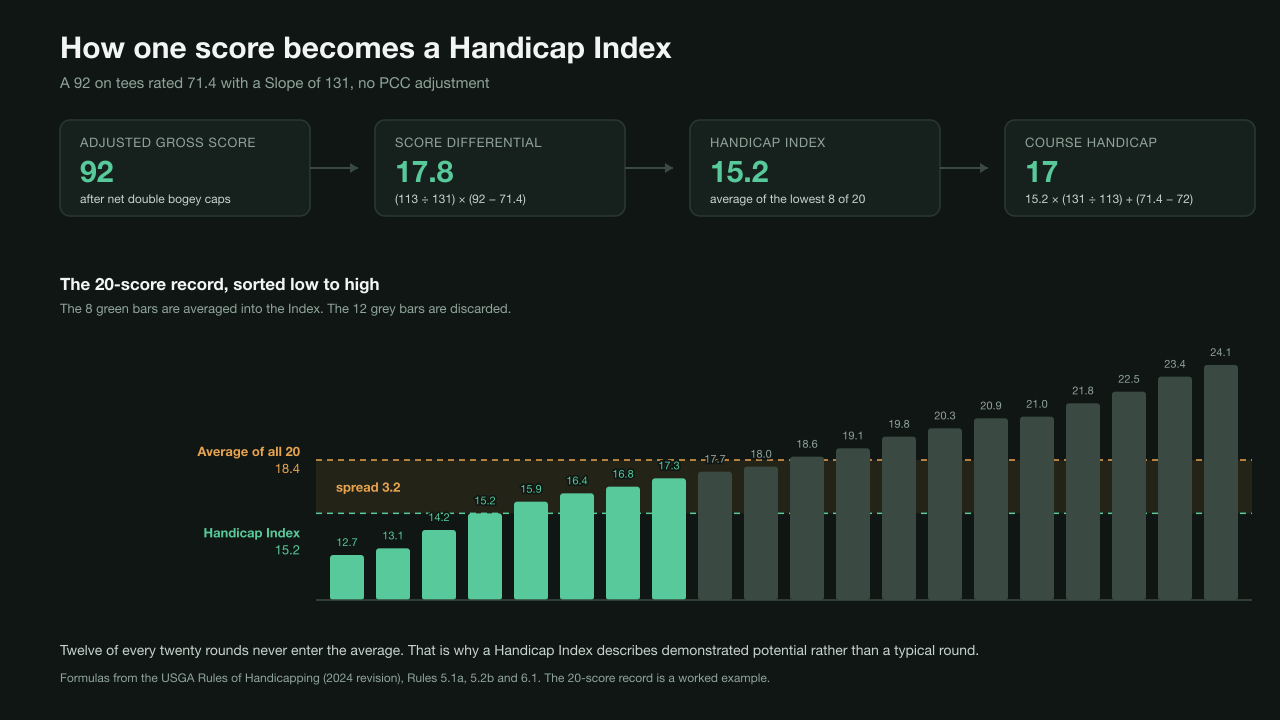
How 20 scores become one Index
With a full record, the math is short: average the lowest 8 of the most recent 20 differentials, round to 0.1, then apply the caps. Rule 5.2b is the governing text.
Run a real record. Twenty differentials, sorted ascending:
12.7, 13.1, 14.2, 15.2, 15.9, 16.4, 16.8, 17.3, 17.7, 18.0, 18.6, 19.1, 19.8, 20.3, 20.9, 21.0, 21.8, 22.5, 23.4, 24.1
The lowest 8 are 12.7 through 17.3. They sum to 121.6, so the average is 15.2. That player carries a 15.2 Handicap Index while the average of all 20 rounds sits at 18.4 — a number the system never displays.
With fewer than 20 scores, Rule 5.2a sets the subset and, at the thin end, an extra downward adjustment:
| Scores in record | Differentials used | Extra adjustment |
|---|---|---|
| 3 | lowest 1 | −2.0 |
| 4 | lowest 1 | −1.0 |
| 5 | lowest 1 | 0 |
| 6 | lowest 2 | −1.0 |
| 7–8 | lowest 2 | 0 |
| 9–11 | lowest 3 | 0 |
| 12–14 | lowest 4 | 0 |
| 15–16 | lowest 5 | 0 |
| 17–18 | lowest 6 | 0 |
| 19 | lowest 7 | 0 |
| 20 | lowest 8 | 0 |
The maximum Handicap Index is 54.0 for every player regardless of sex. Getting one requires scores totaling 54 holes in any combination of rated 9-hole and 18-hole rounds, and since 2020 the Index revises daily rather than twice a month.
Course Handicap and Playing Handicap
A Handicap Index is portable. A Course Handicap is what you actually get on the first tee:
Course Handicap = Handicap Index × (Slope Rating ÷ 113) + (Course Rating − par)
Take the 15.2 above, on tees with a Slope of 131, a Course Rating of 71.4, and a par of 72:
- 15.2 × (131 ÷ 113) = 17.62
- 71.4 − 72 = −0.6
- 17.62 − 0.6 = 17.02 → Course Handicap 17
The Course Rating − par term arrived with the 2020 rollout. Before that, a Course Handicap represented the strokes needed to play to the Course Rating; now it represents the strokes needed to play to par, which is the number golfers were already assuming it meant. The USGA published the detailed change note at the time.
A Playing Handicap applies the format’s allowance to the unrounded Course Handicap. Appendix C sets the recommendations: 95% for individual stroke play, 100% for individual match play, 85% for four-ball stroke play, 90% for four-ball match play, 50% of the combined team handicap for foursomes, and a sliding 25/20/15/10% for a four-player scramble. The committee running the event sets the actual allowance; the table is guidance.
Net double bogey: the cap that protects your Index
One catastrophic hole cannot wreck your Index, because it never gets posted at full value. For a player with an established Index, Rule 3.1b caps every hole at:
Net double bogey = par + 2 + handicap strokes received on that hole
On a par 4 where you receive one stroke, a 9 gets posted as a 7. Players without an established Index use par + 5 instead. That capped total is your Adjusted Gross Score, and it is the only score the differential formula ever sees.
This replaced Equitable Stroke Control, the old sliding table that capped a 10-to-19 handicap at 7 on any hole regardless of par. ESC retired when the World Handicap System took effect on January 1, 2020.
The three safeguards
The system also defends against an Index drifting away from a player’s real ability in either direction.
Low Handicap Index is the lowest Index you held in the 365 days before your most recent score. It only exists once your record holds 20 acceptable scores (Rule 5.7).
Soft cap and hard cap limit upward movement from that anchor. Once the calculated Index rises more than 3.0 strokes above the Low Handicap Index, the excess above 3.0 is suppressed by 50%; the hard cap then blocks any increase beyond 5.0 strokes (Rule 5.8). A player with a 12.0 Low Index whose raw calculation comes out at 16.5 has risen 4.5 strokes: the first 3.0 stands, the remaining 1.5 is halved, and the published Index becomes 15.8.
Exceptional Score Reduction works the other way. Post a differential 7.0 to 9.9 strokes below your Index and every one of your most recent 20 differentials drops by 1.0; post one 10.0 or more below and they drop by 2.0 (Rule 5.9). The 15.2 player above who returns a 7.5 differential — 7.7 below the Index — triggers the 1.0 adjustment across the record.
Where your Index sits
The USGA’s 2025 Golf Scorecard put the average Handicap Index at 14.0 for men and 28.8 for women, across roughly 3.68 million U.S. golfers holding an Index. Around 2.0% of men and 0.85% of women carried an Index of 0.0 or better, as reported from that scorecard.
The USGA’s own statistics page renders its distribution as a chart rather than as published figures. The most complete band breakdown of the 2024 numbers in text form is Golf Monthly’s transcription:
| Band | Men | Women |
|---|---|---|
| Below 0.0 | 1.99% | 0.75% |
| 0.0–4.9 | 8.55% | 1.38% |
| 5.0–9.9 | 20.15% | 2.53% |
| Cumulative under 5.0 | 10.54% | 2.13% |
| Cumulative under 10.0 | 30.69% | 4.66% |
Single digits put a male golfer inside the top third and a female golfer inside the top 5%. Scratch is roughly a 1-in-50 outcome for men.
What is a good golf handicap?
Measured against the population, anything under the 14.0 male average or the 28.8 female average is above the median. The commonly used bands map onto the USGA data like this: 0 to 9 is low (top 31% of men, top 4.7% of women), 10 to 19 is mid and contains the largest share of golfers, and 20 and above is high. Breaking into single digits is the milestone that actually separates a golfer from the field, and it takes an average Score Differential in the low teens across your best 8 rounds.
The spread: the diagnostic hiding in your record
Here is a measurement the handicap system computes and then throws away. Your Index is the average of your best 8. Average all 20 instead, subtract the Index, and the gap is what PracticeCaddie calls your spread — the distance between your potential and your typical round.
The 15.2 player above has a spread of 3.2 strokes (18.4 average, 15.2 Index). The USGA’s own guidance says most golfers land 2 to 5 strokes above their Index in a normal round, which makes that 2.0–5.0 window the honest definition of typical. Outside it, the number is telling you something:
| Your spread | What it means | Where practice pays |
|---|---|---|
| Under 2.0 | Your worst rounds look like your best rounds | Ceiling work: approach quality, carry distance, birdie chances. Consistency is already handled |
| 2.0–5.0 | Normal, matching USGA’s published expectation | Balanced. Weight practice to your largest Strokes Gained leak |
| Over 5.0 | Blow-up rounds dominate your record | Floor work: penalty avoidance, tee-shot dispersion, bail-out targets, never short-siding |
The mechanism behind the wide-spread case is measurable. Shot Scope’s benchmark data, built from more than 90 million tracked shots, shows penalty strokes per round running 0.56 at scratch, 1.62 at a 10 handicap, and 3.03 at a 20 (Shot Scope strokes-gained report). Penalties are the single most volatile line in an amateur’s card, and volatility is exactly what a wide spread is made of.
Computing your spread takes about four minutes: open your scoring record, copy the 20 most recent differentials into a spreadsheet, average them, subtract your Index. Recompute every 6 to 8 weeks. A spread that shrinks while the Index holds means your floor rose — usually the first thing to move when a practice plan starts working.
What actually lowers a Handicap Index
Lowering an Index means lowering the lowest 8 differentials, which is a long-game problem far more often than a putting problem. Mark Broadie’s Golfmetrics dataset — amateur shot data collected since 2005 and published as Every Shot Counts — is where Strokes Gained came from, and the strokes-lost-by-category table it produces sits in Strokes Gained Explained for Amateurs.
Shot Scope’s 90-million-shot benchmarks show the same separation in traditional stats:
| Metric | Scratch | 10 handicap | 20 handicap |
|---|---|---|---|
| Score to par | +0.83 | +10.88 | +21.69 |
| Fairways hit | 50% | 49% | 46% |
| Greens in regulation | 61% | 36% | 17% |
| Up-and-down rate | 47% | 31% | 20% |
| Putts per round | 29.4 | 31.2 | 33.1 |
| Penalty strokes | 0.56 | 1.62 | 3.03 |
Fairways hit moves 4 percentage points from scratch to a 20. Greens in regulation moves 44. That single contrast is the entire argument for weighting practice toward approach play, and it lines up with Arccos’s tracking of a cohort that started between 5 and 10 handicap — 6.1 on average — and reached scratch: approach was the biggest gainer, driving second, short game third, putting a distant fourth, with the group improving about 2.5 strokes per year.
The practical translation lives in Strokes Gained Explained for Amateurs, with the category-level detail in Strokes Gained: Approach.
Common misconceptions
- “My handicap is my average score over par.” The average of all 20 rounds sits 2 to 5 strokes above the Index for most golfers. The Index is built from the best 8.
- “A 15 handicap should shoot 87 on a par-72.” The target gross score is par plus your Course Handicap, which changes with the tees. The same 15.2 Index gets 17 strokes on a 131-Slope course and 14 on a 113-Slope course rated at par.
- “One blow-up round wrecks your handicap.” Net double bogey caps every hole before posting, and the lowest-8 rule discards the round entirely if it lands in the top 12.
- “Posting a bad score raises my handicap right away.” A single high differential only matters if it displaces a low one inside the best 8. Most bad rounds change the Index by 0.0.
- “Sandbagging is easy under WHS.” Exceptional Score Reduction applies a 1.0 or 2.0 stroke cut across the whole record when a differential lands 7.0 or more below the Index, and handicap review procedures sit on top of that.
- “Nine-hole rounds don’t count.” Since the 2024 revision, an established player’s 9-hole score is converted immediately by adding an expected 9-hole differential, so it reaches the next revision on its own.
Related reading
- Strokes Gained Explained for Amateurs — the framework that tells you which category is holding your best 8 differentials up, with strokes-lost figures by handicap.
- Strokes Gained: Approach Explained — how the approach category is measured, with proximity data by distance and a practice protocol.
- Golf Practice Plan by Handicap — practice weighting for every Index band, from beginner to single digit.
- How to Actually Improve at Golf — the improvement math behind why Index movement is slower than most golfers expect.
- Golf Course Management Tips — the decision layer that shrinks a wide spread faster than any swing change.
- Golf Practice Schedule — three weekly calendars for putting the practice into the week.
- Golf Swing Speed Chart by Age and Handicap — the distance side of the long-game gap, benchmarked by Index.
Key takeaways
- Your Index is the average of the lowest 8 of your last 20 Score Differentials, rounded to 0.1 and capped at 54.0. Twelve of 20 rounds never enter the math.
- The differential formula is (113 ÷ Slope) × (AGS − Course Rating − PCC). A 92 on a 131-Slope, 71.4-rated course is worth 17.8; the same 92 on a 113-Slope course is worth 20.6.
- Course Handicap adds the
Course Rating − parterm introduced in 2020, so it represents strokes needed to play to par. A 15.2 Index gets 17 strokes on a 131/71.4/par-72 setup. - Net double bogey caps every hole at par + 2 + strokes received, which is why a single 9 on a par 4 posts as a 7.
- The soft cap suppresses 50% of any rise beyond 3.0 strokes above your Low Handicap Index, and the hard cap blocks anything beyond 5.0.
- Golfers reach their Index in roughly 1 round out of 5 — about 17 to 20 percent, per the USGA probability table.
- Average Index is 14.0 for men and 28.8 for women (USGA 2025 Golf Scorecard); about 31% of men and 4.7% of women are under 10.0.
- Compute your spread — all-20 average minus Index — every 6 to 8 weeks. Under 2.0 means practice for ceiling; over 5.0 means practice for floor.
Frequently asked questions
How is a golf Handicap Index calculated?
With a full record of 20 acceptable scores, the Handicap Index is the average of the lowest 8 Score Differentials from your most recent 20 rounds, rounded to the nearest 0.1 and then checked against the soft cap and hard cap. With fewer than 20 scores, the system uses a smaller subset: 1 differential at 3 to 5 scores, 2 at 6 to 8, 3 at 9 to 11, and so on. At 3, 4, and 6 scores an extra adjustment of 2.0, 1.0, and 1.0 strokes is subtracted.
What is a Score Differential in golf?
A Score Differential converts one round on one set of tees into a number comparable to any other round anywhere. The formula is (113 divided by the Slope Rating) times (Adjusted Gross Score minus Course Rating minus the PCC adjustment), rounded to the nearest 0.1. The 113 is the standard Slope Rating, so a course rated 113 leaves the bracket unchanged. The PCC term is a daily correction between minus 1.0 and plus 3.0 that accounts for how the whole field scored that day.
What is the difference between Handicap Index and Course Handicap?
A Handicap Index is portable and course-neutral, carried to one decimal place, and capped at 54.0. A Course Handicap is the number of strokes you actually receive on a specific set of tees, calculated as Handicap Index times Slope Rating divided by 113, plus Course Rating minus par. Since 2020 that Course Rating minus par term has been included, which makes a Course Handicap the strokes needed to play to par rather than to the Course Rating.
What is the average golf handicap?
The USGA’s 2025 Golf Scorecard reported an average Handicap Index of 14.0 for male golfers and 28.8 for female golfers across roughly 3.68 million U.S. golfers with an Index. Roughly 2.0 percent of men and 0.85 percent of women carried an Index of 0.0 or better. Using the 2024 distribution bands, about 31 percent of male golfers were under 10.0 and about 10.5 percent were under 5.0, versus 4.7 percent and 2.1 percent of female golfers.
How many rounds do I need to get a Handicap Index?
You need scores totaling 54 holes, in any combination of rated 9-hole and 18-hole rounds. Three 18-hole rounds works, and so does six 9-hole rounds. Since the 2024 revision, an established player’s 9-hole score is converted immediately by adding an expected 9-hole differential, rather than being held until a second 9-hole score arrives. Handicap Indexes have revised daily since 2020, so a posted score normally shows up in your Index the following day.
How often does a golfer actually shoot their handicap?
About one round in five. The USGA’s published probability table puts the odds of producing a Score Differential equal to or better than your Handicap Index at roughly 1 in 5.0 for a 20 to 29 Index, 1 in 5.2 for a 10 to 14 Index, and 1 in 5.9 for a plus player, which works out to roughly 17 to 20 percent of rounds. The Index describes demonstrated potential, so most rounds land 2 to 5 strokes above it by design.
What is the maximum score I can post on a hole?
Net double bogey: par, plus 2, plus any handicap strokes you receive on that hole. On a par 4 where you receive one stroke, the maximum you may post is 7, even if you made 9. Players without an established Handicap Index use a limit of par plus 5 instead. Net double bogey replaced Equitable Stroke Control when the World Handicap System took effect on January 1, 2020, and most apps apply the cap automatically when you post hole by hole.