
Wedge Bounce Explained: What the Number Means and Why It Doesn't Travel
Three published bounce charts label the same 7-degree wedge three different ways. What bounce measures, what changes it at impact, and how to test yours.
Quick answer
Bounce is the angle between a wedge’s sole and the ground with the shaft vertical, and it keeps the leading edge from digging. The stamped number is not a cross-brand spec: three published charts label a 7-degree wedge three different ways, and PING publishes effective bounce while others publish a static angle. What reaches the turf depends on shaft lean, face angle, sole width and grind.
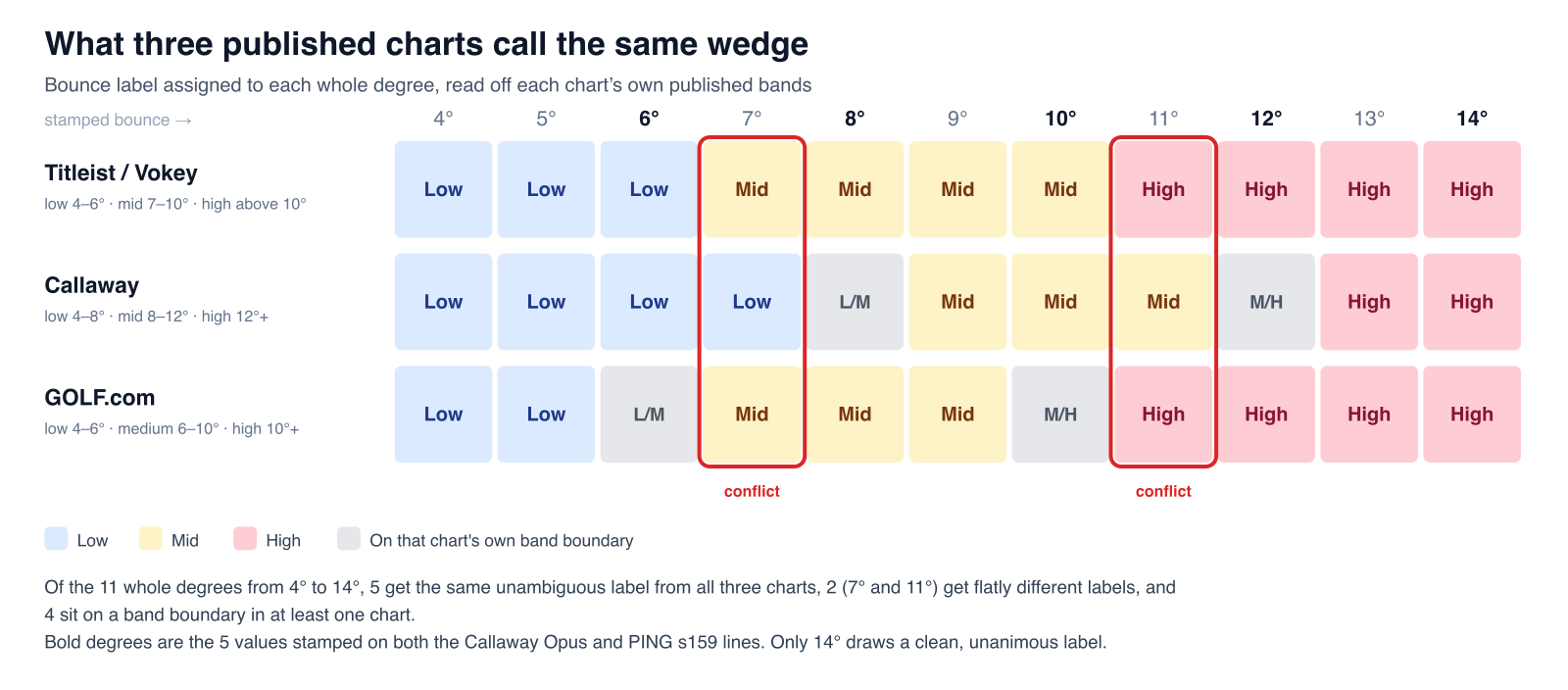
The wedge bounce chart problem: three charts, three answers
| Stamped bounce | Titleist / Vokey | Callaway | GOLF.com |
|---|---|---|---|
| 4° | Low | Low | Low |
| 5° | Low | Low | Low |
| 6° | Low | Low | Boundary (low / mid) |
| 7° | Mid | Low | Mid |
| 8° | Mid | Boundary (low / mid) | Mid |
| 9° | Mid | Mid | Mid |
| 10° | Mid | Mid | Boundary (mid / high) |
| 11° | High | Mid | High |
| 12° | High | Boundary (mid / high) | High |
| 13° | High | High | High |
| 14° | High | High | High |
Sources: Titleist’s Vokey wedge page puts low at 4°–6°, mid at about 7°–10°, and high above 10°. Callaway’s wedge buying guide puts low at 4°–8°, mid at 8°–12°, and high at 12°+. GOLF.com’s Fully Equipped explainer puts low at 6° and under, medium at 6°–10°, and high at 10° or above.
Read the table down the column, not across the row. Of the eleven whole-degree values from 4° to 14°, only five — 4°, 5°, 9°, 13° and 14° — get the same unambiguous label from all three charts. Two get flatly different labels: a 7° wedge is mid bounce to Titleist and low bounce to Callaway, and an 11° wedge is high bounce to two charts and mid bounce to the third. The remaining four sit on a band boundary in at least one chart, which means that chart puts the number in two categories at once.
Now look at what gets stamped on wedges. Callaway’s own Opus grind chart offers 6°, 8°, 10°, 12° and 14°. PING’s s159 line offers the same five values. Only one of those five — 14° — draws a clean, unanimous label from all three charts. The other four land on a band boundary in at least one of them, and 8° and 12° are values Callaway’s own chart puts in two bands at once.
That is the whole problem in one sentence. “Low,” “mid” and “high” are fitting shorthand. No standards body defines them, and they are least reliable exactly where most wedges are sold.
What bounce actually measures
Bounce is the angle the sole makes with the ground when the shaft sits vertical at address. Andrew Rice states it plainly: a club with ten degrees of bounce has a ten-degree angle between the sole and the ground, barring any rounding of the sole. The trailing edge sits lower than the leading edge, so the leading edge rides slightly above the turf.
Rice credits the design to Gene Sarazen, whose sand wedge put a flanged sole under the club so the leading edge would skid rather than shovel. His framing is the most useful one in this whole subject: the leading edge digs into the ground, the bounce glides along it.
That “barring any rounding of the sole” caveat is doing more work than it looks. A flat sole gives you a clean line to measure from leading edge to trailing edge. A cambered, relieved or dual-level sole does not — the lowest point of contact may sit nowhere near the geometric rear edge, and different brands can pick a different representative line. Bob Vokey describes it directly: “what happens as soon as you put a grind on it, all of a sudden you are taking that bounce angle and you are reducing the effective bounce of it because you are reducing the volume.”
Volume is the word to hold onto. Bounce is an angle, but what resists the ground is an amount of sole.
Static bounce versus what reaches the turf
The stamped number describes the club sitting still in a neutral position. You never hit a shot from that position.
| What changes | Effect on the bounce presented at impact | Evidence |
|---|---|---|
| Forward shaft lean | Delofts the head and rotates the sole away from the turf, removing presented bounce | 10° of bounce with more than 10° of forward lean gives approximately zero or negative bounce (Rice) |
| Opening the face | Raises effective loft and exposes more sole to the ground | The mechanism behind the standard open-faced bunker shot |
| Heel relief in the grind | Lets the face open without the heel levering the leading edge high | Central to Callaway’s C and Z grinds and PING’s H grind |
| Trailing-edge relief | Narrows the sole and speeds the head’s exit through turf | Reduces the sole volume behind the contact point |
| Sole width | Wider sole floats more even at the same stamped angle | A wide sole can play higher than its number; a narrow one lower |
| Camber | Moves the contact point, keeping the leading edge low while retaining sole behind it | Callaway’s W grind pairs generous camber with high bounce to promote skidding |
| Bending loft | Moves bounce degree for degree with loft | Bending a 54° to 55° adds 1° of bounce; a 56° to 55° removes 1° (Frank Thomas) |
Rice’s shaft-lean arithmetic is the single most useful line in this article for a golfer who chunks and blades in the same round. If you shove the handle forward on short shots, you are cancelling the bounce you paid for, and no number stamped on the sole fixes a delivery that removes it.
PING publishes a different number entirely
There is a reason cross-brand comparison fails at the source. PING’s s159 spec table labels its bounce column “EFFECTIVE BOUNCE” — a figure that already accounts for the complete sole rather than a single measured angle. Its grinds run from 6° on the T to 14° on the W. PING also states outright that these are design specifications that may vary due to manufacturing tolerances.
Most other brands publish a static measured angle. So an 8° PING and an 8° wedge from a brand publishing static bounce are not two readings of the same quantity, and shopping by the stamped number across brands compares two different measurements.
Callaway makes the same point from the other direction. Its Opus chart carries a cross-reference column mapping competitor wedges to Callaway grinds, and the mapping is not by bounce number at all — the Vokey F grind maps to Callaway’s S, the Vokey M maps to the Z, and the Vokey K maps to the W. Callaway itself does not translate these clubs by their stamped angles.
What the controlled testing actually found
Two public tests put real golfers on real grass with wedges that differed only in the sole. Read together, they say something neither says alone.
MyGolfSpy’s wedge sole test, run by Andrew Rice with PING, used three 58° prototypes matched for grip, shaft, length, lie and weight, differing only in effective bounce at 6°, 10° and 14°. Eighteen golfers from 0 to 20 handicap hit eight shots with each, carrying 25 yards to a target off real grass, blind to the differences, measured on TrackMan 4 — 432 shots in total. Findings:
- The thin sole was rated highest for strike quality by 8 testers, against 5 each for the standard and wide soles.
- Twelve of the eighteen golfers chose the club with the highest quality-of-strike score as their favorite. Consistency of ball speed was the next-best predictor.
- There was little to no correlation between handicap or attack angle and the sole a golfer chose, at the distance tested.
- A clean, dry face produced 15% to 20% more spin than a face that had gone four shots without a towel.
Plugged In Golf’s bounce test at Club Champion took five golfers from scratch to 18 handicap through high-, medium- and low-bounce wedges matched for brand, model, loft, shaft and grip, seven shots per combination on TrackMan, across full swings, half swings and chips. Findings:
- No correlation between angle of attack and better performance with more bounce.
- Bounce did affect strike quality, by managing turf interaction toward center-face contact.
- In only two of fifteen trials did testers identify which wedge performed best. Four times they selected their worst-performing wedge.
- No player found one wedge best for every type of shot.
Put the two bolded lines side by side. In the first test, a golfer’s own strike rating predicted their choice two-thirds of the time. In the second, that same instinct picked the best performer 13% of the time and the worst performer 27% of the time.
Your feel is an excellent predictor of which wedge you will buy and a poor predictor of which one works. That is why a bounce fitting has to be scored on outcomes. Both tests are small — 18 golfers and 5 golfers, one distance and one facility apiece — so treat this as directionally useful rather than settled. But they point the same way, and they were run independently.
High bounce vs low bounce: which do you actually need?
| Lower bounce (roughly 4°–8°) | Higher bounce (roughly 10°–14°) | |
|---|---|---|
| Turf it suits | Firm, dry, tight lies; hardpan | Soft, wet, lush turf; thick rough |
| Sand it suits | Firm, compacted, shallow | Soft, dry, deep |
| Delivery it suits | Shallow, sweeping; little or no divot | Steep, digging; moderate to deep divot |
| Face use | Rewards players who open the face on a relieved sole | Works square; needs heel relief to open well |
| The miss it causes | Digs and chunks when the turf is soft | Skids into the ball, driving the strike up the face and thin |
| Callaway’s own mapping | T grind 6°, “little to no divot,” mostly firm | W grind 14° in sand wedges, “deep divot,” soft |
The honest read on this table: it is a shortlist, not an answer. Two independent controlled tests, covered below, went looking for the relationship between a golfer’s delivery and their best-performing sole and neither found a strong one. Use the table to pick two wedges to test. Use the test to pick one.
Bob Vokey’s own advice for a golfer who plays a variety of courses is to split the difference and go with medium bounce. He also says he would rather see average players carrying more bounce than less, because higher bounce means shallower divots. Both are starting points, and both come with his own qualification that tight lies and firm turf reverse the advice.
If you carry three wedges, the more useful decision is which bands to spread across them rather than which single band to buy three times. Fitters routinely advise against that, and the two-lie test below usually explains why within forty shots.
Divot depth is the best proxy available, and it is still a proxy
Manufacturers fit bounce off divot size, and Callaway publishes the mapping explicitly. From its Opus grind chart:
| Divot the chart names | Grind | Bounce | Conditions |
|---|---|---|---|
| “Little to no divot” | T | 6° | Mostly firm |
| “Small divot” | C | 8° | Medium to firm |
| “Shallow divot” | Z | 10° in sand wedges, 8° in lob wedges | Soft, medium, firm |
| “Moderate divot” | S | 12° in sand wedges, 10° in lob wedges | Soft, medium, firm |
| “Deep divot” | W | 14° in sand wedges, 12° in gap and lob wedges | Soft |
The chart is genuinely useful, and the honest read is that no manufacturer defines “deep” in millimetres. There is no published depth scale, no threshold at which a small divot becomes a moderate one. Soil moisture, rootzone, grass species and the shot you were attempting all change the divot without changing anything about your delivery. We cover what a divot can and cannot prove in how to read your divots; the short version is that depth is the least reliable of the three things a divot shows you, which makes it a shaky foundation for a spec purchase.
Use it to shortlist two options. Do not use it to pick one.
Attack angle: a weak input dressed up as a strong one
The fitting logic sounds airtight. Steep attack angle digs, so a steep player needs more bounce. Shallow attack angle skims, so a shallow player needs less.
For scale, TrackMan’s attack angle reference puts a pitching wedge at −3.9 degrees and a 6-iron at −3.2 degrees in its optimizer, with a PGA Tour 6-iron average of −3.7 degrees. Wedge delivery is descending for essentially everyone.
Both controlled tests above looked for the attack-angle relationship and neither found one. MyGolfSpy reported little to no correlation between attack angle and the chosen sole. Plugged In Golf reported no correlation between angle of attack and better performance with more bounce. Rice noted that steeper players seemed to lean toward the standard and wide soles, but that the correlation was not strong.
Attack angle still earns a place in the process, as one shortlisting variable among several, sitting alongside the turf you actually play, whether you open the face, where you set the handle, and which miss costs you shots. A launch monitor number is easy to measure and easy to overweight, which is a pattern worth watching for anywhere in launch monitor numbers.
Sand: the least-tested part of the subject
Bounce matters most where the club never touches the ball. In a greenside bunker the sole enters sand behind the ball and everything about the shot depends on how much the sand resists it.
The Pelz Golf Institute, working with PGA Tour ShotLink staff and tracking hundreds of amateurs under tournament conditions at the World Amateur Handicap Championship, found pros leave greenside bunker shots less than 10 feet from the cup on average while amateurs leave the same shots 19 to 26 feet away — many of them still in sand or in other trouble. Pelz attributes the gap to method rather than equipment: pros stand farther behind the ball, playing it forward in the stance, and use their normal wedge swing. Amateurs keep the ball central and change their swing to hit behind it.
No public test isolates bounce in sand the way MyGolfSpy isolated it on turf. Bunker claims in fitting material are engineering reasoning and experience, not controlled experiment, and sand itself is not one substance — particle size, shape and moisture change how firm a bunker plays from course to course and from morning to afternoon on the same course. If your fitting happened in one dry practice bunker, it tested one bunker.
The defensible guidance stays qualitative. Soft, deep, dry sand rewards more sole and more effective bounce. Wet, compacted, shallow sand punishes it. Test in the bunkers you play, which is exactly what step four of the protocol below is for. Our bunker shot guide covers the technique side, and fairway bunkers are a different problem entirely, since there you want to pick the ball clean.
The two-lie bounce test
The published tests point at a specific protocol. Score outcomes rather than feel, because feel predicts preference and not performance. Test from two lies rather than one, because the one controlled sole test ran a single 25-yard shot off a single surface and its own author recommended evaluating across distances, sand, rough and tight lies.
- Borrow two wedges of the same loft, four degrees of bounce apart. Frank Thomas put one degree below the threshold of significance and four or five degrees at the point where performance changes. Two 56s at 8° and 12° is the shape of it.
- Score outcomes, not feel. Two entries per shot: strike location on the face, and finish position relative to target. Nothing about how it felt.
- Hit ten shots from a tight lie. Real turf, firm and thin, alternating between the two wedges rather than blocking them. A mat cannot test a sole, because there is nothing for the sole to resist.
- Hit ten shots from a soft lie or a bunker. Same ten-and-ten. This is the step almost every fitting skips.
- Count the misses, not the good ones. Two tallies per wedge per lie: thin or low-face strikes, and fat or dug strikes. Too little effective bounce digs. Too much skids the sole and drives the strike up the face. Across forty shots, your worst-shot count is the reading that matters, because a sole is insurance against bad strikes rather than an upgrade to good ones.
- Split the difference across the bag. One wedge winning the tight lie and the other winning the soft lie is the normal result, and it is telling you to carry both. Fitters routinely advise against buying every wedge in the same bounce profile.
Forty scored shots is one focused practice session. Log it as a session with a countable outcome rather than a vibe, the same way you would any other ball-striking work — the whole point of the protocol is that it produces a number your memory of the session would not.
When to skip the fitting entirely
Bounce is worth money when turf interaction is what costs you shots, and worth nothing when the problem sits upstream of it.
Skip it if your short-game misses are scattered in both directions rather than clustered — chunk, blade, chunk, blade, with no pattern by lie. That is low-point control, not sole geometry, and a different wedge will not fix it. Work through fat and thin shots first, because the same golfer who cannot find the low point will produce a different result from the same wedge on consecutive swings, which makes the test above unreadable.
Skip it if you shove the handle hard forward on every short shot. You are removing the bounce before it reaches the turf, so buying more of it changes nothing. Rice’s lie-board drill is the diagnosis: pitch a few shots off a flat, sturdy board and look at where the sole marked up. Marks near the leading edge mean the handle is too far forward at impact.
Skip it if you only ever play one turf condition and your current wedges work there. Cross-brand bounce comparison is unreliable enough that “this one works” beats “this one has a better number.”
Worth doing if you take deep divots on soft turf and blade it off tight lies, or the reverse. That split is exactly what different bounce profiles exist to solve.
Turn one test into a plan
Forty scored shots gives you a countable result rather than an impression, which is the same reason we build practice around measurable outcomes rather than time spent. PracticeCaddie’s free forever plan, no credit card, lets you log the two-lie test as a real session and track whether the change held up a month later. Build one free in 30 seconds — Pro adds AI-generated plans with a 3-day free trial.
Related reading
- How to Grip a Golf Club — the setup pillar this equipment cluster hangs off; the hold that moves face angle before any spec does.
- How to Read Your Divots — the turf-interaction companion to this post; what a divot’s start point, direction and depth each prove, and what they do not.
- Golf Loft and Lie Explained — the two specs bounce moves with; bending loft moves bounce degree for degree, so read this before you bend anything.
- Golf Shaft Flex Chart — the same failure mode one spec over: published cutoffs that disagree with each other, and a blind test that tells you whether flex is your problem at all.
- Golf Grip Size Chart — the spec under your hands, measured 2 inches below the cap, and what PING’s testing pinned the ball-flight change on.
- How to Hit a Bunker Shot — the technique that makes bounce work in sand, which the data says matters more than the number stamped on the sole.
- Chipping vs Pitching — which shot you are playing, since the two demand different amounts of sole from the same wedge.
- Golf practice drills that transfer — the companion drill library, if the two-lie test tells you the problem is contact rather than equipment.
Key takeaways
- Bounce is the angle between sole and ground with the shaft vertical, and it exists so the leading edge skids instead of digging. Gene Sarazen added it; every modern iron carries some.
- The stamped number is not a cross-brand spec. Of the eleven whole-degree values from 4° to 14°, only five get the same unambiguous label from Titleist’s, Callaway’s and GOLF.com’s published charts.
- Of the five bounce values Callaway and PING actually stamp — 6°, 8°, 10°, 12° and 14° — only 14° draws a clean, unanimous label from all three charts.
- PING publishes “effective bounce,” most brands publish a static angle. Two 8-degree wedges from two brands are two different measurements.
- Forward shaft lean cancels bounce degree for degree. Ten degrees of bounce with more than ten degrees of forward lean presents approximately zero.
- Feel predicts your choice, not your performance. 12 of 18 golfers picked the wedge they rated best for strike; in a separate test, golfers identified the best performer in 2 of 15 trials and the worst in 4.
- Attack angle is a weak fitting input. Both controlled tests looked for the correlation with bounce preference and neither found one.
- Bending loft moves bounce with it, 1:1. Frank Thomas put one degree below significance and four or five degrees at the point it changes performance.
- Test from two lies, score outcomes, and count your misses. Forty shots split between a tight lie and a soft lie beats any chart.
Frequently asked questions
What is bounce on a golf wedge?
Bounce is the angle between the sole of the club and the ground when the shaft is held vertical, which lifts the leading edge slightly off the turf at address. Andrew Rice describes a ten-degree wedge as having a ten-degree angle between sole and ground. Rice credits the design to Gene Sarazen, who put a flanged sole on the sand wedge so the sharp leading edge would skid across the ground instead of digging into it. Every modern iron carries some bounce, not only the wedges, which is why the number is a sole-geometry spec rather than a wedge-only feature.
What is a good bounce for a sand wedge?
There is no single answer, because the number depends on the turf you play and how steeply you deliver the club, and because published charts disagree about what the number even means. Callaway maps a deep divot to its 14-degree W grind and little-to-no divot to its 6-degree T grind. PING’s s159 line spans 6 to 14 degrees of effective bounce. Bob Vokey’s own advice for golfers who play a variety of courses is to split the difference and go with medium bounce, then test that choice from your own course’s tight and soft lies before you buy.
Is high bounce or low bounce better for a beginner?
Higher bounce is the safer default for a golfer who takes deep divots or plays soft turf, because more sole resistance keeps the leading edge from digging on a slightly heavy strike. Bob Vokey has said he prefers more bounce than less for many average players because it makes divots shallower. The caveat is real, though: a controlled test of 18 golfers from 0 to 20 handicap found little to no correlation between handicap and which sole a player preferred, so skill level alone is a weak fitting input.
Does opening the wedge face add bounce?
Opening the face generally raises effective loft and presents more sole to the turf, which is why the open-faced bunker shot works. How much it adds is not a fixed conversion, because heel relief, sole camber, lie angle and where you set the handle all change which part of a three-dimensional sole touches the ground. A grind with heavy heel relief is designed so the leading edge stays low when the face opens, which is the opposite of what a full, unrelieved sole does.
How does shaft lean change bounce at impact?
Forward shaft lean delofts the club and rotates the sole away from the ground, removing the bounce the club was built with. Andrew Rice puts it in arithmetic: a club with ten degrees of bounce whose shaft leans forward more than ten degrees at impact effectively has zero bounce, or negative. This is why two golfers with identical wedges can need different numbers stamped on them. The bounce that matters is the angle presented at impact, not the one printed on the sole.
Do bounce numbers mean the same thing on every brand?
No. PING publishes an effective bounce figure that already accounts for the whole sole, and labels the column that way in its spec table. Other brands publish a static angle measured in a neutral position. The category labels disagree too: Titleist calls 7 to 10 degrees mid bounce, Callaway calls 4 to 8 low and 8 to 12 mid, and GOLF.com calls anything at 10 or above high. A 7-degree wedge is mid bounce on one chart and low bounce on another.
Can you change a wedge’s bounce by bending it?
Yes, and it moves degree for degree with loft. Frank Thomas, the USGA’s former technical director, explained that bending a 54-degree wedge to 55 increases the bounce by one degree, while bending a 56 down to 55 decreases it by one. He added that a one-degree change is not significant, but four or five degrees does change how the club performs. That makes bending a way to fine-tune a gap, not a substitute for buying the right sole in the first place.