
Chipping vs Pitching: The Three Gates That Decide Every Greenside Shot
Chipping vs pitching, decided by data: a three-gate framework for the greenside choice, carry-to-roll ratios by club, and the 8% edge lower loft actually buys.
Quick answer
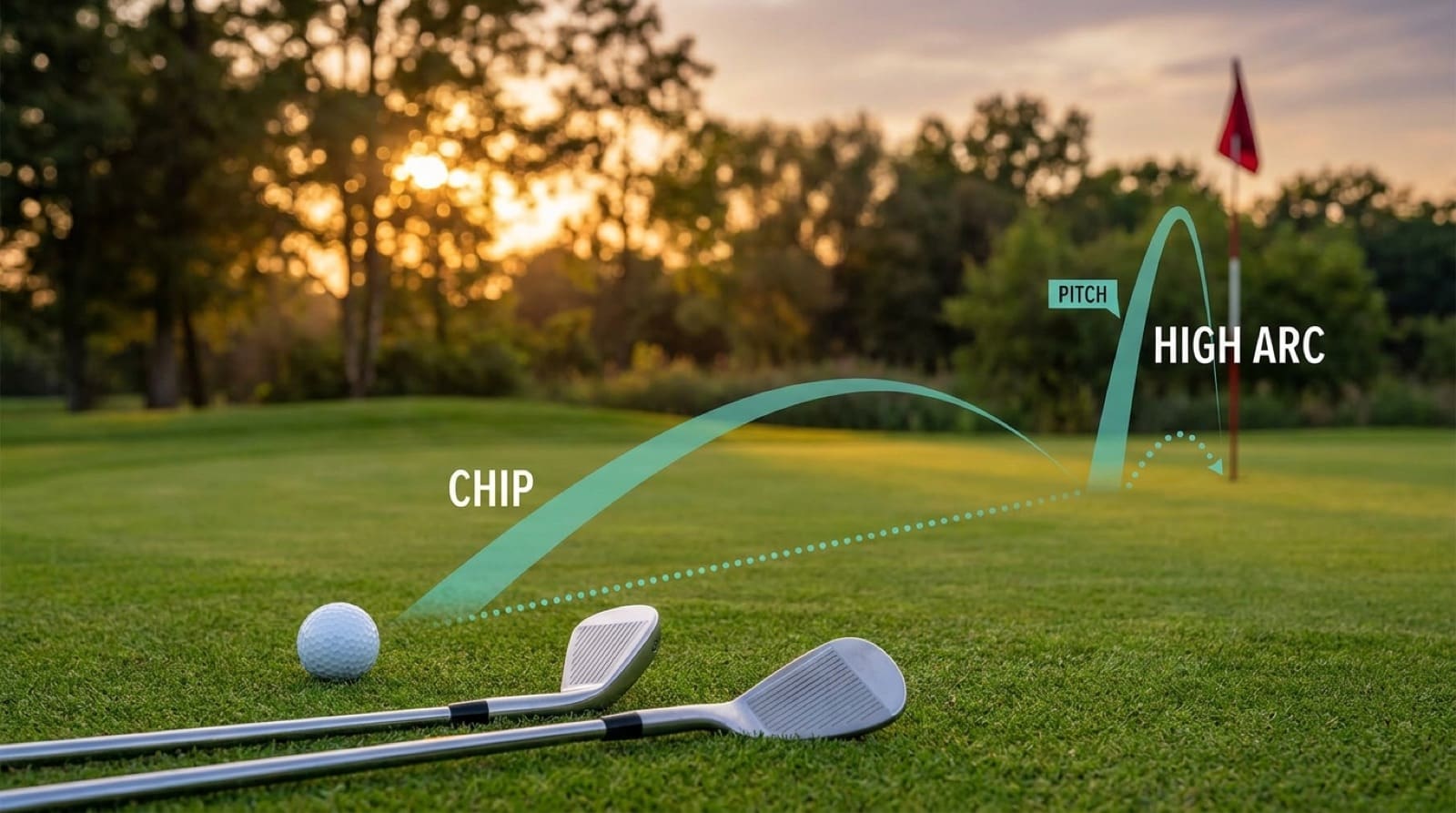
Chip when the ball can spend most of its trip on the ground. Pitch when it has to fly. Run three gates in order — carry (can you land on the green?), roll (is there green to run on?), lie (will a low-lofted club reach the ball cleanly?). Fail any gate, add loft. Shot Scope data has amateurs getting up and down 8% more often with an 8-iron, 9-iron, or pitching wedge than with a gap, sand, or lob wedge.
Chip vs pitch at a glance
| Variable | Chip | Pitch |
|---|---|---|
| Trajectory | Low; more ground time than air time | High; more air time than ground time |
| Typical club | 7-iron to pitching wedge | 52, 56, or 60-degree wedge |
| Levers | One (shoulders, quiet wrists) | Two (trunk rotation plus wrist hinge) |
| Ball position | Back of center | Center of stance |
| Weight at setup | About 80% on the lead foot | About 50/50 |
| Stance | Narrow, square | Slightly wider, slightly open |
| Swing length | An extended putting stroke | A partial full swing |
| Distance band | Just off the green, inside about 15 yards | Roughly 15–50 yards, or any short-sided shot |
| Breaks down when | Forced carry, short-sided pin, buried lie | Tight lie, long roll available, pressure |
Why the choice costs more strokes than the technique
Most greenside instruction goes straight to the swing. The strokes are lost earlier, at the moment a golfer decides which shot to play, and the size of that leak is measurable. Shot Scope’s handicap benchmarks put a scratch player at a 54% up-and-down rate, a 5-handicap at 47%, and a 10-handicap at 39%. A 20-handicap converts about 32%. PGA Tour scrambling sits around 58.5% across all players, so the gap between a 20-handicap and a tour professional is roughly 26 percentage points of conversion.
Some of that is strike quality. A meaningful slice of it is club choice, and that part is free to fix.
Shot Scope’s club-selection study around the green found the average golfer is 8% more likely to get up and down using an 8-iron, 9-iron, or pitching wedge than a gap, sand, or lob wedge. No swing change. No lesson. Just a different club pulled from the bag. For a golfer facing eight greenside shots a round, that is real scoring, and it points in the opposite direction from the lob wedge most amateurs reach for first.
Titleist’s short-game coaching frames the principle as minimum air time, maximum ground time. The ground is predictable. Air is not.
What is the difference between a chip and a pitch?
A chip spends more of its journey on the ground than in the air; a pitch spends more time in the air than on the ground. The mechanical difference is one lever versus two.
PGA Master Professional Alison Curdt gives the cleanest mechanical definition. In PGA of America’s breakdown of the two shots, she describes the chip as a one-lever move dominated by the shoulders with very little wrist hinge, and the pitch as a two-lever movement that adds both trunk rotation and wrist hinge to produce power and height.
GOLFTEC’s comparison adds the trajectory test most golfers can apply without a camera: a chip has more ground time than air, with very little carry and most of its journey bouncing and rolling. A pitch spends more time in the air than on the ground, carries farther, and lands with enough spin to stop. GOLFTEC also specifies the chip setup — a narrowed stance, roughly 80% of weight on the lead foot, ball just forward of the trail big toe, handle even with the lead thigh — and explicitly recommends an 8- or 9-iron for many chips because those clubs produce more predictable roll-out than a wedge.
For the pitch, PGA of America’s pitching guide prescribes the opposite setup: stance slightly wider and slightly open to the target line, weight near 50/50, ball nearer the center, and the most lofted club that fits the carry.
GOLF Top 100 Teacher Jon Tattersall makes the same split in his Golf.com piece on the two shots: drive the handle forward on a chip to keep the ball down, and let the momentum of the club swing carry a pitch with the ball nearer center.
Two shots. Two setups. The interesting question is which one the situation is asking for.
The three-gate framework
The published guidance above agrees on the variables and leaves the golfer to weigh them in the moment. Here is a framework that sequences them instead. Rather than considering lie, distance, slope, and pin position all at once, run three yes/no gates in a fixed order. The first gate that fails ends the process and hands you a wedge.
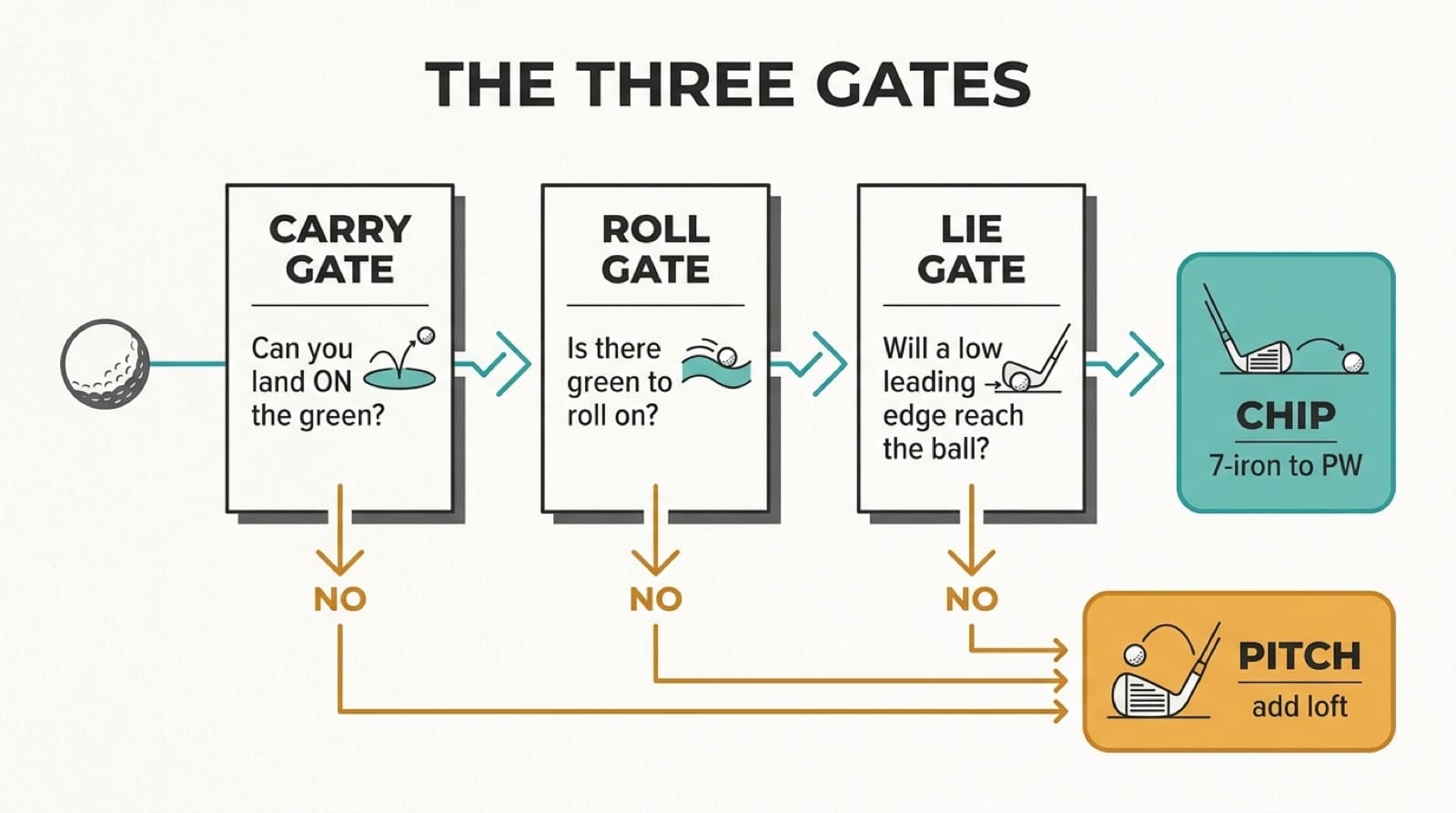
Gate 1 — the carry gate
Can the ball land on the putting surface without flying over rough, sand, or a ridge?
This gate is about what sits between the ball and the front edge. A chip needs a clean runway. If a bunker lip, a thick collar, or a mound has to be carried, a low running shot either snags or bounces unpredictably off the obstacle. Fail this gate and the ball has to fly, which means loft.
Note the wording: land on the green, not near the hole. A chip that lands on the fringe takes a first bounce off turf you did not read and cannot predict.
Gate 2 — the roll gate
Is there enough green between your landing spot and the hole for the ball to roll out?
This is the short-sided test, and it has a price tag. Mark Broadie’s Short Side Index measures how close a pin sits to the near edge of the green relative to the ball. From 29 yards in a rough lie, a PGA Tour player needs 2.72 strokes to hole out at an SSI of 0.5 and 3.06 strokes at an SSI of 0.9. Same yardage, same lie, a third of a stroke of difference — bought entirely by pin position. Tour average around-the-green SSI is 0.48, which is a fair measure of how hard professionals work to leave themselves room.
Fail this gate and the shot has to stop quickly. That is a pitch.
Gate 3 — the lie gate
Will a low-lofted leading edge reach the ball cleanly?
A ball sitting down in rough, in a divot, or on a soft upslope defeats a chip regardless of what the first two gates said. The leading edge of an 8-iron catches grass before it catches ball, the club decelerates, and the shot comes up short. Loft and bounce solve what a leading edge cannot.
Short-game coach Stan Utley’s approach to tight and bare lies runs in the other direction. In his chipping and pitching demonstration he closes the face fractionally to take bounce off the club and sharpen the leading edge, so it can nip the ball off firm turf. The lie gate cuts both ways: fluffy lies want bounce, bare lies want edge. James Sieckmann’s Your Short Game Solution builds the same finesse-wedge distinction into a full method.
Pass all three gates and you chip. Fail any one and you pitch. That ordering matters: the carry gate is the cheapest to evaluate and the most binding, so checking it first ends most decisions in two seconds.
Which club should you chip with? Carry-to-roll ratios
Passing the gates tells you to chip. It does not tell you which iron. That is what carry-to-roll ratios are for, and they convert an unanswerable question (“how hard do I hit this?”) into an answerable one (“where do I land it?”).
The ratio chipping method documented by Process Golf publishes these figures for greens running around 10 on the Stimpmeter:
| Club | Approx. loft | Roll : carry | Landing point for a 30-foot chip |
|---|---|---|---|
| Sand wedge | 56–60° | 1 : 1 | 15 feet |
| Gap wedge | 52° | 2 : 1 | 10 feet |
| Pitching wedge | 46–48° | 2.5 : 1 | ~8.5 feet |
| 9-iron | 42–44° | 3 : 1 | 7.5 feet |
| 8-iron | 38–40° | 4 : 1 | 6 feet |
| 7-iron | 34–36° | 5 : 1 | 5 feet |
The arithmetic is one division: landing point = total distance ÷ (ratio + 1). A 30-foot chip with a gap wedge lands at 10 feet and rolls 20. The same 30-foot chip with a 7-iron lands at 5 feet and rolls 25.
Two honest caveats. These ratios are calibrated guidelines, not physical constants — they shift with green speed, slope, and how much shaft lean your own strike delivers. And they apply to chips. Pitch shots land with more spin and are far more sensitive to strike quality, so their roll-out resists a tidy ratio.
Which is why the ratios worth trusting are the ones you measure yourself. The five-step calibration session in this post’s HowTo takes about ten minutes on a practice green and replaces every borrowed number above with your own.
When should you pitch instead of chip?
The framework above is biased toward the ground, deliberately. That bias has limits, and ignoring them costs as much as over-lofting does.
PGA of America’s guidance states the reverse condition plainly: a difficult lie, more distance from the green, or a pin cut close all mean relying on a pitch. Four situations force the issue.
- Forced carry. A bunker, a thick collar, or a false front between you and the green. Gate 1 fails.
- Short-sided pin. Too little green for any meaningful roll-out. Gate 2 fails, and Broadie’s SSI data puts a number on what it costs.
- A ball sitting down. Rough, a divot, or a soft upslope where the leading edge will snag. Gate 3 fails.
- Firm, fast greens sloping away. A running shot arrives with speed onto a surface that will not hold it, so height and spin become the only brake available.
There is also a personal-skill caveat worth being honest about. Tattersall argues in his Golf.com piece that a golfer short on practice time should prioritize pitching, on the reasoning that the two-lever motion transfers to more shots than a one-lever chip does. That is a defensible position for a player who practices seriously.
For a golfer with limited practice time and an inconsistent strike, the Shot Scope conversion data points the other way. The honest read: chip by default, and earn the right to pitch by measuring your own results.
Common mistakes
- Reaching for the lob wedge first. The most expensive habit in the amateur short game, and the one the Shot Scope 8% figure directly contradicts.
- Landing chips on the fringe. The first bounce comes off turf you have not read. Land every chip on the putting surface, a yard or so past the fringe.
- Evaluating all the variables at once. Lie, slope, pin, speed, and distance considered simultaneously produces a coin flip. Gates run in order produce a decision.
- Borrowing a ratio chart without calibrating it. Published ratios assume Stimp 10 and a neutral strike. Yours may be neither.
- Judging the shot by whether the putt dropped. A chip to six feet followed by a made putt and a chip to twenty feet followed by a made putt look identical on the scorecard. They are not the same shot. Track proximity, as Strokes Gained does.
- Practicing one shot at a time. Twenty chips from the same lie to the same flag build a swing, not a decision.
How to practice the decision itself
Shot selection is a skill, and it responds to the same practice research every other golf skill does. Shea and Morgan’s 1979 contextual-interference study found that randomized practice produced worse performance during the session but better retention and transfer afterward — the trade every golfer should want, because the course is random.
The practical translation for the short game: scatter a dozen balls into genuinely varied lies at varied distances around one green, and before each ball, say out loud which shot you are playing and which gate decided it. Ten minutes of block work on strike quality, then twenty minutes of randomized selection. The block-to-random progression is the same one that governs full-swing practice.
Related reading
- How to Hit a Bump and Run in Golf — the shot that wins when all three gates pass; club selection, setup, and the putting-style stroke in full.
- How to Hit a Pitch Shot in Golf — the shot that wins when a gate fails; Pelz-style clock lengths and a calibrated distance ladder.
- How to Hit a Flop Shot in Golf — the highest-variance option on the spectrum, and the narrow set of conditions that justify it.
- 10 Golf Chipping Drills Tour Coaches Actually Use — the drill catalog that builds the strike quality this framework assumes.
- How to Hit a Bunker Shot in Golf — where the carry gate always fails and loft is the only answer.
- Strokes Gained Explained for Amateurs — why proximity beats up-and-down percentage as a measure of whether your greenside choices are working.
- How to Read Greens in Golf — a chip finishes as a putt, so the roll you plan is a green read.
- 8 Lag Putting Drills That Cut Three-Putts — the distance-control skill a long chip roll-out is really testing.
- Block vs Random Practice in Golf — the motor-learning research behind practicing the decision rather than the repetition.
- Chipping drills to lower your scores — the companion guide with proximity and up-and-down scoring criteria.
Key takeaways
- Run three gates in order — carry, roll, lie. Pass all three, chip. Fail one, pitch. Sequencing the checks beats weighing every variable at once.
- Lower loft measurably wins. Shot Scope has the average golfer getting up and down 8% more often with an 8-iron, 9-iron, or pitching wedge than a gap, sand, or lob wedge.
- Short-siding has a price. Broadie’s Short Side Index shows a PGA Tour player needing 2.72 strokes from 29 yards at SSI 0.5 versus 3.06 at SSI 0.9, and tour average SSI is 0.48.
- The mechanical split is one lever versus two. Chip: shoulders, quiet wrists, ball back, 80% lead-side weight. Pitch: trunk rotation plus wrist hinge, ball center, 50/50 weight.
- Ratios turn distance into a landing spot. Landing point = total ÷ (ratio + 1). At Stimp 10 a sand wedge runs about 1:1, a 9-iron 3:1, a 7-iron 5:1.
- Calibrate the ratios on your own green. Ten minutes with a towel and five balls per club beats any published chart.
- Conversion gaps are large and closable. Scratch 54%, 10-handicap 39%, 20-handicap 32%, PGA Tour ~58.5% — and shot selection is the cheapest lever in that spread.
- Practice the decision. Randomized lies with a spoken shot choice before every ball; Shea and Morgan’s contextual-interference finding says that is what transfers.
Frequently asked questions
What is the difference between a chip and a pitch in golf?
A chip spends more of its journey on the ground than in the air. A pitch spends more time in the air than on the ground. PGA Master Professional Alison Curdt frames the mechanical difference as one lever versus two: the chip is driven by the shoulders with quiet wrists, while the pitch adds trunk rotation and wrist hinge to generate height and spin. Chips typically use a 7-iron through pitching wedge; pitches use a 52, 56, or 60-degree wedge.
Should I chip or pitch from just off the green?
Chip whenever the ball can safely reach the putting surface on a low trajectory and you have green to roll across. Run three checks in order: can you land on the green without flying rough or a bunker, is there enough green between your landing spot and the hole for the roll-out, and will a low-lofted club reach the ball cleanly in that lie. If all three pass, chip. If any one fails, add loft and pitch.
Which club should I chip with?
Pick the lowest-lofted club that still carries whatever sits between you and the putting surface. Shot Scope data shows the average golfer gets up and down about 8% more often using an 8-iron, 9-iron, or pitching wedge than a gap, sand, or lob wedge. A common starting chart at Stimp 10 has a sand wedge rolling about as far as it carries, a 9-iron rolling roughly three times its carry, and a 7-iron about five times.
Is it better to chip or pitch for a high handicapper?
Chip more. Higher-lofted wedges are more sensitive to small errors in strike, face angle, and speed, so the same mis-hit produces a bigger miss. Shot Scope’s handicap benchmarks show a 20-handicap converting roughly 32% of up-and-downs against 54% for a scratch player, and the lower-loft advantage applies across the board. Reserve the lob wedge for shots that genuinely have to fly, such as a short-sided pin or a forced carry over sand.
How much does being short-sided actually cost?
Mark Broadie’s Short Side Index quantifies it. From 29 yards in a rough lie, a PGA Tour player needs 2.72 strokes to hole out at an SSI of 0.5, and 3.06 strokes at an SSI of 0.9. That is roughly a third of a stroke lost from the same yardage purely because the pin sits closer to the near edge. Tour average around-the-green SSI is 0.48, which is a measure of how deliberately professionals avoid short-siding themselves.
How do I practice chipping and pitching so the choice transfers to the course?
Rehearse the shot choice as deliberately as the swing. Scatter balls into varied lies at varied distances, and before each shot say out loud which shot you are playing and why. Shea and Morgan’s contextual-interference work found that randomized practice performs worse in the session but transfers better afterward, which is exactly the trade a golfer wants. Ten minutes of block work on strike, then twenty minutes of randomized shot selection, beats an hour of repeating one shot.
When should I pitch instead of chip?
Pitch when the shot must fly. That means a forced carry over a bunker, a collar of thick rough, or a ridge; a short-sided pin with too little green to roll on; a ball sitting down where a low-lofted leading edge would snag; and firm, fast greens running away from you where a running shot cannot be stopped. PGA of America guidance is the same: difficult lie or a tightly cut pin means rely on the pitch.