
Senior Golf Swing Tips: The 7 Changes That Work After 50
Arccos has golfers 60+ hitting 43 yards shorter but 10 points more fairways. The seven swing permissions that fit that trade, and the bag audit it forces.

Quick answer
After 50 the losses are speed and rotation, and the swing changes that work remove a restriction: lifting the lead heel, flaring both feet, turning early, softening the lead arm, letting the head rotate. Randomized trials in over-55 golfers added 2 to 4 mph in eight weeks. The rest of the yardage gets managed with loft, gapping and target choice.
What changes between your 30s and your 60s
| Metric | Ages 21–30 | Ages 41–50 | Ages 60+ | Direction |
|---|---|---|---|---|
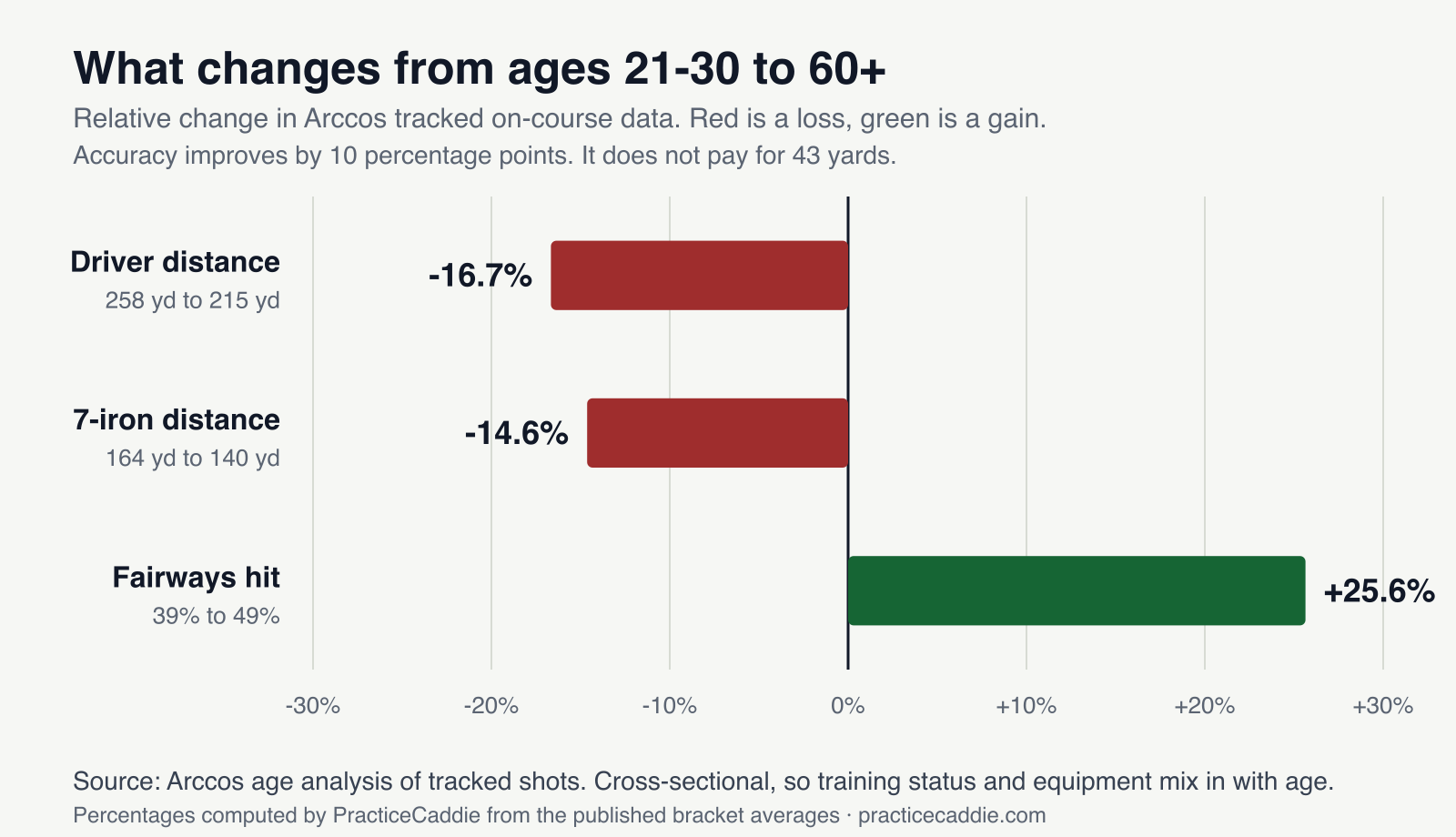
| Driver distance | 258 yd | 244 yd | ~215 yd | 43 yd shorter |
| 7-iron distance | 164 yd | — | 140 yd | 24 yd shorter |
| Fairways hit | ~39% | — | 49% | 10 points better |
| Short game vs. same handicap in their 20s | baseline | — | 0.68 strokes better per round | better |
| Rounds per year | 19 | — | 33 | more reps |
Distance, accuracy and rounds-played figures come from Arccos’s own age analysis of tracked on-course shots; the short-game comparison is Lou Stagner’s strokes-gained breakdown by age, measured at a 10 index. Both are cross-sectional, so they mix training status, health and equipment with age itself.
The trade is real, and it is lopsided
Older golfers get more accurate and better around the green. Arccos has the 60-plus group hitting 49% of fairways against roughly 39% for golfers in their 20s, and Stagner’s data has them gaining 0.43 to 0.68 strokes per round around the green on same-handicap players in their 20s. Neither is enough to cover 43 yards.
The reason is where the strokes live. Mark Broadie’s shot-level analysis in Every Shot Counts attributes about two-thirds of scoring separation to the long game — shots from 100 yards and out — and Arccos’s own study of golfers whose distance changed found that 81% of players who added 10 or more yards gained strokes, while 65% of those who lost 10 or more yards lost strokes. Distance changes which club is in your hands on every approach.
So the plan has two halves: defend the speed that is defendable, then stop pretending about the rest.
What the body actually loses
Power goes before strength. Reid and Fielding’s review in Exercise and Sport Sciences Reviews concluded that muscle power declines earlier and more rapidly than muscle strength with age, and that type II fibers — the ones preferentially lost — generate about four times the power output of type I. A downswing is a short, explosive effort, which is the kind of task those fibers do. That mismatch is why a golfer can still feel strong walking 18 holes and lose yardage anyway.
Balance and squat depth go too, and they go quietly. The Titleist Performance Institute’s senior training guidance says older players typically score poorly on the deep squat and balance screens. The 2025 study that built the Senior Golfers Movement Assessment tested 19 senior amateurs averaging 67 years old and found the overhead squat, basic balance and shoulder 90/90 rotation were the hardest items, scoring 44%, 42% and 53% of available points.
Two of those three are lower-body and one is shoulder rotation. None of them is hip flexibility, which is the thing most senior golf advice tells you to stretch.
The permission list: seven changes that fit a 50-plus body
Each of the seven below removes something a golfer was told to do in 1995. Every one comes from a named teacher, and every one has a self-test, because a permission that costs you center contact is the wrong permission for your body.
1. Let the lead heel come off the ground
The most-repeated senior fix among Top 100 Teachers. Todd Sones rebuilt one senior golfer’s backswing by having him keep turning the trail shoulder and hip, which meant allowing the lead knee to move back and the lead heel to lift — that player went from scoring in the high 90s to breaking 80 the following summer. Jonathan Yarwood teaches heel lift to older golfers specifically to add hip turn, backswing length and spinal turn.
Test it: film from behind and check that your hips rotate further with the heel up. If the heel lifts and the hips don’t turn, you are swaying, not rotating.
2. Flare both feet open at address
Kellie Stenzel, a GOLF Top 100 Teacher, recommends flaring the toes outward to make backswing rotation easier, and pairs it with a slightly closed stance to offset lost flexibility. Foot flare cheaply buys hip rotation you no longer have to find in the joint.
Test it: add flare a little at a time and check your balance at the top of the backswing. Too much flare buys rotation and gives back a stable base.
3. Start the turn immediately instead of pushing the arms back
When mobility shortens the swing, the standard mistake is to take the club straight back with the arms and start turning too late. Stenzel’s instruction is to complete rotation as early as possible, so the turn you have gets used before the backswing runs out of room.
Test it: at hip height, your chest should already be turning. If the clubhead is well outside your hands and your chest is still square, you are running out of swing.
4. Let the lead arm fold slightly at the top
The straight-lead-arm rule creates tension in golfers whose shoulders no longer allow it. PGA instructor Baden Schaff’s argument in GOLF’s bent-arms column is that forcing both arms straight produces tension, overactive hands and lost power, and that a small fold at the lead elbow near the top is acceptable. His framing is width without rigidity: the arm stays extended, the elbow just stops being locked.
Test it: a soft fold at the top is fine. A folded lead arm still folded at impact is a different fault, and a coach should look at it.
5. Let the head rotate with the spine
Peter Kostis, a Top 100 Teacher and Hall of Fame member, calls “keep your head down” disastrous advice: “if you keep your head down, you’ve locked your cervical spine. What’s that gonna do? It’s gonna reduce your ability to turn back.”
Top 100 Teacher Tony Ruggiero adds the low-point half — keeping the head down restricts the upper body and moves the bottom of the swing behind the ball, which is how a fat shot gets manufactured.
Test it: head height should stay reasonably steady. Head direction should be free to turn both ways.
6. Hold the club in the fingers and stop squeezing
Stenzel’s grip-pressure cue is to hold the club in the fingers to eliminate stress in the hands, wrists, elbows and arms. Grip tension is the cheapest speed leak in golf, and it is the one most likely to creep back in when a golfer starts fighting for distance. The floor is face control — light still has to be secure.
Test it: if you can feel the clubhead’s weight during a slow rehearsal swing, the pressure is about right. If your forearms are tight at address, it isn’t. Start from a neutral grip and reduce pressure from there.
7. Let the trail heel release early through impact
Stenzel also permits the trailing heel to lift during the downswing to reduce strain on the back and hips while increasing power. Blocking the trail heel to the ground is a common attempt at “staying down” that stops the pelvis from clearing.
Test it: at the finish, your belt buckle should face the target and your trail shoe should show its sole.
Matching the permission to the limitation
| What limits you | The permission to test first | What proves it worked |
|---|---|---|
| Hips won’t turn away from target | Lead heel lift (1) + foot flare (2) | More hip rotation on video at the top |
| Backswing feels short and armsy | Turn early (3) | Chest turning by hip height |
| Shoulders won’t allow a straight lead arm | Soften the lead arm (4) | Less forearm tension, same or better strike |
| Neck stiffness, restricted turn back | Let the head rotate (5) | Fuller backswing without lifting the chest |
| Grip pressure, sore hands, low speed | Fingers, lighter pressure (6) | Clubhead feel in rehearsal, faster speed |
| Can’t finish, weight stuck on trail foot | Trail heel release (7) | Buckle at target, trail sole showing |
| Fails single-leg balance or deep squat | None of the above — train it | Balance work, per the gym program |
That last row matters. When the balance and squat screens are what is failing, the constraint is physical capacity, and training capacity is the change with a plausible mechanism behind it — swing shape is downstream of a base that holds.
Yes, you can still add speed — about 2 to 4 mph
The evidence here is randomized and specific to older golfers, which is rare. Christian Thompson and Wayne Osness ran 31 men aged 55 to 79 through eight weeks of strength and flexibility work and driver clubhead speed rose from 85.0 to 87.1 mph, a significant gain against controls. Thompson’s follow-up put 18 men averaging 70.7 years old through eight weeks of flexibility, core, balance and resistance training: the exercise group went from 127.3 to 133.6 km/h, equivalent to 79.1 to 83.0 mph, while the control group’s speed fell.
Both successful programs combined flexibility, strength and balance work. Neither was rotation stretching alone, and neither was overspeed swinging alone.
What the two trials delivered:
- 8 weeks, +2.1 mph (2.5%) in men aged 55 to 79 starting at 85.0 mph.
- 8 weeks, +3.9 mph (4.9%) in men averaging 70.7 years old starting near 79 mph, while the control group lost speed.
Both cohorts were small — 31 and 18 golfers — so treat 2 to 4 mph as the demonstrated range rather than a promise, and note that the slower starting group gained the larger percentage. Bigger individual gains circulate widely; the ones large enough to be quoted come from uncontrolled case series, so they are not a number to plan around.
Two or three non-consecutive sessions a week is PracticeCaddie’s starting structure, chosen so recovery sits between sessions, and volume comes down when speed drops or joints complain. The mechanics of the speed side are covered in how to increase golf swing speed; the gym program that supports it is in golf exercises; the benchmarks by age sit in the swing speed chart.
Re-gap the bag for the speed you have now
Slower speed changes which lofts produce a playable descent angle, and most senior bags are still built for a 1998 swing.
| Decision | What to do below about 90 mph | Source |
|---|---|---|
| Shaft flex | Fit to measured speed: Senior roughly 72–83 mph, Regular 84–96 | True Spec’s ranges via GOLF.com |
| Driver loft | Test up from 10.5°; sub-80-mph designs ship at 11.5° with 42–47 g shafts | PING G Le4 specs |
| 3-wood | Stop assuming 15° is longest off the turf; test 16.5°–19° | Golf Digest fairway-wood loft testing |
| Longest iron | Replace it once it can’t produce useful height — hybrid or 7/9-wood | Titleist’s moderate-speed hybrid lofts: 20°, 23°, 26°, 29° |
| Wedge gaps | 4° to 6° between wedges, then verify actual carry | Bob Vokey’s wedge selector |
Two cautions worth stating. “Under 90 means senior flex” is too crude — the True Spec ranges put Regular from 84 mph up, and transition and release move the answer within any speed band.
The second is a judgment call rather than a measured finding: ultralight shafts are marketed on speed, and the honest read is that a shaft light enough that you stop feeling where the clubhead is will cost you center contact, which is worth more than the fraction of a mph it bought. Fit the launch, spin and dispersion you produce. Stenzel’s own club-selection advice is the simplest version of all of this — a 7-hybrid instead of a 6-iron.
Then run PracticeCaddie’s gapping audit against your own numbers: median carries in order, no hole wider than 20 yards, no two clubs inside 8. The golf club distance chart has the benchmark tables, and how to hit a hybrid covers the swing change a hybrid asks for over a long iron.
The scoring plan for 20 fewer yards
Shorter drives leave longer approaches, and a longer approach arriving at a shallower descent angle needs a bigger target. That is the strategic consequence, and it costs or saves strokes on every hole rather than on the few where a swing tip shows up.
- Aim at the widest third of the green. A tucked pin plus a shallow descent angle is a bogey generator at any age.
- Choose the club whose median carry clears the trouble. Front bunkers and false fronts punish the best-ever number.
- Lay up to a full wedge when the long club can’t hold the green. A comfortable 95-yard shot beats a 195-yard hope.
- Keep taking the tee shot that scores. Broadie’s framework still values distance where hazards allow it, and the 10-point accuracy gain above didn’t pay for the yardage.
- Practice the approach distances your drives now leave. A 25-yard drop off the tee pushes every approach yardage that far out.
The last one is the most-skipped. If the driver lost 25 yards, the yardages in your practice log describe a game you no longer play. Strokes gained: approach is where the leverage sits for most players, and course management covers the target-selection half in more detail.
Warm up differently, and screen before you stretch
Older golfers play more — 33 rounds a year against 19 in the 21-to-30 bracket, per Arccos — which makes the pre-round routine a larger share of total swings than it used to be. The evidence favors moving over holding: Gergley’s 2009 study in the Journal of Strength and Conditioning Research measured driver clubhead speed 4.19% lower, distance 5.62% lower and consistent contact 16.34% worse when 20 minutes of passive stretching was added ahead of an active warm-up. That cohort was 15 competitive golfers, not seniors, so read it as evidence about stretching timing in golfers generally. The full sequence is in the golf warm-up routine.
Two senior-specific adjustments to it. Add a balance item, because balance is one of the three screens seniors score worst on. And schedule the long static stretching somewhere other than the ten minutes before the first tee.
When to stop self-diagnosing
Three situations call for someone else’s eyes:
- Any pain, in any joint. Pain belongs with a clinician before it belongs with a coach, and nothing on this page is a treatment for it. Stop the permission testing while you sort it out; a swing change made around a painful joint tends to become a compensation you keep.
- A two-way miss that got worse with the permissions. More rotation freedom on an unstable base can produce misses in both directions. A coach sorts it in one session.
- Failing single-leg balance or the deep squat. These are capacity limits, so the useful next step is training them, with a physio involved if balance is genuinely poor.
Common mistakes
- Stretching hip rotation while ignoring balance and squat depth. The screens seniors score worst on are lower-body and shoulder.
- Changing five things in one range session. One permission per set of five balls, scored on strike, or you learn nothing.
- Planning around a distance from 2015. Log the median of ten shots and plan from that.
- Buying senior flex on a birthday instead of a number. 90 mph is a Regular-shaft speed at any age.
- Treating the short game as compensation for lost distance. Seniors are already better around the green by roughly half a stroke a round. The gap is in the long game.
- Doing speed work daily. Two or three non-consecutive sessions, dropped when speed falls or joints hurt.
Build it into a practice plan
The five-step audit above spreads across eight weeks: baseline, permission testing, gapping, a speed block, then the approach yardages that follow from all of it. PracticeCaddie’s plan builder sequences that work and holds the log, so the eight-week re-test is a comparison against recorded numbers. The free forever plan covers the pre-built plans; the AI plan builder is Pro, with a 3-day free trial.
Related reading
- How to Grip a Golf Club — the setup fundamental behind permission 6, and the root cause of most face-control faults.
- Golf Swing Speed Chart by Age, Handicap, and How to Add MPH — the benchmark tables to compare your baseline against.
- How to Increase Golf Swing Speed — the kinetic-sequence and overspeed mechanics behind the 2-to-4-mph block.
- Golf Exercises: The Year-Round Strength and Mobility Program — the multimodal training both senior trials used.
- Golf Warm-Up Routine — the dynamic sequence, plus why passive stretching before you swing costs speed.
- Golf Club Distance Chart — benchmark carries for the re-gapping audit.
- Golf Stance and Posture — stance width and foot flare in detail.
- Golf Swing Tips: 7 Data-Backed Fixes You Can Actually Measure — the general-population version of this post, with a phone-camera checkpoint for each tip.
- Practice Plan by Handicap — how to weight the practice week once you know where the strokes are going.
Key takeaways
- The measured trade after 50 is lopsided. Arccos has golfers 60+ at about 215 yards against 258 for the 21-to-30 group, with 49% fairways against 39% — 10 points of accuracy for 43 yards.
- Power declines before strength. Type II fibers produce about four times the power of type I and are lost first, which is how a golfer stays strong and still loses yardage.
- The screens seniors score worst on are lower-body. Overhead squat, balance and shoulder 90/90 came in at 44%, 42% and 53% of available points in the 2025 SGMA study.
- Seven permissions, tested one at a time. Lead heel lift, foot flare, early turn, soft lead arm, free head rotation, finger grip, trail heel release — keep the two or three that improve strike.
- 2 to 4 mph in eight weeks is what the trials produced. 85.0 to 87.1 mph in 31 men aged 55 to 79; 79.1 to 83.0 mph equivalent in 18 men averaging 70.7 — both multimodal, both against controls, both small.
- Fit the shaft to measured speed. Senior flex runs roughly 72 to 83 mph and Regular 84 to 96, so 90 mph is a Regular at any age.
- The gap sits in the long game. Two-thirds of scoring separation comes from 100 yards and out, and seniors already gain around the green.
Frequently asked questions
What are the best senior golf swing tips?
The changes that hold up give the body permission to move. Let the lead heel come off the ground, flare both feet open at address, start the body turn early instead of pushing the arms back, allow a small fold in the lead arm at the top, let the head rotate with the spine, and hold the club in the fingers without squeezing. GOLF Top 100 Teachers Kellie Stenzel, Todd Sones and Peter Kostis all teach versions of these. Test each one over five balls and keep only what improves your strike.
How much driving distance do you lose after 50?
Arccos on-course data puts golfers 60 and over about 43 yards behind golfers aged 21 to 30, roughly 215 yards against 258. The decline is not linear: the 41 to 50 bracket averages 244 yards, so most of the loss lands after 50. Iron distance moves too, with the 7-iron falling from about 164 yards to about 140. These are bracket averages from cross-sectional data, so individual results spread much wider than the gap between brackets suggests.
Can a senior golfer actually gain clubhead speed?
Yes, and randomized trials back it. Thompson and Osness put 31 men aged 55 to 79 through eight weeks of strength and flexibility work and driver speed rose from 85.0 to 87.1 mph against a control group. A later eight-week program in men averaging 70.7 years old produced a gain equivalent to 3.9 mph while the control group declined. Two to four mph over eight weeks is what those two multimodal programs produced, from starting speeds in the high 70s and mid 80s.
Should senior golfers use a senior flex shaft?
Fit the flex to measured speed. The fitting ranges True Spec Golf gave GOLF.com put Senior flex at 72 to 83 mph of driver speed and Regular at 84 to 96, so a 62-year-old swinging 90 mph belongs in a Regular shaft. Transition, release and strike quality shift the answer as much as raw speed does, which is why the final call belongs on a launch monitor and a chart is only a starting point.
Should seniors take a shorter backswing?
Shorter is fine when the body is what limits it. The failure mode is a golfer who takes the club straight back with the arms and never turns, which shortens the swing and removes the rotation at the same time. Kellie Stenzel’s fix is to begin torso rotation earlier so the available turn is used up before the swing runs out of length. If pain is what shortens the motion, that is a question for a clinician before it is a question about swing length.
Is it bad to lift the lead heel in the backswing?
It is a legitimate accommodation, and named teachers coach it deliberately. Todd Sones rebuilt a senior golfer’s backswing by letting the lead knee move and the lead heel lift so the trail hip could keep turning, and Jonathan Yarwood teaches heel lift specifically to add hip turn and backswing length for older golfers. The guardrail is balance: the heel should lift because the hips are turning, and your weight should stay inside your feet instead of sliding away from the target.
What stretches should senior golfers do before playing?
Keep it moving. Gergley’s 2009 study in the Journal of Strength and Conditioning Research measured driver clubhead speed 4.19% lower when 20 minutes of passive stretching preceded an active warm-up, in 15 competitive golfers rather than a senior cohort. So the pre-round work should move: two to three minutes of walking, then supported hip rotations, thoracic turns, arm circles and shallow lunges with rotation, then progressive swings from half effort up. Add a balance item, because balance is among the screens seniors score worst on. Save long static holds for a separate session.