
Golf Course Management Tips: 5 Decisions Strokes-Gained Data Says Actually Save Strokes
Course management is decision cost: strokes lost to target and club choices, not your swing. The five highest-cost amateur decisions, ranked by the data.
Quick answer
Golf course management is decision cost — strokes lost to target, club, and miss-side choices, separate from execution. Mark Broadie’s strokes-gained framework shows approach play is the single largest category in the amateur-to-scratch scoring gap — roughly 40 percent of the difference — and a meaningful share of that gap is decision cost rather than execution cost. Aim at centers of greens, club up to the longer miss, avoid short-side misses, and skip hero recoveries. A reasonable model puts the savings at two to four strokes per round for the average 15-handicap.
What the data actually says — at a glance
| Decision | What amateurs typically do | What the data says they should do | Stroke cost of getting it wrong |
|---|---|---|---|
| Approach target | Aim at the flag. Arccos data shows 15-handicap golfers miss the green 65–70% of the time when aiming at pins within 15 yards of an edge. | Aim at the safer half of the green. A 15-handicap aiming at the center misses the green 40–45% of the time, and the misses cluster on the long side rather than the short side. | Modeled ~0.8 to 1.5 strokes per round |
| Club selection | Use the club that reaches the flag with a perfect strike. Amateurs chronically club down by 0.5 to 1.0 club on approach shots. | Use the club that reaches the back of the safer-half target on a flush strike. The default miss is short, and short is where bunkers, false fronts, and short-side trouble cluster. | ~0.7 to 0.9 strokes per round |
| Miss side | Don’t think about it. Most amateurs short-side themselves 4 to 5 times per round when they miss greens. | Pick the side with the most green between you and the hole. Broadie’s Short-Side Index shows the long-side miss costs roughly half as many strokes to recover as the short-side miss. | ~0.6 to 0.8 strokes per short-side miss |
| Trouble shots | Attempt a hero recovery 4 to 5 times per round, success rate around 25 to 30%. | Chip out sideways to the fairway and play your strength. Tour pros only attempt those recoveries 1.5 to 2 times per round because their target selection rarely puts them in the position. | ~1.0 to 1.3 strokes per round |
| Wind | Club up by one when the math says two. Most amateurs default to feel and end up short. | Take two extra clubs into a meaningful headwind, one extra in a stiff crosswind. The default short miss costs an estimated 1 to 1.5 strokes per round in measurable wind. | ~1 to 1.5 strokes per round in 10+ mph wind |
Why course management is the highest-leverage thing you can change this week
Open any tour-pro biography and you’ll find a version of the same line: the player knew where they couldn’t miss, and they aimed away from it. Golf course management is the layer between your real ball-striking capability and your final score. For amateur golfers, that layer is where most of the lost strokes live.
Mark Broadie, the Columbia University professor whose strokes-gained framework the PGA Tour adopted in 2014, built a stroke-cost model from millions of shots. The framework separates a shot’s cost into two parts: the execution cost (how well you struck the ball) and the decision cost (how good the target was in the first place). For a tour player, both numbers are small. For an amateur, both numbers are large, and decision cost is the one you can fix without changing a swing.
The proportion matters. Broadie’s data shows that for a 90-shooter compared to a scratch golfer, approach play is the single largest category in the scoring gap — roughly 40 percent of the difference — counting every shot from 100 yards and beyond that’s not a tee shot on a par 4 or par 5. Driving accounts for roughly a quarter, the short game for around 17 percent, and putting for about 15. Approach play is the largest lever, and target selection is the largest piece of that lever.
Scott Fawcett, the founder of DECADE Golf, put the same finding more bluntly: amateurs lose more strokes to where they aimed than to how they swung. His data, derived from years of analyzing PGA Tour shot patterns and amateur Arccos data, shows that eliminating five specific decision errors — pin-seeking with a wedge, ignoring wind, attempting hero recoveries, under-clubbing approaches, and ignoring natural miss patterns — saves the average 15-handicap three to four strokes per round. No new motor pattern required.
What course management actually is
Most amateurs hear “course management” and think one of two things: lay up everywhere, or play scared. Both are wrong, and the second one is corrosive.
Course management is the structured pre-shot decision sequence that converts your real capability — not your aspirational capability — into the lowest possible score. The structure has three layers.
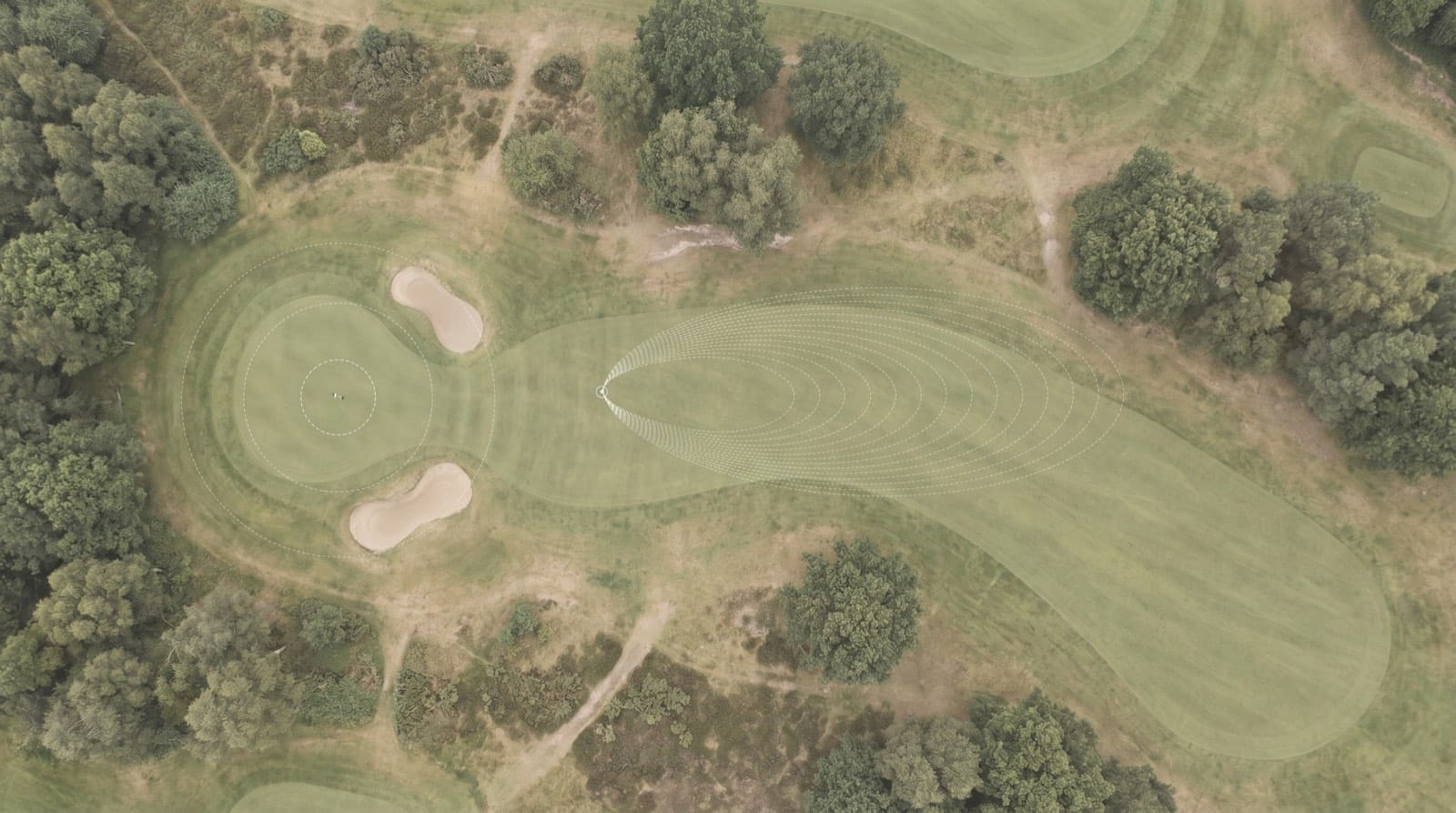
Layer one: the dispersion pattern. Every golfer has a shot dispersion — a roughly elliptical pattern around the target where their shots actually finish. For a tour pro at 150 yards, the pattern is about 15 to 20 yards wide. For a 15-handicap at the same distance, it’s about 35 yards wide, often skewed toward a dominant miss side. The target you can aim at without inviting a catastrophic miss is the center of the largest area where your full dispersion pattern still finds safe ground. That’s almost never the flag.
Layer two: the worst miss. On any given shot, one direction is more expensive than the others. Water is more expensive than rough. Short-sided is more expensive than long. Bunkers are more expensive on the short side than on the long side. Course management starts by identifying the worst miss on this specific shot and then biasing the target away from it by an amount proportional to the dispersion pattern.
Layer three: club selection. Once the target is set, the club has to actually reach the safer half of that target. Arccos data on club selection consistently shows that amateurs select clubs that reach the front of the target on a perfect strike, not the back. Because the average strike is not a perfect strike — and because the average miss is short — the chronic result is balls finishing short of the green, in bunkers, or facing short-sided chips. Clubbing for the longer miss reverses the bias.
Course management is “play to your dispersion pattern, biased away from the worst miss, with a club that reaches the back of the safer half.” That definition fits on a yardage book.
The five decisions that cost amateurs the most strokes
Fawcett’s Tiger Five Mistakes framework names them. The Broadie and Arccos datasets quantify them. In aggregate, eliminating these five alone saves a 15-handicap three to four strokes per round.
1. Pin-seeking with a wedge in hand. The single most expensive amateur decision. Arccos data on 15-handicaps shows that aiming directly at a pin tucked within 15 yards of a green edge produces a green-in-regulation rate of 30 to 35 percent. Aiming at the center of the same green from the same distance produces a green-in-regulation rate of 55 to 60 percent. The modeled cost is roughly 0.8 to 1.5 strokes per round, concentrated on holes where the pin sits close to a hazard. Aim at the center or the safer half of the green when the flag sits within 10 yards of an edge — the upside on a perfect strike is small, the downside on a typical strike is large.
2. Wind misjudgment. Andrew Rice’s wind-effect work and Broadie’s strokes-gained-by-condition data both point the same direction: most amateurs under-club into wind, because feel reliably understates what the math implies. A 150-yard shot into a 15 mph headwind needs roughly two extra clubs; the typical amateur takes one. The result is a ball that lands ten to fifteen yards short of the front edge — usually in a bunker, often short-sided. Estimated cost: roughly 1 to 1.5 strokes per round in measurable wind.
3. Hero recovery shots. Shot Scope data shows amateurs attempt low-percentage recoveries — through tree gaps, off pine straw, out of fairway divots — about 4 to 5 times per round, with a success rate of 25 to 30 percent. Tour pros attempt the same recoveries 1.5 to 2 times per round because their target selection has already kept them out of the position. The cost differential is roughly 1.0 to 1.3 strokes per round. The fix is the most painful one psychologically: chip out sideways to the fairway.
4. Under-clubbing approach shots. Arccos club-distance data shows amateurs systematically choose clubs that match their best yardage, not their average yardage. Across millions of tracked shots, the average 15-handicap selects a club 0.5 to 1.0 club shorter than the one that would put them in the back-third of the green on a flush strike. Cost: 0.7 to 0.9 strokes per round. The fix is a habit, not a swing change.
5. Ignoring the natural miss pattern. Every golfer has a dominant miss. Aiming as if your dispersion pattern is symmetrical when 60 percent of your misses go right — or aiming directly at the pin when your typical iron miss is fifteen yards short — leaves strokes on the course every round. Cost: 0.5 to 0.8 strokes per round. The fix requires data, which is what makes structured AI plans actually useful here — the patterns surface from logged shots.
A decision framework you can run on every shot
Five steps. Use the framework on every shot, full swing or short game.
Step 1 — Identify the worst miss. Where is the shot you cannot afford? Water, OB, deep bunker, a tucked pin with no room behind it. If you can’t name one, there’s no strategic problem; pick a center target and go. If you can name one, the worst miss anchors every subsequent decision.
Step 2 — Pick the safer half. Mentally split the target into two halves at the line of the worst miss. Aim at the center of the safer half, not the center of the whole target. On a green with water left, the safer half is the right two-thirds; the target is the center of that, not the middle of the green and not the flag.
Step 3 — Club for the longer miss. Use the club that reaches the back of your safer-half target on a flush strike, not the club that needs your best yardage to reach the front. The default amateur miss is short. Clubbing for the longer miss reverses the bias and converts short-side trouble into long-side ease.
Step 4 — Commit out loud, then run the pre-shot routine. Say the target and the club out loud, quietly: “right edge of the center bunker, seven iron.” Cross the decision line. Past the line, analysis stops and the pre-shot routine takes over — sensory only, no swing thoughts, no re-evaluation. Beilock and Carr’s work on explicit monitoring points to indecision as the choking mechanism; verbal commitment plus a fixed decision line is the antidote consistent with that research.
Step 5 — Judge the decision, not the outcome. A good decision can produce a bad result; a bad decision can produce a lucky one. Score the decision honestly before you see the outcome: did you pick the safer half, club for the longer miss, and commit? If yes, the decision was right regardless of where the ball ended up. Strategic improvement requires separating decision quality from outcome variance.
What the data actually says about amateur decision cost
The numbers are specific enough to plan around. The sources below converge on the same picture.
The amateur approach-proximity gap is huge — and most of it is decision cost. Shot Scope amateur data puts the average 15-handicap’s proximity-to-pin from 150 yards in the fairway at about 45 feet. PGA Tour ShotLink data from the same distance puts the tour-pro number at 23 feet. The 22-foot gap doesn’t come from raw ball-striking alone — it comes from amateurs aiming at pins their dispersion pattern can’t hold, and amateurs being short of their target on the typical strike. Aiming at the center of the green and clubbing for the longer miss closes a measurable portion of that gap without touching the swing.
The “magic number” tells you when to be aggressive. Arccos’s analysis of millions of amateur shots identifies the distance from which each handicap group hits greens 50 percent of the time. For a 15-handicap, that number is roughly 110 yards. Inside 110, you can be moderately aggressive — your dispersion pattern is small enough that the green is still the most likely outcome. Outside 110, your dispersion pattern is wider than most greens, so center-of-green targets and safer-half logic become the higher-percentage play. For a 20-handicap the magic number drops to about 92 yards; for a 10-handicap it climbs to about 129 yards.
The short-side penalty is the most under-appreciated number in amateur golf. Broadie published the Short-Side Index — a measure of how much green sits between the ball and the hole when you’ve missed the green. Even for tour pros, a short-sided miss from 29 yards (SSI 0.9) takes 3.06 strokes to hole out, versus 2.72 strokes from the same distance with more green to work with (SSI 0.5). That’s a 0.34-stroke penalty for the pros, and the amateur penalty is plausibly larger given how short-game proficiency falls off on the short side, though the multiplier isn’t pinned down in the published SSI work. Greenside bunker save rates illustrate the underlying point: PGA Tour pros save par from greenside bunkers around 50 percent of the time on long-run average; a 15-handicap saves par from greenside bunkers about 20 percent of the time. Avoid the short side and you avoid the worst version of that math.
Missing fairways doesn’t cost as much as you think. Arccos’s driver-distance and accuracy data shows the typical male amateur drives the ball around 225 yards on average, and a 15-handicap hits roughly 47 percent of fairways. The penalty for a normal rough miss is materially smaller than the penalty for a recovery or penalty-area miss — Broadie’s strokes-gained data puts the rough-miss cost from full-shot distance in the 0.2-stroke range for most amateur situations. The implication: extra distance off the tee usually outweighs the small accuracy penalty for almost every amateur, as long as the ball stays playable. Don’t club down to a 4-iron off the tee to “find the fairway” if it leaves a 6-iron approach instead of a 9-iron. That decision is a strokes-gained loser.
Common mistakes
- Aiming at the flag because the rest of the group does. Social proof is not statistical evidence. Use the framework, not the foursome.
- “Playing safe” by clubbing down and then aiming at the pin anyway. Half-measures don’t help. Either commit to a center-of-green target with the right club, or aim at the pin with full understanding of the cost. The hybrid is the worst of both options.
- Treating every hole identically. Course management is a per-shot evaluation, run fresh on each approach. Some pins are gettable. Most aren’t. Run the framework hole by hole, not as a global setting.
- Aiming at the flag with a wedge in hand. Of the five Tiger Five Mistakes, this one tops the list. The wedge produces overconfidence; the dispersion pattern at 80 yards still misses tucked pins more often than it hits them. Center-of-green targets stay correct down to about 60 yards for most amateurs.
- Going for it from trouble. Tour pros chip out sideways. They make that decision more often than amateurs do, and they make it from better lies. If they’re chipping out, you’re chipping out.
- Ignoring the wind because you “feel like a six iron.” Wind misjudgment is statistical, not perceptual. The Andrew Rice wind data is unambiguous; club up by what the math says, not by what the feel says.
- Skipping the commitment phase. Picking a target and then second-guessing it during the swing produces the worst possible outcome — a tentative swing at a target you don’t believe in. Commit out loud, cross the decision line, run the pre-shot routine, and execute.
When course management is not the bottleneck
Strategic decisions return strokes only when the swing can execute the chosen shot at all. The framework above assumes a roughly stable strike. If contact is the actual ceiling, fix the strike first.
- Chronic contact issues. Shanks, tops, fat shots at a rate of more than once or twice per round mean the swing — not the strategy — is the priority. Run the shank-fix protocol and the contact-focused ball-striking drills first.
- Long-iron struggle. If 4i through 6i are unreliable, the strategic answer is often hybrid; the technical answer is the long-iron technique fix. Both belong in the plan.
- Severe ball-flight curvature. A 40-yard slice is a swing problem, not a strategy problem. The center-of-green target you chose still misses by 35 yards. Fix the curvature, then layer the framework.
- Sub-90 shooters with sub-150-yard approach distance. If you’re already inside the magic number on most approaches and consistently hitting greens, the marginal return on more conservative strategy is small. Execution is the ceiling. The strategic gains compound for the 90-to-100 shooter; they’re smaller for the 75-to-80 shooter.
For everyone in the 90-to-110 range with reasonable contact, course management is the largest single available stroke saver.
A four-week protocol to actually change your on-course decisions
Strategic improvement is a habit change. Reading the framework above is the easy part. Installing it in your actual round takes four weeks of structured, logged practice.
Week 1 — Decision log. Play four rounds in a row with a notebook. On every approach shot inside 200 yards, write down — before you swing — your target choice, your club choice, and your assessment of the worst miss. After the round, write down where the ball actually finished. Don’t change anything yet. The output is your baseline decision pattern.
Week 2 — Center-of-green only. Play four more rounds. Every approach shot, no exceptions, aim at the center of the green. No pin-seeking. Continue the decision log. The point is to feel what center-of-green discipline does to your scorecard — the typical 15-handicap drops 1 to 2 strokes per round on this single change alone.
Week 3 — Club for the longer miss. Continue center-of-green targeting, and now add a one-club-extra rule on every approach where you’d normally feel “in between.” Continue the log. Most amateurs notice the second drop in scoring here — the missed greens that used to land in front-of-green bunkers now find the back fringe instead.
Week 4 — Add the worst-miss filter. Now layer in the worst-miss step on every approach. Center-of-green is no longer automatic; on holes with asymmetric trouble (water on one side, OB on one side, tucked pin with no room behind), pick the safer half of the green specifically. Continue the log through four rounds. The log from week 1 versus week 4 is the only meaningful evidence of strategic change; trust the log, not the feeling.
The cadence mirrors the four-week protocol other PracticeCaddie posts use — block-vs-random practice for motor learning, the pre-shot routine build for attentional control, and now course management for decision-making. All three slot into the same weekly structure inside a PracticeCaddie practice plan.
Build the framework into a structured practice block
Deeper-context pieces:
- The golf mental game — what the research actually says about pressure, routine, and focus — the parent post for routine, arousal, and focus levers.
- The golf pre-shot routine — what tour data actually says — the routine deep-dive that step 4 of the framework calls on.
- How to actually improve at golf — the strokes-gained-by-area framing this post extends.
- How to hit long irons in golf — the technical answer when the strategic answer is hybrid.
- 10 golf practice drills tour coaches actually use — the drill catalog the four-week protocol assumes.
- The complete golf practice plan guide — pillar guide for the weekly cadence.
Key takeaways
- Course management is decision cost, not “play safe.” Mark Broadie’s strokes-gained framework separates a shot into execution cost and decision cost; decision cost is the largest correctable component of amateur scoring.
- Approach play drives the gap. Approach is the single largest category of the strokes-gained gap between a 90-shooter and a scratch golfer — roughly 40 percent in Broadie’s framework — and a meaningful share of that gap is decision cost rather than ball-striking error.
- Aim at centers of greens. Arccos data shows a 15-handicap aiming at a tucked pin misses the green 65 to 70 percent of the time, versus 40 to 45 percent when aiming at the center. The fix saves about 0.8 to 1.5 strokes per round.
- Avoid the short side. Broadie’s Short-Side Index quantifies the penalty: tour pros lose 0.34 strokes per short-side miss versus a long-side miss, and amateurs roughly double that number. Avoiding short-side misses is the highest-leverage single decision in amateur course management.
- Club for the longer miss. Amateurs systematically under-club by 0.5 to 1.0 club on approach shots. Picking the club that reaches the back of your target on a flush strike — not the front — saves about 0.7 to 0.9 strokes per round.
- Stop attempting hero recoveries. Tour pros chip out sideways more often than amateurs do; the math says you should too. Hero recoveries succeed about 25 to 30 percent of the time, and the failure cost is roughly 1.0 to 1.3 strokes per round in aggregate.
- The five-step framework is the version that actually survives the round. Identify the worst miss, pick the safer half, club for the longer miss, commit out loud and cross the decision line, judge the decision rather than the outcome. Run it on every shot for four weeks and the scorecard moves.
Frequently asked questions
What is golf course management?
Course management is the set of pre-shot decisions — target, club, shape, miss-side — that translate your actual ball-striking capability into the lowest possible score. Mark Broadie’s strokes-gained research separates a shot’s cost into decision cost (target and club selection) and execution cost (strike quality). Approach play is the single largest category of the amateur-to-scratch scoring gap — roughly 40 percent in Broadie’s framework — and a meaningful portion of that gap is decision cost rather than swing skill. Course management is the layer where you recover those strokes without changing your swing.
Does course management actually lower scores for amateurs?
Yes, faster than swing changes do. Scott Fawcett’s DECADE work and Arccos’s longitudinal amateur data both show that golfers who restructure their target selection — aim at conservative parts of the green, club up to the longer miss, avoid hero recoveries — typically save two to four strokes per round within five to ten rounds. Swing changes take longer to consolidate (motor consolidation literature points to weeks of deliberate practice), and they take even longer to hold up under pressure. Better decisions hold immediately because they don’t require new motor patterns.
Should I aim at the flag or the center of the green?
Center of the green, almost always. Arccos’s amateur-shot database shows that a 15-handicap golfer aiming directly at the pin misses the green 65 to 70 percent of the time when the pin sits within 15 yards of an edge, versus 40 to 45 percent when aiming at the green’s center. The miss-the-green probability is bad on its own, but the more expensive penalty is that pin-seeking misses cluster on the short side. Center-of-green targets convert short-side misses into long-side misses, which cost roughly half as many strokes to recover from.
How much do amateurs lose from going at tucked pins?
Roughly 0.8 to 1.5 strokes per round for a 15-handicap, depending on how many tucked-pin holes the course presents. The number comes from two pieces of data: amateurs miss greens about 25 percentage points more often when targeting tucked pins, and each missed-green situation costs 0.4 to 0.6 strokes; when those misses land short-sided, the penalty climbs to roughly 0.6 to 0.8 strokes. Scott Fawcett’s Tiger Five Mistakes framework, which catalogs the five most costly decision errors, ranks pin-seeking with a wedge in hand at the top of the list.
When is it actually correct to aim at the pin?
Three conditions, all of which have to hold simultaneously: the pin sits more than 8 to 10 yards from the nearest edge (so a small miss still finds the green); the shot is inside your “magic number” — the distance from which Arccos data says you hit greens at least 50 percent of the time, which is around 110 yards for a 15-handicap; and there is no asymmetric penalty (water, OB, deep bunker) on the short-side of the flag. Outside those conditions, aiming at the pin is decision cost paying for a small upside.
Is course management more important than ball striking?
For most amateurs, yes — and the strokes-gained data is unambiguous on the direction. Approach play is the single largest contributor to the scoring gap between a 90-shooter and a scratch player (roughly 40 percent of the difference in Broadie’s framework), and a meaningful share of approach-shot stroke loss is decision cost rather than pure ball-striking error. Once contact issues are stable enough that you can hold a 30-yard dispersion at 150 yards, course management is the largest available stroke saver. If contact is unreliable — chronic shanks, tops, fat shots — fix the strike first and the strategy second.
How do I practice course management?
Course management is on-course skill that needs on-course reps. The simplest protocol: pick four rounds in a row, and on every approach shot inside 200 yards, write down your target choice and your club choice before you swing — then write down where the ball finished. After each round, review the log. The pattern that almost always emerges is consistent short-siding, consistent under-clubbing, and pin-seeking on the wrong holes. Fixing those three patterns alone typically saves two to three strokes per round without any swing work.
Related reading
- The golf mental game — what the research actually says about pressure, routine, and focus — the parent post for arousal, routine, and focus as three measurable scoring levers.
- The golf pre-shot routine — what tour data actually says — the routine deep-dive that step 4 of the decision framework calls on.
- How to actually improve at golf — the strokes-gained-by-area framing this post extends into decision-making.
- How to hit long irons in golf — the technical answer for the long-iron-versus-hybrid decision when long irons aren’t holding up.
- Ball-striking drills that move strokes-gained-approach — when execution is the ceiling and strategy is already in place.
- How to stop shanking the golf ball — the contact-first prerequisite when shanks are turning approach decisions moot.
- 10 golf putting drills that move strokes-gained-putting — the matching post for the putting side of the strokes-gained breakdown.
- The complete golf practice plan guide — pillar guide for combining the four-week decision protocol with weekly practice cadence.
- Strokes Gained Explained for Amateurs — the framework that tells you which on-course decisions actually save strokes.