
Golf Exercises: The Year-Round Strength and Mobility Program
Pooled data from 20 studies: jump power drives clubhead speed, flexibility barely registers. The year-round golf strength and mobility program, phase by phase.

Quick answer
Golf exercises that measurably add clubhead speed are strength and power work, run as 2 to 3 full-body sessions per week for 8 to 12 weeks: a squat or hinge, single-leg work, upper-body push and pull, rotational core, and jumps and medicine-ball throws. Trials report 1.5 to 4% speed gains. Pooled data puts jump impulse (r = 0.68) far above flexibility (r = −0.04), so mobility work goes only where a screen finds a restriction.
The weekly template at a glance
| Movement category | Example exercises | Weekly dose |
|---|---|---|
| Squat or hinge | Goblet squat, trap-bar deadlift, hip thrust | 2 sessions, 3–4 sets of 5–10 |
| Single-leg strength | Split squat, step-up, single-leg RDL | 1–2 sessions, 2–3 sets of 6–10 per side |
| Upper push + pull | Push-up, dumbbell bench, row, pull-up | 2 sessions, 3 sets of 5–12 each |
| Rotational core | Cable chop, Pallof press, half-kneeling band rotation | 2 sessions, 3 sets of 6–10 per side |
| Jumps + throws | Countermovement jump, broad jump, rotational med-ball throw | 2 sessions, 3–4 sets of 3–5, full rest |
| Targeted mobility | Only measured restrictions: hip rotation, t-spine, ankle | 4–5 short doses per week, re-test at 4 weeks |
One scope note before anything else. This is the long-term program you run across weeks and months. The 20 minutes before a round is a different job with different rules — that sequence lives in the golf warm-up routine post. And overspeed protocols with light clubs are a third tool, covered in how to increase golf swing speed. This post is the gym foundation both of those sit on.
Why gym work earns a slot next to range time
Strength training moves the golf numbers that matter, and the effect sizes are published. Ehlert’s 2020 systematic review in the Journal of Sports Sciences found that where golf-fitness interventions produced significant results, clubhead speed, ball speed, and distance improved by an average of 4.0 to 6.4%. A second review by Uthoff and colleagues put combined general-plus-golf-specific resistance programs at +4.1% clubhead speed and +5.2% hitting distance, with roughly 8 weeks of 3 to 4 sets of 5 to 15 reps as the most effective pattern among reviewed protocols.
Speed converts to strokes. Mark Broadie’s strokes-gained examples put 20 extra yards of driving distance at roughly 0.15 strokes per drive for an amateur, about 2 strokes per round before accounting for changes in accuracy — his worked example is in this Every Shot Counts presentation. The observational data agrees directionally: Arccos found that among users who added at least 10 yards of distance, 81% gained strokes on their handicap benchmark, and Data Golf’s analysis shows 10 yards of driving distance separating tour players by 0.30 to 0.35 strokes per round.
The gains are real but bounded. Individual trials cluster at 1.5 to 4% — Doan’s 11-week collegiate program added 1.6% clubhead speed and an estimated 4.9 meters of distance, and Fletcher and Hartwell’s 8-week program added about 1.5% speed and 4.3% driving distance. One six-week study on highly skilled golfers found no gain at all, which is worth keeping in view: short programs, small samples, and poor transfer can and do produce nothing. Re-testing is how you find out which group you are in.
What actually correlates with clubhead speed
A 2024 meta-analysis put pooled numbers on the “which physical quality matters” argument. Brennan and colleagues, in Sports Medicine, pooled 20 studies relating physical capacities to driver clubhead speed:
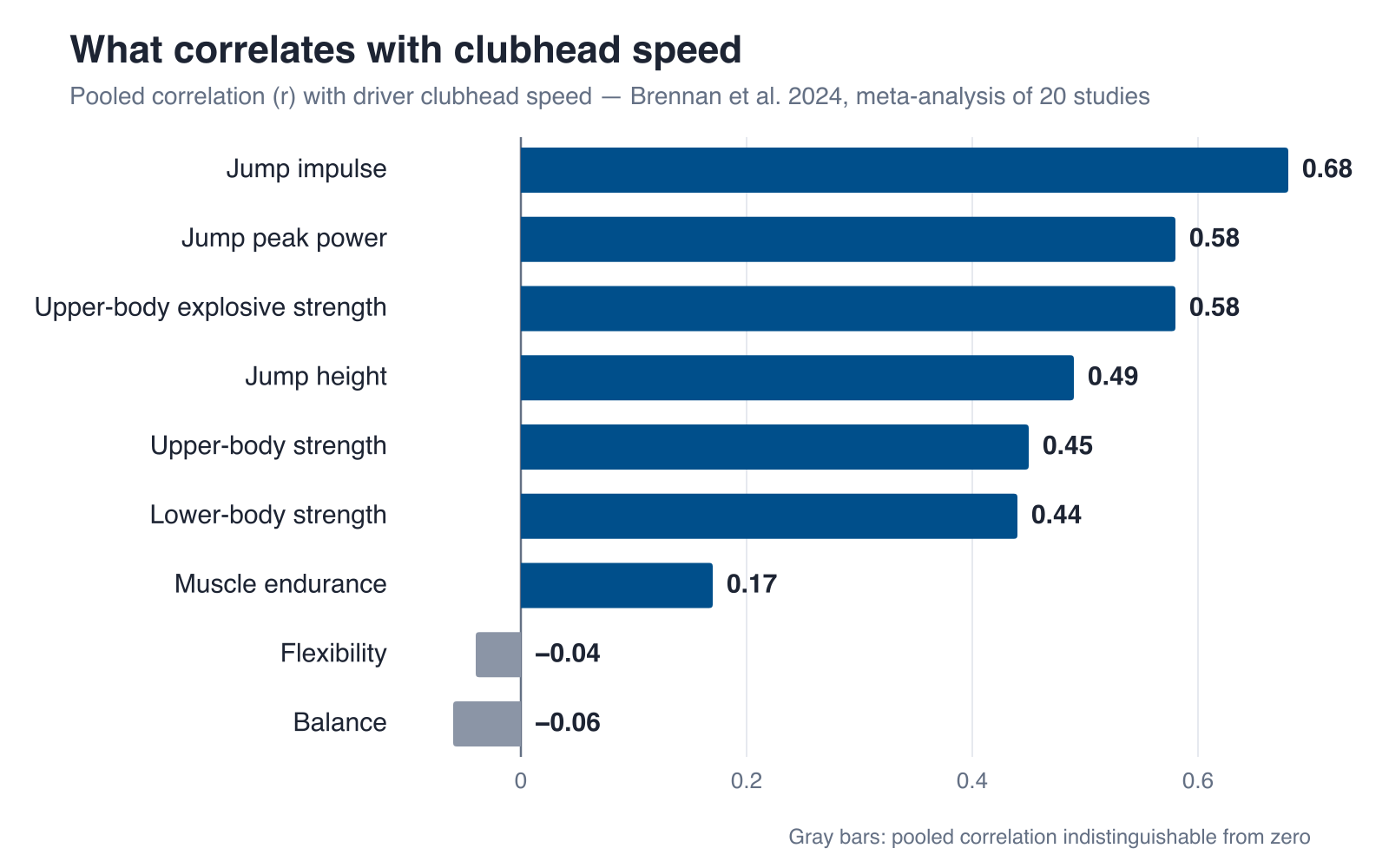
Three readings of that chart shape the whole program.
Explosive force wins. Jump impulse measured on a force plate correlated with clubhead speed at r = 0.68, jump peak power and explosive upper-body output (medicine-ball throws, ballistic presses) at r = 0.58. A vertical jump is a proxy for rapid whole-body force production rather than a swing measurement, and it is the best gym-measurable predictor the literature has.
Basic strength is the platform. Lower-body strength (squats, deadlifts, mid-thigh pulls) pooled at r = 0.44 and upper-body strength at r = 0.45. In Hellström’s study of 33 elite golfers, 1RM back squat correlated with clubhead speed at r = 0.54 and countermovement jump at r = 0.61. Oranchuk’s collegiate data ran the same direction: power clean r = 0.70, jump r = 0.73.
Flexibility, pooled across studies, was a null: r = −0.04. Balance was similar at −0.06. That does not make mobility work worthless — it means generic stretching volume does not buy speed, and the case for mobility has to come from somewhere else. It does, and the next section covers where.
Golf mobility exercises: train what a screen finds, then re-test
Mobility work earns its slot when a measured restriction forces a swing compensation. The Titleist Performance Institute’s screens are the standard field tests, they need no equipment, and three of them cover the swing’s rotation demands:
| Screen | Pass mark | If you fail |
|---|---|---|
| Seated trunk rotation | Past 45° to both sides | Thoracic mobility: open books, rib rotations, reach-backs |
| Single-leg balance, eyes closed | 25 seconds per side | Single-leg strength and balance work in the weekly template |
| Overhead deep squat | Full-depth squat, club overhead | Ankle dorsiflexion and hip work before loading deep patterns |
The screen-to-fault link has some real evidence behind it. In Gulgin’s study of 36 golfers, players who failed the overhead squat or lead-leg balance screens were roughly 2 to 3 times more likely to show early extension, loss of posture, or a slide — small sample, but consistent with what TPI-certified coaches report from the field. If your swing shows early extension, screening ankle and hip mobility before buying another training aid is the cheap first move.
Hip internal rotation deserves its own paragraph because the back-pain data is specific. Golfers with low-back pain averaged about 10° less passive lead-hip internal rotation than pain-free controls in Murray’s 2009 study, and professionals with severely restricted hips (under 20°) showed significantly more lumbar flexion and side-bending compensation in Kim’s 2015 kinematic data. TPI’s tour reference is about 45° of internal rotation per side. These are associations rather than proven causes, so the practical read is modest: if your lead hip is visibly restricted and your back complains after rounds, hip mobility work plus a physio visit beats stretching everything indiscriminately.
The programming rule that falls out of all of this: mobility doses are prescriptions against a measured deficit, with a re-test date. Four to five short doses per week at the restricted joint, re-screen at 4 weeks, and retire the drill once the screen passes. Stretching that never gets re-tested is the fitness version of hitting range balls with no target.
The year-round schedule
The dose that shows up across successful studies is 2 to 3 non-consecutive full-body sessions per week, the same range the NSCA’s golf framework recommends for amateur players. A survey of elite professionals’ preparation found a median of 4 weekly resistance sessions in the off-season falling to 2 in-season, with about two-thirds of players living in the 2-to-3 band. And there is a floor worth knowing: one coached 60-minute session per week for 12 weeks raised clubhead speed by an estimated 4.25 mph in youth golfers. One quality session beats zero by a wide margin.
The year splits into four phases. This table is PracticeCaddie’s synthesis of the intervention literature, TPI’s off-season periodization guide, and Fit For Golf’s in-season guidance — an evidence-informed template rather than a protocol tested end-to-end in a single trial:
| Phase | Weekly structure | Objective |
|---|---|---|
| Foundation (off-season) | 2–3 full-body sessions, 3–4 sets of 5–10 on main lifts | General strength and muscle; clear failed mobility screens |
| Power (pre-season) | 2–3 sessions; keep heavy lifts, add jumps and med-ball throws | Convert strength into rapid force and rotational power |
| In-season | 2 shorter sessions; fewer sets, load stays heavy | Hold strength and speed without wrecking practice days |
| Tournament weeks | 1–2 brief sessions, away from the key round | Manage soreness by cutting sets, and keep the intensity |
The in-season mistake to avoid is the reflexive switch to light weights and high reps. Mike Carroll of Fit For Golf, whose app tour players use, recommends reducing total sets while keeping meaningful load — soreness comes mostly from volume, and strength drains away when the bar gets light for four months. Muscle endurance, for what it’s worth, pooled at r = 0.17 with clubhead speed, the weakest positive correlate in the Brennan data.
Progress check on a fixed cadence: re-test clubhead speed every 4 to 6 weeks under the same conditions, the same way you would re-baseline any practice metric. The swing speed chart by age and handicap gives you the benchmark table to place your number against.
What about injury prevention?
The honest read: strength training probably helps, and the golf-specific proof does not exist yet. A 2023 clinical commentary in the International Journal of Sports Physical Therapy states plainly that no study had assessed a golfer-specific injury-prevention exercise program. What exists is general-sport evidence, and it is strong: a dose-response meta-analysis found strength-training-based prevention cut sports injury risk to roughly a third (relative risk 0.338).
The injury problem it would address is well documented. A 2024 meta-analysis in the British Journal of Sports Medicine put amateur golfers’ lifetime musculoskeletal-injury prevalence at 56.6%. The low back leads the injury-site tables — about 25% of reported injuries in McHardy’s survey of 1,634 Australian amateurs — with elbow, wrist, and shoulder behind it, and Gosheger’s cohort data classifying 82.6% of golf injuries as overuse rather than acute. A body that tolerates more load before breaking down is a reasonable bet against an overuse-dominated injury profile, even while the golf-specific trial remains unrun.
So write the claim the way the evidence allows: golf exercises are proven to add speed, plausible but unproven as golf-injury prevention, and the low back is the joint the program should respect most — which is an argument for hinging and anti-rotation work done well, with a coach or physio if back pain is already present.
Golf exercises for senior golfers
The senior data is the most encouraging corner of the literature. In Thompson and Osness’s randomized trial, golfers averaging 65 years ran an 8-week strength-and-flexibility program and gained 2.1 mph of clubhead speed (2.47%) while controls stayed flat. A follow-up 8-week program in golfers averaging 70.7 years added 3.9 mph (4.95%) — and the control group lost speed over the same window, which is the aging default the program is fighting. The Uthoff review noted golfers aged 50 to 70 generally improved more from resistance training than golfers under 30.
The mechanism is mostly about what is being lost. Sarcopenia estimates in community-dwelling older adults run about 10% by common definitions and climb steeply with age; those figures come from general populations rather than golfers specifically, but the direction applies to every aging body. Fast-twitch capacity — exactly the quality the jumps-and-throws category trains — declines first. For a 60-year-old golfer, two weekly strength sessions are less about adding 10 yards and more about keeping the 220 they have.
Scaling for older golfers is straightforward: the same six movement categories, with box step-downs and sit-to-stand squats replacing jumps where joints object, medicine-ball throws kept (they load tissue gently and train speed well), and an extra day of recovery between sessions.
Common mistakes
- Stretching as the whole program. Pooled flexibility-to-speed correlation: r = −0.04. Mobility work belongs where a screen finds a restriction, and strength work everywhere else.
- Only “golf-specific” band rotations. Light band chops mimic the swing’s shape without its force demands. The pooled data favors heavy basics plus genuinely explosive throws over swing-lookalike exercises.
- Treating the pre-round warm-up as training. The warm-up primes what you have for the next 4 hours; it builds nothing. Only progressive loading across weeks adds capacity.
- Going light in-season. Cutting load instead of sets drains strength across a 4-month season. Keep the weight, halve the volume.
- No baseline, no re-test. Without a clubhead-speed number at week 0 and week 8, the program’s outcome is a feeling. One six-week study found zero gain in skilled golfers; you want to know if that’s you.
- Copying tour players’ routines. Tour fitness content is maintenance work layered on years of base. The PGA Tour hauls a four-trailer gym to every event; the players using it built their foundations first.
Build the range side to match
The gym adds force. Converting force into strokes still happens on the grass, through strike quality, start-line control, and wedge distance — and that side benefits from the same structure this program brings to lifting. PracticeCaddie generates practice plans that slot range sessions around your gym days, weight them toward where you actually lose strokes, and log the re-tests. Build one free in 30 seconds — the free forever plan covers session structure and logging, and AI-generated plans are Pro with a 3-day free trial.
Related reading
- Golf Warm-Up Routine: The Dynamic Sequence That Adds Clubhead Speed — the pre-round half of this equation: what to do in the 25 minutes before you tee off.
- How to Increase Golf Swing Speed — the speed-specific training layer: overspeed protocols, sequencing, and intent work that sit on top of this strength base.
- Golf Swing Speed Chart by Age and Handicap — benchmark tables for the clubhead-speed number this program is built to move.
- Block vs Random Practice in Golf: What the Research Actually Says — the motor-learning science for structuring the range sessions that convert gym gains into scores.
- How to Actually Improve at Golf — the measurement-first improvement loop this program’s baseline-and-re-test cadence comes from.
- Golf practice plan — the companion guide for structuring the practice sessions between gym days.
Key takeaways
- Strength and power training adds measurable clubhead speed: 1.5 to 4% in individual trials, 4 to 6% average improvements across reviews’ significant outcomes, typically over 8 to 12 weeks.
- Jump impulse (r = 0.68) and explosive upper-body output (r = 0.58) are the strongest pooled correlates of clubhead speed; flexibility pooled at r = −0.04.
- The weekly template is six categories: squat/hinge, single-leg, push and pull, rotational core, jumps and throws, plus mobility only for measured restrictions.
- 2 to 3 non-consecutive sessions per week is the modal effective dose; one quality weekly session still produced a measurable gain in the minimum-dose study.
- In-season, cut sets and keep load. Muscle endurance was the weakest positive speed correlate (r = 0.17); light-and-high-rep season maintenance trains the wrong quality.
- Senior golfers respond at least as well: +2.1 mph at average age 65 and +3.9 mph at average age 71 in randomized 8-week trials, against controls that lost speed.
- Injury prevention is plausible, unproven in golf: 56.6% of amateurs report a lifetime injury, low back leading, and general-sport strength training cuts injury risk by roughly two-thirds — but the golf-specific trial has not been run.
- Screen, baseline, re-test every 4 to 6 weeks. A program without a week-0 clubhead-speed number can’t tell you whether it worked.
Frequently asked questions
What are the best exercises for golf?
Cover six categories weekly: a squat or hinge (goblet squat, trap-bar deadlift), single-leg work (split squats, step-ups), an upper-body push and pull (push-ups, rows), rotational core (cable chops, Pallof presses), explosive work (jumps, rotational medicine-ball throws), and mobility for measured restrictions. Pooled data from 20 studies puts jump impulse (r = 0.68) and explosive upper-body output (r = 0.58) as the strongest physical correlates of clubhead speed, so the explosive category is the one most amateurs are missing.
How often should golfers lift weights?
Two to three non-consecutive full-body sessions per week is the dose most successful golf studies used, and a framework the NSCA also recommends for amateur golfers. Effective programs typically run 8 to 12 weeks before re-testing. There is also a minimum-dose data point: one coached 60-minute session per week for 12 weeks raised clubhead speed by an estimated 4.25 mph in youth golfers. In-season, most tour-level programs drop to about two shorter sessions per week.
How much clubhead speed can strength training add?
Individual trials on trained programs typically report 1.5 to 4% clubhead-speed gains over 8 to 12 weeks, and systematic reviews report roughly 4 to 6% average improvements across significant speed, ball-speed, and distance outcomes. In concrete terms, a collegiate program added 0.7 m/s and an estimated 4.9 meters of driving distance in 11 weeks. Gains are not guaranteed: one six-week study on highly skilled golfers found no improvement, which is why re-testing matters.
Should golfers stretch to swing faster?
Stretching alone is a weak speed play. A 2024 meta-analysis pooling 20 studies found flexibility essentially uncorrelated with clubhead speed (r = −0.04), while strength and explosive qualities correlated at r = 0.44 to 0.68. Mobility work still earns a place when a measured restriction, like limited hip internal rotation or a failed trunk-rotation screen, forces a swing compensation. Train the restriction you can measure, re-test it, and spend the rest of the time on strength and power.
Can senior golfers gain clubhead speed in the gym?
Yes, and the senior data is unusually strong. In a randomized 8-week strength-and-flexibility trial, golfers averaging 65 years gained 2.1 mph of clubhead speed (2.47%). A follow-up 8-week program in golfers averaging 71 years added 3.9 mph (4.95%) while controls lost speed. A review of resistance-training studies found golfers aged 50 to 70 generally improved more than golfers under 30. Strength work is how older golfers defend distance against age-related muscle loss.
Do golf exercises prevent injuries?
Honest answer: plausibly, but golf-specific proof does not exist yet. A 2023 clinical review found no study had tested a golfer-specific injury-prevention program, and about 57% of amateurs report a musculoskeletal injury in their golfing lifetime, most often the low back. Across sports in general, strength-oriented training cuts injury risk substantially, roughly a two-thirds reduction in one dose-response analysis. Building strength stacks the odds in your favor without being a proven golf-specific shield.