
Golf Warm-Up Routine: The Dynamic Sequence That Adds Clubhead Speed
A dynamic golf warm-up adds clubhead speed and cuts early mishits, yet over 70% of amateurs skip it. The research-backed sequence, timing, and order.

Quick answer
A dynamic golf warm-up adds measurable clubhead speed and sharpens the tee shots that follow, and most golfers skip it entirely. The research says two things clearly: dynamic movement and progressive swings raise driver distance about 2 to 3% immediately, while long static stretches held right before play cut driver speed and distance by about 4 to 6%. Arrive 20 to 30 minutes early, spend 5 to 10 on mobility, then hit a reverse-order ladder from wedge up to driver. Static holds wait until after the round.
The warm-up at a glance
| Full (25 min) | Range-only (10 min) | First-tee (3 min) | |
|---|---|---|---|
| Arrive before tee | 25–30 min | 12–15 min | 5 min |
| Dynamic mobility | 8–10 min, full 4 phases | 3–4 min, abbreviated | 2–3 min, swings only |
| Range balls | ~28, wedge → driver | ~15, wedge → driver | 0 |
| Putting green | 3–4 min, speed focus | Skip or 1 min | Skip |
| Static stretching | None (save for post-round) | None | None |
| Primary goal | Full speed + calibrated contact | Speed primed, contact roughed | Basic range of motion |
Why most golfers skip the one thing that adds free distance
Warming up is close to a free swing-speed upgrade, and almost nobody does it. When Fradkin and colleagues watched 1,040 amateur golfers at three facilities, only 54.3% performed any warm-up at all, and of those who did, 88.7% just made a few air swings on the tee. A companion survey of the same population found over 70% said they never or seldom warm up, and only 3.8% warmed up every time they played. The reasons golfers gave for skipping it were telling: 38.7% figured they did not need to, 36.4% said they lacked time, and 33.7% could not be bothered.
That is a lot of players walking from the car to the first tee and asking a cold body for a near-maximal rotational move. The full golf swing is a high-intensity power action built on the stretch-shortening cycle, the same rapid load-and-fire mechanism a sprinter or a jumper relies on. Demand peak force from cold tissue and two things happen: you produce less speed, and your first swings are your least reliable of the day.
The upside of fixing it is real and it is measured. A structured warm-up moves the needle on the exact numbers golfers chase with new drivers and lessons, and it costs nothing but a few minutes of the time you already spend standing around before the round.
What the research says: dynamic warm-up adds speed, static stretching takes it away
The evidence splits cleanly along one line: how you prepare matters more than whether you feel loose.
Dynamic warm-up raises speed and accuracy right away. A study in the Journal of Men’s Health tested golf-specific warm-ups on adult golfers and found a dynamic warm-up increased driver total distance by 2.65% and carry by 2.30%, while cutting the rate of directional errors by 47.49% in the shots that immediately followed. A weighted-club potentiation warm-up added 2.21% to driver distance and a 3.35% carry bump on the 6-iron. The authors judged the dynamic warm-up the most efficient overall for distance and accuracy.
Static stretching held before play takes speed away. The most golf-specific demonstration comes from Gergley’s 2009 study in the Journal of Strength and Conditioning Research. Fifteen competitive golfers hit drivers after two warm-ups: an active dynamic warm-up alone, and the same warm-up preceded by 20 minutes of passive static stretching. The stretching condition was worse on every metric, with driver clubhead speed down 4.19%, distance down 5.62%, accuracy down 31.04%, and consistent contact down 16.34%. The broader picture backs this up. Simic and colleagues’ meta-analysis of 104 studies found pre-exercise static stretching reduced maximal strength by 5.4%, power by 1.9%, and explosive performance by 2.0% on average, with bigger losses the longer the holds.
The mechanism is well understood. Behm and Chaouachi’s 2011 review in the European Journal of Applied Physiology explains that long static holds reduce musculotendinous stiffness, so the tissues store and return less elastic energy, and dampen neural drive to the muscle. Dynamic movement does the opposite: it raises temperature, preserves stiffness, and heightens central drive. Their recommended warm-up sequence, submaximal aerobic activity, then large-amplitude dynamic stretching, then sport-specific dynamic drills, is the exact shape of the routine below.
The effect compounds over time, too. Fradkin, Sherman and Finch had golfers run a golf-specific warm-up routine over multiple weeks and measured clubhead speed climbing roughly 24% by week 7, while a control group that skipped it barely moved. That number reflects a conditioning habit built over weeks rather than a single session, but it points the same direction as the acute data: preparing to swing fast is itself a skill that pays.
Dynamic warm-ups add roughly 2 to 3% to driving distance and nearly halve directional errors in the swings that follow, while 20 minutes of static stretching costs about 4 to 6% of driver speed and distance. The prescription is the same across every study: move dynamically before the round, and save the long stretches for after it. — synthesized from Gergley (2009), the Journal of Men’s Health (2021), and Behm & Chaouachi (2011)
The 4-phase warm-up: Activate, Mobilize, Accelerate, Calibrate
Most published warm-ups stop at the range mat. PracticeCaddie’s sequence extends the three-phase dynamic model that performance groups like Par4Success use, adding a fourth golf-specific phase so the routine ends with calibrated contact instead of a random bucket. The four phases run about 25 minutes start to first tee.
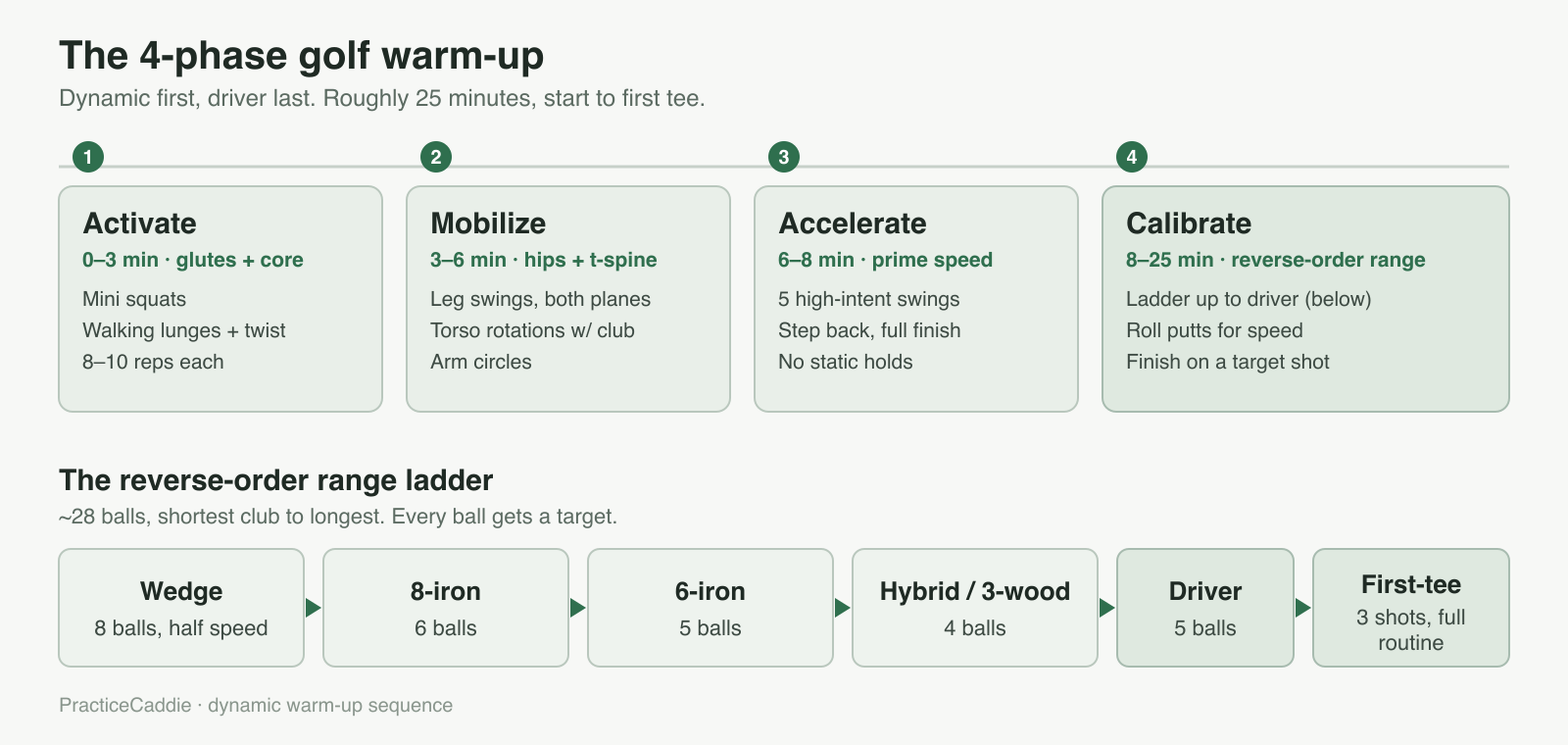
Phase 1 — Activate (0 to 3 minutes). Switch on the muscles that stabilize rotation before you rotate hard. Eight to ten mini squats and eight to ten walking lunges with a torso twist. The goal is temperature and glute-and-core engagement, and this needs no equipment.
Phase 2 — Mobilize (3 to 6 minutes). Open the hips and thoracic spine, the two areas the swing rotates around. Leg swings front-to-back then side-to-side, torso rotations with a club held across the shoulders, and arm circles building in size. Large amplitude, controlled speed, no held positions. Titleist Performance Institute demonstrates this same progression, from calf raises and mini squats up through leg swings and load-and-turn moves with a club or alignment stick.
Phase 3 — Accelerate (6 to 8 minutes). Five high-intent practice swings, stepping back off the ball each time, building toward a full-speed finish. These prime the nervous system to recruit the fast-twitch fibers a driver swing needs, the potentiation effect documented across sprint and jump research. Keep the count low; the goal is priming, and too many swings fatigue rather than potentiate.
Phase 4 — Calibrate (8 to 25 minutes). This is the golf-specific phase the generic routines skip. Move to the range and hit the reverse-order ladder below, then roll putts for speed and finish on one full tee shot with your complete pre-shot routine. You walk to the first tee already warm, already calibrated, already in your routine.
The reverse-order range ladder (about 28 balls, not 60)
The Calibrate phase has a shape, and it runs shortest club to longest. Progressive loading takes the body from short, controlled swings up to full rotational effort, so the driver is never the first max-effort move from cold. It also calibrates rhythm and strike on forgiving clubs first, and that feel carries up into the long clubs.
A workable ladder, about 28 range balls plus a few finishing tee shots:
- 8 wedges at half speed. Pure tempo and contact, no target pressure yet.
- 6 eight-irons to a specific flag. Now every ball gets a target.
- 5 six-irons, alternating targets to start rehearsing variability.
- 4 hybrids or 3-woods, still building intent.
- 5 drivers, full effort, to a defined fairway width.
- 3 tee shots with your complete first-tee routine, one per club you might open with.
That is about 30 balls, and it beats 80 balls of random driver bashing on every count that matters. Extra volume does not deepen the warm-up; it drains the readiness you just built and eats the minutes you should spend on the putting green feeling out green speed, which coaches flag as a frequent source of early three-putts.
A quick self-test. Want to know if your warm-up is doing anything? Hit your first three wedges with a clean-contact criterion, say a ball-first strike and roughly straight flight. If the third is noticeably crisper than the first, your body was cold and the ramp is working. If all three are clean, you arrived warmer than you thought and can move up the ladder faster. That three-swing read is the cheapest launch monitor there is.
When you have no range (or 3 minutes): the first-tee warm-up
Plenty of rounds start with a rushed arrival and no practice facility. You can still prime the body in the two or three minutes you have. Teaching pro Mark Crossfield’s approach is to hold three clubs together, a 6, 7 and 8-iron, and make several dynamic swings from both your normal and your opposite side for 2 to 3 minutes, getting range of motion into the body before the opening drive. Two right-handed swings and two left-handed swings loosen the rotation more evenly than one-sided air swings.
Then manage the early holes like the cold golfer you are. Club down off the first tee, aim at the widest part of the fairway, and play for the center of the first few greens regardless of where the flag sits. The strategy buys margin while your swing settles into rhythm over the opening stretch.
Be honest about what this does. The launch-monitor gains from a full dynamic warm-up are proven; the claim that skipping it costs you specific strokes on the first three holes is a reasonable extrapolation from those gains and from what nearly every coach observes. No controlled scoring study has tested it directly. What is measured is the physical readiness. A body that produces 2 to 3% more speed and nearly half the directional errors on the swings right after a warm-up is a body better equipped for the opening tee shots, and that is the strongest defensible version of “protects your first few holes.”
How long, how early, how many balls
The practical numbers converge across sources. Arrive 20 to 30 minutes before your tee time for a full warm-up, per Par4Success’s pre-round guidance: about 10 minutes of dynamic mobility and activation, then 10 to 15 minutes of progressive ball-striking. The TPI-aligned dynamic routine itself runs 5 to 10 minutes and needs nothing but a club.
Ball count lands around 20 to 40, worked in reverse order, finishing with a handful of drivers and a few full-routine tee shots. None of the peer-reviewed studies prescribe an exact rep or ball count, so treat these as coaching-tested guidelines rather than lab-optimized doses. The principle underneath them is firm: enough to raise temperature and prime the nervous system, not so many that fatigue eats the benefit.
One more habit worth stealing: keep the warm-up alive during the round. A few torso turns with a club or side-to-side hip sways while you wait on a tee preserve the range of motion you built, and a single high-intent rehearsal swing before a big tee shot re-primes the system after a slow group has let you go cold.
Common warm-up mistakes
- Long static stretches right before teeing off. The single most counterproductive pre-round habit. Gergley measured a 4.19% clubhead-speed loss from adding static stretching; save the long holds for after the round.
- Leading with the driver. The first max-effort swing from cold is where speed and reliability both suffer. Ramp up through the bag, shortest club to longest.
- Air swings as the entire warm-up. Better than nothing, but air swings alone do not raise core temperature or activate the glutes and core. They were 88.7% of amateurs’ warm-up in the Fradkin data, which is exactly the gap to close.
- Hitting a full bucket. 80 balls fatigues more than it prepares and steals the minutes you need for putting speed. About 28 targeted balls is plenty.
- Skipping the putting green. Distance control on cold greens is a frequent early-round leak by most coaches’ reckoning. Two or three minutes rolling long putts for speed is worth more than five extra drivers.
- Arriving 5 minutes early. The warm-up you plan for does not survive a rushed arrival. Block the buffer before you leave home.
Key takeaways
- A dynamic warm-up adds about 2 to 3% driver distance and cuts directional errors nearly in half in the swings that immediately follow, per the Journal of Men’s Health data.
- Long static stretching before play costs speed, roughly 4 to 6% of driver clubhead speed and distance in Gergley’s golf study, and 5.4% of maximal strength across Simic’s 104-study meta-analysis. Save it for after the round.
- Over 70% of amateurs seldom or never warm up, and most who do only make air swings, so warming up well is a genuine untapped edge for most amateurs.
- Run four phases: Activate, Mobilize, Accelerate, Calibrate. Dynamic movement first, high-intent swings next, then a reverse-order range ladder that ends in your pre-shot routine.
- Ramp the range from wedge to driver in about 28 balls, every ball to a target, then roll putts for speed. A full bucket fatigues more than it prepares.
- Arrive 20 to 30 minutes early for the full routine; when time is short, 2 to 3 minutes of dynamic swings on the tee plus conservative early-hole strategy still beats starting cold.
- The habit compounds. A warm-up routine practiced over multiple weeks raised clubhead speed about 24% by week 7 in Fradkin, Sherman and Finch’s trial.
Frequently asked questions
How long should a golf warm-up take?
About 20 to 30 minutes is the target if you have a range. Budget 5 to 10 minutes for dynamic mobility and activation, then 10 to 15 minutes of progressive ball-striking that builds from wedges up to driver, per Par4Success and Titleist Performance Institute guidance. When you arrive late, even 2 to 3 minutes of dynamic swings on the first tee measurably beats hitting your opening drive completely cold. The point is raising temperature and switching on the muscles, which takes minutes, not a full bucket of balls.
Should I stretch before golf?
Do dynamic stretching, not long static holds. Static stretching held immediately before play acutely reduces power: a meta-analysis of 104 studies found static stretching cut maximal strength by 5.4% on average, and a golf-specific study measured a 4.19% drop in driver clubhead speed when 20 minutes of passive stretching was added before a dynamic warm-up. Save long static holds for after the round or a separate flexibility session. Before you tee off, use leg swings, torso rotations, and progressive practice swings instead.
Does a warm-up actually add clubhead speed?
Yes. In a Journal of Men’s Health study, a dynamic warm-up increased driver distance by 2.65% and cut directional errors by 47.49% in the shots taken right after. Over the longer term the effect compounds: Fradkin, Sherman and Finch found a golf-specific warm-up routine practiced regularly over multiple weeks raised clubhead speed by roughly 24% by week 7 versus a control group that did not warm up. A single pre-round warm-up delivers the acute gain; making it a habit builds the bigger one.
What if there’s no driving range?
Use a first-tee warm-up. Teaching pro Mark Crossfield recommends holding three clubs together, such as a 6, 7, and 8-iron, and making several dynamic swings from both sides for 2 to 3 minutes to get range of motion into the body. Pair it with conservative early-hole strategy: club down off the tee, aim for the fat part of the fairway, and play for the center of the first few greens while your swing settles. It won’t match a full warm-up, but it beats a cold first swing.
How many balls should I hit warming up?
Roughly 20 to 40 balls, not a full bucket. Work in reverse order, shortest club to longest: a set of half-speed wedges, then short irons, mid-irons, a fairway wood or hybrid, and finish with a handful of drivers. Every ball needs a target so you calibrate contact and start line before the round. Hitting 80 balls does not warm you up better; it fatigues you and eats the time you should spend rolling putts for speed.
Why start with wedges instead of the driver?
Reverse order matches how the body should ramp into speed. Progressive loading takes the muscles and tendons from short, controlled movements up to full rotational effort, so the driver is not the first max-effort swing from a cold start. It also calibrates rhythm and contact on forgiving clubs first, which carries up into the longer clubs. Leading with driver asks for peak rotational power before the system is ready, the same mistake that makes cold opening tee shots so unreliable.
Related reading
- Block vs Random Practice in Golf: What the Research Actually Says — the motor-learning backbone behind the reverse-order ladder and why the Calibrate phase shifts toward varied targets.
- Driving Range Practice Routine: 3 Plans by Handicap — where the warm-up ends, structured practice begins; three weekly routines built from on-course data.
- How to Increase Golf Swing Speed — the training side of the speed you prime here, from kinetic sequencing to speed work.
- Golf Swing Speed Chart by Age and Handicap — benchmark the clubhead speed a good warm-up helps you reach.
- Golf Pre-Shot Routine — the routine your Phase 4 finishing tee shots should rehearse, and the one that carries to the first tee.
- The 30-minute golf practice plan — a time-boxed session template for the practice that follows the warm-up.
- Golf practice plan — the pillar guide for structuring full sessions, with warm-up baked into each one.